
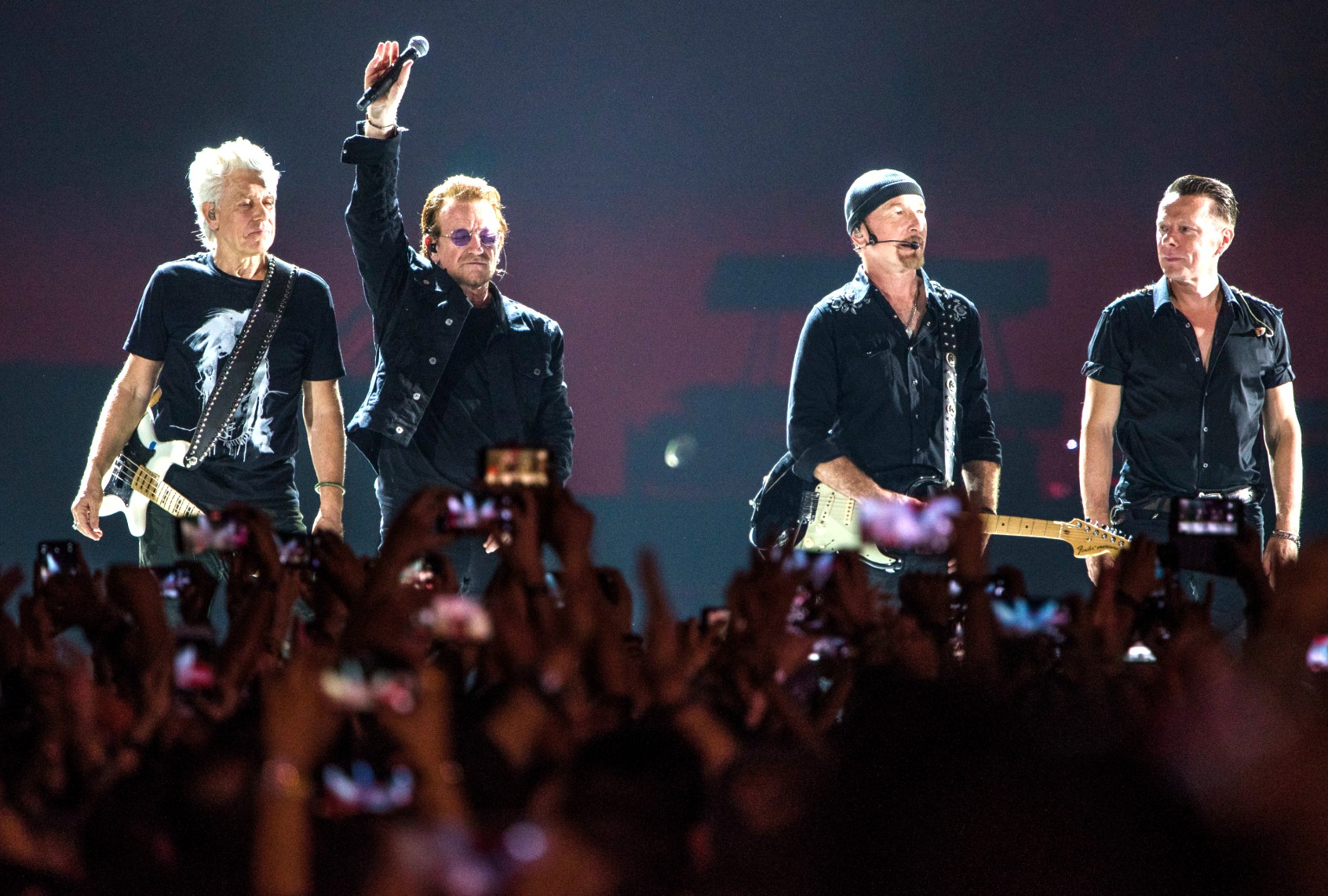

With the surprise release of brand new music from U2 — the EP, “Days of Ash” — it feels self-indulgent to be thrilled that all four members of the band, including Larry Mullen Jr. (who had been missing from U2’s Las Vegas Sphere residency in 2023-24), are in the studio, writing and recording new music.
“Days of Ash” was released on Ash Wednesday, a digital-only (at least at press time) release featuring five new, original songs and one spoken-word performance. (It’s worth mentioning that there are no physical copies of the EP available, so anything you see being sold as “promo-only” on online auction sites is 100% fake, so don’t waste your money.)
The band called the record “. . .an immediate response to current events and inspired by the many extraordinary and courageous people fighting on the frontlines of freedom.” It is the first new music from all four members of U2 as a band since 2023’s “Atomic City” single, a mostly forgettable song about Las Vegas timed to coincide with the band’s extended residency at the Sphere.
“Days of Ash” is bright and brash and loud. The Edge’s guitar chords are as big as ever, written to echo off the walls of a football stadium. Adam Clayton’s bass rumbles majestically, and Larry Mullen Jr. — despite the cautionary description he provides about needing to change his intention and approach — still sounds exactly like LMJ. Bono’s voice has as much power and elasticity as ever. They all sound fantastic.
But unlike other reviews that are acting like U2 have just released “Sandinista,” despite the timeliness and topicalism, they’re not breaking any new ground here, nor is the level of intensity feeling like it’s specific to the moment. After spending the last decade writing about his life and childhood, writing about what’s happening right now has clearly enlivened Bono’s storytelling and songwriting abilities.
The songs are undeniably solid: they sound like old friends, like you already know them and can sing along to things like “I love you more/than hate loves war” (as Bono sings in “American Obituary,” the EP’s opening track) after just one listen. It’s absolutely the specific kind of noise that only these four people can make when they get in a room together, so it is wonderful to have this kind of proof of life.
Want more from culture than just the latest trend? The Swell highlights art made to last.
Sign up here
But these songs are out now because they are a commentary on what is happening in the world around us, or as Bono describes it, “It’s also part of U2’s job to describe the world around us.” The lead track, “American Obituary,” is both a dedication and a tribute to Renee Good, the Minneapolis woman murdered by ICE at the beginning of 2026. The song opens with “You have the right to remain silent or not…,” which in terms of intent and positioning is right out of the Clash’s “Know Your Rights” and “this is a public service announcement/with guitar.” It’s a fair reference.
There are other familiar riffs here — “there is no us if there is no them, “ “perfect love drives out all fear,” or “the power of the people is stronger than the people in power” — but they’re repeated because the sentiment is still true, because the work isn’t done. It’s worth pointing out that Bono did not write “The power of the people is stronger than the people in power.” The band helpfully and correctly credits this phrase to Arab Spring activist Wael Ghonim. The latter keeps being misattributed as an homage to Patti (and Fred) Smith’s “People Have The Power,” and while that might be part of the reason it’s included in “American Obituary,” it is important to correctly attribute it.
After spending the last decade writing about his life and childhood, writing about what’s happening right now has clearly enlivened Bono’s storytelling and songwriting abilities.
The EP’s release was accompanied by a digital issue of Propaganda (with a limited-edition print run promised), the band’s original fan service publication, which was last heard from back in 2002 and used to show up in physical mailboxes around the globe. In its digital presentation, it’s both a convenient way to deliver lyrics, statements, interviews and links to videos and sources as well as provide another layer of visual presentation when there is no (at least as of yet) physical release. It’s a beautiful package.
But its existence also means there’s no excuses for misattribution or misquotes, which is surely part of its at least temporary revival. If you publish a 50+ page magazine talking about the music you just put out and your reasoning behind it, you don’t have to sit through days of press to support that release, and you can more effectively direct your visual presentation and messaging.

(SAMEER AL-DOUMY/AFP via Getty Images) Bono
“The Tears of Things,” the EP’s strongest track, is a ballad and a psalm, applicable to a dozen or more different scenarios around the world, a story in the voice of David as created by Michelangelo, the triumph of good versus evil, and the refusal to become Goliath in order to win. “When people go around talking to God, it always ends in tears” is absolutely the most Bono lyric, not taking himself too seriously but also still being completely, 100% sincere. The vocal delivery here is absolutely heartrending.
Then there’s “Song of the Future”: “I’m running my mouth off again,” sings Bono (with perhaps the tiniest bit of irony) on the track inspired by the murder of 16-year-old Sarina Esmailzadeh by Iranian security forces. According to the notes in Propaganda, Bono began writing the song in 2022, following the death of another young woman, Jina Mahsa Amini, at the hands of Iran’s “guidance patrol,” the religious morality police of the government. The band finished the song at the end of 2025, right before Iranians once again rose up in protest and were once again punished by the apparatus of the state for doing so.
Typing those words as an American in 2026 is overwhelming, even if the purpose here is simply to temporally contextualize this project. “Days of Ash” will likely be compared to Bruce Springsteen’s “Streets of Minneapolis,” in terms of both subject matter and speed of delivery, but “Ash” didn’t get pulled together in a matter of days, despite the considerable abilities of U2’s various creative teams. That doesn’t make the effort less impressive.
We need your help to stay independent
“Wildpeace,” a poem by Yehuda Amichai and vocalized here by the Nigerian artist Adeola features music by U2 (and producer Jacknife Lee). It’s the kind of contemporary texture that shows up on latter day U2 albums — like Kendrick Lamar’s great cameo on “American Soul” or Lykke Li’s vocal on “The Troubles” — but tends to feel less organic than the music on the other sides of it. This is a beautiful composition, but there is nothing particularly U2-ian about it.
But that poem, about war and how attaining peace is as much of an active pursuit as fighting a war, precedes “One Life At A Time,” which is dedicated to the Palestinian activist Awdah Hathaleen, who was murdered by an Israeli settler. The phrase comes from a speech at Awdah’s funeral and is utilized here to describe the active process of peace as described by Amichai in his poem: “How’s it gonna happen here?/One life at a time.” It is a delicate, intricate piece of music. Bono read some lyrics from the song when he and Edge accepted the 2025 Woody Guthrie Peace Prize on behalf of the band, and explained, “This ‘one life at a time’ is so powerful because you can make or break the world one life at a time. And we wrote the song that week.”
“Days of Ash” will likely be compared to Bruce Springsteen’s “Streets of Minneapolis,” in terms of both subject matter and speed of delivery, but “Ash” didn’t get pulled together in a matter of days, despite the considerable abilities of U2’s various creative teams. That doesn’t make the effort less impressive.
“Yours Eternally” features guest vocals from Ed Sheeran as well as from a Ukrainian musician — Taras Topolia — who is serving in the army in defense of his country. There’s a fantastic interview with Topolia in Propaganda where he explains how he met Bono via phone call (and both didn’t believe it was him, and also could not talk to him at that particular moment because they were literally on the front lines) when he and the other members of his band, Antytila, were serving in a medical evacuation unit as part of Ukraine’s 130th Territorial Defence Battalion. (Meanwhile, Sheeran’s quoted as saying, “‘You’re not gonna get me involved in politics, are you?’ ‘No, ‘course not, Ed,’” Bono replied. Oops.) The smoothness of Sheeran’s vocals is almost a distraction here, but not quite.
Larry Mullen Jr. is quoted as saying, “Who needs to hear a new record from us?” when describing the impetus behind “Days of Ash,” adding, “. . .the way the world is now feels like the right moment. Going way back to our earliest days, working with Amnesty or Greenpeace, we’ve never shied away from taking a position and sometimes that can get a bit messy; there’s always some sort of blowback, but it’s a big side of who we are and why we still exist.”
Bono has, for decades, riffed on this concept: “America isn’t just a country, it’s an idea.” “America is a song yet to be written.” In 2009, he wrote an op-ed for The New York Times where he closed by saying, “The world wants to believe in America again because the world needs to believe in America again. We need your ideas . . . at a time when the rest of the world is running out of them.”
When he gave a commencement speech at Harvard in June of 2001, he asked, “Civil Rights in America and Europe are bound to human rights in the rest of the world. The right to live like a human. But these thoughts are expensive; they’re going to cost us. Are we ready to pay the price? Is America still a great idea as well as a great country?”
“When I was a kid in Dublin, I watched in awe as America put a man on the moon and I thought, wow, this is mad! Nothing is impossible in America! America, they can do anything over there!
“Is that still true? Tell me it’s true. It is true, isn’t it? And if it isn’t, you of all people can make it true again.”
And despite everything on “Days of Ash,” it’s clear that he still believes.
Read more
from music columnist Caryn Rose
