
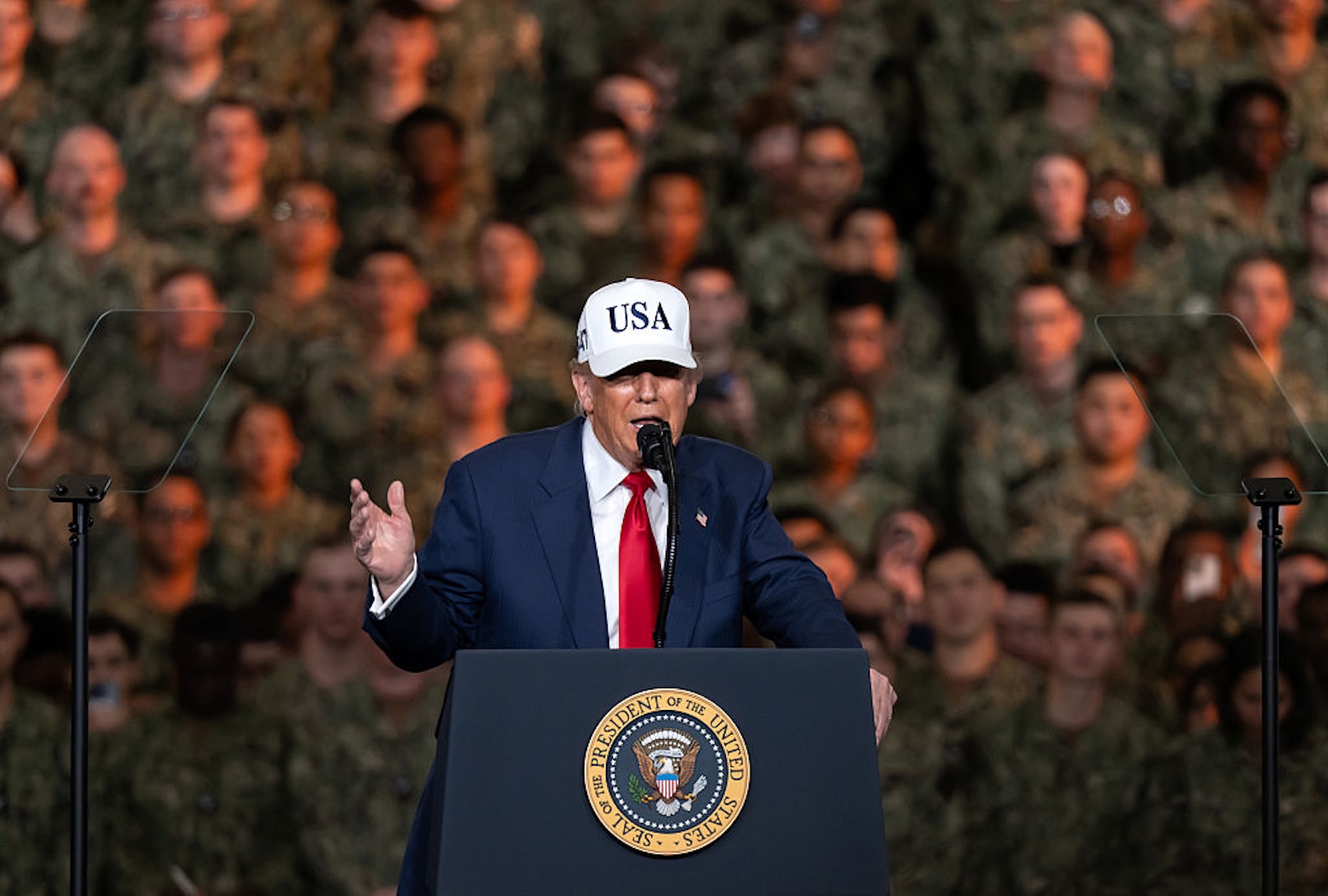

As President Trump’s war against Iran spirals out of control, there is a growing concern he will order a ground invasion to remove the country’s leaders and take control of its vast supplies of oil. The consensus among military and foreign policy experts is that such a move would be disastrous — and that its failure could be catastrophic enough to permanently damage America’s standing as a superpower. But horrible outcomes have, at least to this point, not stopped Trump and his enablers from making irresponsible and dangerous decisions.
The Wall Street Journal is now reporting that Defense Secretary Pete Hegseth has authorized deploying elements of a Marine Amphibious Expeditionary Unit and an amphibious-ready group to the Middle East. Such a force typically has 5,000 Marines and sailors, as well as warships, helicopters, jets and other capabilities.
On March 8, Fox Business host Maria Bartiromo asked White House press secretary Karoline Leavitt a direct question. Would Trump consider ground forces or reinstating the draft to fight Iran?
“I know a lot of politicians like to do that quickly,” she replied, “but the president, as commander-in-chief, wants to continue to assess the success of this military operation. It’s not part of the current plan right now, but the president, again, wisely keeps his options on the table.”
Reinstating a military draft would face enormous practical and political obstacles. The draft has not been part of American culture for 50 years, and Congress would need to update the Military Selective Service Act. Since the Trump administration has yet to make a coherent case for why this war is necessary, many Americans would likely simply refuse to comply.
A more terrifying reality is that a draft would mean that the U.S. is presumably facing an existential threat from Iran, or some other major power like Russia or China. In reality, it is not.
A more terrifying reality is that a draft would mean that the U.S. is presumably facing an existential threat from Iran, or some other major power like Russia or China. In reality, it is not.
“Absent a dramatic change in the nature of the conflict, the political system would struggle to justify a draft to the American public — and this is particularly true against a background of conflicting, and in some cases, patently false, reasons offered so far for a surprise attack on Iran,” said Steven Cash, director of the Steady State, a pro-democracy organization of more than 360 former senior U.S. government national security and diplomacy officials. “A draft becomes politically plausible only when the nation believes it cannot defend itself without it. At that point, the question would no longer be political convenience but national survival.”
As a political matter, a draft for an already-unpopular war would likely leave Americans outraged and make landslide victories by Democrats over Republicans in the midterms and beyond a near certainty. Such a move could even cause a generational political realignment away from Trumpism and the GOP.
The administration has offered a range of changing, contradictory, untrue and incoherent justifications for why the U.S. is at war with Iran, such as self-defense from an imminent attack, stopping terrorism, defending Israel, regime change and preventing the spread of nuclear weapons. But these explanations are solely for public consumption.
“Trump is running out of options to keep himself in power, and manufacturing war is one of the few strategies left,” Barbara F. Walter, a leading expert on political violence, explained in a recent essay. “When leaders believe losing office could mean political ruin for them or even prison, they sometimes gamble for resurrection by starting a war. The more personal consequences a leader faces for losing office, the more likely they are to gamble.”
In Trump’s mind, war with Iran could provide a number of upsides, including creating a rally-round-the-flag effect to bolster his weak public support; serving as a distraction from the ongoing Epstein scandal, rising inflation and a weak job market; and reinvigorating his strongman persona with what could be spun as a quick, decisive victory to burnish his credentials as a great man of history and destiny.
So far, the war has done none of these things effectively.
Trump’s public approval is historically low for a president at this point in his term. A new report from the New York Times shows that his war against Iran is one of the most unpopular conflicts in the history of modern polling. During the 2024 election, Trump promised to keep America out of “dumb” foreign wars. In reality, he was never a real peacemaker. As we have seen in Iran, Venezuela and other parts of the world, Trump’s America First ethos actually means militant nationalism.
The Epstein scandal has not gone away — and shows no signs of doing so. If anything, the Iran war has brought heightened focus on Trump’s real motivations.
Want more sharp takes on politics? Sign up for our free newsletter, Standing Room Only, written by Amanda Marcotte, now also a weekly show on YouTube or wherever you get your podcasts.
Trump’s war against Iran has exposed more of his weakness. Iran has not capitulated to his demands for unconditional surrender. In fact, the country’s leaders have done the opposite: They are now even more defiant. While the United States is currently winning on a tactical level, it is losing on a strategic level. Iran has effectively closed the Strait of Hormuz, causing the largest disruption of the world’s energy supplies in recent history. It is estimated that the United States is spending more than $11 billion a week on the war, a massive expenditure that will only worsen inflation and the already-weak job market.
But Trump’s war against Iran also stands to serve a more dangerous goal that has received scant attention from the mainstream news media and political classes: The president and his allies are laying the groundwork for declaring a permanent state of emergency.
In such a scenario Trump, with the support of MAGA Republicans in Congress, would enact more restrictions on voting by nationalizing elections, use the Justice Department and other federal law enforcement to crack down on non-existent voter fraud, and take even more aggressive actions to suppress and nullify voting in Democratic-led cities, and in blue and battleground states. A state of emergency could also be a tool for the Trump administration to suspend constitutional rights and further silence dissent.
There are already credible reports that the Trump administration is planning to use armed federal agents — including the National Guard and active-duty military — to help ensure the outcome for his MAGA coalition. This is part of a much larger pattern, where Trump and his agents have repeatedly threatened to use the U.S. military against American citizens by invoking the Insurrection Act and declaring martial law.
Trump’s war against Iran and other examples of his military adventurism and belligerence should be primarily understood as an extension of his deep attraction to chaos and violence, his corrupt self-interest and his bottomless appetite for unlimited power.
At its heart, Trumpism is a form of personalist rule. This means that Trump’s war against Iran and other examples of his military adventurism and belligerence should be primarily understood as an extension of his deep attraction to chaos and violence, his corrupt self-interest and his bottomless appetite for unlimited power.
“The genius of democratic governance is that it recognizes no one person is smart enough to run a modern state alone,” Cash said. “Donald Trump disagrees, and appears to be absolutely confident that he, the ‘very stable genius,’ can do it all, alone.”
He went further, arguing that Trump’s war against Iran is another symptom of how America’s democratic institutions are rapidly collapsing into authoritarianism: “The emerging lesson of the Iran war may therefore be larger than the conflict itself. It may be a warning about what happens when the constitutional architecture designed to produce careful, informed decisions is weakened or ignored. What remains is a system in which enormous national choices — choices involving lives, resources, and global stability — are made by a very small number of people with very little institutional constraint. And history suggests that such systems rarely make wise decisions for very long.”
We need your help to stay independent
The motives for Trump’s war against Iran are not a great mystery. What is happening thousands of miles away in Iran and the Middle East is all connected to America’s democracy crisis at home.
As his popularity continues to collapse, the president will become more dangerous. Trump is trapped in a spiral of escalation at home and abroad, and both the American people and the wider world will suffer for it. Unlike his first time in office, there are no “adults in the room” to restrain him, and the Republican Congress, which has the power under the Constitution to do so, has steadfastly refused.
On Wednesday, Trump told his followers at a rally in Kentucky that he personally chose the name “Operation Epic Fury” for the war against Iran. Why? Because the other options were boring, and he was “falling asleep” while listening to them.
None of this is normal. And with the war against Iran, it is now a life and death matter for many tens of millions of people.
Read more
about Iran
