
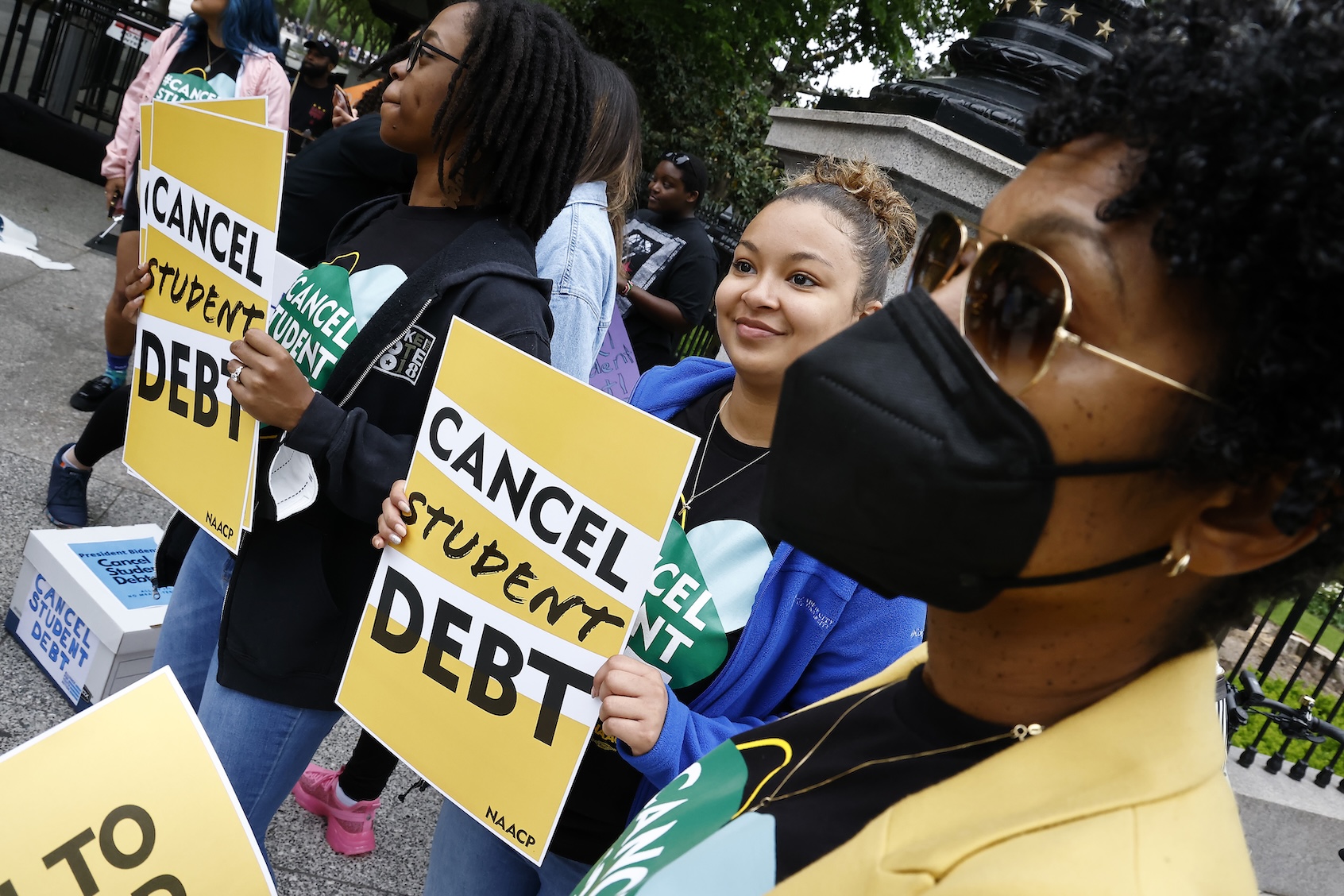

This story was originally reported by Nadra Nittle of The 19th. Meet Nadra and read more of their reporting on gender, politics and policy.
Mary Modica tried to do everything right. When a rise in digital music signaled she should reconsider a radio career, Modica decided to become a teacher — with the understanding that after she made a decade of payments, the Department of Education would discharge any outstanding student debt she owed through its Public Service Loan Forgiveness (PSLF) program.
But after teaching English learners in New York’s Hudson Valley for 12 years, Modica still has $102,000 in student debt. With her monthly payment rising more than 71 percent to $875 during President Donald Trump’s second term, she can’t afford to heat her house above 60 degrees. She’s also stopped physical therapy because she can’t cover the co-pays.
“I broke down three times today,” Modica, 41, said. “I have a disease that will inevitably make me completely disabled, and I can’t afford the treatment because I’m hemorrhaging money to a 20-year-old debt.”
The Department of Education hasn’t forgiven her loans, she said, because it is excluding two full years of her public service, a period when she taught full time but enrolled in a teacher training program at night, kicking her loans into deferment. Accordingly, her payments then don’t count toward the 120 payments required to earn public service loan forgiveness. And that’s not Modica’s only problem: Some of her pre-pandemic payment history, she said, no longer shows up in federal databases.
Over the past year, millions of borrowers have run into similar difficulties trying to navigate a student loan system that has grown more confusing and chaotic during President Donald Trump’s second term. He may have campaigned on “affordability,” but his administration has systematically stripped borrowers of protections, threatened to garnish their wages and raised their monthly payments — all while promising to forgive the student debt of immigration enforcement agents. Experts say these policy shifts have broken a student loan system that was already in shambles, leaving nearly 45 million borrowers, disproportionately women, in financial and emotional distress.
Older borrowers, in particular, have felt the quakes in the student loan landscape since the interest on their debt has had more time — often, decades — to accrue. Black women, who rely more on student loans than other demographics, are grappling with student debt at the same time they have been pushed out of the public service sector due to waves of government cuts during the second Trump administration.
Rep. Ayanna Pressley, a longtime student loan reform advocate, knows what it’s like to experience the stress of student debt.
“I took on loans like so many Black borrowers, at higher rates,” the Democrat from Massachusetts told The 19th. “My family did not have wealth in the form of home ownership. We did not have generational wealth, given the discriminatory GI Bill and redlining. Being raised in a single-parent home, believing that education was the great equalizer, I took out loans and defaulted on those loans, and that affected my credit score, my ability to make progress, to purchase a home.”
Pressley, 52, whose Massachusetts district includes some of the nation’s most prestigious colleges and universities, did not finish paying off her own loans until 2019 — her first year in Congress.
“I know intimately how gutting it is to be a borrower, just sitting on the phone with a loan servicer as you try to navigate your options,” she said. “I know what it’s like trying to make those monthly payments balancing other financial responsibilities. And I also know the shame that comes along with that — though it was never our shame as borrowers to carry. It really is the shame of a nation that has burdened our families with this crushing debt.”
Five years ago, Florida educator Dannielle Boyer owed $200,000 in student debt. A first-generation college student of Haitian and Dominican descent, she took out loans for her bachelor’s and master’s degrees, but it was her pursuit of a doctorate that really shot up her balance. The deaths of her grandparents in quick succession left her so distraught — they had raised her — that she never finished her dissertation.
For years afterward, her loans haunted her, with loan servicers telling her that they didn’t qualify for public service loan forgiveness. Then, a temporary waiver under former President Joe Biden’s administration allowed her to consolidate her debt. In a matter of weeks, she received forgiveness, a development Boyer calls “a godsend.”
Now the first vice president of the United Teachers of Dade, Florida’s largest teachers union, Boyer created a guide to help members with student debt get their loans forgiven, just as she had in January 2022. During Biden’s presidency, the union helped hundreds of teachers secure over $150 million in relief.
Fast forward to 2026, when the avenues to make affordable payments or obtain forgiveness have dried up. Last December, the Trump administration announced that it had entered a settlement with the state of Missouri to terminate the Biden-era Saving on a Valuable Education (SAVE) Plan, which capped monthly payments and curbed interest. On March 9, a federal appeals court order formally ended the plan, which the One Big, Beautiful Bill Act was slated to sunset by 2028.
What’s more, the Department of Education moved applications for income-driven repayment plans offline a year ago, reposting them only after the American Federation of Teachers (AFT) labor union and a borrower advocacy group sued. Today, borrowers face an extreme backlog.
“There are almost 800,000 outstanding applications — income-driven repayment, consolidation requests, forgiveness forms — all of it is massively delayed,” said Natalia Abrams, president and founder of the Student Debt Crisis Center. She blames this, in part, on a reduction in force at the Department of Education. “They don’t have the people to do the processes.”
Following an AFT lawsuit, the Trump administration last month agreed to process thousands of backlogged applications in the Public Service Loan Forgiveness and income-driven repayment plans. “Twenty-thousand more teachers, nurses, firefighters and public service workers finally got their debt discharged,” said AFT President Randi Weingarten.
The AFT has filed multiple lawsuits against the administration over its handling of student debt. Weingarten said the state of the student loan system is no accident. “It’s worse than mismanagement,” she said. “They have intentionally broken the student loan system. They have pushed hard on all the penalties — garnishment, debt collectors — and made the positives, like how you actually get an affordable payment, indecipherable.”
In an amended lawsuit filed against loan servicer MOHELA in January, AFT alleged the company “traps more than 6.5 million borrowers in a system of its own design, rife with errors, misinformation, and broken promises.” The complaint also notes that it is “practically impossible for borrowers to speak with a live customer service representative.”
In January, the federal government prepared to resume wage garnishments for millions of borrowers who defaulted on their loans, a move that would have cut into the pay of workers barely making ends meet and directed more criticism to the White House. It backed down after a public outcry and also because mass layoffs at the Department of Education likely left the agency without the resources to collect the debts. But experts warn it’s a temporary reprieve.
“It’s a testament to borrowers sharing their stories,” said Aissa Canchola Bañez, policy director at advocacy group Protect Borrowers. “It’s awkward for the president to talk about lowering costs while his education secretary takes people’s hard-earned wages. But it’s a when, not an if. They’ll turn it back on.”
Experts worry about the long-term effects of the One Big, Beautiful Bill Act. Under the legislation, the Repayment Assistance Program will become the default income-driven plan for loans disbursed after July 1, 2026, and existing borrowers must switch to the program by 2028.
“Compared to the SAVE Plan, the new income-driven repayment plan increases payments, charges the lowest-income borrowers disproportionately more than those with higher incomes, and extends the maximum repayment term from the current 10 to 25 years to 30 years,” said Michele Zampini, associate vice president of Federal Policy & Advocacy at The Institute for College Access & Success, a nonprofit focused on college affordability. “Borrowers will see unpredictable payment spikes whenever their income crosses certain arbitrary thresholds. They could be penalized for small cost-of-living raises.”
The 19th asked the Department of Education for comment about the concerns raised in this article, but the agency did not respond to the request before publication.
With SAVE gone for good, Zampini predicts that waves of borrowers won’t be able to afford their payments, worsening the default crisis. “The safety net is gone,” she said.
A recent survey that The Institute for College Access and Success commissioned Data for Progress to conduct on federal student loan borrowers found that 45 percent said they have to choose between loan payments and basic needs like rent and food. One in five borrowers is already in delinquency or default, including 33 percent of those with some college but no degree. One respondent said, “With how the economy is, I can barely afford to live. I have to choose between rent, loans, or putting food on the table. There’s no help and it feels like [the] government doesn’t care.”
Sarah Knight, a 55-year-old grandmother, can relate. She took out $60,000 in loans to attend the State University of New York at Brockport in the late 1990s, hoping to pursue a career in education, but ultimately never graduated. Three decades later, despite making payments and even having her wages garnished previously when she fell behind, she still owes $60,000.
Student debt has affected all aspects of her life, she said. “Every penny you spend, you feel guilty. You think, ‘I should be spending this on my loans.’” A transportation scheduler for people with disabilities, Knight only has $2,000 saved for retirement, but she said her loan payments make it impossible to pay more. “The money just goes down this hole.”
Knight’s circumstances seemed especially bleak several years ago, when she defaulted on her student loans, prompting the government to garnish her wages, a major hit to her take-home pay.
“I was making maybe 20 cents above minimum wage, but they were taking $150 a pay period,” she recalled. “That garnishment actually pushed me below minimum wage. How was that legal?”
But when Knight found out about the Debt Collective, a borrowers’ union advocating for debt cancellation, she became an activist. She has traveled to Washington, D.C., with the group to speak up for older borrowers. They persuaded the Biden administration to limit garnishments of social security payments to prevent beneficiaries from experiencing financial hardship. The victory was short-lived, as the Trump administration removed that protection upon the president’s return to office.
“They rubbed a little salt in the wound,” Knight said. “The cruelty is just the point with this administration.”
Pressley has introduced the Ending Administrative Wage Garnishment Act, which would “protect borrowers by ending garnishment as a tool writ large for student debt collection by the federal government, regardless of who’s in office.”
The thought of garnishing wages from seniors on fixed incomes particularly rattles Pressley. “The fastest growing borrower constituency is 55-plus,” she said. “I’ve heard from seniors as old as 75 that their benefits were being garnished for loans they defaulted on. They wept in my arms that they were going to die still paying on these loans, and at this point, owed more than they had even initially borrowed.”
Since women hold nearly two-thirds of the nation’s $1.7 trillion in student loan debt, the policy changes stand to impact them the most. The Trump administration has added to that burden by taking aim at women-dominated fields such as teaching, nursing and social work, reclassifying graduate degrees in these occupations as “non-professional” and, thus, significantly limiting the amount of loans students pursuing these careers can borrow.
“When you look at the jobs this administration is making harder to access, they are the caretaking professions,” Bañez said. “By cutting the subsidies to become teachers and nurses to pay for tax cuts for the rich, the effect is going to be that women, and especially women of color, are not going to be able to afford to enter these fields.”
These policy shifts coincide with a larger effort to push Black women out of the federal workforce as well as the dismantling of diversity, equity and inclusion initiatives, Pressley said.
“Many of those jobs had been held by Black women in senior roles,” she said. “Black women, we’re always the canaries in the coal mine,” she added. “We bear the brunt of everything. This is really a layered tsunami of hurt.”
Having taught in some of Miami’s most under-resourced schools, Boyer has seen that hurt firsthand. But fewer people want to be teachers given the low pay, student debt and a presidential administration hostile to education.
“There’s a teacher shortage, and it’s going to get worse,” Boyer said. “Who will teach the children in the neediest schools? The communities will suffer. It’s cyclical, and it’s scary.”
While educators struggle with the cost of living, the Trump administration has singled out one group for debt relief: immigration enforcement agents. In a move critics have characterized as “appalling” and “hypocritical,” the Trump administration is offering Immigration and Customs Enforcement (ICE) recruits up to $60,000 in student loan forgiveness. That sum surpasses the $10,000-$20,000 in broad loan forgiveness that Biden offered to borrowers in fall 2022 over the objections of Republicans who deemed it “unfair” to people who had already paid off their debt and successfully blocked this relief in court.
The offer of loan forgiveness to ICE recruits suggests that the Trump administration recognizes how powerful such relief is, Weingarten said.
“They’re willing to give it to people who will terrorize our communities, but they’re using a wrecking ball on the infrastructure that helps teachers and nurses,” she said.
Pressley finds it “disgraceful” that the Trump administration is using student debt forgiveness to lure in ICE recruits.
“It’s using debt forgiveness to really deepen inequality, to keep borrowers underwater,” she said. “It’s a weaponizing of structural wealth and equity in exchange for building up an ICE militia and an anti-immigrant agenda. We should be pushing for incentives for our educators, for our nurses and for our first responders.”
As the breadwinner for her family, Modica said the stress of student debt never goes away. Her home, health and car insurance have all increased, as has her mortgage, but she can’t defer her student loan payments because she must stay current on them to obtain public service loan forgiveness. If she didn’t oppose ICE on ideological grounds, she might be tempted to run the numbers on the debt relief the agency is offering. But her sense of morality trumps her financial desperation.
“That’s a signing bonus to sell your soul,” she said.
When her anxiety about her finances flares up, she draws strength from how women have historically risen to the occasion when faced with challenges, she said.
“Women have had to hustle. We’ve had to hustle and fight for space in those rooms,” she said. “That’s why we have the predominant student loan debt because we’ve had a hustle for it. Women and immigrants and people of color are continuing to hustle because that’s the only way we’ve known how to operate. And I think about it a lot.”
Read more
about this topic
