
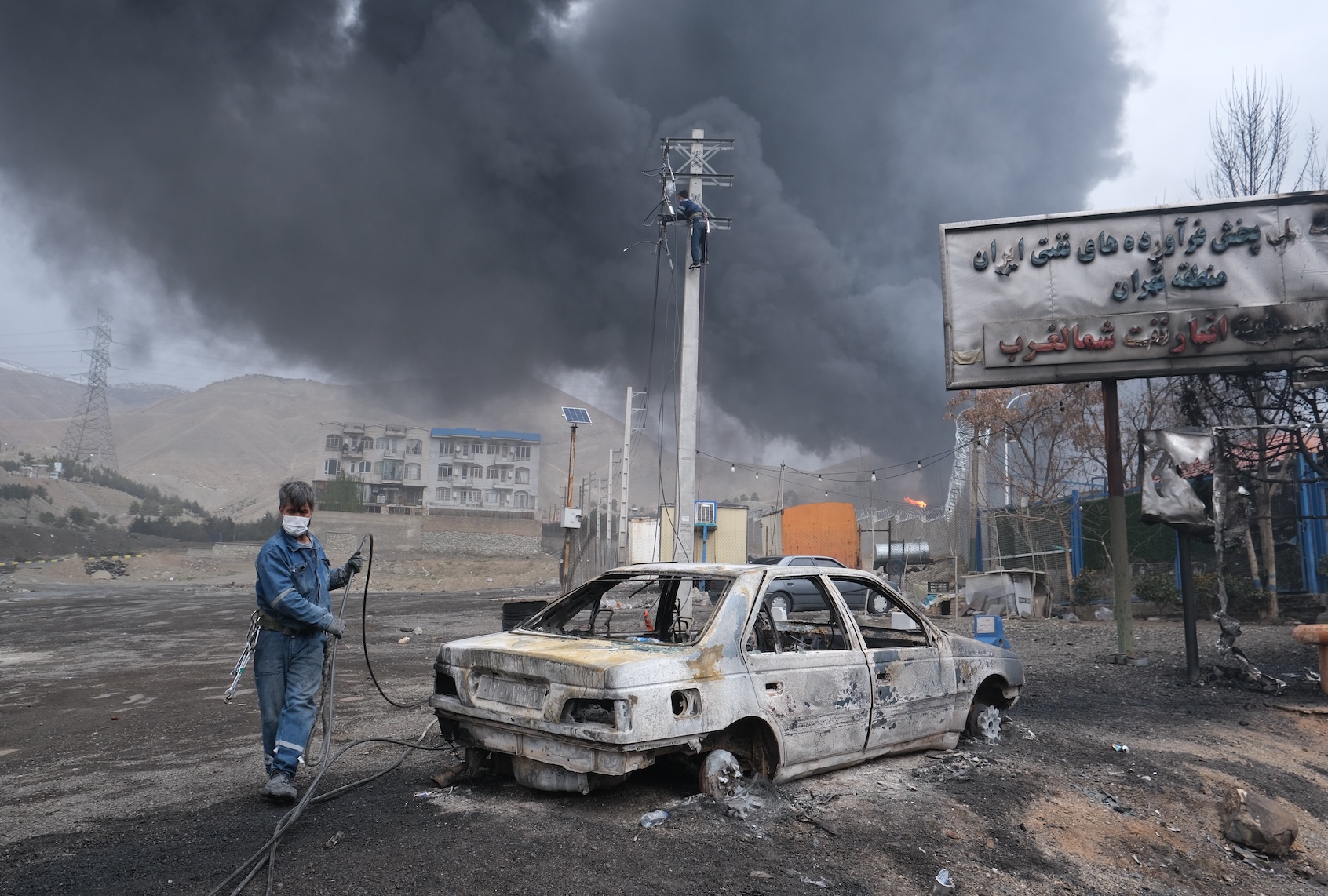

The joint U.S. and Israel war with Iran has triggered an energy crisis that is only deepening. Now President Donald Trump seems to be unexpectedly and unintentionally pushing the world away from oil and natural gas, a trend that may only expand the longer the war continues.
The Iranian government has asserted their control of the Strait of Hormuz, a crucial waterway through which about one-fifth of the world’s crude oil and liquid natural gas transits. Acting as a natural chokepoint, only ships from countries friendly to Iran have been able to pass the strait, limiting the amount of oil and natural gas leaving the Persian Gulf. So far, ships from Turkey, India and Pakistan have been allowed to pass, though other countries are in talks to arrange passage.
Meanwhile, multiple parties in the war have suffered strikes to their energy infrastructure. While these strikes have been limited so far, an escalation could mean a prolonged disruption to oil and gas markets even long after the war ends.
This, coupled with murky goals in the war and no end to the hostilities in sight, both oil and LNG prices have skyrocketed and remain volatile, despite the lifting of sanctions on countries like Russia and attempts from world leaders to soften the impact of the supply shock by releasing oil from strategic petroleum reserves.
The crisis is forcing some countries to reconsider their relationship with fossil fuels and step back from an overreliance on oil and natural gas — at least for countries able to reduce their vulnerability to future shocks. Persistent high prices can also result in what’s known as demand destruction.
David Victor, a professor at UC San Diego’s School of Global Policy and Strategy, told Salon that there are three kinds of demand destruction that stand to play out over different time periods as the war proceeds. The first, and most immediate, is a general economic slowdown resulting directly from the war.
“If we have a kind of global recession, we’re going to see significant demand destruction just because the economy is slower. People won’t travel as much, and all that other kinds of stuff. And that works pretty quickly,” Victor said.
“When you create a powerful price incentive, people figure out how to do more with less. And so there’s been a decoupling of the economy from energy consumption.”
There are already examples of this playing out around the world. Slovenia became the first European country to begin fuel rationing as a result of the war while Sri Lanka began operating on a four-day work week, (they get Wednesdays off), and also rationing petrol. In countries like the U.S., this could manifest as a reduction in travel as airfare and jet fuel costs rise.
The second type of demand destruction, Victor explained, has to do with people finding efficiencies in order to make due with less of the resources being limited by the war. This can be accomplished with things like new investments in equipment, which play out over a longer time frame compared to rationing.
“When you create a powerful price incentive, people figure out how to do more with less. And so there’s been a decoupling of the economy from energy consumption,” Victor said.
The third, and most long-term change, has to do with, in this case, economies moving away from their reliance on oil and natural gas by exploring alternatives. While this has already been happening in some ways in certain markets — for example, electric two-wheel vehicles are now much cheaper than gas-powered two-wheelers in India — a strong price incentive can change considerations and speed up transitions.
We need your help to stay independent
In transportation, this could look like the adoption of electric vehicles where possible, and for energy production, this could mean countries exploring alternatives, like wind, solar and nuclear power. In other cases, that means turning to older and dirtier energy sources like coal. Demand responsiveness differs with oil products used for transportation because, as it stands, there are no alternatives that could replace oil products like gasoline or diesel at the moment.
“Oil products are used for transportation, in particular, where there just aren’t really any alternatives and so demand destruction is to just do less,” Victor said. “We don’t have a lot of ready alternatives. Whereas gas is used not exclusively, but heavily, in the power sector and in the power sector, there are other options.”
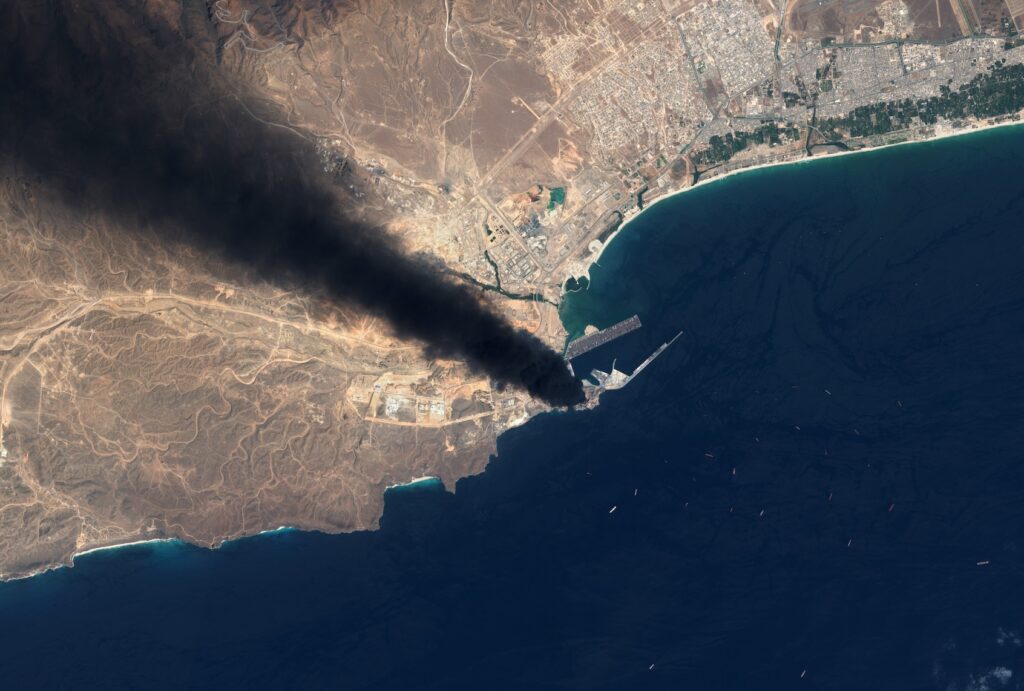
(Photo by Gallo Images/Orbital Horizon/Copernicus Sentinel Data 2026) Satellite view of the Salalah oil storage fire in Oman, March 13, 2026. An Iranian drone strike on March 11 ignited the blaze, sending a plume over the Gulf of Oman’s strategic port.
Max Pyziur, the research director for the Energy Policy Research Foundation, a non-profit, non-partisan organization that advises policymakers, told Salon that he believes that most policymakers will wait for the 120-day release of oil from the U.S.’s Strategic Petroleum Reserve to expire before they consider longer-term changes.
Pyziur explained that, although the situation varies from country to country, policymakers will generally attempt to mitigate the supply problem before considering major changes. In the case of the current oil crisis, for instance, some oil is being transited across Arabia to the Red Sea for export. Other oil had been transited to Fujairah, UAE for export as well. Some tankers are also making it through the Strait by paying a toll to the Iranian government. The biggest mitigation factor, however, is the coordinated release of oil from strategic reserves from the U.S. and its allies, totaling some 400 million barrels over 120 days.
The relative trickle of oil passing through the Gulf and the release of oil from reserves is such that, according to Pyziur, belies another potential problem: the lack of fertilizer coming out of Gulf countries. This will likely translate into higher prices (with social strife as an additional byproduct) in most countries as well as food shortages across significant portions of the globe.
“Make no mistake, the current situation with Iran is unprecedented.”
“It’s not just demand structure. I think you’re going to see higher food prices and greater social unrest,” Pyziur said. “It depends on how long the conflict is prolonged, and if there are no true remedies, and whatever black market that you have, meaning that Iran is collecting a toll for qualified tankers crossing the strait. If that’s the only transit you have through the Gulf, then there are going to be serious consequences.”
At the same time, Pyziur said, the American economy is relatively insulated from these supply shocks because of significant domestic production of oil, LNG and fertilizer. The U.S. is the largest producer of oil, natural gas and fertilizer in the world. In 2025, for example, the U.S. exported some 15 billion cubic feet of natural gas a day, and in an emergency, the government could take action to limit exports.
While he couldn’t put an exact timeline on when American policymakers might consider more dramatic changes, he said it would take a prolonged supply shortage, given how long some of these changes take. The recommissioning of a nuclear power plant, for example, takes two to three years, and while no countries have announced an intention to recommission a plant based on the current war, it could be an option if the conflict produces a long-term disruption.
Kenneth Medlock III, the senior director at the Center for Energy Studies at the Baker Institute for Public Policy, gave a similar analysis, telling Salon that this sort of structural demand destruction doesn’t generally occur from a transitory shock.
Start your day with essential news from Salon.
Sign up for our free morning newsletter, Crash Course.
“Recall that we lived through a world where $100 a barrel was the ‘new normal’ from 2010 to 2015, and global demand for petroleum increased from just under 89 million barrels per day to almost 96 million barrels per day. So, even at an average price over $100 a barrel, we did not see structural demand destruction,” Medlock said.
Likewise, Medlock said, regional energy rationing is currently resulting from the lack of specific types of crude oils and is concentrated in East Asia at the moment.In the short term, countries like China are more likely to limit exports than commit to longer-term changes.
“Make no mistake, the current situation with Iran is unprecedented. However, a structural demand shift requires significant capital investment,” Medlock explained. “For example, consumers must sell their internal combustion engine vehicles and buy electric vehicles, but this can be cost-prohibitive, especially if oil price settles back into the range where it has been over the last couple of years. The cost of turning over capital stocks is high, and is typically avoided.”
Still, some experts, like Andrew Thomas, a scholar at Cleveland State University’s Energy Policy Center, said that he’s still watching closely how the war impacts the adoption of alternative solutions for transportation, like hydrogen fuel cells.
“The Ukraine war has already started that transition in Europe. Diesel is already over $5 a gallon in the U.S. At what price will hydrogen start to make sense for trucking? We are getting closer — the transition will probably start at around $7.00 a gallon diesel,” Thomas said, speculating as to when the cost of hydrogen fuel may become competitive with diesel. There have also been recent developments in the production of hydrogen fuel that could make it more competitive in the future.
Thomas compared the situation to the fuel shocks of the 1970s, which helped advance the mass adoption of natural gas for heating instead of fuel oil and the doubling down of drilling for oil domestically.
“We may have a different response now. It appears Europe will not risk another 30 years of Russian pipeline politics. So this may be where the most profound change occurs internationally: we begin the transition from fossil fuels to hydrogen, at least for our transportation,” Thomas said.
Read more
about the Iran war
