
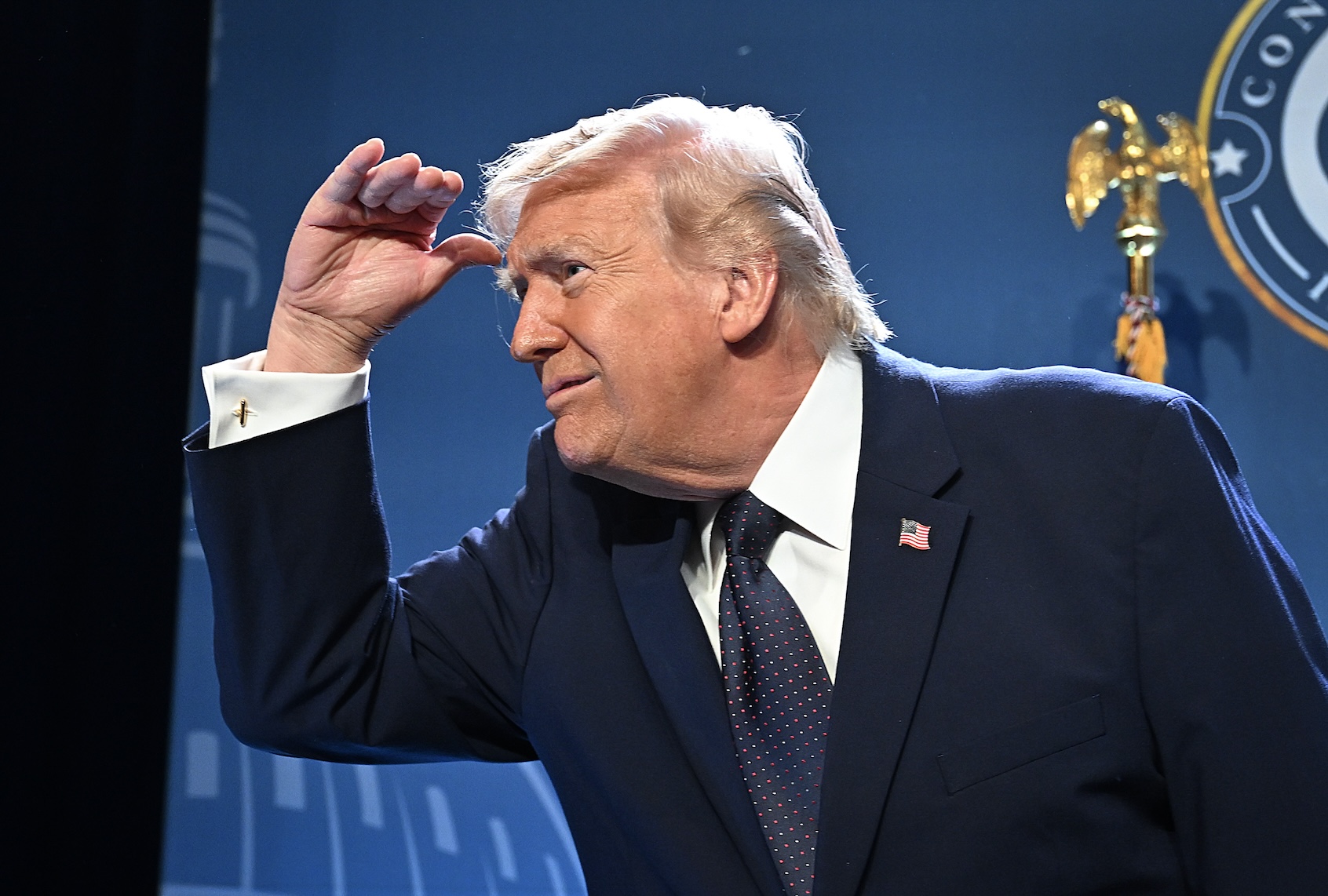

I saw the Emperor — this world-soul [Weltseele] — riding out of the city on reconnaissance. It is indeed a wonderful sensation to see such an individual, who, concentrated here at a single point, astride a horse, reaches out over the world and masters it.
— G.W.F. HegelAs democracy is perfected, the office of president represents, more and more closely, the inner soul of the people. On some great and glorious day the plain folks of the land will reach their heart’s desire at last and the White House will be adorned by a downright moron.
— H.L. Mencken
All credit goes to John B. Judis, formerly of In These Times and the New Republic, for his ecumenical spirit. A lifelong democratic socialist, Judis has authored a scrupulously fair biography of William F. Buckley Jr., and has lately pondered the world-historical significance of Donald John Trump through the philosophical lens of Georg Wilhelm Friedrich Hegel.
Watching Napoleon ride into the German university town of Jena in 1806 shortly before his great victory over the Prussian army, Hegel had an epiphany: He was seeing the mysterious forces of history embodied in one man. He later elaborated on this theme in his “Lectures on the Philosophy of World History,” a posthumous compilation of his lecture notes and transcripts from his time teaching at the University of Berlin between 1821 and 1831.
Judis gives us a brief tour d’horizon of history from Hegel’s perspective. Figures like Alexander the Great, Julius Caesar and Napoleon were adventurers, and while perhaps not personally admirable, they changed history and changed it irrevocably:
These world-historical individuals were “practical, political men” of action, not philosophers. Caesar, Hegel writes, was driven by “an unconscious impulse that occasioned the accomplishment of that for which the time was ripe.” Their ability to enact change depended on their willingness to defy current custom and mores. “It is even possible,” Hegel writes, “that such men may treat other great, even sacred interests, inconsiderately; conduct which is indeed obnoxious to moral reprehension.”
The word “obnoxious” certainly calls more recent leaders to mind, so it’s pretty clear where Judis is going. Then Hegel’s prose, as quoted by Judis, gets more purple: These world-historical leaders “appear to have done everything under the impulse of some passion, more grand — some morbid craving — and on account of these passions and cravings to have not been moral men.” One almost gets a sense that the great doers of history were like robots, temporarily inhabited by an otherworldly spiritual force or, alternatively, were stick figures that Hegel moved about on his grandiose world-historical tableau. Which fairly raises a few questions about the utility of employing Hegel as a guide to historical significance.
Hegel was a metaphysician whose insistence that Geist, or spirit, pervades the historical process and moves it to some grand culmination is difficult to distinguish from New Age mysticism, and hence charlatanism. Some contemporaries thought so: Arthur Schopenhauer remarked, “Should you ever intend to dull the wits of a young man and to incapacitate his brains for any kind of thought whatever, then you cannot do better than give Hegel to read.” A century later, the philosopher of the scientific method Karl Popper concurred: “There is so much philosophical writing (especially in the Hegelian school) which may justly be criticized as meaningless verbiage.” Imagine Deepak Chopra with a German accent.
Judis proceeds to outline all the ways in which Trump, like the titans of Hegel’s metaphysical reflections, brought down the existing order in such a way that there can be no going back to the status quo ante. He cites the collapse of the laissez-faire and free-trade consensus in economics and the dissolution of the post-World War II security architecture centered on NATO and other longstanding mutual defense treaties.
Trump, like the titans of Hegel’s metaphysical reflections, brought down the existing order in such a way that there can be no going back to the status quo ante.
This is of course true; these arrangements had weakened over the last two decades and were ripe for supersession. But the distinctive thing about Trump – and Judis doesn’t quite make this explicit – is that any hypothetical president could have adopted an economic nationalist program (as Joe Biden did, at least in part), or could have weakened the U.S. link to NATO, even withdrawn from it altogether (which Trump has not done — so far). Yet another future president might have retraced a path toward more balanced economic or security policies once the disadvantages of trade wars or diplomatic and military isolation became obvious.
But Trump, in large part through his feral nastiness and adolescent vulgarity, has made that sort of reversal all but impossible. A hypothetical president might have distanced himself from NATO, but it’s inconceivable that he would covet an alliance partner’s territory to the point where that government made plans to blow up the airfields in the coveted territory in case of invasion, as Denmark has reportedly done. Even if that president were stupid enough to plunge into a Middle East war, it is unlikely the would have besought the prime minister in charge of the world’s fourth-largest navy for assistance in opening the Strait of Hormuz by insulting her with juvenile remarks about Pearl Harbor.
Judis is undoubtedly correct that the changes over which Trump has presided are of great global significance, and that there is no way back. In any case, no rational person who is appalled by Trump would want to go back to the previous status quo, since the objective conditions of the pre-Trump era were precisely what led to his political ascendancy.
We need your help to stay independent
In a sense, though, Judis understates the transformation that Trump and his minions hope to complete. The failed intellectuals of the Claremont Institute, the Heritage Foundation and Hillsdale College, financed by plenty of Silicon Valley money, are in the midst, with Trump as their avatar, of a revolution intended not merely to get rid of NATO and free trade, but to reverse or undo every positive ethical feature of Western civilization since the 18th century. The rule of law at home, war constrained by the Geneva Convention, consent of the governed under a secular state, the emancipation of women, the abolition of torture, the amelioration of suffering through scientific application of medicine, the idea that society can and should improve the human condition rather than leave it to the will of a supernatural being — all these and more they seek to overturn to bring on the reign of a Dark Enlightenment.
How Trump came to be the Lenin of this revolution is a story that does not quite square with the Hegelian worldview. That thesis posits a great man, successfully forcing through his ideas against the conventional wisdom of the age and shifting the course of history; men like Alexander, Caesar or Napoleon were definitely out of the ordinary and certainly possessed high intelligence.
Trump, on the other hand, is the crystallization of a common American character type, one that has become widespread in the last decades of saturation by electronic and digital media, the decline of the printed word, the replacement of citizens by consumers, the all-pervading worship of money and the elevation of mindless entertainment to the status of religion. If we assume, to borrow Mencken’s words, that Trump “represents the inner soul of the people” (or at least a voting plurality of them), he didn’t wrestle with the gods to change the course of history. Rather, he walked through an open door. If Bonaparte rode a horse through Jena to reconnoiter on the eve of a great battle, Trump glided down a gold escalator to the plaudits of the red-hatted rubes he would fleece.
Trump is the crystallization of a common American character type, one that has become widespread in the last decades of saturation by electronic and digital media, the decline of the printed word, the replacement of citizens by consumers, the all-pervading worship of money and the elevation of mindless entertainment.
Trump hates reading, as his spotty education and lack of general knowledge testify. That reflects his profound lack of intellectual curiosity. He attempts to disguise this deficiency with endless boasting about himself and endless denigration of others. He is obsessed with popular media and showbiz and the shabby values they embody. He’s the loudmouthed bore at a social gathering or the mean drunk at the bar who looks you in the eye with a murderous stare and announces that he doesn’t like you. He’s the chickenhawk who carefully avoids military service. He kisses up and kicks down. His awareness of culture expresses itself only in the most godawful kitsch.
Much of this squares with Mencken’s character portrait of the “booboisie,” the unthinking type of American whose numbers seem to have exploded in recent decades, perhaps in interaction with contemporary historical events. It is almost certain, to this observer anyway, that after the last hanging chad in Florida, after the rubble of the World Trade Center had cooled, after the first improvised roadside bomb exploded in Iraq, and after Lehman Brothers collapsed, Trump, or someone like him, was inevitable. The 1990s were probably the country’s last chance. The circumstances of the first decade of the 21st century made Trump into the mouthpiece of millions of inferiority complexes.
Evidence of this lies in the 72 percent of Americans who supported the 2003 invasion of Iraq — a war of aggression based on flimsy lies by a president who was proud to think with his gut, not his brain. Nearly half of Americans polled approved of torture — and that poll came many years after the scandal of Abu Ghraib, in the absence of any “ticking time bomb” scenarios that might supposedly justify torturing terror suspects. That same poll showed that 71 percent of Republicans and Republican-leaning independents supported torture: Trump’s natural base.
On the micro level, we have the employee of a federal prison in Florida, complaining about a 2019 government shutdown for which she blamed Trump, the candidate she helped elect: “I thought he was going to do good things. He’s not hurting the people he needs to be hurting.” Regrettably, there was no follow-up question about exactly which people Trump should be hurting. It would be fascinating to know whom she went on to vote for in 2020 and 2024.
Then there is the Treasury Department employee who had a Trump campaign banner in front of her house during election season, and who was abruptly fired during the DOGE purge after he took office. She was deeply hurt; she had voted for him because he promised to cut “waste and fraud,” and was firmly convinced her federal job was safe. Why any federal employee would ever have believed Trump was in their corner is a mystery; it is all too precisely like a turkey voting for Thanksgiving. That woman characterized her firing as Trump hurting the “working class,” but it has been Republican doctrine for decades that federal employees are elitist evildoers, not working-class heroes. Somehow she voted for Trump in three consecutive presidential elections and remained blissfully unaware of what he was loudly proclaiming.
Want more sharp takes on politics? Sign up for our free newsletter, Standing Room Only by Amanda Marcotte, also a weekly show on YouTube or wherever you get your podcasts.
Dogs appear to have a more astute, instinctive sense of who is their friend and who wishes them ill than human beings blinded by ideological nonsense and their own unwillingness to learn the most basic facts about their own well-being. As Isaac Asimov observed, “There is a cult of ignorance in the United States, and there has always been.” Only now has it become rampant, reaching a point at which invincible ignorance, an ignorance which refuses to absorb facts as a kind of holy principle, becomes the kind of moral failure that can produce what Judis deems a world-historical figure.
The biggest flaw in the Hegelian viewpoint about supposedly great men is that his entire hypothesis about an unfolding historical process is flat wrong. History is not a world-spirit moving inexorably towards some breezy, sunlit upland of wisdom. Nor, unfortunately, does it reflect Martin Luther King’s hopeful idea that history’s arc ultimately bends towards justice. Nor is it any other teleological scheme, whether it be Marxism or free-market capitalism.
History as we experience it at the sharp end is the aggregation of moral choices made by individual human beings. When those choices become corrupted by fear, resentment or inexcusable stupidity, and then amplified by mass suggestion, we get a creature like Trump, the reflection of a people’s image.
Read more
from Mike Lofgren
