


The joint U.S.-Israel war with Iran is causing major disruptions to the energy sector, but that’s not all. With the Strait of Hormuz closed in the wake of attacks across the Middle East, more than just oil is being blocked. And, if the war drags on, everything from medical testing to plastic packaging could be negatively impacted.
Oil, natural gas and fertilizer exports have received the most attention, as the cost of transportation, food and energy ripple through the global economy. However, a handful of other commodities like helium, plastics and aluminum stand to see supply shocks as the war goes on.
About 30% of the world’s helium supply is sourced from Qatar, produced as a byproduct of local natural gas extraction. Recent strikes on Ras Laffan, Qatar’s major gas field, as well as the strait’s closure, have left world helium supplies at risk. While most people might be familiar with helium as a filler for balloons, the gas is used as a coolant, including in semiconductor manufacturing and MRI machines.
Phil Kornbluth, the president of Kornbluth Helium Consulting, told Salon that he expects helium suppliers to be affected due to the situation in Qatar and may have to declare force majeure — a legal term that means they are unable to fulfill contracts due to unforeseen circumstances — which will in turn result in rationing.
Kornbluth added that, even with rationing, he expects prices to climb. Depending on the length of the disruption, those higher helium prices also have the potential to create higher prices for products that helium is used to create, like semiconductors.
“With supply allocations, the suppliers have the ability to prioritize the more critical applications, like MRI scanners, semiconductor, aerospace or nuclear power at the expense of less critical applications (e.g. party balloons), so that the critical applications are usually spared much of the impact of the shortage,” Kornbluth said. “The high-priority applications usually get 100%, or close to 100%, of their historical requirements.”
“The kind of downside risks here are that high oil prices cause just broader economic problems in the U.S. and interest rates go up.”
Alasdair Phillips-Robins, a technology and international affairs fellow at the Carnegie Endowment for International Peace, told Salon that semiconductor manufacturers like TSMC and Nvidia have helium reserves and will be isolated from higher helium prices for a while, but that a protracted conflict could cause problems elsewhere in the supply chain.
The conflict, Phillips-Robins explained, is twofold, with countries like South Korea and Taiwan, two major semiconductor manufacturing hubs, also being reliant on oil and natural gas from the Middle East. The more immediate problem for Americans at home, however, has to do with data center construction, and not only because of a potential increase in semiconductor prices.
“The kind of downside risks here are that high oil prices cause just broader economic problems in the U.S. and interest rates go up,” Phillips-Robins said. “If the Federal Reserve has to hike interest rates because prices are rising, then it will be harder for some data center operators to finance their build-outs, especially the smaller ones that rely mostly on credits.”
High electricity prices due to data centers, which have already been a political flashpoint, could deepen the political problem for the president as well.
We need your help to stay independent
“I think the real question is whether local grid operators, consumers and households are going to put up with price spikes. Data centers are able to pay the high rates, and then they effectively bid the price up even further, while consumers are paying large amounts for their air conditioning across the U.S.,” Phillips-Robins said. “That seems like it could become a politically untenable situation, especially if gas prices are also high.”
Helium isn’t the only commodity affected. Polymers like polyethylene and polypropylene, common forms of plastic with broad use in thousands of products, also pass through the strait in significant quantities, with around 85% of Middle Eastern exports of these polymers passing through the strait.
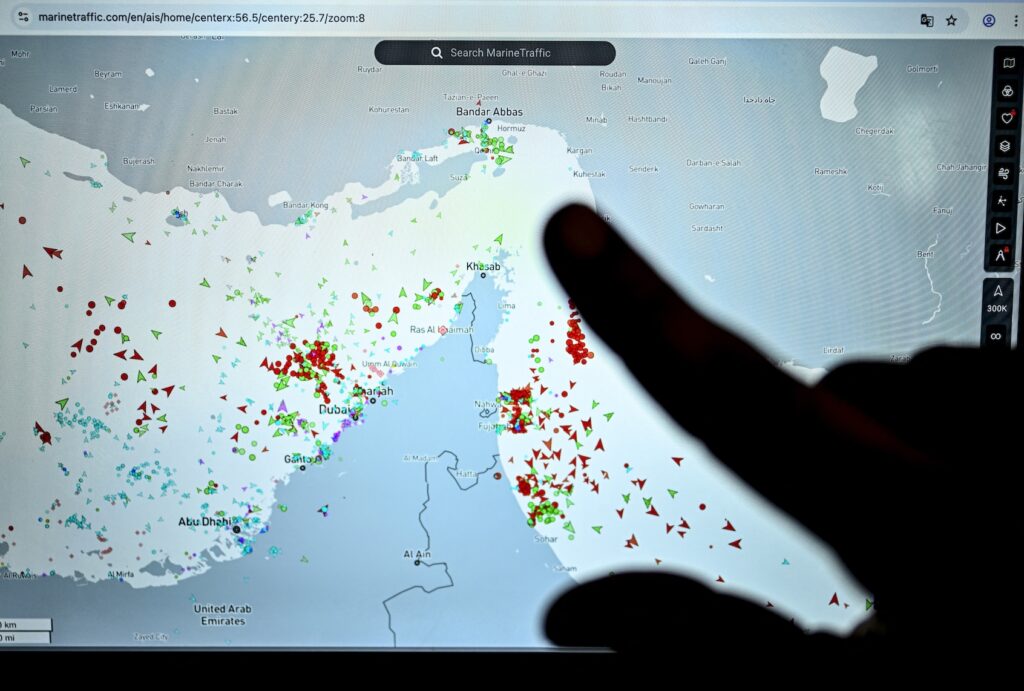
(Photo by JULIEN DE ROSA / AFP) A person points at a page on the Marinetraffic website that shows commercial boats traffic on the edge of the Strait of Hormuz near the Iranian coast, in Paris on March 4, 2026.
Polyethylene is commonly used as a packaging material used for everything from food to medical supplies to consumer electronics. Most plastic water bottles are a form of polyethylene and around 40% of it comes from the Middle East. Similarly, polypropylene, commonly used in packaging for medical supplies, cleaning supplies, and even furniture, also comes through the strait, with about 42% of the world’s supply coming from the region.
Aluminum is another common material that is shipped through the strait in significant quantities, with Gulf countries supplying around 8% of the world’s aluminum supply, equal to about 6.16 million metric tons in 2025. Early in the war, this led aluminum prices to spike in Europe, and a prolonged conflict could further stress supply for the metal, which is used in everything from soda cans to airplanes as well as a swath of military equipment and munitions. Early in the war, concerns about the war led some producers in the region to suspend production.
Start your day with essential news from Salon.
Sign up for our free morning newsletter, Crash Course.
Artem Volynets, CEO of ACG Metals, told Salon that he expects there to still be some pressure on prices once production is restored, saying “aluminum is solidified energy. Higher energy prices will limit production growth.”
Volynets added that the production disruption will take time to dig out of, but that there are enough refineries in China to potentially remedy any longer-term supply problems, if the Chinese decide the price is too high.
“It takes time to restart smelters when the supply of alumina — the raw material for aluminium production — has been cut off, as it has. Getting metal out of the ground is not the difficulty; it is about getting alumina into smelters,” Volynets explained. “When you stop an aluminum smelter, it takes 12 months and significant capital to restart it. If the Chinese decide that aluminum prices are too high, they can restart a number of idle smelters in the country, and the world will be full of aluminum.”
Read more
about the Iran war
