
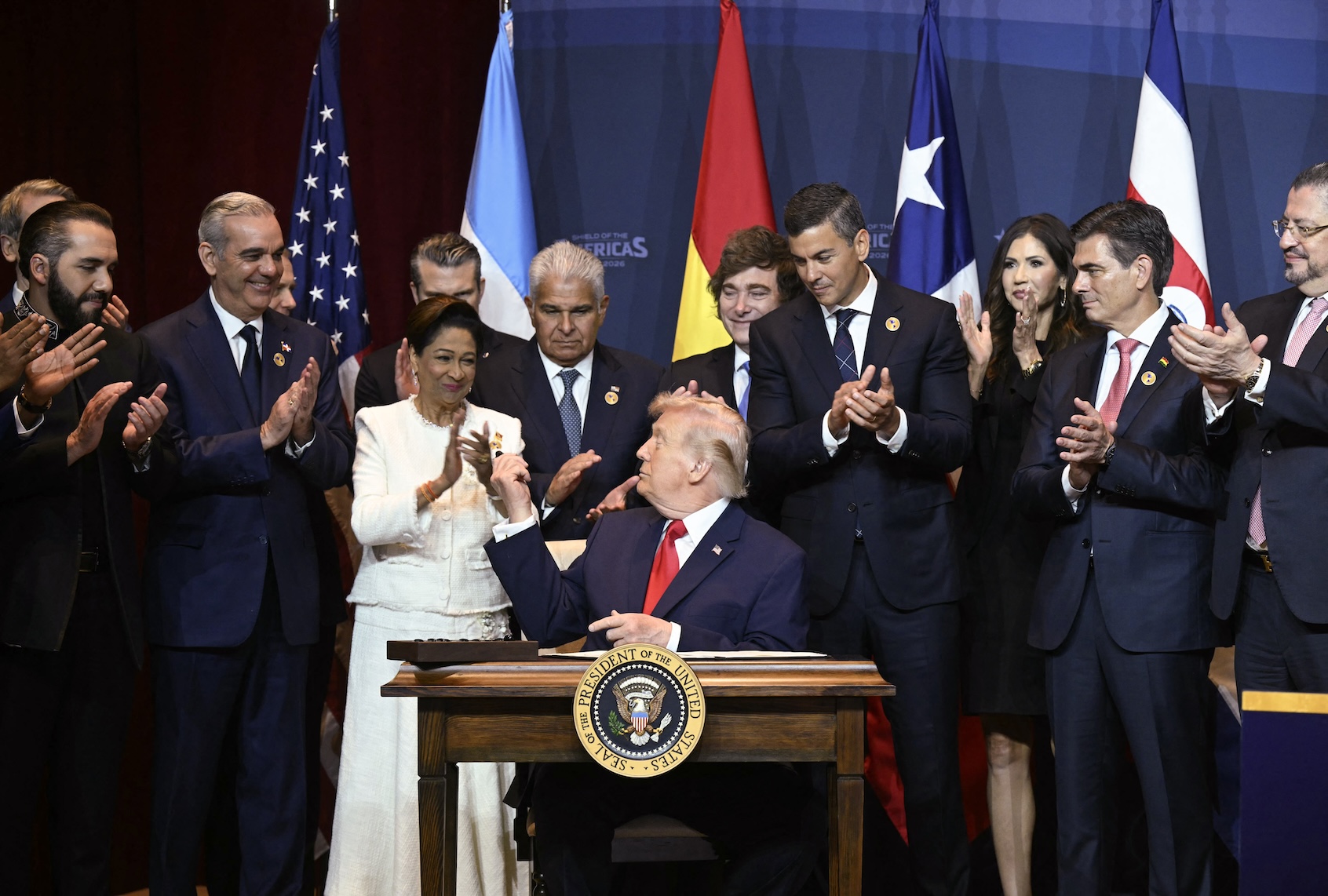

At the first summit meeting of the Shield of the Americas on March 7, more than a dozen countries in the Caribbean and Latin America signed a joint security declaration with the U.S., which called for increased cooperation on international security. The signatories agreed to “join a coalition to combat narco-terrorism” and advocated for the policy of “peace through strength.”
The Shield is President Donald Trump‘s new international coalition to combat drug cartels in the Americas — but experts say it uses old, heavy-handed tactics, with a focus more on centralized control than real results.
Following her ouster as head of the Department of Homeland Security, Kristi Noem was appointed — or, as some have argued, demoted — to Special Envoy to the Shield, where she said the U.S.’s interests lay in helping nearby countries “with their borders and the challenges they have.”
“This is intended to be a group that works together to ensure we’re defending our own sovereignty, we’re each defending our own security and economic prosperity,” Noem said at the summit.
Notably absent were Mexico, Colombia and Brazil, major players whose combined GDP accounts for 60% of Latin America’s economy. Each nation has a strained or tense relationship with the Trump administration, and all refused to join the Shield.
Trump said in a March 7 proclamation that the members of the Shield will use “any necessary resources” to destroy “criminal cartels and foreign terrorist organizations” in the Western Hemisphere.
Those tactics have been in play since last September, known as Operation Southern Spear, a highly controversial campaign of missile strikes on suspected drug-running boats began in the Caribbean. To date, nearly 50 strikes have been documented across the Caribbean and the Pacific, killing more than 160 people. These expanded into a shocking operation in Venezuela that saw its president, Nicolás Maduro, captured by U.S. forces in Caracas in January on the grounds of “narcoterrorism.”
Ground operations in Latin America have continued. Earlier in the month, a joint U.S.-Ecuadorian operation was launched near the Ecuador-Colombia border which destroyed a suspected hideout of drug traffickers. The Pentagon called it a “successful operation against a narco-terrorist supply complex.” A recent New York Times report found that the suspected hideout in Ecuador was actually a rural cattle and dairy farm, and residents reported harsh treatment by Colombian forces during the raid.
“What you see already is the immediate and extremely dangerous policy of bombing regions without even showing any pretense of evidence that you’re actually hurting the drug trade”
In recent years, Ecuador has gone from being one of the safest countries in South America to one of the most dangerous. It is also noted as being a major highway for drug traffickers, though few illicit drugs are actually produced in the country.
Ecuador’s Interior Minister John Reimberg announced on March 16 that a “very strong offensive” was under way in trafficking-affected areas of the country, with 35,000 soldiers deployed. “We’re at war,” Reimberg said.
Oswaldo Zavala, author of “Drug Cartels Do Not Exist: Narcotrafficking in U.S. and Mexican Culture” and professor of Latin American Literature and Culture at the City University of New York, said the regional operations are being carried out with “no regard to law domestically or international law, or any sense of human rights and decency.”
“What you see already is the immediate and extremely dangerous policy of bombing regions without even showing any pretense of evidence that you’re actually hurting the drug trade,” Zavala told Salon.
Zavala raised the issue of increased militarization to combat the drug trade, pointing out that a militarized drug war is likely to cause “tremendous damage” to the everyday people of a country, with plenty of historical precedent.
In 2006, Mexican President Felipe Calderón kicked off his own U.S.-backed drug war, thus beginning a nightmarish internal conflict that has raged for two decades. To date, more than 460,000 people have been homicide victims, and 130,000 have gone missing or disappeared.
Zavala says the burgeoning war in Ecuador carries with it “policies of extermination” by Daniel Noboa, Ecuador’s authoritarian president and a Trump ally. Investigations into Noboa’s family have uncovered links to trafficking cocaine to Europe, some of which was discovered in banana shipments from the Noboa Trading Company. Trump has also pardoned former Honduran president Juan Orlando Hernández, who was serving a 45-year sentence for trafficking cocaine into the U.S. and related firearms offenses.
Start your day with essential news from Salon.
Sign up for our free morning newsletter, Crash Course.
“Some of the most vulnerable people in Latin America are getting killed without any pretense of demonstrating that they are somehow vaguely related to the drug trade,” Zavala said. Just so, the joint U.S.-Ecuadorian mission was named “Operation Total Extermination.”
“If they continue, you’re going to have more and more poverty, more and more hostility, more violence detonated by these murderous policies. This is going to create an entire effect of violence and instability in the region that may last for decades,” Zavala warned.
“This is really one of the darkest times in U.S.-Latin American relations,” Zavala said. “President Trump, in the most irresponsible and criminal way, is playing with the lives of Latin Americans.”
The Shield of the Americas initiative is directly linked to the so-called “Donroe Doctrine” championed by Trump, which posits that the U.S. should be the guardian of the Western Hemisphere. It calls for strong words, aggressive posturing, and a show of force that the administration can use as a spectacle.
Alexander Aviña, associate professor of Latin American history at Arizona State University, says that the Trump administration’s real goal is to bring “direct U.S. power in the region” via the Shield.
“I see it as part of this broader project where they’re now trying to use the old imperial strategy of divide and conquer,” he told Salon. “They’re using the cover of a war on drugs to justify the advancement of U.S. power, imperial power.”
The strategy rests on Trump-allied leaders, like the Salvadoran President Nayib Bukele and Argentine President Javier Milei, according to Aviña. If right-wing leaders go along with Trump’s ambitions, the U.S. will help them maintain power and control by creating a “specter of narco-terrorism.”
An example of this is in the logic the Trump administration has used to justify Maduro’s removal from power. The White House accused the deposed president of being a “kingpin flooding America with deadly fentanyl” and labeled Venezuela a narco-terrorist nation.
We need your help to stay independent
However, Maduro’s successor, Delcy Rodriguez, has her own direct ties to the drug trade. She was even noted as “priority target” by the DEA in 2022. While Trump has threatened to indict her, he has also praised her for doing “a great job” as Venezuela’s new leader.
Following the raid, Vice President J.D. Vance made it clear that the administration’s interests lay in the country’s vast oil reserves. “We tell the regime: you’re allowed to sell the oil so long as you serve America’s national interest, you’re not allowed to sell it if you can’t serve America’s national interest,” Vance said in January.
Aviña said the entire Shield initiative has been done in bad faith, with tactics and strategies in place to create an image of fighting the drug trade, while Trump and the pliant governments pursue their own interests.
“They were never designed to deal with the issue of the traffic and consumption of illicit drugs,” he said. “Drug wars tend to foster and encourage really undemocratic political forms when it comes to thinking about these issues that other countries have treated as a public health issue.”
Aviña thinks a solution to America’s drug issues is possible, but it is not one that Trump is likely to be interested in. “I think we would have to rethink how we start to look at this issue from the demand side,” Aviña said. “What is it about U.S. society now that encourages so many people to turn to illicit drugs, either as a form of consumption or as a way to make ends meet?”
Read more
about the War on Drugs
