
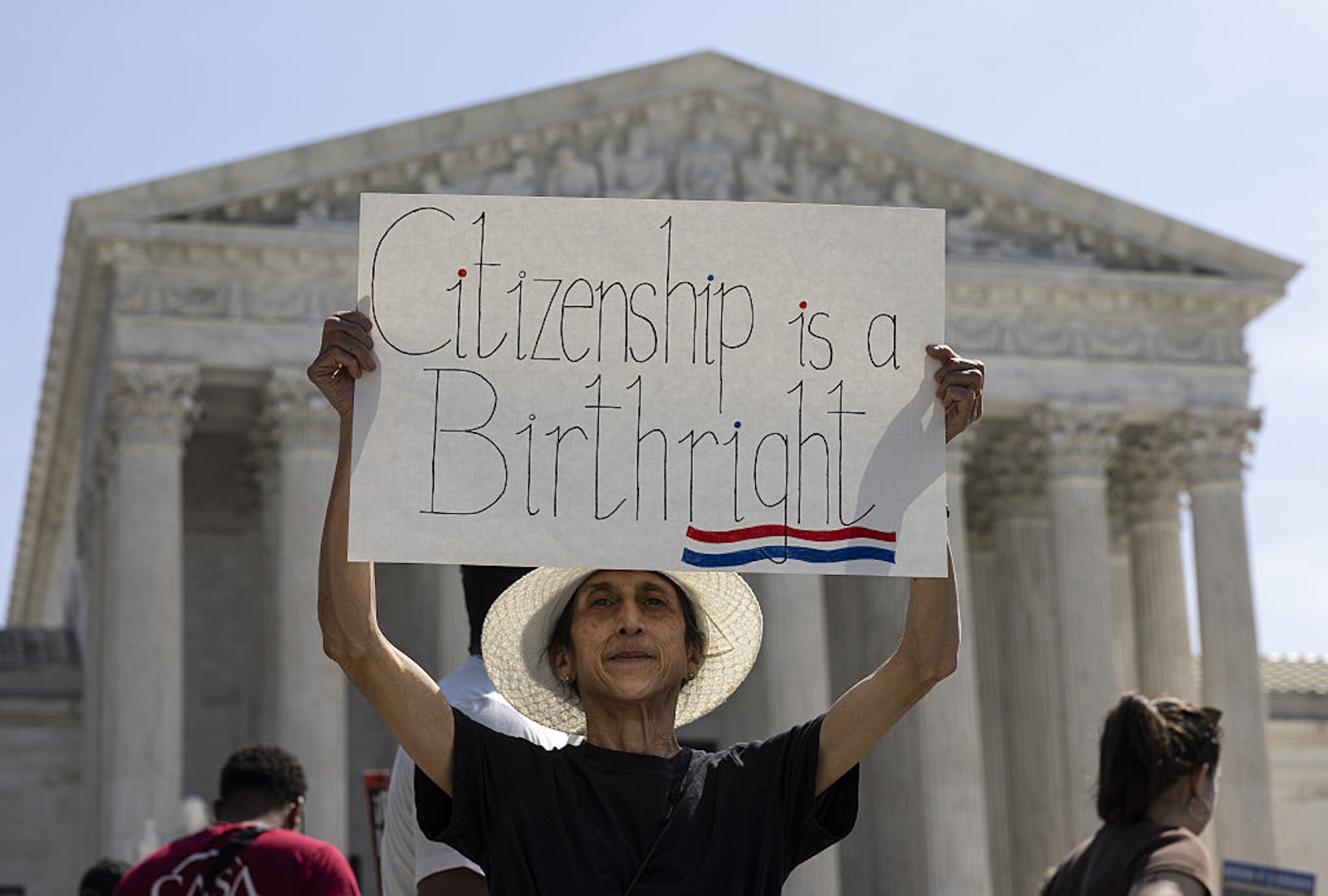

I was born in the wee hours of Dec.15, 1980 at St. Mary’s Hospital, now Hoboken University Medical, the same hospital where Frank Sinatra was born. It wasn’t until I was a teenager that I learned my family was undocumented at my birth and on through my early childhood. I was an adult by the time I realized I had gained U.S. citizenship through birthright, which the Trump administration is now attempting to strike down.
On Wednesday the Supreme Court heard arguments for the Trump administration’s challenge of birthright citizenship, which was established by the 14th Amendment’s guarantee of citizenship to “all persons born or naturalized in the United States, and subject to the jurisdiction thereof.” It’s the latter portion — “subject to the jurisdiction thereof” — that leaves room for interpretation, forming the beachhead upon which legal arguments against birthright citizenship have been mounted. Republicans claim that “jurisdiction thereof” does not apply to undocumented immigrants, as they owe allegiance to another country and, therefore, are not subject to the jurisdiction of the United States.
The Supreme Court appeared skeptical of the administration’s case. Donald Trump’s presence in the court during oral arguments, a presidential first, seems not to have influenced the proceedings, as justices on both sides of the aisle wasted no time calling into question the basis for the federal government’s case. When Solicitor General D. John Sauer declared “It’s a new world,” referencing the dubious idea of “birth tourism” in the age of global travel to cast doubt on the conventional application of the 14th Amendment, Chief Justice John Roberts was doubtful. “It’s the same Constitution,” he replied.
Undocumented immigrants contribute much more to the economy than they withdraw. In 2023, they paid $90 billion in federal, state and local taxes, and held almost $300 billion in spending power.
The case stemmed from an executive order issued by Trump on Jan. 20, 2025, hours after he was sworn in, that ostensibly aimed to disrupt chain migration via so-called “anchor babies,” an ugly term that paints immigrants as social parasites. This is an easily debunked myth. A central pillar of casting undocumented immigrants as mooches is that they can’t pay taxes, which is patently untrue. In fact, they often do so by using individual tax identification numbers (ITIN), even though they do not gain legal immigration status or access to public benefits. In other words, undocumented immigrants contribute much more to the economy than they withdraw. In 2023, they paid $90 billion in federal, state and local taxes, and held almost $300 billion in spending power.
It’s harder to disprove using statistics that immigrants use birthright citizenship as a form of chain migration because it’s impossible to establish intent. But just a modicum of logic reveals how impractical birthright citizenship is as a chain migration tactic. Consider the following: A U.S. citizen can only file a Form I-130 (Petition for Alien Relative) on behalf of parents when they’ve turned 21. That’s two decades of living on the margins of society, not having access to public benefits and not being able to apply for most jobs — all while living under the pall of deportation, where any slip-up, no matter how small, could have uprooted their lives in one fell swoop.
Many immigrants want to return to their native countries, but often life gets in the way. My parents moved from Mendoza, Argentina, to Hell’s Kitchen in New York City in 1969. The plan was to save enough money to move back to Argentina and start a bakery, which was the family business on my dad’s side of the family. It took them three years of working multiple jobs before they had enough. My parents sent the money to a friend in Argentina to start the business in their stead while they tied up loose ends in the States. Before long, the money was gone. To this day, it remains the biggest controversy in our family’s history. My parents were left with a choice: Move back to Argentina with their tails between their legs, or start again where they were. They started again. Meanwhile, my sister was born, and throughout her childhood and most of her adolescence, my dad insisted they were moving back to Argentina. She grew up thinking that her life in the U.S. was temporary.
The overwhelming majority of undocumented immigrants who choose to remain in the U.S. for a wide range of reasons don’t want to game the system. Just the opposite: They’re scared of the system. They avoid anything official at all costs, anything that involves paperwork. That they take advantage of the medical system is another myth. They avoid hospitals, often at the expense of their own family’s health. They commit crimes at much lower rates because they’re acutely aware that even a minor infraction can upend their lives.
Want more sharp takes on politics? Sign up for our free newsletter, Standing Room Only, written by Amanda Marcotte, now also a weekly show on YouTube or wherever you get your podcasts.
When I was a child, my father warned me about answering the phone or the doorbell. I didn’t know why until much later. Once you understand the fears and motivations of undocumented immigrants, you realize that most of what’s said about them makes no sense.
Donald Trump’s fixation on ending birthright citizenship has nothing to do with ending chain migration. In fact, multiple studies show that ending birthright citizenship would dramatically increase the number of unauthorized immigrants in the U.S. As a general principle, reducing the number of legal pathways increases the number of unauthorized immigrants. Is the administration not aware of this phenomenon? If one were conspiracy-minded, one might arrive at the conclusion that Republican politicians are not only aware but incentivized to draw or create more undocumented immigrants in the U.S. to introduce more “customers” into the ballooning deportation and detention business. Private prison companies, like CoreCivic and the Geo Group, are compensated by the government according to the number of detainees in their custody, after all, and are seeing their profit margins soar under the administration’s mass deportation crackdown.
We need your help to stay independent.
Trump’s other motivation is ideological. Republicans are determined to create tiers of citizenship, which became evident in December when Ohio Sen. Bernie Moreno introduced the Exclusive Citizenship Act, which, if passed, would end dual citizenship. The GOP is keen to showcase all the ways in which a citizen may not be a “true” U.S. citizen. If you have more than one citizenship, well, you’re a fence-rider who is not properly committed to the U.S. According to Moreno, “it’s all or nothing.” If you’re a naturalized citizen, your citizenship is subject to review. And if your parents are not legal residents of the U.S. when you’re born, you don’t deserve citizenship.
Even if the Supreme Court upholds birthright citizenship, as most Court watchers are predicting, the Trump administration’s message remains clear: Some U.S. citizenships deserve skepticism.
In October, my wife and I moved to France so she could attend the graduate program of her dreams. I have been watching with horror from afar as this administration takes step after step to persecute and disenfranchise families like mine — to create a hierarchy of citizenship, which is a hallmark of fascism.
Sunsetting birthright citizenship would prevent people like me from becoming U.S. citizens, and denaturalization efforts could affect people I love. Ending dual citizenship would force me to choose between the country of my origin and the country of my parents’ origin. Yet, despite the distance and the threats, or maybe because of them, I have never felt more American.
Read more
about immigration
