
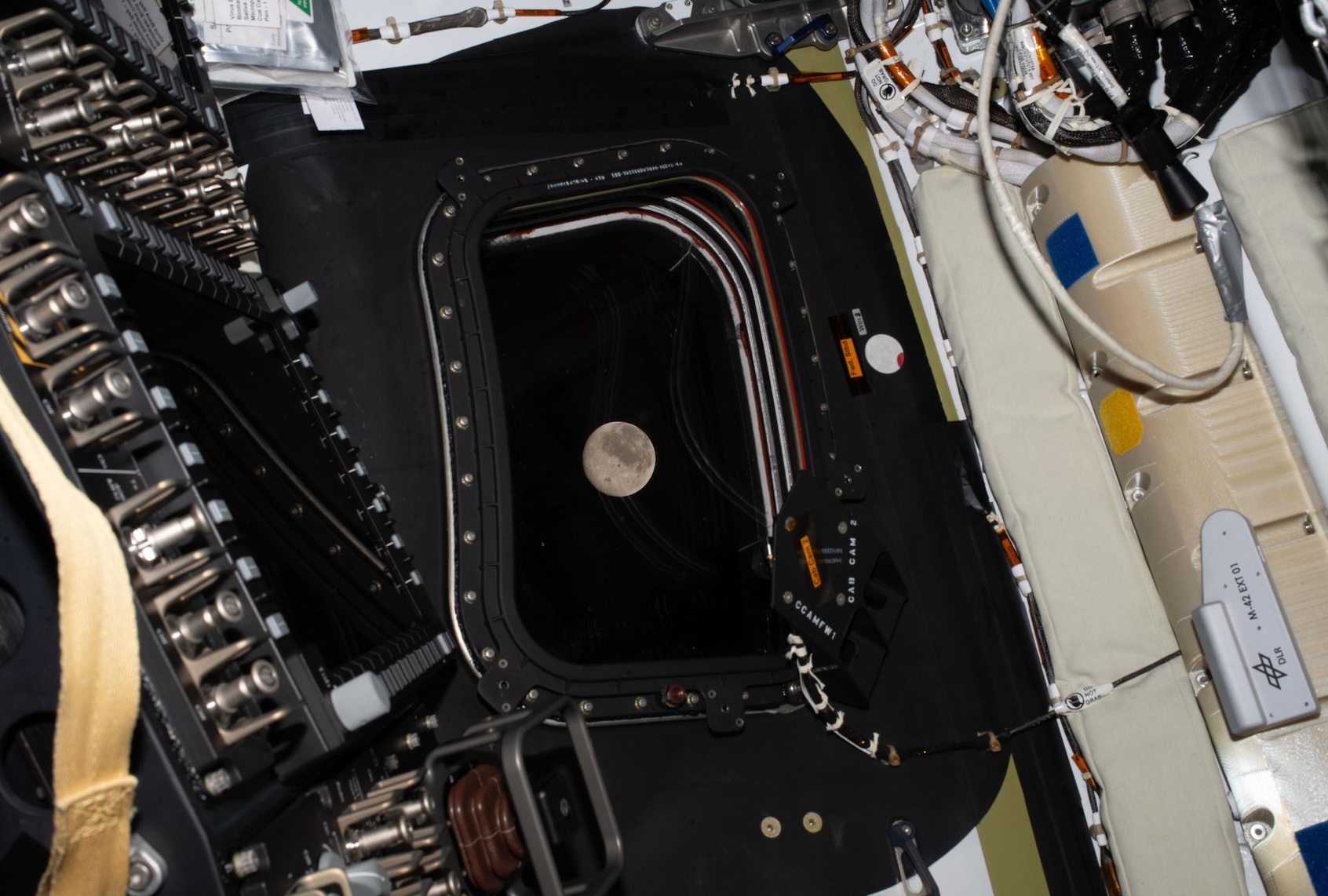

On Friday, the crew of the Artemis II mission will splash down on Earth after its historic 10-day flyby of the Moon. President Donald Trump is celebrating the achievement as a patriotic win “beyond the stars” for the United States, even as funding for future scientific endeavors sits on a knife-edge thanks to his administration’s priorities.
“America is going back to the Moon,” Trump posted to his social network Truth Social on April 1. “America doesn’t just compete, we DOMINATE, and the whole world is watching.”
Speaking with the Artemis II astronauts on Monday evening, Trump said their mission had made the U.S. “the hottest country in the world.”
“America will be second to none in space and everything else that we’re doing, and we will continue to lead the whole thing,” he said.
Trump’s positive mood and nationalistic championing go far beyond the scientific successes of Artemis II. They indicate the president’s ambitions for the U.S. to dominate space, with specific focus on the moon. In its recently released 2027 budget, the Trump administration requested $8.5 billion for the Artemis program to put Americans on the moon in 2028 — coincidentally the same amount in proposed cuts for K-12 programs.
“The Budget fully funds the lunar landers, space suits, lunar surface systems, and astronaut transportation systems necessary to safely and cost-effectively expand America’s presence to the surface of the Moon,” the budget reads in part.
It also calls for hundreds of millions of dollars to establish a “lunar base camp” near the Moon’s south pole, and makes the intentions of such an endeavor clear: “The base camp would establish U.S. dominance on the Moon, enable more intensive use of lunar resources by NASA and U.S. companies,” it reads.
The three-phase, $30-billion-dollar plan for lunar dominance is relatively straightforward. Between 2026 and 2036, the U.S. will identify future landing sites for astronauts on the moon. It will test numerous types of technology on the lunar surface, from vehicles and drones to small nuclear reactors, before moving on to building infrastructure for a moon base and conducting semi-regular manned missions.
Eventually, a permanent settlement of sorts will be established, acting as a base camp for future expeditions deeper into space. The plan’s success could solidify the image of U.S. as a leader in space, and give it ample mining access to a plethora of minerals and elements on the moon. Andrea Harrington, co-director of McGill University’s Institute of Air and Space Law, says that, so far, the plan is legal.
“If you try to carry out dominance to mean exclusion of others, that is absolutely unlawful under international law.”
“‘Dominance’ is just a word,” Harrington told Salon. “Nothing about establishing a moon base, a permanent presence on the moon, is unlawful in international law, and it could just be that dominance is rhetoric.”
Indeed, former Vice President Mike Pence called for “American dominance in space” in 2018. Depending on how that is interpreted and acted upon, however, could violate international agreements on space exploration.
“If you try to carry out dominance to mean exclusion of others, that is absolutely unlawful under international law,” Harrington said. “Just building a fixed facility in and of itself does not qualify as territorial appropriation or territorial sovereignty.”
She pointed to the 1967 Outer Space Treaty, a keystone document on international space law that President Lyndon Johnson signed onto. The treaty allows all nations to explore and use the moon “exclusively for peaceful purposes,” and bans any claims of sovereignty over the moon. It also bans nuclear weapons and weapons of mass destruction on the moon or in Earth’s orbit. For nearly sixty years, the tenets of the treaty have been respected by all nations.
However, Harrington notes that the treaty has gray areas, notably regarding the retention of non-WMDs on the moon. She speculates that the U.S. and other major powers could argue that keeping weapons on the moon is “perfectly reasonable and legal within their rights under the treaty.”
“Of course, it could still lead to tension and escalation from an international relations perspective,” Harrington said. “I think it’s worth keeping that in mind.”
Those tensions are already in play between the U.S. and its biggest adversary, China, which has been no slouch when it comes to space exploration. They were the third country to land a rover on Mars, they have Tiangong space station, a rival to the International Space Station, which is due to be decommissioned by NASA in 2030 and launched its second rover, Yutu-2, on the moon in 2018. It became the first vehicle to reach the moon’s far side, becoming the longest-lived rover on the lunar surface.
Start your day with essential news from Salon.
Sign up for our free morning newsletter, Crash Course.
China’s interests also lie in ensuring military defense capabilities. It first tested shooting down a satellite in 2007, and has since invested in anti-satellite missile systems and an orbital defense system to deter attacks from orbit, along with enhanced space surveillance technologies. A 2025 report from the Air Force’s China Aerospace Studies Institute warned that the offensive use of these technologies “could threaten U.S. military superiority” to “project power globally.”
Sen. Ted Cruz, R-Texas, laid out American concerns during a congressional hearing in September 2025. “Make no mistake,” Cruz said, “We are in a new space race with China. And if we fail, there will be a bad moon on the rise.”
The Trump administration is not keen on failing. An executive order from Trump in December 2025, entitled “Ensuring American Space Superiority,” called for “creating a responsive and adaptive national security space architecture” through allied cooperation and private sector investments.
Steven Mirmina, a former senior attorney at NASA and an adjunct professor of space law at Georgetown University Law Center, cites China’s successful lunar rover, the success of its Tiangong space station, and its proposed International Lunar Research Station as elements of a new space race.
“China is the only other game in town,” Mirmina told Salon, noting that its one-party system does not have the challenges a democracy has in political battles over budget and timeframes in space operations.
“Every four years, the leadership changes, Congress changes, and priorities change,” Mirmina said. “In China, if they have a long-term goal, they can attain it.”
We need your help to stay independent
Trump’s new budget certainly prioritizes the Artemis program, but at a tremendous cost to science funding. The budget calls for more than $3 billion in cuts to what it calls “wasteful” scientific initiatives, including an unmanned sample mission to Mars and a climate change program that it claims “imposed climate extremism on developing countries.”
Nearly $300 million would be cut from space technology, which includes so-called “frivolous technology projects such as “in-space sustainability goals.” A further $143 would be cut from STEM engagement initiatives for students, which the Trump administration slammed as “woke” and “misguided.” All in all, NASA would see its budget cut by $5.6 billion in 2027.
NASA administrator Jason Isaacman defended the cuts in an interview on Sunday, saying that the agency has a budget “greater than every other space agency across the world.”
Those budget cuts have Mirmina questioning the U.S.’s chances of winning the new space race and retaining highly knowledgeable personnel. He called the cuts “short-sighted.”
“How are you going to develop the space technology that you need to do what you want on the moon if your space technology budget is cut?” he said. “How are you going to inspire young people to go into careers doing STEM if you don’t engage with them, if you don’t have public outreach for them, don’t get them involved in NASA’s events?”
“It’s hard for me to wrap my head around,” Mirmina added.
Read more
about science
