
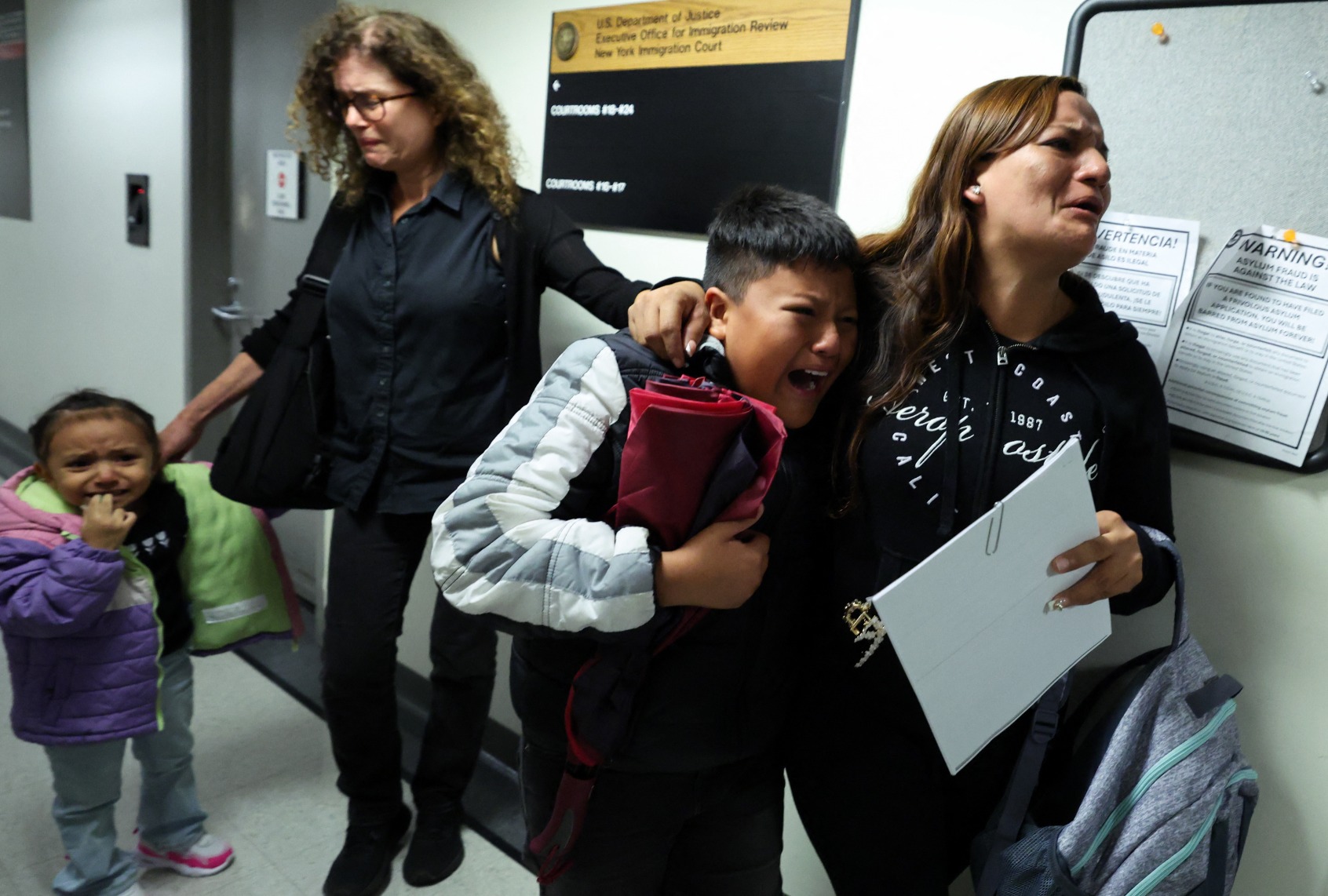

Early in Donald Trump’s second administration, officers of Immigration and Customs Enforcement began making unannounced visits to the schools and homes of unaccompanied immigrant minors, meaning children who don’t have a parent or guardian in the country. Officials branded these visits as “wellness checks,” ostensibly aimed at ensuring that the children in question did not fall victim to human trafficking and were keeping up with their obligations for their immigration cases. Other agencies were also enlisted to make such visits, including the FBI, the Drug Enforcement Administration and the Bureau of Alcohol, Tobacco, Firearms and Explosives. But the true purpose of these visits has been called into question by reports that, in some cases, they have led directly to deportations.
Newly released documents suggest that the Trump administration has turned this program, ostensibly intended to ensure the well-being of immigrant kids who don’t live with their parents, into another means for ICE and similar agencies to track down children and their sponsors (most often family members) who may be eligible for deportation.
These documents, provided to Salon by American Oversight, a nonpartisan watchdog group, show that the Trump administration is actively seeking to recruit local law enforcement to conduct these checks. Communications between the federal government and the sheriff’s office in one rural Minnesota county indicate that checks are used to collect information on both immigrant minors and their sponsors in the U.S. This information can then be shared across multiple government agencies.
Chioma Chukwu, the executive director of American Oversight, told Salon, “This administration has demonstrated a callous disregard for the well-being of children.”
Chukwu continued, “We’ve seen deeply troubling incidents — including reports that immigration agents used a five-year-old child as a prop to facilitate an enforcement operation. We’ve also seen children separated from their families and detained in conditions that have long drawn criticism from medical experts, advocates, and courts.”
Under the guise of these purported wellness checks, Chukwu said, “The Trump administration is sending federal law enforcement to gather information about children and their caregivers — raising serious concerns that these encounters are designed to lead to detention or separation. These so-called wellness checks are a troubling expansion of the administration’s inhumane and abusive immigration policy that puts already vulnerable children and families in harm’s way.”
The documents offer some details about the working relationship between the sheriff’s office in rural Mille Lacs County, Minnesota — about 85 miles north of Minneapolis — and ICE under what is called a 287(g) program, a provision of the 1996 Illegal Immigration Reform and Immigrant Responsibility Act that lays out a framework for local law enforcement to cooperate with federal immigration authorities. According to ICE, some 1,637 law enforcement agencies spanning 39 states and two territories have signed 287(g) agreements.
“These so-called wellness checks are a troubling expansion of the administration’s inhumane and abusive immigration policy that puts vulnerable children and families in harm’s way.”
Under these agreements, local law enforcement officers conduct operations on ICE’s behalf, including confirmation of address and school enrollment, and then pass any information they collect to the Department of Homeland Security. Local officers are given “prioritized case lists” that lay out likely targets for deportation, and are tasked with ensuring the “smooth facilitation of transfers when ICE determines that [an unaccompanied minor], sponsor or other aliens encountered should be placed into ICE custody for the next steps in their case.”
Following their field work, ICE’s partners are expected to fill out a standardized report with details about the minor and their sponsor. Local officials are then graded by ICE based on the number of cases worked, the number of checks completed, the number of contact information updates and their average turnaround time.
In an email to Salon, Kyle Burton, the sheriff of Mille Lacs County — a region of rolling hills and woodlands with just 28,000 residents — said his department had “not participated” in a wellness check yet under 287(g), although he had “received the information on it” from DHS. Burton was “reviewing that to see if it is something we can dedicate resources to at this time,” he said.
The sheriff’s office was offered significant financial incentives to participate in the 287(g) program, including “unprecedented reimbursement opportunities,” such as a $100,000 transportation stipend as well as a $7,500 stipend intended to cover equipment costs for each officer who participates. In Mille Lacs County, 10 officers participated, with the sheriff’s office receiving a total of $75,000.
We need your help to stay independent
The American Oversight documents also indicate that information collected during police operations is shared with ICE. In one instance, a sheriff’s deputy passed along an arrest report from a traffic stop to ICE. The individual was arrested for reckless driving, speeding and driving after having their license revoked.
The specific agreement made with ICE by the Mille Lacs sheriff appears to have been initially unlawful, according to an opinion from the Minnesota attorney general’s office included in the documents. State law requires a county board of commissioners to approve any 287(g) agreement before a county sheriff can sign on, and also prohibits law enforcement from detaining or holding people based solely on a civil detainment order from ICE, even if the sheriff’s office has entered into a lawful 287(g) agreement. The ACLU of Minnesota is currently suing a different county — Freeborn County, on the state’s southern border — over a similar 287(g) agreement.
In the Mille Lacs case, Sheriff Burton continued to operate under the 287(g) agreement after the attorney general’s opinion was shared with his department last September. This week the county board finally ratified the 287(g) agreement.
DHS has boasted about instances when wellness checks reportedly helped a minor escape a dangerous living situation. White House border czar Tom Homan insists that the purpose of these checks is to ensure well-being rather than to deport people. But advocates for unaccompanied minors feel differently, calling them a pretext to locate and deport children and their families.
White House border czar Tom Homan insists the purpose of these checks is to ensure well-being rather than to deport people. But advocates for unaccompanied minors feel differently.
Mary Miller Flowers, director of policy and legislative affairs at the Young Center, which advocates on behalf of immigrant children, told Salon that she has significant concerns with the Trump administration’s version of the wellness check policy.
These kinds of checks, Flowers said, should be done by social workers, not by ICE or police officers, or anyone else working in the deportation system.
“One of the problems that has historically plagued the unaccompanied children’s program,” Flowers said, is that “lots of families won’t open the door,” even if the person at the door is “a post-release case worker who is a social worker, not employed by the enforcement arm of the government.”
Under the Biden administration, the well-being of unaccompanied minors was handled through the Office of Refugee Resettlement, by assigning children a caseworker through a post-release services program, established under the Trafficking Victims Protection Reauthorization Act of 2008. These post-release services were handled by a network of federally-funded providers and the system was governed by the Department of Health and Human Services, rather than Homeland Security.
Start your day with essential news from Salon.
Sign up for our free morning newsletter, Crash Course.
If local police or ICE officers perform these checks, Flowers said, the non-response problem can be compounded and the program is all too easily diverted from prioritizing the well-being of children. In the context of a 287(g) agreement, Flowers added, community trust in the police can be undermined, especially when the information collected is being channeled back to ICE and other agencies.
Such services work much better if “embedded in a community-based service model where you have members of their own community coming to the door,” Flowers said, “maybe through a church congregation that receives grant money, maybe through an NGO that knows people on the ground, maybe in school.”
Burton, the Mille Lacs County sheriff, told Salon, “I do not share those concerns. Those criticisms (in my opinion) seem to be the narrative pushed by those who support sanctuary policies and do not support enforcement of immigration laws. Checking on the welfare of kids should not be a political issue.”
ICE did not respond to Salon’s request for comment.
Read more
about the ICE age
