
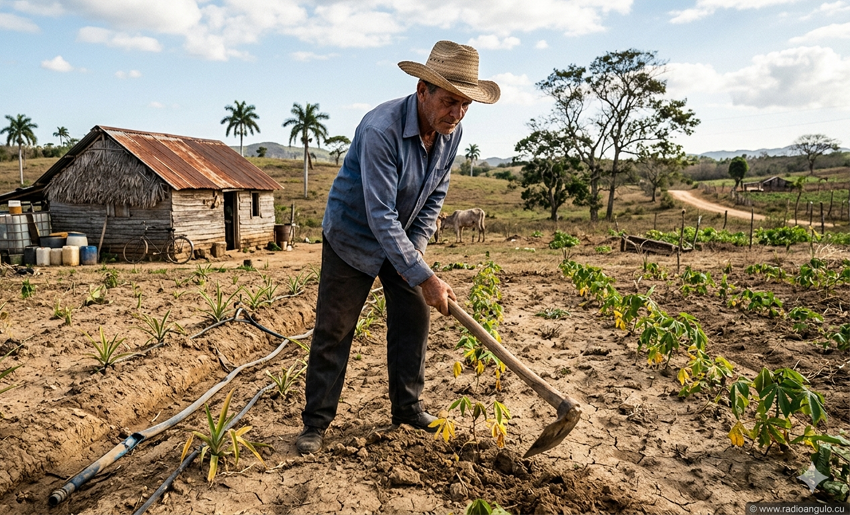

In Cuba today, food is rotting in the fields while families go hungry.
On a recent trip to the eastern part of the island, I spoke with farmers who are watching their livelihoods slip away — not because they lack skill or dedication, but because they lack fuel, parts and basic inputs. One farmer described fields ready to harvest but no diesel to bring the crops in. Others showed me broken machinery they have no way to repair. Even those who have turned to animal traction are having problems with feed. These are not isolated stories; they reflect a system under siege.
The U.S. fuel embargo, together with tightened sanctions under Donald Trump‘s administration, is strangling Cuba’s agricultural system from seed to table — making it harder and harder for Cubans to feed themselves.
Cuban farmers have already been operating under severe constraints imposed by U.S. sanctions — struggling to obtain spare parts to repair tractors, access fertilizers and pesticides or secure basic inputs like seeds. Machinery breaks down and sits idle for months because parts can’t be imported or paid for through normal banking channels.
Add to that Hurricane Melissa, which struck the island nation in October 2025, flooding fertile farmland and destroying crops. Climate change is wreaking havoc on agriculture, bringing stronger storms, longer droughts, erratic rainfall and rising temperatures.
Into this already fragile system comes the fuel crisis, compounding every existing problem. Even the farm equipment that can be repaired can’t be used because there is no diesel to run it. Irrigation systems go dry, planting is delayed or scaled back and harvests are lost.
At the same time, there is not enough fuel to transport fresh produce from rural farms to urban markets. Trucks sit idle. Distribution chains break down. Food that could nourish communities never makes it to the people who need it most.
Processing food becomes impossible. Tomatoes — one of Cuba’s most abundant seasonal crops — are a painful example. Without reliable electricity, processing factories cannot operate. Mountains of ripe tomatoes, waiting to be turned into paste or sauce, are left to spoil.
We need your help to stay independent
Cuban farmers are certainly resilient. Across the island, they have been experimenting with agro-ecology, animal traction, local inputs and cooperative models. They are finding creative ways to grow food with fewer resources. But resilience has its limits. No amount of ingenuity can substitute for fuel that doesn’t arrive, machinery that can’t be repaired or markets that can’t be reached.
This is not just an agricultural crisis but a humanitarian one.
On various trips to Cuba delivering humanitarian aid, I met women across the island who are desperate to find enough food to feed their children. They spend hours in lines, piecing together meals from whatever they can find, constantly worrying about what to put on the kitchen table tomorrow. Their struggle mirrors what is happening in the countryside: a breakdown that is squeezing both producers and consumers at once.
I met women across the island who are desperate to find enough food to feed their children. They spend hours in lines, piecing together meals from whatever they can find, constantly worrying about what to put on the kitchen table tomorrow.
Families stand in long lines for basic staples. Protein is scarce. Fresh fruits and vegetables — when available — are often priced beyond the reach of ordinary people. State salaries — often the equivalent of $15 to $30 a month — have been completely overtaken by soaring food prices driven by scarcity and inflation. A few pounds of tomatoes, a carton of eggs or a bottle of cooking oil can consume a week’s wages. Pensioners and families living on fixed incomes are hit the hardest, forced to stretch rations, skip meals or rely on remittances from relatives abroad — if they are lucky enough to have them.
The government has set up soup kitchens — the Sistema de Atención a la Familia, or Family Care System — to support the most vulnerable. But at the one we visited in Holguín, portions had gotten smaller and less varied, and staff were forced to scavenge for wood to cook with, due to gas shortages and unreliable electricity.
Rep. María Elvira Salazar of Florida, a leading Republican voice in Congress for tightening sanctions, has openly acknowledged that she views the suffering of mothers and children as a price worth paying for regime change. Perhaps she should consult with Cubans on the island, not just those in Miami, about whether they feel the same way.
Start your day with essential news from Salon.
Sign up for our free morning newsletter, Crash Course.
In the Trump Cabinet, the major proponent of squeezing Cuba is Secretary of State Marco Rubio, another Cuban American. He argues that this pressure is necessary to force regime change and a flowering of private enterprise. But across the island, small-scale farmers and cooperatives already operate as private entrepreneurs, growing food, managing their own production and selling to local markets, most of which have been privatized. Yet instead of supporting this sector, U.S. sanctions are crippling it. The very people the U.S. claims to champion are being strangled by the same policies that supposedly promote them.
If the goal is to support the Cuban people, this policy is an utter failure. And those unmoved by humanitarian concerns should think about an unstoppable wave of mass migration that may well be unleashed. In recent years, over a million Cubans — roughly one in 10 — have migrated elsewhere in search of a better life, most of them heading to the United States. While Trump has now closed the borders, the crisis risks fueling a new wave of desperate Cuban refugees.
The solution is not complicated. If the blockade is lifted and Cuba is allowed to import fuel — without the threat of sanctions against countries that provide it — farmers will grow more food and the Cuban people will be able to feed their families.
Read more
from Salon on Cuba
