
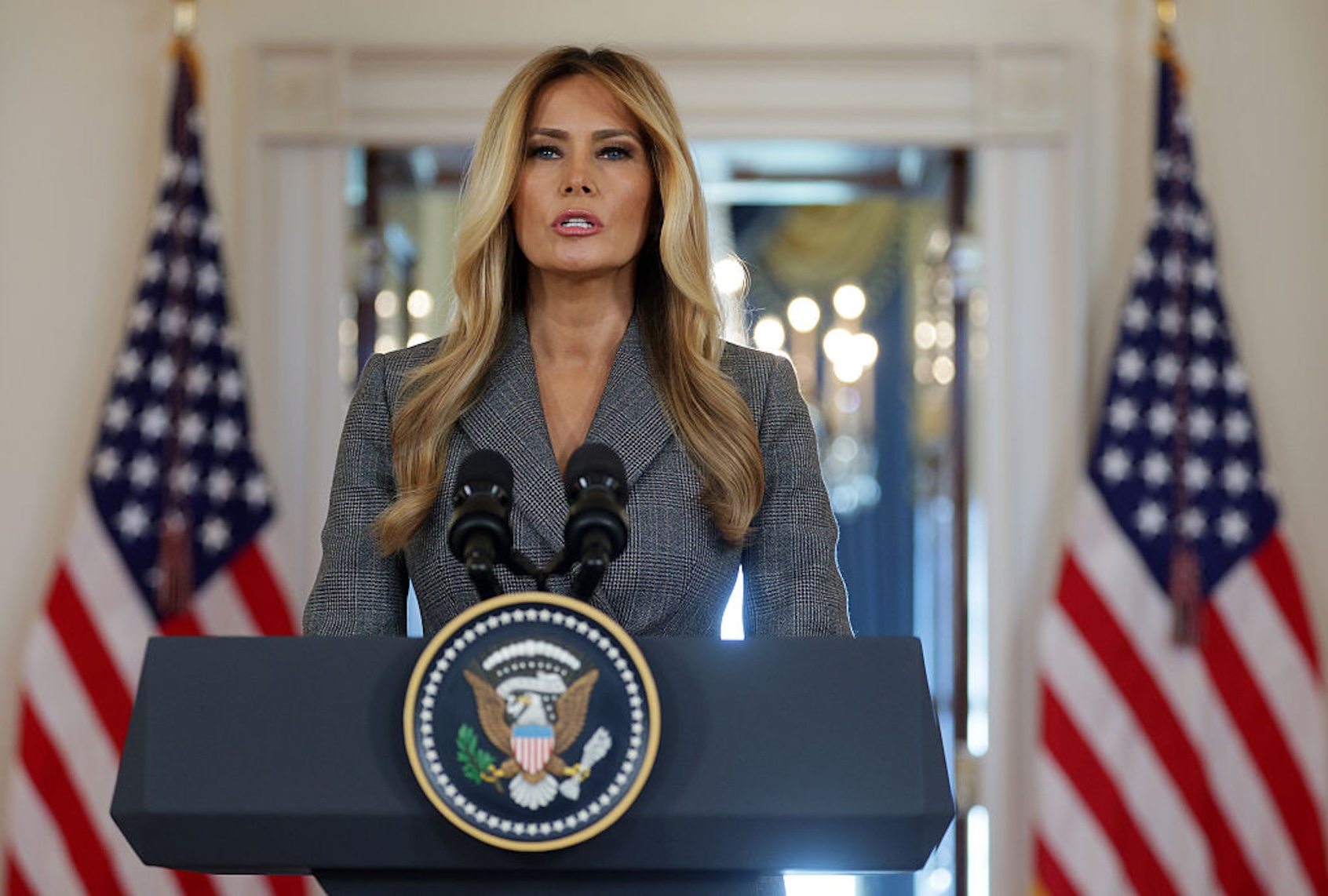

Jacqui Heinrich was visibly puzzled while reporting from the White House lawn on Thursday. The Fox News senior White House correspondent was trying to make sense of a bizarre on-camera press statement First Lady Melania Trump had just given, a move that was, in Heinrich’s words, “out of left field.”
After summoning the White House press pool, Trump strode to a podium bearing the presidential seal and, unprompted, declared that the “lies” linking her to Jeffrey Epstein had to end. She called on Congress to hold hearings featuring survivors of the convicted sex offender’s alleged abuse. Trump did not mention her husband. And she did not address why now, after a year of sustained media attention, she suddenly felt the need to speak.
The bewilderment that followed was real — both inside and outside the White House. “I didn’t know what the statement was,” the president admitted to the New York Times, “but I knew she was going to make a statement.” Reporters for mainstream and right-wing outlets alike admitted they had no idea why the first lady chose that particular moment to go on the record about her relationship with the deceased financier.
“Why is Melania Trump speaking out about Epstein now?” the BBC wondered. “What on Earth is Melania Trump thinking?” the Guardian asked. On “Fox & Friends,” co-host Ainsley Earhardt bluntly asked “why now” at the start of an interview with the first lady’s top adviser the next day. As Shawn McCreesh wrote at the New York Times, “the spectacle braided two narratives that officials in this White House always approach with utmost caution: the deeply private first lady and the deeply poisonous Epstein saga.”
But the question of “why now?” doesn’t begin to illuminate what motivated the first lady to reignite a controversy the White House had been trying to contain for months with a demand that Congress investigate a scandal her husband’s own administration has spent 14 months trying to bury.
But the question of “why now?” doesn’t begin to illuminate what motivated the first lady to reignite a controversy the White House had been trying to contain for months with a demand that Congress investigate a scandal her husband’s own administration has spent 14 months trying to bury. Her intervention brought renewed focus to the first couple’s friendship with Epstein, which Trump described as superficial and noted that “overlapping in social circles is common in New York City and Palm Beach.” (That attention continued on Monday when a federal judge dismissed the president’s $10 million defamation lawsuit against Rupert Murdoch, publisher of the Wall Street Journal, for the paper’s report on a 2003 birthday letter the president supposedly sent Epstein that featured a drawing of a naked woman and Trump’s signature below her waist.)
Investigative journalist Vicky Ward, who has reported on Epstein for decades, captured the absurdity plainly. If Melania Trump had done this at the start of the crisis a year ago, Ward noted, it might have felt meaningful. Instead it arrived after the administration spent months managing the political fallout of its own failure to deliver the goods it had promised to MAGA voters.
The first lady’s statement came just days after the president fired Pam Bondi who, as attorney general, went on Fox News in 2025 to boast that she had Epstein’s client list “sitting on my desk right now to review,” and then presided over a year of broken promises and theatrical releases of already-public documents. During his first press conference as acting attorney general, Bondi’s replacement, Todd Blanche, said, “I think that to the extent that the Epstein files was a part of the past year of this Justice Department, it should not be a part of anything going forward.” His sentiment was so naive it led Fox News’ Jesse Watters to remark, “I’m not sure you totally get what people feel about that.”
Over the past year, the Epstein files have metastasized into a defining symbol of elite impunity. Each partial release, redaction or bureaucratic delay has reinforced the idea that there is one system of accountability for ordinary people and another for the powerful. By early 2026, large majorities of Americans believed the government was withholding key information about Epstein and his alleged accomplices, and dissatisfaction with the pace and transparency of disclosures was overwhelming. In that context, Melania Trump’s recent intervention looks less like a random act and more like the performance of transparency.
Want more sharp takes on politics? Sign up for our free newsletter, Standing Room Only, written by Amanda Marcotte, now also a weekly show on YouTube or wherever you get your podcasts.
Recall what the Trump administration promised and what it delivered. During his 2024 campaign, Trump vowed multiple times that he would “probably” declassify Epstein files if elected. Then-vice presidential candidate JD Vance added to the chorus, saying on a podcast, “We need to release the Epstein list.” During Kash Patel’s Senate confirmation hearing to become FBI director, he was asked whether he would help expose those who worked with Epstein in building his alleged sex trafficking ring and replied “Absolutely.”
Within weeks of taking office, the administration’s commitment to transparency began revealing itself as something else entirely. In February 2025, the White House released what it called “Phase 1” of the Epstein files to MAGA influencers, who walked out of the West Wing carrying binders bearing the seal of the Justice Department. Journalists and analysts who examined those binders found they were largely made up of documents that had already been made public. Months later, the Wall Street Journal reported that Bondi and other Justice Department officials told Trump in May that his name “is among many in the Epstein files.” In July, the FBI and Justice Department announced they had found no evidence of any client list kept by Epstein or that he blackmailed prominent figures, and concluded that no further disclosure would be appropriate or warranted.
We need your help to stay independent
Democrats in the House, along with a handful of Republicans, moved to force a vote to require the Justice Department to release the documents through a discharge petition. Files released by the Justice Department showed that Commerce Secretary Howard Lutnick, who had been Epstein’s literal next-door neighbor on East 71st Street in Manhattan, visited the financier’s island in 2012 — four years after Epstein had pleaded guilty to procuring a person under 18 for prostitution. Lutnick had previously told the New York Post he decided in 2005 that Epstein was “disgusting” and that he had wanted nothing more to do with him after making an inappropriate remark while hosting Lutnick and his wife. For her part, Bondi, who was subpoenaed to testify before Congress this week, has successfully used her removal from office to avoid appearing before the House Oversight Committee.
For a year now, the Epstein files have exposed not just individual connections but systemic weakness. By calling for hearings, Melania Trump attempted to position herself on the side of transparency and accountability, even as the real power to act lies with the executive branch, which is of course led by her husband. When Marc Beckman, Trump’s senior media adviser, was asked by Fox News what led her to make the statement, he said, “To be honest, it’s a combination of legacy media, social media, different corporate entities, and personalities.”
Like Beckman’s comment, the Trump administration’s relationship to the Epstein story has never been coherent. The first lady’s speech fit that pattern. The past year of media coverage has followed that pattern. Each attempt to close the book has instead turned the page. Each effort to minimize the story has amplified it. Each declaration that there is “nothing more to see” has convinced millions that there must be.
Read more
about the Epstein files
