

There was a time when the very concept of a conflict of interest in politics was a serious matter that could cause investigations and resignations in the federal government. Long before Watergate, Richard Nixon was famously accused of corruption when it was revealed at the height of the 1952 presidential election, in which he was Dwight D. Eisenhower’s running mate, that some supporters had set up a slush fund to help pay for his expenses. Nixon went on television and delivered his famous “Checkers” speech to upwards of 60 million people, insisting that his wife Pat wore a respectable Republican cloth coat and that they intended to keep Checkers, the little dog a supporter had given to his daughters. He got away with it that time, but the moniker ‘Tricky Dick” stuck with him throughout his political career.
Nixon wasn’t the only Republican dogged by conflict of interest accusations in the 1950s. Sherman Adams, Eisenhower’s chief of staff, resigned in 1958 after refusing to answer questions about a vicuña coat and an Asian rug given to him by a textile manufacturer. Two years later, John C. Doerfer, chairman of the Federal Communications Commission, likewise bowed out when it was revealed he had vacationed on the yacht of a wealthy friend.
Seventy years later, it all sounds so quaint.
At one time, it was considered an absolute necessity for public officials to observe these rules and take proper action to avoid them. If they didn’t there would be consequences: dismissal or resignation, and sometimes legal action.
The following decades saw scandals featuring legislators and political operatives of both parties who were accused of conflicts of interest, which were generally defined as a person’s private interests. These were usually financial and directly clashed with their duties, making it difficult for them to act objectively. Many were even determined to have the appearance of conflict of interest — the distinction being that even if a person were acting ethically, someone else might look at their situation and believe they could be compromised — in which case they were required to either divest themselves of the conflict or resign their public position. At one time, it was considered an absolute necessity for public officials to observe these rules and take proper action to avoid them. If they didn’t there would be consequences: dismissal or resignation, and sometimes legal action.
The way money and power converge in our political system, some amount of corruption is probably inevitable. In fact, the system is built for it. But Donald Trump and his cronies have made all the previous cases look like child’s play. As the president himself would say, “We’ve never seen anything like it.”
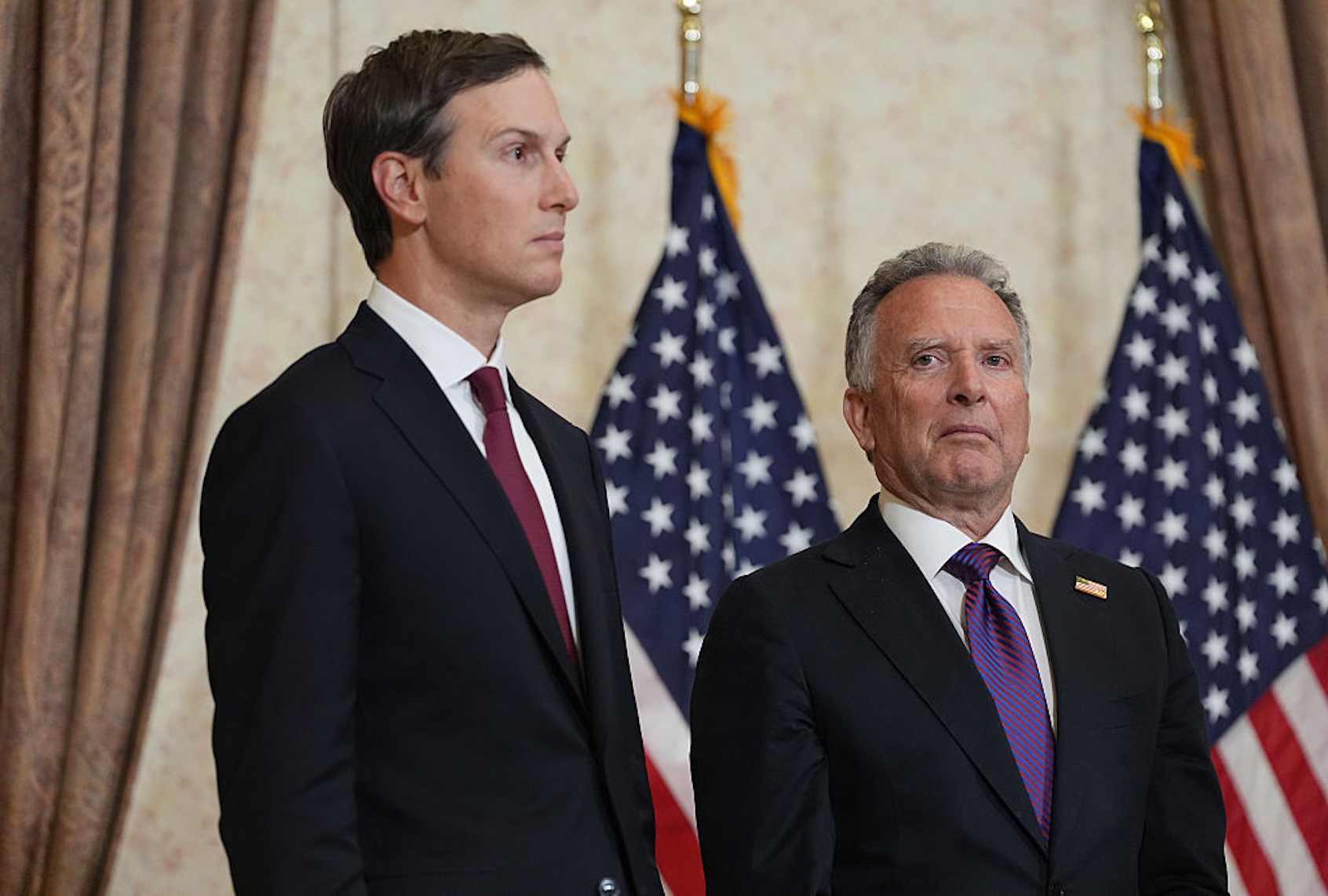
And if you want to really see why these prohibitions once existed, you have only to look at Trump’s special envoys for peace: Jared Kushner and Steve Witkoff, whose lack of experience and conflicts of interest have turned the Middle East into a raging fire and even helped lead to the Iran war.
The New York Times reported on Monday about an event that would have been unthinkable just a decade ago when Republicans were shrieking that former Secretary of State Hillary Clinton should be disqualified from running for president because she would supposedly sell out America’s national security to procure money from foreign leaders to fund her family’s global charity. In late March, as the Iran war was dragging into its 26th day, Kushner appeared at a Saudi investment conference in Miami. The president’s son-in-law, who had represented the U.S. in the failed talks that led to war breaking out with Iran, was not in south Florida as an American official but as the founder and chief executive of Affinity Partners, an investment firm that had received billions from the Saudi Arabia sovereign wealth fund.
Kushner was reportedly fundraising for another massive cash injection from the Saudi crown prince at the same time he was serving as a special envoy in the administration’s negotiations with Iran — and as the Saudis were reportedly pushing for war with the Islamic Republic. It is one of the most egregious examples of conflict of interest in American political history. And nobody said a word.
Within days he was off to the Middle East for more talks with Trump’s other special envoy, Steve Witkoff, another arrogant real estate investor with no diplomatic experience who is botching American foreign policy all over the globe.
Want more sharp takes on politics? Sign up for our free newsletter, Standing Room Only, written by Amanda Marcotte, now also a weekly show on YouTube or wherever you get your podcasts.
Like his partner in duplicity, Witkoff’s conflicts are numerous. He previously joined with the Trump family in the cryptocurrency World Liberty Financial, and after he was named special envoy, Witkoff leveraged his position to argue for an export deal to export the world’s most advanced artificial intelligence chips to the United Arab Emirates, a deal which had not been previously approved due to national security concerns. Coincidentally, I’m sure, a UAE government-backed company handed World Liberty a $2 billion investment in its stablecoin. Democratic Sens. Elizabeth Warren of Massachusetts and Ron Wyden of Oregon issued a statement saying that “[the deal] appears to have aided a foreign power’s effort to acquire U.S. technology with serious economic and national security implications — and [Witkoff] potentially did so in exchange for his personal financial benefit.”
This is a marked contrast to the Clinton Foundation, which did accept foreign and corporate donations in support of programs to fight HIV/AIDS and economic empowerment for women. But when issues about the appearance of conflicts of interest were raised during Hillary Clinton’s 2016 campaign for president, how did the organization respond? By pledging to stop taking foreign and corporate corporations if she were elected, and by ending the Clinton Global Initiative regardless.
Ten years later, it’s apparently fine for Kushner and Witkoff to allegedly be profiteering from their diplomatic partners.
The epic failure of this duo in dealing with the Iran war — at least from a national security perspective, if not their own personal portfolios — shows how this sort of conflict of interest can warp someone’s ability to do the job. As the Times lays out, Kushner and Witkoff represent Donald Trump’s mindset — “a rogue version of diplomacy that’s focused on the flashy and theatrical, a reflection of the Trump real estate developer ethos. But that ethos has failed, and Iran is proof.”
We need your help to stay independent.
But they also symbolize his blatantly corrupt view of government as a legitimate tool for growing their own personal fortunes. As Trump himself said in January after being asked by Times reporters why he was no longer abiding by any ethics rules about conflicts of interest, “because I found out that nobody cared. I’m allowed to.”
Blatant corruption, it seems, has become just another perk of the job.
The White House is not requiring Kushner to file financial disclosure documents, and certification of Witkoff’s has been inexplicably delayed for months. Since Trump has promised to issue mass pardons to his staff before leaving office, it’s highly unlikely the pair will be held accountable for their behavior.
But the lesson is clear: Allowing government officials, even so-called special envoys, to leverage their positions for personal financial gain is a recipe for disaster. When Democrats return to power, those arcane rules about conflicts of interest should be codified into law — and made to stick.
Read more
about Iran
