
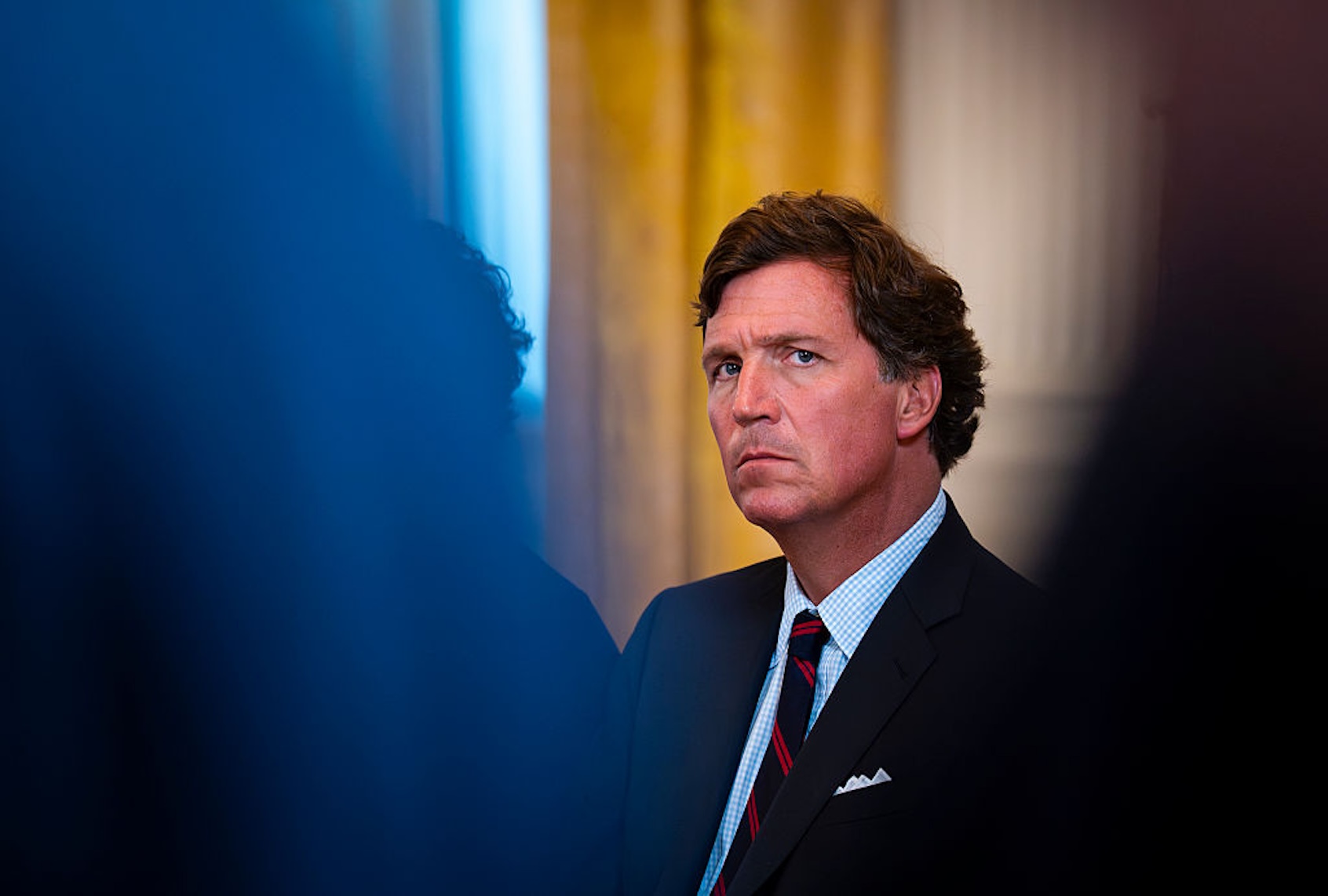

Tucker Carlson, the former Fox News host turned popular right-wing podcaster, recently announced he is teaming up with Skyhorse Publishing to release books by a familiar cast of provocateurs. Among his stable of authors is Russell Brand, the actor currently facing multiple sexual assault charges in the U.K. — to which he has pleaded not guilty — and Milo Yiannopoulos, the far-right media figure who once identified as gay but now advocates for so-called “conversion therapy,” and whose previous publishing deal imploded after comments widely interpreted as condoning sex between adults and minors.
Carlson has framed the venture as a defiant stand against censorship, and it seems clear the imprint intends to push against the boundaries of what legacy media will tolerate, like a book on cancer by Los Angeles Times owner Dr. Patrick Soon-Shiong, whose controversial cancer drug Anktiva recently received FDA warnings about misleading claims.
Conservative publishing isn’t dead — but it is drifting, trading politics for piety, and intellectual rigor for the safer margins of lifestyle content and cultural signaling.
Carlson’s inaugural slate of writers is a good snapshot of where the right’s intellectual life has arrived in 2026. Conservative publishing isn’t dead — but it is drifting, trading politics for piety, and intellectual rigor for the safer margins of lifestyle content and cultural signaling.
For decades, the right-wing publishing industry was one of the most potent and profitable engines of American conservatism — and was a serious enterprise. Books were central to the movement’s identity and translated ideology into mass-market form. Unapologetically cerebral, William F. Buckley Jr.’s seminal 1951 work “God and Man at Yale” was a provocation aimed at the Ivy League establishment that set the stage for the author’s career as a conservative intellectual and, eventually, for the conservative moment itself. Many followed in his wake. From the success of Allan Bloom’s “The Closing of the American Mind” in 1987 to the rise of dedicated conservative imprints in the early 2000s, the right treated publishing as a legitimate place to contest ideas.
When Fox News launched in 1996 — the same year Amazon completed its first full year of operations — it gave conservative authors a dedicated national broadcast platform for promotion. By the early 2000s, the numbers were impossible to ignore, and New York’s major publishers responded accordingly. Every member of the Big Five had a dedicated conservative imprint. Random House founded Crown Forum in 2002, Penguin launched Sentinel in 2003, Simon & Schuster debuted Threshold and HarperCollins added Broadside Books. Collectively, those imprints have produced more than 50 New York Times bestsellers. The mission seemed clear: to give conservative writers a platform to activate a political coalition, as Broadside founding executive Adam Bellow characterized his publishing of Ann Coulter and Sean Hannity.
But two decades later, Broadside has lost its way. Its Fox News Books imprint, launched in 2020 as a subsidiary of HarperCollins, has published 17 titles, all of which became national bestsellers. And not one of them making a political argument.
Shannon Bream, anchor of “Fox News Sunday” and the network’s chief legal correspondent, recently completed her Bible trilogy. “Fox & Friends” personality Carley Shimkus released a cookbook. Her former colleague Pete Hegseth, now secretary of defense, sold more than 300,000 copies of his last two books, both of which were military grievance memoirs. In all of these publications, the politics are implicit, carried by the authors’ public personas rather than articulated through sustained argument. The intellectual work of the Coulter era — arming the reader with talking points meant to “expose” the left — has been replaced by something that functions more like branded merchandise that is almost always explicitly Christian.
Meanwhile, the conservative publishing ventures that tried to operate outside the major imprints’ infrastructure have mostly collapsed. The Daily Wire launched a book publishing arm in 2021 with stated ambitions of breaking the stranglehold traditional houses had on conservative books. Within three years, it largely wound down operations. Winning Team Publishing — founded by people close to Donald Trump with the goal of self-publishing books by the former president and his coalition — has sold small numbers outside of Trump’s own expensive collector’s editions. The late MAGA influencer Charlie Kirk’s books cratered in sales after he moved away from HarperCollins; the last title released before his death sold roughly 6,000 copies compared to nearly 60,000 with a mainstream publisher.
Want more sharp takes on politics? Sign up for our free newsletter, Standing Room Only, written by Amanda Marcotte, now also a weekly show on YouTube or wherever you get your podcasts.
Which brings us back to Carlson, who understands that major publishers aren’t a censoring force to be circumvented, which is why he has partnered with Skyhorse rather than trying to build something entirely from scratch. An independent press known for publishing books by controversial authors including Robert F. Kennedy Jr. and Melania Trump, Skyhorse is a real publisher with real distribution. And Carlson, who spent years at Fox News mainstreaming extremist talking points with a veneer of intellectual curiosity, has framed his publishing project as the brave recovery of suppressed truth. Tony Lyons, the company’s publisher, said the imprint will “give a platform to things that would, in many cases, be shut down, be censored, and be covered over by propaganda.”
But these are not books designed to win arguments in the traditional sense. They are extensions of the same media ecosystem that has already displaced books as a primary vehicle for political discourse. Carlson’s own career illustrates the shift.
On television, he mastered a style that blurred the line between inquiry and insinuation, using the rhetorical pose of “just asking questions” to introduce and normalize fringe ideas — most notably the so-called Great Replacement theory, which recasts demographic change as a deliberate conspiracy against so-called heritage (i.e. white) Americans. Transposed into book form, that approach doesn’t become more rigorous. It becomes longer. A 300-page argument cannot compete, in speed or emotional immediacy, with a viral clip or a daily podcast. In our current environment, books are too slow to function as political interventions. A policy argument has a limited shelf life; a devotional or memoir can sell indefinitely.
We need your help to stay independent.
So Shannon Bream promises faith and uplift. Tucker Carlson is publishing Russell Brand’s encounter with Jesus. Neither is making a case for anything; they are simply selling an evangelical Chrisitian identity. Brand’s forthcoming title, “How to Become a Christian in Seven Days,” is emblematic of this trend. It is marketed as both testimony and guide, blending spiritual exploration with a kind of psychedelic self-help ethos. As the political sphere becomes less susceptible to persuasion, the cultural and spiritual dimensions of conservatism have taken on greater prominence. Faith, family, and national identity — long central themes — have moved from the background to the foreground. They are safer, in a sense: less vulnerable to factual rebuttal and more deeply rooted in personal experience.
The shift from politics to piety is not just thematic. It reflects a movement that has, to a significant degree, abandoned the project of persuasion in favor of the consolidation of identity. It is easier to affirm what your audience already believes than to challenge them with new arguments. What remains is a publishing sector that still generates revenue but no longer drives the intellectual life of the movement.
For all its rhetoric about censorship and dissent, Carlson’s imprint promises to operate squarely within that logic. It offers the thrill of transgression without the burden of intellectual rigor. It promises access to forbidden truths while relying on the same tired narratives. Carlson’s own career has rendered that era of conservative intellectual combat largely obsolete.
Read more
about right-wing media
