
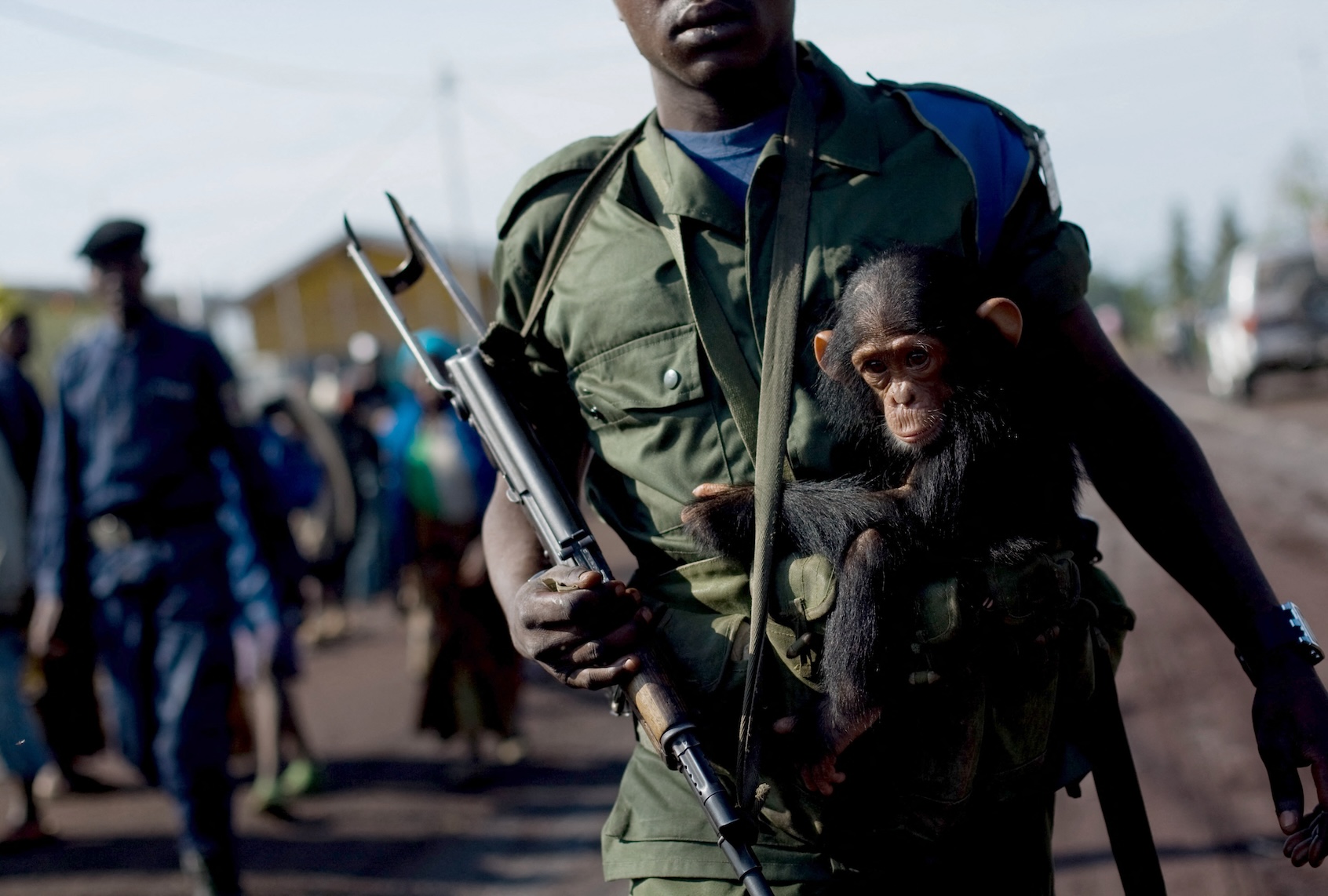

For decades, the 200 Ngogo chimpanzees in Kibale National Park, Uganda, lived what seemed a calm and normal existence. Males and females hunted together, groomed each other and went on patrols through the forest. Within this large group, cliques were formed but they often intermingled and share territory, like something from a simian Pixar film. But in June 2015, something happened and the group split in two. Then, the violence started.
The scientists watching this schism aren’t sure why things became so belligerent. It started with members from one group chasing the other and prolonged periods of avoidance. As polarization increased, so did the aggression, eventually becoming lethal. Over the years, at least six adult males were targeted, followed by at least 17 infants that were killed.
What was surprising about these killings isn’t that chimpanzees are some sort of primate pacifists and these ones suddenly went rogue. Indeed, chimps have been documented killing each other before, but usually one-off in events rather than in conflict between distinct groups that were formerly united. What made this different is how systematic and coordinated the slaughter was. It was, by some accounts, a civil war.
“Individuals who lived, fed, groomed and patrolled together for years became targets of lethal attacks on the basis of their new group membership,” the authors reported recently in the journal Science. “This highlights that chimpanzees have a sense of group identity that goes beyond familiarity or lack thereof, which, as in humans, can reorganize in the face of changing relationships and social contexts.”
The implication is obvious: Might this explain how humans turn on each other in war? The chimp war study went viral for a variety of reasons, not least of them the lurid spectacle of a species other than our own committing despicable acts. Against the backdrop of rising war and genocide, as the constricting climate ramps up the temperature for more conflict, watching apes shamelessly and needlessly kill one another feels familiar. It has us asking ourselves whether war is a part of human nature. Examining the question is critical, especially now, for reasons that anyone who values stable living doesn’t need explained. But examining the animal kingdom for answers can only tell us so much. Indeed, it can serve as a trap for our own self-destructive behavior.
Against the backdrop of rising war and genocide, as the constricting climate ramps up the temperature for more conflict, watching apes shamelessly and needlessly kill one another feels familiar.
Chimpanzees (Pan troglodytes) are the closest living relatives to humans — although neither species evolved from each other. Humans, chimps and bonobos share a common ancestor going back 7 million years or so. Maybe it’s not so surprising that humans aren’t the only animals that practice warfare. Group violence among mongeese and ants has also been documented by researchers, although the definition of “war” becomes nebulous depending on the species and its social dynamics. Only once before in recorded history has war between chimpanzees been documented, by none other than the late primatologist Jane Goodall. In the 1970s, she observed a stratification between groups of chimpanzees at a national park in Tanzania, with increasing aggression as males screeched and threw objects. Things escalated and over time, males from one group systematically killed members of other groups, with the winners taking over the others’ territory.
“Unfortunately, this is the kind of moving into the dark side of chimpanzees and human nature. We used to think it was only humans who waged war, but we find that chimpanzees like humans have this rather unpleasant ability to create an in-group and an out-group,” Goodall said in a 1997 interview, adding that it broke her heart to witness this. “The saddest part of learning all that is that it made them seem even more like us than they had before.”
Goodall’s research on warring chimpanzees was criticized because she had named and fed the animals, which some suspected might have played a role in their coordinated violence. Indeed, cases like these are rare, but when they do happen — as when a group of chimpanzees overthrew their tyrant of a leader, killed and ate him — we are reminded of ourselves and our worst tendencies. We are like a warped version of Narcissus, looking into the mirror and not liking what we see.
Start your day with essential news from Salon.
Sign up for our free morning newsletter, Crash Course.
Goodall recalled her scientific peers encouraging her not to publish her research, because it “will indicate that we have innate aggressive tendencies,” as she put it. That didn’t faze her. “Well, yes, I do believe we have innate aggressive tendency,” she said. “I don’t honestly think you can look around the world today and deny that that must be true. However, that doesn’t mean that war is inevitable. That doesn’t mean that we have to continue in this mold of of aggression. And we do have the ability to control our selfish genes.”
Goodall was likely referencing Richard Dawkins’ 1976 popular science book, “The Selfish Gene,” which helped synthesize numerous cutting-edge 20th-century ideas on biology, creating the discipline of memetics — the study of how culture and behavior (even war) embed themselves in evolution. Dawkins was not using “selfish” in the conventional sense of the word, but as an overextended metaphor for the lengths that DNA will go to replicate itself. The book was revolutionary for its time but has since been widely dismissed as a reductive, anthropomorphic and oversimplified view of evolution, focusing too heavily on the processes of genes and less about how they are expressed, in what environment, under what conditions and so on. Genes are important, of course, but they’re like cogs in an engine — they’re aren’t steering the ship and we are much more than vessels for our DNA.
“The selfish-gene model increasingly impoverishes both scientific and popular views of genetics and evolution,” David Dobbs wrote in an essay for Aeon. “As both conceptual framework and metaphor, the selfish-gene has helped us see the gene as it revealed itself over the 20th century. But as a new age and new tools reveal a more complicated genome, the selfish-gene is blinding us.”
So there’s no such thing as a “war gene.” There is nothing innate in human beings that demands we “double-tap” a hospital or bridge in order to maximize the death and destruction, to send white phosphorous raining down on villages or scatter landmines across landscapes where children play. It’s important to debunk this genetic stuff as we now live in a genomic age in which science has been used to justify all sorts of atrocity. Indeed, the Science paper is an important replication of Goodall’s work, but its authors do not argue that humans wage war because that’s just who we are. Far from it.
There’s no such thing as a “war gene.” There is nothing innate in human beings that demands we “double-tap” a hospital or bridge in order to maximize the death and destruction.
“In the absence of ethnicity, religion or political ideologies, social networks can divide, and new group boundaries can emerge, leading to collective violence,” the authors write. “This study encourages a reevaluation of current models of human collective violence. If chimpanzee groups can polarize, split and engage in lethal aggression without human-type cultural markers, then relational dynamics may play a larger causal role in human conflict than often assumed.”
Maybe the excuses we make for warfare aren’t as complex as they seem, though the practice itself obviously predates written history. Arguably war, especially in its modern version, is an emergent phenomenon triggered by a host of factors, but not by some genetic impulse we can’t be rid of. The miracle of our species isn’t that we annihilate each other, it’s that we cooperate at all. And as bleak as things may seem lately, we still do a lot more getting along than tearing at each others’ throats. That’s evident not just in how we treat each other, but other organisms as well.
We need your help to stay independent.
Humans are incredibly efficient at plant and animal domestication, the process of selecting and curating prosocial hereditary traits for our own benefit. But there’s also some solid evidence that humans domesticated ourselves, selecting tameness over aggression. Some researchers propose we did this by ganging up on disliked despotic individuals and kicking them out of groups or killing them. Language, culture and art likely also played a role in self-domestication. Over time, bullies became the exception and not the norm as prosocial traits became more likely to help genes get passed down.
But importantly, domestication is not a fixed point in evolution — it’s an ongoing process. Humans, and the animals we have brought under our fold, such as dogs and horses, are still evolving and still being domesticated. What this really boils down to is making our choices consciously. We don’t have to allow violent bullies to dominate us, carving up the world with bombs and drones.
As for the warring chimpanzees, the study’s lead author Aaron Sandel, an associate professor of anthropology at the University of Texas at Austin, said in a press release that he would “caution against anyone calling this a civil war,” adding, “But the polarization and collective violence that we have observed with these chimpanzees may give us insight into our own species.”
“It is tempting to attribute polarization and war that occur in humans today to ethnic, religious or political divisions,” Sandel and his co-authors conclude. “Focusing entirely on these cultural factors, however, overlooks social processes that shape human behavior — processes also present in one of our closest animal relatives. In some cases, it may be in the small, daily acts of reconciliation and reunion between individuals that we find opportunities for peace.”
Read more
science from Troy Farah
