
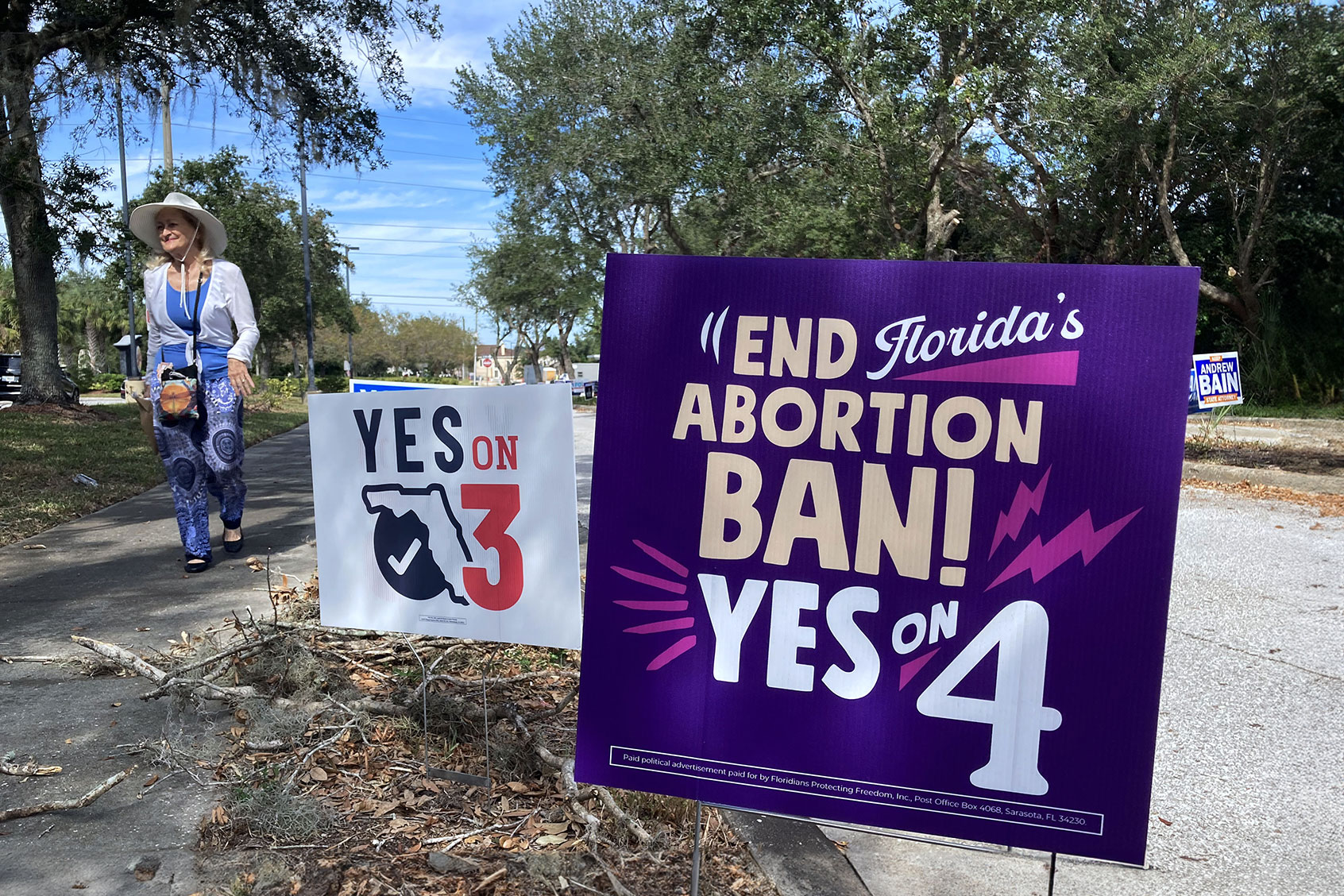

Nearly two years ago, Florida’s six-week abortion ban went into effect, forcing most people to travel out of state if they need an abortion. In the wake of the Supreme Court’s Dobbs decision, which overturned the constitutional right to an abortion and essentially made access a state issue, Florida became one of the top three states to see a rise in out-of-state abortions. In other words, it became an unlikely surge state.
The new law made it a penalty to perform or actively participate in an abortion six weeks after gestation, with limited exceptions. Before the new law went into effect, the state allowed for abortions up to 15 weeks of gestation. Not only has the law been severely restrictive to Floridians needing to access abortion care, but it has been devastating to people in the South who live in states that have similarly strict laws.
New data from Guttmacher’s Monthly Abortion Provision Study shows just how dramatically restricting access in Florida has affected reproductive care in the state and throughout the Southeast region, forcing thousands of people to travel long distances for out-of-state care.
“In the nearly two years since Florida’s six-week ban took effect, the number of abortions provided in the state has dropped significantly,” Candace Gibson, director of state policy at the Guttmacher Institute, said in a statement. “However, the need for care has not decreased.”
According to the new data, in 2023, the year before the six-week ban took place, there were close to 88,000 abortions provided in the state of Florida. In 2025, a year after the ban, this decreased by 25% to 65,800. This data includes in-clinic care before six weeks and telehealth care from providers living in shield law states.
“A major driver of the decline was a drop in the number of people traveling from out of state into Florida to access care,” Isaac Maddow-Zimet, a data scientist at the Guttmacher Institute, told Salon.
Technically, Florida’s six-week ban has exceptions for rape, incest and human trafficking, up to 15 weeks gestation, and to save a woman’s life or prevent “substantial and irreversible” impairment. However, as Salon has previously reported, these exceptions are designed to be difficult to use and frequently act as another burden for patients at a time of crisis. For example, according to the law, to leverage one of the exceptions for rape, incest or human trafficking, a woman “must provide a copy of a restraining order, police report, medical record or other court order or documentation providing evidence that she is obtaining the termination of pregnancy because she is a victim of rape, incest or human trafficking.”
“No one should be forced to leave their home state to access the abortion care they need.”
In 2023, before the ban, over 9,000 people were estimated to have traveled to Florida for abortion care, primarily coming from Georgia, Louisiana, Alabama and Texas — surrounding states with stricter abortion bans at the time. But in 2024, that number dropped to 4,000 people. Then, in 2025, it dropped to 2,500. The number of Florida residents who traveled out of state nearly tripled between 2023 and 2024, from 2,800 to 8,200. Preliminary data suggests that the number of Floridians traveling out of state continued to increase in 2025.
“When people are forced to travel out of state for essential healthcare, there are inevitably others that cannot overcome the immense financial and logistical obstacles,” Maddow-Zimet said. “No one should be forced to leave their home state to access the abortion care they need.”
In May 2025, the Chicago Abortion Fund reported that they had supported over 360 Floridians since the ban went into effect; a 267% increase compared to the year before the ban, when CAF supported only 98 Floridians. In the year after the ban, the abortion fund provided Floridians with more than $180,000 in direct assistance to access care.
“Data show that many Floridians are being forced to travel hundreds or even thousands of miles, as far as New York and Virginia, to get care,” Gibson said.
In November 2024, the abortion ballot measure, Amendment 4, could have amended the Florida state constitution to prohibit government interference with the right to abortion before around 23 and 24 weeks. Fifty-eight percent of Florida voters wanted it to pass, but the measure required a 60 percent supermajority to pass — a threshold higher than all other abortion amendments on the ballot that year.
Start your day with essential news from Salon.
Sign up for our free morning newsletter, Crash Course.
“Florida’s deadly abortion ban is out of line with the values of our state,” Lauren Brenzel, campaign manager of Yes on 4 Florida, said at the time. “Florida voters sent that message loud and clear today, and despite the fact that only a minority of voters voted to retain the abortion ban, our extremist government will exploit the situation to deny its own constituents the right to decide on our bodily autonomy.”
For many reasons, even those seeking an abortion before six weeks of gestation can be difficult. Most recently, this year, policymakers in Florida introduced several bills that would increase a culture of surveillance around pregnancy and abortion care. Advocates for ending the abortion ban say it’s not only a health issue, but also a human rights one.
“Florida’s near-total abortion ban undermines our health, freedoms and rights as Floridians,” Cheyenne Drews, the reproductive freedom program director for Progress Florida, said in a statement. “Patients are facing delays and denials of abortions and emergency management of pregnancy complications, and now, providers are leaving the state.”
Drews added that the situation is “not sustainable.”
We need your help to stay independent.
“Advocates and abortion funds are doing everything possible to share resources and cover costs, including out-of-state travel,” Drews said. “Political interference in our personal lives is unacceptable and Floridians remain fully committed to the urgent fight for reproductive freedom.”
Research in the U.S. and across the globe has shown that abortion rates don’t drop once abortion access is restricted — but it does make abortion far less safe. In fact, updated data in March found that despite the bans and restrictions, the number of abortions in America have remained the same. But Maddow-Zimet, at Guttmacher Institute, says number of abortions provided nationally in the past few years have “masked serious fluctuations at the state level.”
Read more
about Florida
