
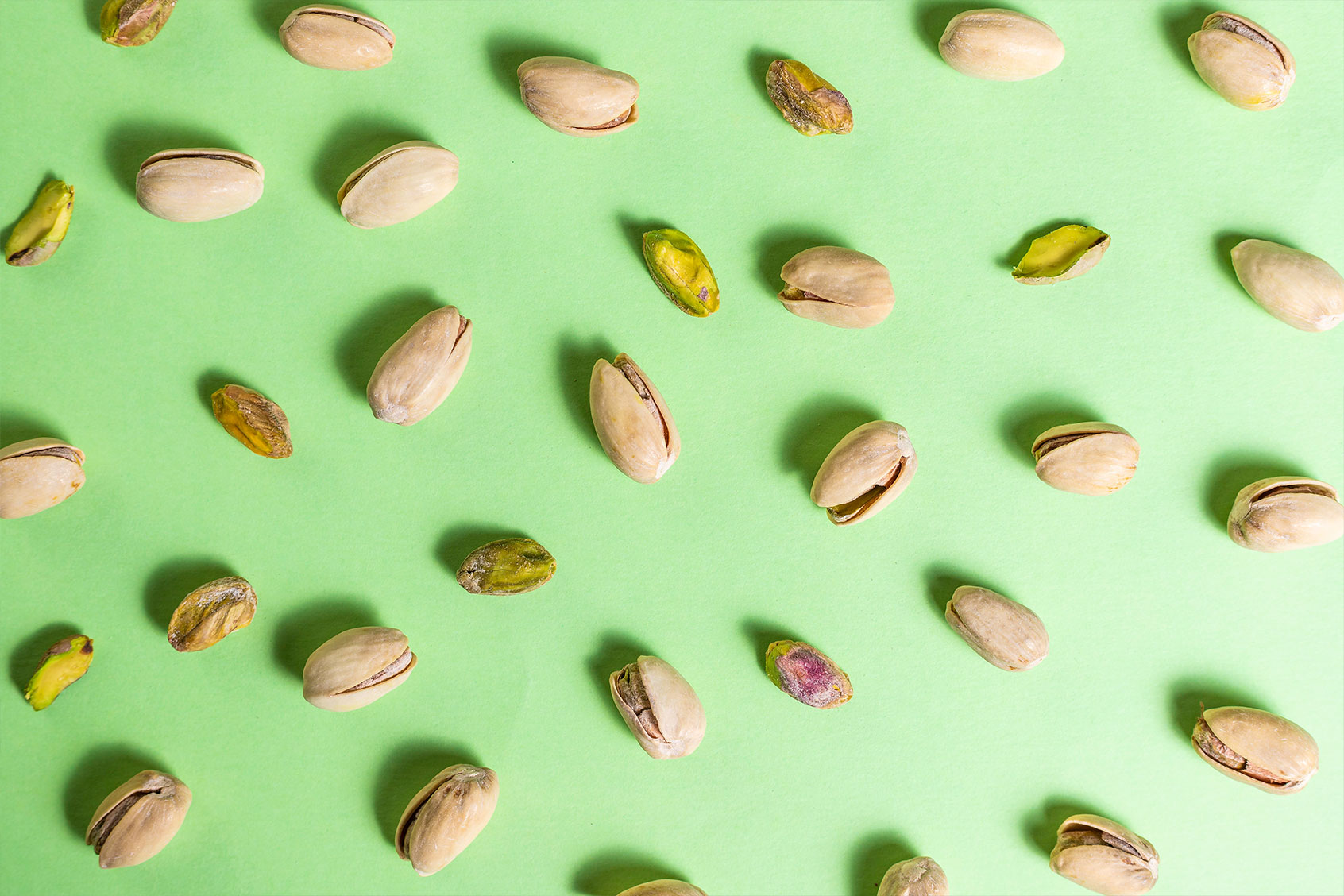

From Dubai chocolate to lattes, pistachios are having a moment. Of course, the nut itself has been cultivated for thousands of years in Persia, modern day Iran, where pistachios are still the country’s number one commodity crop. But the United States has only grown them commercially for 50 years. The U.S. now produces the lion’s share of pistachios globally — despite their relative newness for American farmers.
The tagline on a bag of salt and pepper pistachios in my cabinet reads, “300-year-old recipe — reborn in California.” That short phrase aptly describes how one U.S. state overtook hundreds of years of Iranian market power in a matter of decades.
Pistachio’s ubiquity is also new as the nut trickles down from TikTok virality to mass market explosion. What was once an occasional snack and ice cream flavor choice became a typical presence in coffee shops, bakeries and grocery stores all over the world.
Pistachio cold foam now perches atop iced coffees from nationwide chains, Dubai chocolate knock-offs sit at every grocery checkout stand and boutique patisseries fill croissants with pistachio butters and creams. Mentions of pistachios on non-alcoholic drink menus has increased 189% in the last four years and further growth is expected over the next four years, according to Andrew Chen a senior marketing manager at Dataessential, a food and beverage market insights firm.
It’s hardly a coincidence that the nut is blowing up just as the U.S. hit its stride in global pistachio dominance. Though the pistachio filling and flavor craze has just taken off in the past few years, “viral” food trends like these are really decades in the making.
Within those decades, there wasn’t just deft marketing campaigns and organic interest growth that raised American pistachio’s profile — there was punitive foreign policy on the world’s then-top pistachio producer.
The first commercial crop of pistachios in the U.S. was harvested in 1976, just a few years before the Iranian Revolution. By 1980, a sanction on Iran halted nearly all trade, and over 93% of pistachio consumption in the U.S. that year came from within the country.
But as trading relationships began opening back up through the first half of the decade, fledgling pistachio growers in the U.S. took issue with the volume and low price of Iranian pistachio imports.
By targeting Iran instead of all pistachio exporting countries, it shows the policy was mainly punitive, rather than intentionally protectionist.
Complaints to the International Trade Commission led to an investigation, which Andrew Muhammad, an agriculture policy professor at the University of Tennessee says “usually happens when domestic producers feel threatened in some way.”
The investigation found that Iran was selling below market value, which materially injured the American pistachio industry. “In a lot of these investigations, very much like the ones we’re doing now, there’s a political bent to them, and so in that sense, the punitive side of it is both politically as well as based on what commerce has found in terms of their unfair practices in the global arena,” Muhammad told Salon.
Ten years after American growers began investing in pistachios, a prohibitive anti-dumping tariff on Iranian raw in-shell pistachios was announced. A staggering 241% tariff was instated in 1986 and remains in effect to this day, being most recently renewed on May 30, 2025. Overall trade with Iran has generally remained volatile in the decades since, with outright bans on pistachio imports lasting years at a time. Other tariffs on roasted pistachios too have been put in place, and though not permanent, the duty also peaked in the triple digits in 1986.
Muhammad said tariffs like these, especially a 40-year-long triple-digit duty, likely played a significant role in the U.S.’s speedy overtake of the global pistachio market, though he noted one tariff usually isn’t the sole growth driver of a domestic industry. By targeting Iran instead of all pistachio exporting countries, it shows the policy was mainly punitive, rather than intentionally protectionist.
Start your day with essential news from Salon.
Sign up for our free morning newsletter, Crash Course.
Though it may have still had some protectionist-like impacts on the industry, as the U.S. did not just switch importing from Iran to Turkey — the third largest pistachio producer — but reduced imports all together as the investments at home began to pay off. Further, American growers have not just decreased imports and increased their exports over the years, they’ve also innovated on the plant itself.
Practically all pistachios grown in the country come from California, which it lists as a top ten agriculture commodity in the state worth over $2.2 billion. Pistachio trees account for more than 22% of tree nut bearing acres in California — only beaten by the state’s $5.66 billion almond industry. Globally, the only commodity crop that the U.S. produces a larger share of than pistachios is almonds, which account for nearly 80% of almonds grown across the world. But in some ways, almonds are old news, considering American almond farmers planted their first commercial crop in 1843.
The U.S. has established multiple new varieties of pistachios in the past few decades with its most popular, the Golden Hills cultivar, likely aiding the huge jump in production. Kerman, the most commonly-planted pistachio variety, originates from Iran and is named after a famous carpet-making city near Rafsanjan. It’s the industry “workhorse” according to Stephen Vasquez, the executive director of the Administrative Committee on Pistachios (ACP), but is subject to problems. Mostly that pistachios have on and off years, producing significantly less every other year, and need sufficient cooling periods in the winter, which is becoming more challenging in California due to the warming climate.
Year over year, growers are choosing to plant new pistachio trees, likely eating into almond orchards’ domination of California’s central valley, Vasquez told Salon. This is likely because of the newer variety Golden Hills’ potential to boast higher off-year yields and perform better in less-than-ideal weather conditions. Growers planted more than 37,000 new acres of pistachios in 2016, the most recorded by the ACP, and remained in the five-digit acre range until 2024, when new plantings leveled off, dropping below 2011 levels. While all new plantings aren’t solely Golden Hills, the release of the variety around the 2012 accounts for much of the jump and it now makes up about half of the acreage, Vasquez said.
Other reasons why the U.S. outpaces Iran in pistachio production is that growers in the agribusiness capital of America use machinery and technology to their advantage, while Iranian growers often rely on hand picking and their fields aren’t often irrigated.
Many high-end chocolatiers and bakeries insist that Iranian and Turkish pistachios are higher quality and better suited for baking because of their oil content. American pistachios are cultivated for maximum output and size, which is a desired quality for traders, but can also undermine the taste and complexities of the nut, some argue.
However, the ongoing U.S.-Israel war against Iran and multiple bad crop years from Turkey are making that desire for quality and exclusivity even more difficult. The loss of these countries is the United States’ gain, as demand for pistachio continues and California remains the only consistent grower for the foreseeable future. And interest in the green nut doesn’t seem to be waning in the near future either.
“Dubai chocolate lit the fuse, but pistachio has since outgrown its origin story and is now being pulled forward by a different set of consumer behaviors entirely,” Miriam Aniel Oved, the head of integrated marketing at food research firm Tastewise, told Salon.
We need your help to stay independent.
Dubai chocolate, a chocolate bar filled with pistachio cream and shredded phyllo dough called kataifi, emerged in 2023 from United Arab Emirates-based shop, FIX Dessert Chocolatier. It became a viral sensation, spurring countless inspired products from Crumbl Cookies to Shake Shack desserts as well as major chocolate brands like Lindt and Godiva taking their own stab at the pistachio-filled confection.
The chocolate itself is now often reduced to a meme about TikTok-trend overconsumption often lumped into the category of Labubu dolls, matcha and Crumbl Cookies. While the hype for this trendy sweet has started to die down, as well as interest in Middle Eastern cuisine more generally, pistachios themselves are as popular as ever and expanding its reach outside of the Middle Eastern niche, Oved explained.
“The viral entry point is fading, which is exactly what you’d expect from a hype-driven signal,” Oved said. “And here’s the part worth sitting with: pistachio is growing while the cuisine that made it famous is not.”
As pistachio becomes a menu mainstay for matcha and coffee, pistachio-dairy emerges as the next “in” nut milk, and traditional savory snacks see bigger interest in grocery stores, it’s becoming clear that the nut is here to stay divorced from both its cultural roots and TikTok virality.
“That tells you the ingredient has crossed over into the broader American flavor vocabulary, which is the moment trends stop being trends and start being staples,” Oved said.
This may be the ultimate victory for the American pistachio industry, not just being the top global producer but also the cultural owner of the nut with such deep ties to Middle Eastern, and specifically Iranian cuisine. Pistachios aren’t just grown the most in America or exported the most — in many ways, now they are American.
Read more
about agriculture
