
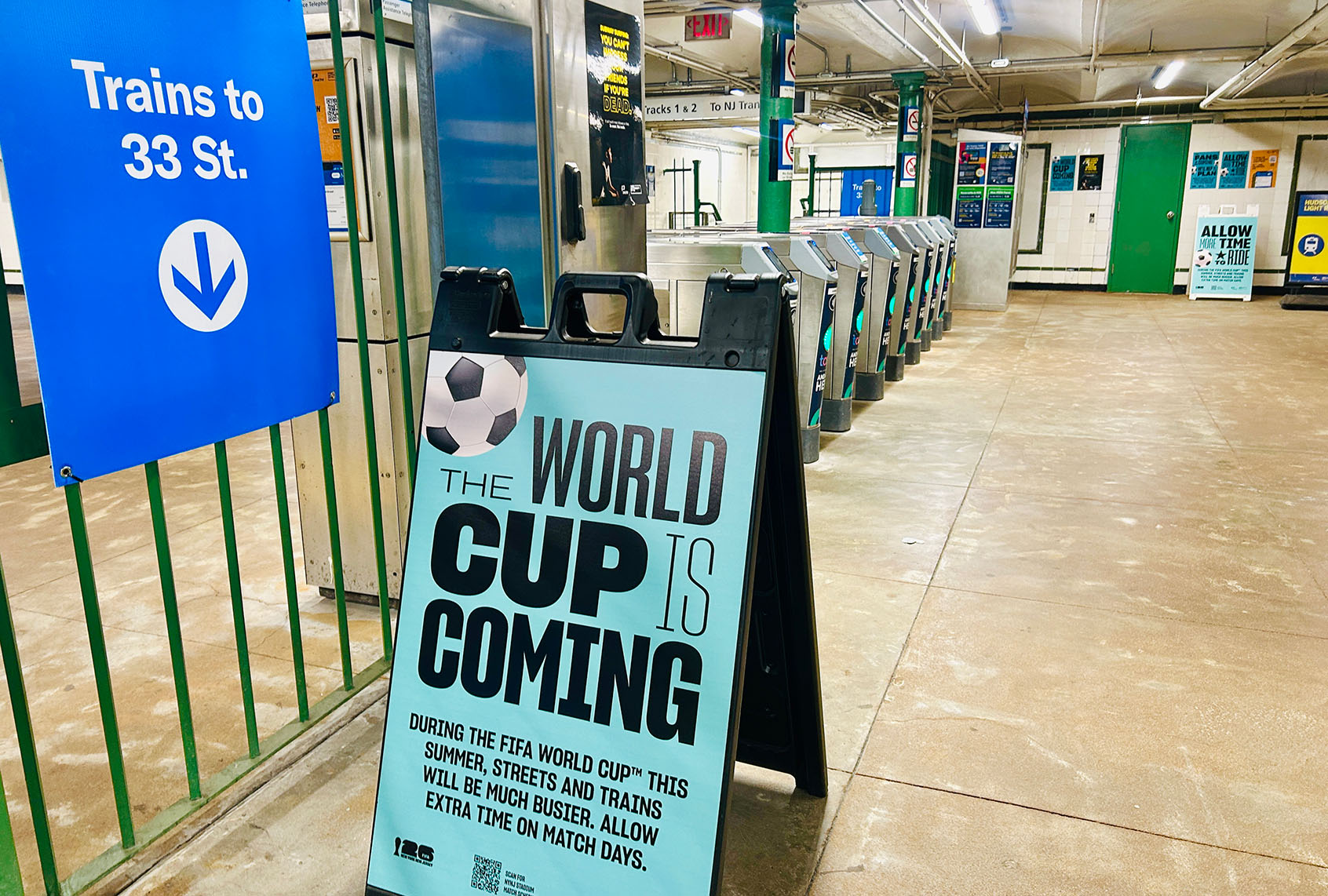

The World Cup is fast approaching, and bigger than ever, with 104 matches spread over 16 North American cities across 39 days — all culminating in New Jersey. For the final match in the world’s largest sporting event, figuring out how to get over 80,000 people in seats has highlighted huge gaps in the public transportation infrastructure connecting New Jersey and New York.
The final match is slated to take place nine miles outside of Midtown Manhattan at MetLife Stadium (or the NYNJ Stadium, as FIFA calls it to avoid giving airtime to stadium sponsors.) The stadium is best known as the home to NFL’s New York Giants and Jets, has a capacity of 82,500 seats for football and soccer matches.
To account for the influx of riders, NJ Transit made some unprecedented, and wildly unpopular, decisions. On April 17, NJ Transit announced round-trip tickets to the stadium from New York Penn Station would be $150. The usual cost of that trip would be $12.90, a price increase over 1,000%.
On top of that, New York Penn Station will shut down all other outbound New Jersey trains beginning four hours before each of the eight matches being hosted at MetLife. NJ Transit has offered commuters a 3% discount for monthly tickets and 5% for weekly tickets and encouraged them to work from home.
While an average concert or football game at MetLife is expected to bring a significant amount of attendees from New York, an added pressure to the World Cup matches is that driving is highly discouraged with no general parking. The only nearby, FIFA-endorsed, parking is at the adjacent property, the American Dream Mall and costs $225 per day. Usual stadium parking costs start at $65. Further, rideshares have been discouraged by officials to avoid road congestion and price surges.
Over the weeks following the ticket price announcement, private sponsors helped subsidize the cost down to $98, which is still nearly a 660% increase from typical prices. A shuttle bus originally cost game attendees $80 but was lowered to $20, making it the most affordable option.
Boston has also increased transit pricing, with a round-trip train costing $80 and a shuttle costing $95. Some fans have resorted to hiring out private busing for their fan groups, but fears about illegal vans and taxis taking advantage of spectators has grown in cities that have increased public transit fares for matches.
“It kind of gums up the wheels of the urban economy just because of the commotion and congestion that’s created.”
FIFA officials were shocked at the fares when they were announced. When New Jersey signed on to host the final in 2018, they agreed to provide free transit accommodations to spectators. However, in 2023 contracts were amended addressing that transit costs would be too high to require free rides, stating “match ticket holders and accredited individuals shall be able to access transport at cost.”
New Jersey Gov. Mikie Sherrill, who inherited the deal from her predecessor Gov. Phil Murphy, both Democrats, said public transportation for the matches would cost the state $48 million and that the state received no subsidization from FIFA. The increased cost placed on the transit system comes from both the need to dispatch more trains and also additional security measures in the form of personnel and surveillance equipment. FIFA argued that no other organizers are expected to subsidize attendee transportation, so an expectation that it would is unrealistic.
In a statement to Salon, a FIFA spokesperson said they “applaud” host city partners that are providing low cost or unchanged rates for mass transit to and from match venues, fan festival locations, airports and other areas. “As one example, the city of Houston has not raised prices for public transit, with light rail tickets costing $1.25 one-way ($2.50 round trip),” the spokesperson said.
“Ever since the host city agreements were signed in 2018, FIFA has worked in collaboration with the host committees and their partners to develop a transportation plan that provides efficient and accessible mass transit options for ticketed fans,” the spokesperson continued. “The goal is to minimize congestion, reduce reliance on private vehicles, and ensure the fan experience is positive and memorable – defined by the action on pitch, not delays on the roads.”
Economist Andrew Zimbalist studies the impact of international sporting events like the World Cup and the Olympics on host cities, and on the whole it’s a bad deal economically, he says.
“Part of the problem here is that FIFA doesn’t allow the host city to keep any of the money,” Zimbalist told Salon. “FIFA keeps all the television money, FIFA keeps all the international sponsorship money, FIFA keeps all the advertising money from signage within the stadium.”
Sherrill noted that FIFA is set to make over $11 billion from the 2026 World Cup. NJ Transit and the governor explained the increased fare for ticket holders was a protective measure so the additional cost isn’t spread across all commuters and New Jersey tax payers. Nevertheless, many believed the situation was an excuse to engage price gouging.
“I’m not going to stick New Jersey commuters with that tab for years to come,” Sherrill said in a statement. “FIFA should pay for the rides. But if they don’t – I’m not going to let New Jersey get taken for one.”
Start your day with essential news from Salon.
Sign up for our free morning newsletter, Crash Course.
Whether or not FIFA should have subsidized transport costs is a point of contention, but host cities also run into more indirect economic costs for hosting these events.
“The problem is that there are also potential tourists or travelers who stay away. They don’t wanna be around when there’s gonna be a lot of congestion,” Zimbalist said. “They don’t wanna be around when there’s a heightened possibility of some kind of security incident, and so the normal tourism tends to dry up.”
This concern extends into New York City, where many attendees are expected to stay and attend fan festivals.
“It kind of gums up the wheels of the urban economy just because of the commotion and congestion that’s created,” Zimablist said. “Then the question is whether the new tourism that’s coming in for the games is greater or less than the tourism that’s not gonna come that otherwise would’ve come.”
Per Zimbalist’s research, that risk of hosting international games doesn’t usually pay off — especially in the long term. While short term injections from increased tourism can be seen in accommodations, dining and commercial sectors, the costs can still often outweigh the gains. This is especially true considering cities make no profit from the games themselves.
One of the biggest potential costs of hosting is needing to build new arenas, which the North American games will avoid with all host cities using existing pitches. Some stadiums will require partial renovation to accommodate the soccer games, but the cost is marginal compared to the 2022 World Cup hosted in Qatar, for example.
The previous World Cup, which occurs every four years, was estimated to be the most expensive in history, at a staggering $220 billion, because everything needed to be newly built for the event. Prior Olympics hosts have also suffered consequences of building huge sports infrastructure that goes unused after the games conclude, creating more of a cost than a benefit to the region.
“It kind of gums up the wheels of the urban economy just because of the commotion and congestion that’s created.”
After the heightened cost of transportation was announced for the NYNJ matches, corners of the internet were ablaze with a unique strategy for getting to MetLife: walking. Many spectators have threatened to walk to the stadium, or at least floated the idea online, despite official warnings against its feasibility and safety. Whether it’s walking all the way from Manhattan or a nearby hotel, getting to the stadium by foot is not advised due to the heavy car traffic from Interstate Highway 95 and marshland surrounding the arena.
Various reporters and curious citizens have already attempted the multi-hour trek from New York Penn Station to MetLife on foot, with most determining that it is technically possible, but filled with roadblocks both literally and figuratively. Sidewalk closures, fence hopping and rerouting were common for these experimental pedestrians who often concluded that this is not a good plan for getting to the World Cup.
Even online users that were hypothetical proponents of taking the long walk admitted they wouldn’t actually do it themselves, or weren’t even attending the matches in the first place. While the back and forth of European soccer fans and New Jersey locals ignited some interesting discourse, it’s unlikely that many will actually try to get there on foot.
Nevertheless, it brings up larger conversations of why the urban design around the stadium is so inaccessible to pedestrians. While European and other international sports fans are acquainted with ease of foot travel, getting around as a pedestrian is practically impossible in the biggest stadium in the United States’ biggest metro area.
“ I’m not advocating for it, but it would, it would be an interesting political statement if a lot of people said, ‘You know what? Let’s walk, and we’ll see what happens,’” Rachel Weinberger, vice president at the Regional Plan Association said. “It’ll basically illustrate, if we don’t already realize it, that walkability has been sort of a very forgotten stepchild of all of our transportation planning and building over the years.”
The Regional Plan Association is a non-profit civic organization focused on urban planning for the New York metropolitan area. One project the RPA advocates for is the Gateway Program, which is a multi-pronged plan to improve transit infrastructure between New York Penn Station and New Jersey. The largest portion of the project to fix and expand the Hudson Tunnel is currently underway, and considered the biggest infrastructure project in the country.
Another proposed element of the Gateway Program is to directly connect Penn Station to more NJ Transit lines instead of a necessary transfer at the first stop in New Jersey, Secaucus Junction. Called the Bergen Loop, the project is nowhere close to fruition, with the Hudson Tunnel project and various other elements of the program taking precedence. While making many more lines one-seat from Penn Station would be helpful for many commuters, it’s unlikely to be created anytime within the next decade, if at all.
Notably, this problem of riders needing to transfer to a new train just one stop out from New York City will affect all World Cup attendees who take the train to the stadium from Penn Station. Transferring the 40,000 passengers per match from Point A to Point B would be hard enough, but the current infrastructure means fans will have to go from Penn Station, transfer at Secaucus Junction, then arrive at the Meadowlands stadium stop. Typical rush hour congestion already creates borderline unsafe conditions for boarding and exiting popular junctions like Penn Station and Secaucus, partially because these rail lines already run over capacity.
We need your help to stay independent.
While a transfer may be a slight inconvenience for usual commuters, it may cause large problems in mass events like the World Cup where risk of overcrowding and crush are at their highest. Yet, in the eight years between signing on to host the World Cup final and now, NJ Transit has not seemed to make any effort to engage in large scale improvement projects to prepare for an influx of ridership.
“Many cities would leverage a world event like this to build permanent infrastructure, and we got a very late start on it,” Weinberger told Salon. “I mean, partly we got later notice than most cities because of all of FIFA’s own shenanigans, but when the region put in the bid to host the games that would’ve been a time for us to have had at least a conceptual plan of how we might leverage.”
She explained there are metro area plans that could have been leveraged into action like the 34th Street Busway in New York City or more express bus lanes on New Jersey highways.
“New Jersey might have asked, ‘Can we do a better connection? Can we really focus on a one-seat ride that makes sense from Penn Station to the Meadowlands?’” Weinberger said. “But we sort of missed that moment, and so now here we are kind of in a scramble for how we’re gonna make all of this work.”
How successful the scramble to safely transport tens of thousands of fans to the World Cup is still in the air with many questions yet to be answered. Will the area look back on the games as a missed opportunity to improve public transit for the long term? Will the region’s risk of hosting pay off or will it be looked back on as a poor economic choice?
Whether or not hordes of international fans will take over I-95 on foot to get to the stadium is another question entirely.
Read more
about this topic
