
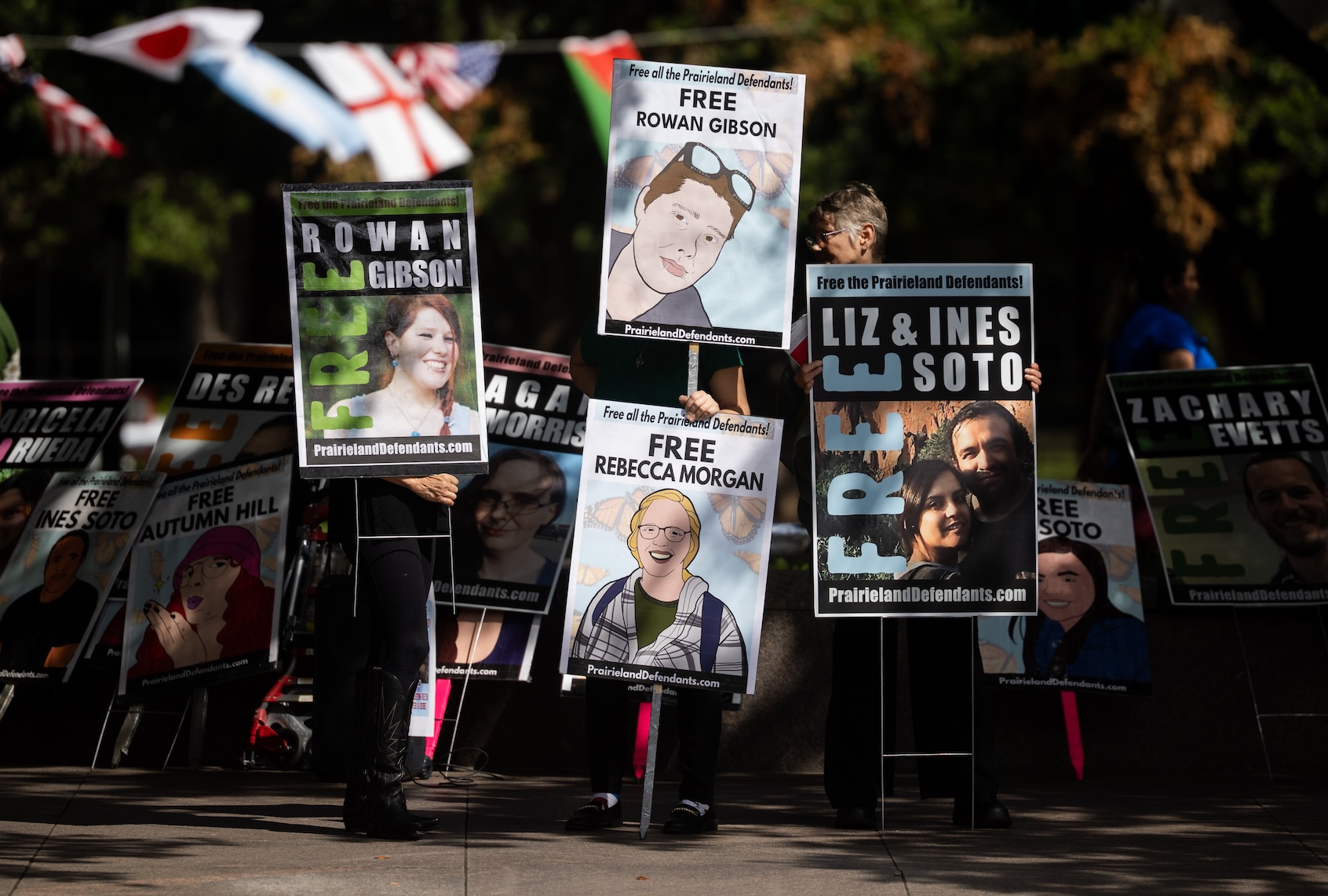

In late June in Texas, nine activists were found guilty of a myriad of criminal charges brought against them after an immigration protest grew chaotic — but critics say the charges and sentencing were unusually excessive and represent overreach from the Trump administration. A 2025 Fourth of July noise protest outside an immigration detention center involved activists setting off fireworks near the Prairieland Detention Center in a show of solidarity with those imprisoned under President Donald Trump’s mass deportation agenda.
However, the protest went awry when a group of protesters broke off and vandalized parts of the facility. When a law enforcement officer responded to the scene and aimed his gun at the protesters, one protester, Benjamin Song, shot his own gun at the officer, striking his shoulder. The officer survived.
Song was ultimately convicted of rioting, explosives charges, and providing material support for terrorism, and received a 100-year sentence for his actions. However, six other protesters — Zachary Evetts, Autumn Hill, Savanna Batten, Elizabeth Soto, Meagan Morris, and Maricela Rueda — were also convicted of rioting, explosives charges and material support for terrorism. All received 50-year sentences but Rueda, who instead received 70 years, as she was also convicted of corruptly concealing a document. Another defendant, Daniel Sanchez-Estrada, did not attend the protest but was still convicted of corruptly concealing a document after prosecutors claimed that he had moved some zines at the request of his wife, Rueda, following her arrest. The ninth defendant, Ines Soto, was sentenced to 50 years on July 1, on charges of rioting, material support for terrorism and conspiracy to carry and use of an explosive.
In the Prairieland case, the terrorism convictions and the draconian sentencing of the protesters at the Prairieland Detention Center represent the culmination of decades of national security law turning inward to criminalize political dissent. However, as in previous eras of American history, the government has wielded this power to attack and criminalize dissent on the left, even as violent supporters of the president, like those who stormed the Capitol on Jan. 6, get off with comparatively light sentences, and may even be rewarded for their attack against the country.
The sentences handed down in the case were widely panned as extreme, considering the actual actions of the defendants and their lack of the sort of criminal records that would typically result in harsher sentencing. The extreme sentences, however, stemmed from the application of the so-called “terrorism enhancement” which pushes judges to hand down maximal sentences.
Sufia Khalid, the deputy director of the National Security Criminal Defense Center at the Muslim Legal Fund of America, compared the sentences of the Prairieland defendants to the sentences of those in the sweeping prosecution of the Jan. 6 rioters, who stormed the Capitol in support of Trump while chanting slogans in support of killing elected officials, like former Vice President Mike Pence.
“There were people who were up in arms about the Jan. 6 prosecutions because they didn’t feel like those 1,500 prosecutions that came out of that case should have been charged at all. Or they thought that they were overcharged, but we had far more serious, egregious conduct in those cases, and in the vast majority of those 1,500 cases, they didn’t seek the terrorism enhancement,” Khalid said. “They could have charged all of them with [material support for terrorism] and all of them, regardless of whether they were charged with it or not, would have qualified for the terrorism enhancement under the theory the government used here and the court applied here.”
The thinking went that because the conduct of the Jan. 6 rioters was far more extreme, and because the defendants in the Prairieland case were largely first-time nonviolent offenders, they might receive comparable sentences.
Khalid said that she believed that the Jan. 6 prosecutors made the right decision in not pursuing terror charges in the vast majority of cases, because the government was able to seek accountability without ruining people’s lives for what many perceived as a First Amendment-protected protest.
Khalid even made the Jan. 6 prosecutions the cornerstone of the sentencing memorandum her organization submitted to the court, because typically judges are expected to sentence people in accordance with cases where defendants exhibited similar behavior, as well as the criminal histories of the defendants.
The thinking went that because the conduct of the Jan. 6 rioters was far more extreme, and because the defendants in the Prairieland case were largely first-time nonviolent offenders, they might receive comparable sentences. For reference, the average sentence was just shy of two years for Jan. 6 rioters who received prison sentences. However, that figure is inflated by just 14 sentences given out to the ring leaders who helped organize the attack, such as the leaders of the Proud Boys and the Oath Keepers, who received between 10 and 20 years. Many of those who stormed the Capitol also got off without a prison sentence, and only received probation, community service or home detention. Trump, after assuming office in 2025, mass pardoned all of the Jan. 6 attackers.
While the Jan. 6 cases were the most direct comparison, Khalid also compared the Prairieland case to the notorious 2001 Holy Land Foundation case in which the government convicted five defendants, also Texans, of providing material support to Hamas, which is a designated foreign terrorist organization, without even proving, or even alleging, that the defendants provided funding to Hamas. Instead, the government successfully convicted them on material support for terrorism, among other charges, by alleging that the humanitarian aid they provided to Palestinians was funneled through charitable organizations, which were associated with Hamas, which is the governing body of Gaza.
“Everyone agreed, the government agreed, that the material support in that case was that the Holy Land Foundation, which was the largest Muslim charity at the time, was using its charitable funds to fund a zakat committee in Gaza, which was used to feed orphans and support widows, and that the funding of that committee freed up Hamas’ resources to use for other activities,” Khalid said.
These convictions came despite the fact that U.S. government programs like USAID funded the same committee, though the government alleged that the Palestinian Americans in charge of the foundation had personal ties to the region and special knowledge of the alleged Hamas connection.
In Khalid’s opinion, the Prairieland case represents a progression of the legal precedent set in the Prairieland case, as in both cases the government pursued maximal sentences against Americans alleging some sort of terror connection. However, in the Prairieland case, the government has moved from doing this in the context of alleged foreign terror connections towards alleging terror because of an individual’s domestic political positions.
We need your help to stay independent.
Xavier de Janon, the National Lawyers Guild director of mass defense, also tied the prosecutions to Trump’s seventh National Security Priorities Memorandum, which directed the government to use the power of the state to crack down on movements they consider anti-fascist, anti-capitalist, anti-Christian or anti-American. De Janon explained that NSPM-7 was connected to the government’s decision to allege that the defendants were part of the so-called “North Texas Antifa Cell,” which amounted to little more than a couple of Signal group chats that not even all of the defendants were part of. Prosecutors even pointed at the decision to bring firearms to the protest as a mark against the defendants, despite the fact that bringing a gun to a protest is a protected right in Texas.
“NSPM-7 is the source. The indictment, the antifa indictment of Prairieland, happened after NSPM-7. Before that, it was a state indictment in Johnson County, with federal charges in a criminal complaint, but antifa wasn’t mentioned in the original criminal complaint,” de Janon said.
De Janon did, however, hold out hope that the defendants might successfully appeal the decision, with most of his optimism stemming from some irregular proceedings in the case, as a result of decisions made by Judges Mark Pittman and Judge Reed O’Connor, who oversaw the cases, Pittman being a Trump nominee and O’Connor being a nominee of former President George W. Bush.
De Janon pointed to examples, like Pittman leveling unusual fines against defense attorneys in the cases, or the fact that he refused to allow local counsel in the case by threatening to hold attorney George Lobb in contempt if he did not withdraw from his role representing Rueda. Similarly, Pittman attempted to place limits on the number of defense objections attorneys could make.
In one instance, Pittman moved the case to a smaller courtroom, which limited observers’ access to the case, and assigned the overflow room to a facility in Dallas, despite the fact the trial was taking place in Fort Worth. In another, Pittman declared a mistrial because one attorney in the case wore a civil rights-themed t-shirt, honoring the death of civil rights leader Jesse Jackson, claiming that the t-shirt contaminated the entire jury pool.
“Judge Pittman, for many months, did a lot of things in the case that will be reviewed on appeal. Everything is reviewable,” de Janon said.
In de Janon’s opinion, one of the most egregious developments came in the testimony of Kyle Shideler, a researcher at the Center for Security Policy, a far-right think tank, which the Southern Policy Law Center describes as a hate group. Shideler admitted at trial that he had helped craft the indictment before eventually also appearing as an expert witness.
O’Connor, a frequent speaker at Federalist Society events, also has a long history of rulings that are later overturned, even by the right-wing Fifth Circuit.
For example, in 2021, O’Connor ruled that the Religious Freedom Restoration Act exempted employers from the Civil Rights Act’s ban on discrimination on the basis of sex, a ruling that was later overturned. In 2015, O’Connor also attempted to strike down a portion of the 1968 Gun Control Act as unconstitutional, though his ruling was overturned. O’Connor’s most infamous overturned decision, however, was his 2018 decision that ruled a portion of the Affordable Care Act unconstitutional. This ruling was overturned by the Supreme Court in a seven-to-two ruling.
Robert Saleem Holbrook, the executive director of the Abolitionist Law Center, said that he was not optimistic about the chances of the defendants winning on appeal at the Fifth Circuit.
“It’s one of the worst circuits in the country, so I don’t have high hopes that this would be overturned, although I hope that there is a judge on that circuit who will look at it in real life and say that this is an injustice,” Holbrook said.
Holbrook did say, however, that this case, and cases like it, are coming out of Minneapolis, where 15 anti-ICE protesters were recently indicted, demonstrating that the next president needed to consider mass pardons for those prosecuted under the Trump administration, especially in cases like this.
He compared the administration’s current attempt to crack down on dissent to the infamous COINTELPRO, a notorious counterintelligence program that focused on the U.S. Communist Party and other leftist organizations between 1956 and 1971. The effort also targeted civil rights activists, anti-war protesters and even some conservative groups like the Ku Klux Klan.
Some elected Republicans are even openly yearning for the days when the government would take any action necessary to strangle progressive political movements in the crib. In reaction to the recent wave of electoral victories for democratic socialists, for example, New York City councilwoman Vickie Paladino reminisced about when law enforcement would crush leftist groups.
Start your day with essential news from Salon.
Sign up for our free morning newsletter, Crash Course.
“There was a time in our history, not too long ago, when the CIA/FBI would’ve made sure unabashed revolutionaries like this were neutralized one way or another,” Paladino posted on X. “In fact, that was basically the entire point of having them.”
In Holbrook’s view, the next administration will need to take a critical look at the role the FBI and the Department of Justice have come to fill in American society, alongside other more widely questioned organizations like ICE. The next administration will even need to critically consider how Trump has shaped the American judiciary. For many government agencies, Holbrook said, there will need to be mass firings of Trump loyalists, with the prosecutors who pursued the Prairieland cases being on the list.
“Trump has stacked the bench with judges who are aligned with him,” Holbrook said. “He stacked the federal bench particularly with judges who seem to be embracing this creeping trend towards authoritarianism.”
Holbrook said, however, that the next administration will need to go beyond just firings if they don’t want to simply tee up the rise of another Trumpian figure. Instead, they will need to pursue something that’s been largely anathema to the American system of government: accountability.
“How do we go back, right? This is the question that I think that we’re all facing: is Trump just a trend that’s when he’s done, when he’s gone, that things are going to go back to pre-2016? I don’t believe that,” Holbrook said. “This mess that we’re dealing with now is going to have to be cleaned up, and more importantly, there’s going to have to be consequences. Because if we just try and act like this was just a temporary period of insanity, we’re going to be lining ourselves up to repeat it again.”
Read more
about immigration
