
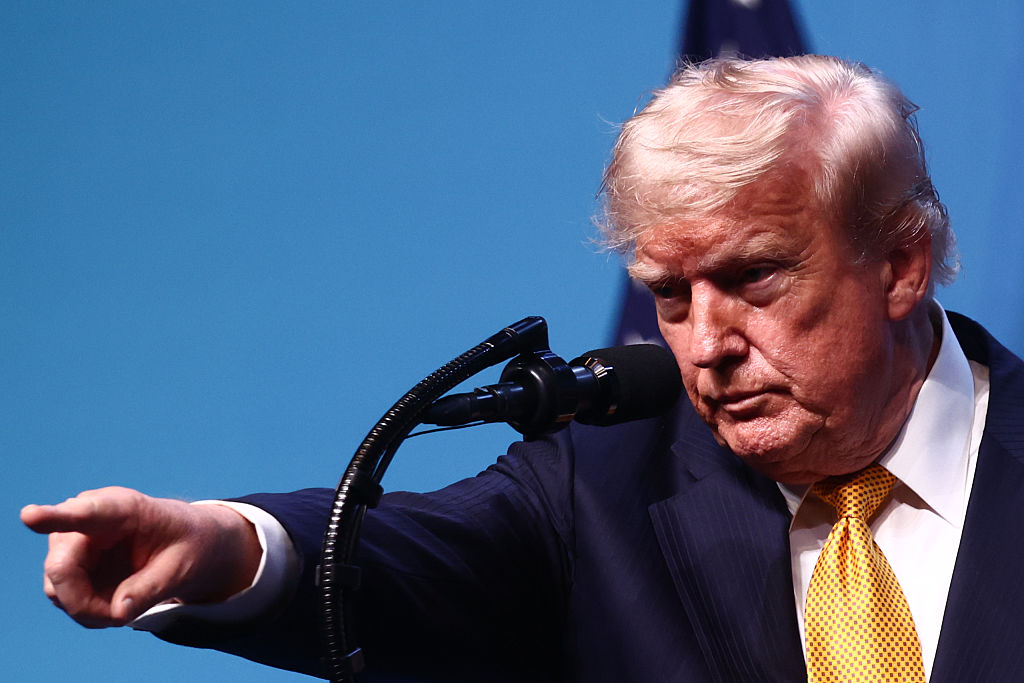

President Donald Trump escalated tensions with Iran on Saturday, claiming he has already given the U.S. military standing orders to unleash a massive retaliatory strike if Tehran carries out or attempts to carry out an assassination against him.
“1,000 Missiles are Locked and Loaded,” Trump wrote on Truth Social, adding that the military had already received orders to “completely decimate and destroy all areas of Iran” for a one-year period if such an attack were to occur. The president’s comments came amid renewed threats from Iran following the recent U.S.-Iran conflict and reports that Tehran continues to view Trump as a target for retaliation over the 2020 U.S. killing of Iranian commander Qasem Soleimani in addition to the assassination of its most recent leader Ayatollah Ali Khamenei.
But while Trump’s language suggested a preauthorized military response, constitutional experts say no president can predetermine how a successor would respond to such an attack.
Under the Constitution and the Presidential Succession Act, if a president dies in office, the vice president immediately becomes president and commander in chief. In this scenario, Vice President JD Vance—not Trump—would determine whether and how the United States responds militarily. Any existing contingency plans or standing directives would be subject to the new president’s authority, who is known not to have been a fan of the conflict from the beginning.
“The U.S. has, for a whole variety of reasons, never utilized a technical ‘dead man’s switch,'” historian Garrett Graff, an expert on continuity of government, told the Associated Press. While the U.S. military maintains extensive contingency plans for crises ranging from nuclear attacks to the death of senior leaders, those plans do not automatically trigger military action upon a president’s death.
The distinction matters because Trump’s post blurs the line between military planning and presidential authority.
The United States routinely prepares response options for a wide range of national security scenarios, including attacks against American leaders. The existence of contingency plans is not unusual. What is unusual is a sitting president publicly describing what he characterized as “standing military orders” on social media and suggesting it would remain in force after he is no longer commander in chief.
Trump’s post also arrives against a complicated diplomatic backdrop. Earlier, he said the United States had agreed to continue talks with Iran even as he declared a previous ceasefire effectively over, underscoring the volatile state of relations between Washington and Tehran.
Start your day with essential news from Salon.
Sign up for our free morning newsletter, Crash Course.
The larger question raised by Trump’s remarks is not whether the United States would respond to an attack on a sitting president. Few national security experts doubt that it would. The constitutional question is who would make that decision.
The answer, experts say, is not the president who issued the order, but the one who succeeds him.
