

“I want to be doing everything I can to change the world and it’s hard to know where to start, but I guess this song is as good a place as any,” Margo Price told Salon, speaking about her performance of Blaze Foley’s scathing “Oval Room,” one of five performances of protest songs now available on “Days of Unrest,” a nine-track EP available on streaming services as well as on vinyl, with proceeds from the physical release going to The Florence Project, an organization that assists immigrants facing detention and potential deportation.
“Days of Unrest” is intended as Price’s response to current events, from an artist who has always spoken her mind and who has been political from the start.
This is a carefully curated offering: five unequivocally intense cover songs, beginning with the traditional Mexican folk song “De Colores,” Woody Guthrie’s “Deportee (Plane Wreck At Los Gatos),” Blaze Foley’s “Oval Room,” a gender-swapped romp through Charlie Daniels’ “Long Haired Country Girl,” and Bob Dylan’s “Maggie’s Farm.” There’s also three original instrumentals and a song out of Price’s early archives, “Can’t Stand Still.” The collection is both furious and joyful, beautifully and carefully cohesive. It’s a significant assemblage of material worth your attention. The band is firing on all cylinders, the production is lively and open, and Price’s voice sounds fantastic. The emotional tone of each vocal performance is beautifully keyed to each song’s context. When you’re trying to make a point, that matters a great deal.
“Days of Unrest” is intended as Price’s response to current events, from an artist who has always spoken her mind and who has been political from the start; titling your first album “Midwest Farmer’s Daughter” and invoking both The Beach Boys and the loss of your own family’s farm is about as political — and American — as it gets.
The protest numbers are all songs that have been part of Price’s repertoire across the years. “De Colores” is a traditional Mexican folk song that made its way to the Americas from Spain during the 16th century, and here Price is accompanied by the Memphis Mariachi. The title of the song literally means “Of Colors” and may remind you of the news story of the schoolteacher in Idaho who was told by the school district that she had to remove a poster she made that read “Everyone is welcome here,” because it featured multi-colored hands held aloft. Price’s rendition of “De Colores” sounds and feels like you’re standing in a sun-drenched plaza. It will transport you.

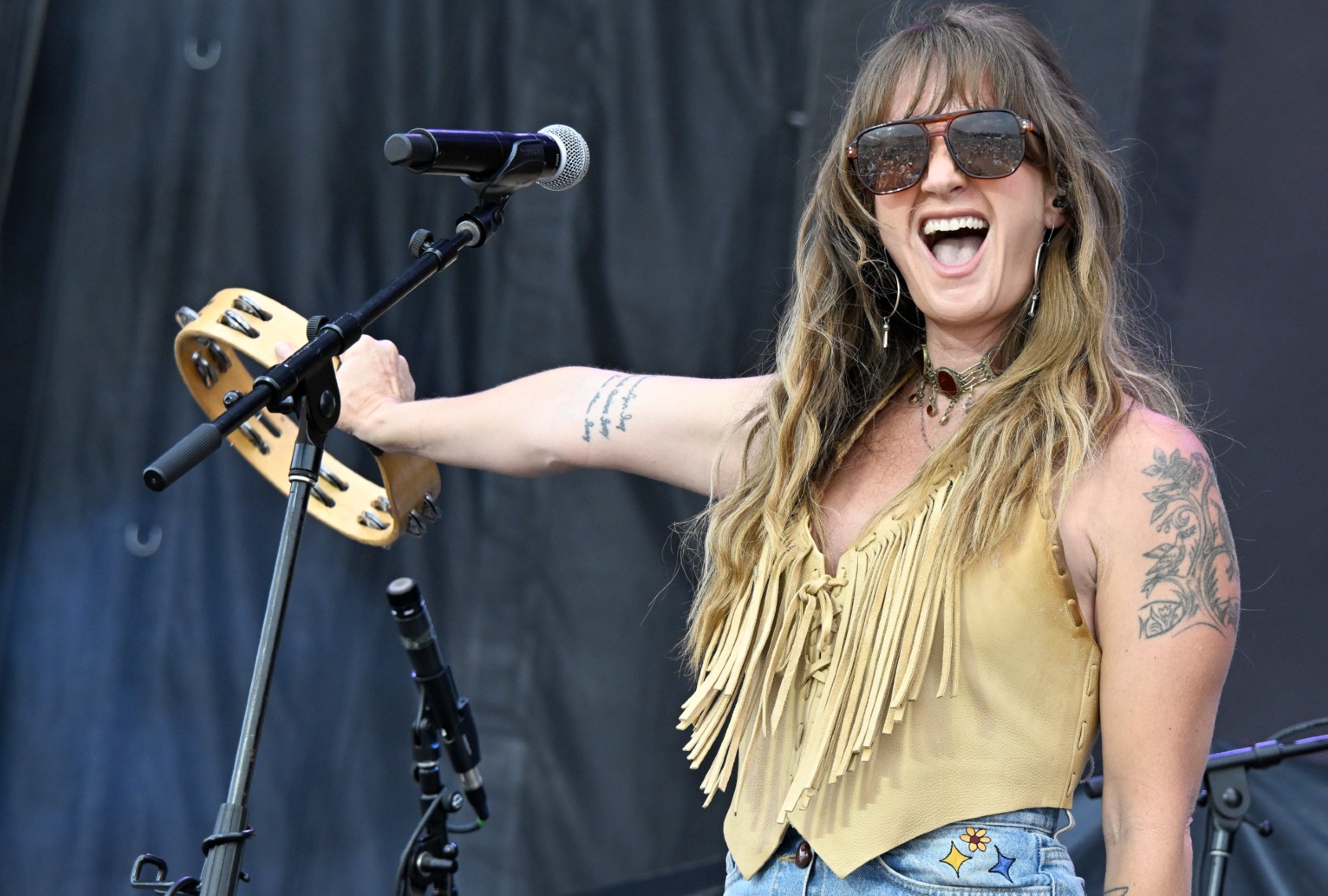
(Douglas Mason/WireImage/Getty Images) Margo Price performs with Kesha at the Bonnaroo Music and Arts Festival
Which is necessary, because the next track is Woody Guthrie’s “Deportee (Plane Wreck at Los Gatos),” which features a verse sung by Joan Baez, who sang the song when she was inducted into the Rock and Roll Hall of Fame. This is probably the most devastating of all of the tracks on “Days of Unrest” because a song Woody wrote about a plane crash in 1948 that killed 28 undocumented immigrants who were being returned to Mexico from California could have been inspired by events happening right now. “You won’t have a name when you ride the big airplane/all they will call you will be ‘deportees,’” Guthrie wrote, because the news reports about the crash only listed the names of the crew members.
“Joan (Baez) texted me this morning; she said, ‘We may not be able to turn the tide, but we can save a few fishes,’ and that’s what we’re doing.”
Pete Seeger was responsible for popularizing it later, and across the decades, “Deportee” has been covered by artists like Billy Bragg, Dolly Parton (on the “9 to 5” soundtrack, as Price points out), Johnny Cash (in the Highwaymen) and, of course, Joan Baez herself, who played it at her induction into the Rock and Roll Hall of Fame. Bruce Springsteen played it recently with Rosanne Cash at the recent “Music America: The Songs that Shaped Us” concerts held at the Bruce Springsteen Center for American Music.
Want more from culture than just the latest trend? The Swell highlights art made to last.
Sign up here
Price’s own gateway into the song was watching Baez and a guy named Bob Dylan perform it in the infamous 1976 concert movie “Hard Rain,” filmed during the second leg of the “Rolling Thunder Revue” tour. “I’ve been playing that since my early 20s because I was obsessed with Bob Dylan and Joan Baez,” Price says, “and we got our hands on a copy of the ‘Rolling Thunder Revue.’ That was when we were on our Winnebago tour, and we were trying to be like them, but we were at the level of, like, burning our own CDs and making our own merch and living in an RV.”
As performed by Price, Baez and Memphis Mariachi, their version of “Deportee” manages to be everything: a lament, a celebration of the lives lost, a tribute, a reminder. “Deportee” as performed by anybody is always heartbreaking, because there is no alternate interpretation. The fact that this story from 1948 is 100% relevant in 2026 is devastating. Baez was seven when the plane crash happened. This is still recent history, and Price is aware of that, noting in the press announcement that “Protest music is not history.”
“I wish everybody would cover it,” Price told Salon about “Deportee,” “Because it needs to be sung and we cannot look away from what is happening right now. We cannot act like this is normal. I mean, I think a lot of people think that I’m radical because I’m talking about this stuff. But I think 20-30 years from now, we’re going to say, ‘Why are more people not concerned about the way that folks are being treated right now. It’s inhumane.” The video released to accompany the song underscores all of this, as did Price’s introduction of “Fu*k ICE” that she offered when she performed it at the Newport Folk Festival last year.
“That’s why I’m really proud to be with The Florence Project; they help people kind of one at a time,” Price continued. “Joan (Baez) texted me this morning; she said, ‘We may not be able to turn the tide, but we can save a few fishes,’ and that’s what we’re doing. That came from the Florence Project folks, and it’s just the least that we can do in this moment.”

(Stephen J. Cohen/Getty Images) Margo Price performing at Railbird Music Festival
If you’re not familiar with legendary Austin singer-songwriter Blaze Foley, Price’s cover of his song “Oval Room” will make you want to go and listen to the rest of his work. The song was originally written in 1984 about Ronald Reagan and yet it remains absolutely relevant: “In his oval room, in his rockin’ chair/he’s the president, but I don’t care/He’s a businessman, he got business ties/He got dollar signs in both his eyes,” it begins, and moves on from there.
Price delivers “Oval Room” with the same steely, straight-ahead tone that Foley had, offering a very faithful reading of the original — but that’s not meant as an insult or a diminishment of Price’s approach. Sometimes a great song shows you how it wants to be performed. It’s a great song with clear, unambiguous lyrics, and to do anything else to it would have been unnecessary. Her read on how to present all of the material on this record is absolutely correct.
Price told Salon, “We were all over the south, and we were playing that song, and people were just so fired up. I mean, I just played it in Dallas, in Austin, and Houston, and in Dallas, I got a standing ovation, like with Willie’s crowd, and it just feels good to sing. I want to be doing everything I can to change the world, and it’s hard to know where to start, but I guess this song is as good a place as any.” It was also a popular request at the merchandise table. “Everybody wants ‘Maggie’s Farm.’ Everybody wants ‘Oval Room.’ They want to buy the record. Okay, when we get home and get a break from touring, I’m going to go back in.”
Threading through the record are three Spanish-influenced instrumentals with “San Marcos” in the title; one opens and closes the record, and there’s one in the middle as an aural palate cleanser before the high-energy romp of the end of the “mixtape” that begins with the Charlie Daniels cover and ends with “Maggie’s Farm.”
When Salon suggested that they felt like a movie soundtrack, Price confirmed that they were written for a movie that never got made. “We had this phase where we were playing these gut strings [guitars] all the time, and there was a movie soundtrack that was supposed to be happening . . . I was always so sad that that instrumental piece fell by the wayside, and then as the shape of the album kind of started to reveal itself, I thought, ‘I’m going to pull that back up.’ Price also confessed, “We’re pulling from Bob Dylan, ‘Pat Garrett and Billy The Kid.’ We have the Bob Dylan songbook and what me and my husband do for fun is just open a page and play whatever song is on that page.”
“I want people to feel, I want people to think, think with their heart, and I want them to maybe bend their mind a little bit. Everybody needs to keep an open mind these days.”
The instrumentals definitely serve as a unifying element. “San Marcos” sets the scene as the first track, before handing the listener off to “De Colores.” “San Marcos Theme” arrives midway as an aural palate cleanser before Price raises the energy another notch in the back half, the sequence that begins with the Charlie Daniels cover and ends with “Maggie’s Farm.” And then “San Marcos el Fin” gently escorts the listener out of this particular room. The instrumentals uplift the presentation of the other tracks.
“Long Haired Country Girl” is a delightful, gender-swapped version of none other than Charlie Daniels’ “Long Haired Country Boy,” and given Daniels’ conservative politics, Salon asked Price what it felt like singing a song by someone who might not be happy about it?
“Maybe he wouldn’t be. Maybe he’d like it. I think I’m a great performer and I don’t think anybody could watch me and say that I don’t do a good job of it and that I don’t embody those lyrics. I think that songs can surpass the cultural norms that somebody thinks . . . But I like that song, I grew up on that song, and I feel the lyrics when I sing it, and it was kind of a way of showing that people have more than just this one side that they think I am.”
Price laughed when it was suggested that the early track “Can’t Stand Still” reads like an anti-trad wife anthem. “I wrote that song before I had kids, wrote that song a long time ago, and I remember showing it to my husband, and I was like, this is what I feel. I’ve kind of never been a homemaker . . . he does most of the cooking and grocery shopping, and it works out. We got a good thing going because you know that I don’t really like to do dishes either. It’s not good for my guitar playing fingernails.”
Bob Dylan’s “Maggie’s Farm” (from 1965’s “Bringing It All Back Home”) has, across the years, been co-opted as political protest by artists from The Specials (when Margaret Thatcher was prime minister) to Rage Against The Machine. It’s also been covered by the Grateful Dead and Solomon Burke (who actually released it before Bob’s version came out). On “Days of Unrest,” Price borrows a heaping serving of Newport ‘65 (yes, that Newport), but Price told Salon that most of the inspiration for her high-octane cover came from Linda Gayle’s incredible country-garage version from 1965. It’s absolutely fantastic.
“When I first moved to Nashville I had this boyfriend,” Price said, “And we didn’t make it, but he’d given me ‘The Essential Bob Dylan,’ and I sat around in my apartment smoking the little crumbs of weed that I had left, and listening to ‘Maggie’s Farm’ on repeat. I love that song, but I never thought about covering it until I heard Linda Gayle’s version, and I almost don’t even want to tell anybody about it because it’s like my little secret weapon.”
She continued, “We added in a couple more stops and split it up even a little bit more, tried to make it our own, but we just had so much fun. And then I had a dream that I was singing it at Newport, and that we were doing this a cappella-like starter that we do, this like slowed down, three-part harmony, and that was my mushroom dream that I had, and that’s worked out quite well. That song’s been really good to us. It’s just contagious. It’s like a magic trick.”
We need your help to stay independent.
None of this is new territory for Margo Price, who has been speaking up and speaking out for some time, which shouldn’t be a surprise to anyone coming to her shows, but there are an equal number of artists who aren’t offering any opinion, or offer the excuse that they want everyone to feel welcome at their shows. Price told Salon, “You know what? More than everyone feeling welcome at my shows — which obviously I do want people to feel safe and welcome and loved. But I want people to feel, I want people to think, think with their heart, and I want them to maybe bend their mind a little bit. Everybody needs to keep an open mind these days.”
She continued, “. . . It’s hard to speak out. It’s scary, and I don’t want to divide people. I mean, the thing that I tried to do subversively with this album is on the cover. I’m holding a gun. I mean, there’s bear wallpaper behind me. I come from a rural, a very rural area — and Jason Aldean can kiss my ass because my town has 3,000 people in it; try that in a small town. And I cover a Charlie Daniels song, and we all know Charlie Daniels’ politics. I think people are more complex than we think; people are more down the center than we think. I wish that we could all see that we all do want the same thing; we all want our children to be safe. Everybody just thinks they have a better way of getting there.”
“Days of Unrest” is available now on streaming platforms and on vinyl, with a portion of proceeds going to the Florence Project, an organization that provides free legal services, social services, and advocacy to immigrants facing detention and potential deportation. Price is on tour this summer, playing on the West Coast in July, headlining the Minnesota State Fair in August, and performing at Farm Aid (where Price serves on the Board of Directors) in September, along with other solo and festival dates.
Read more
from music columnist Caryn Rose
