
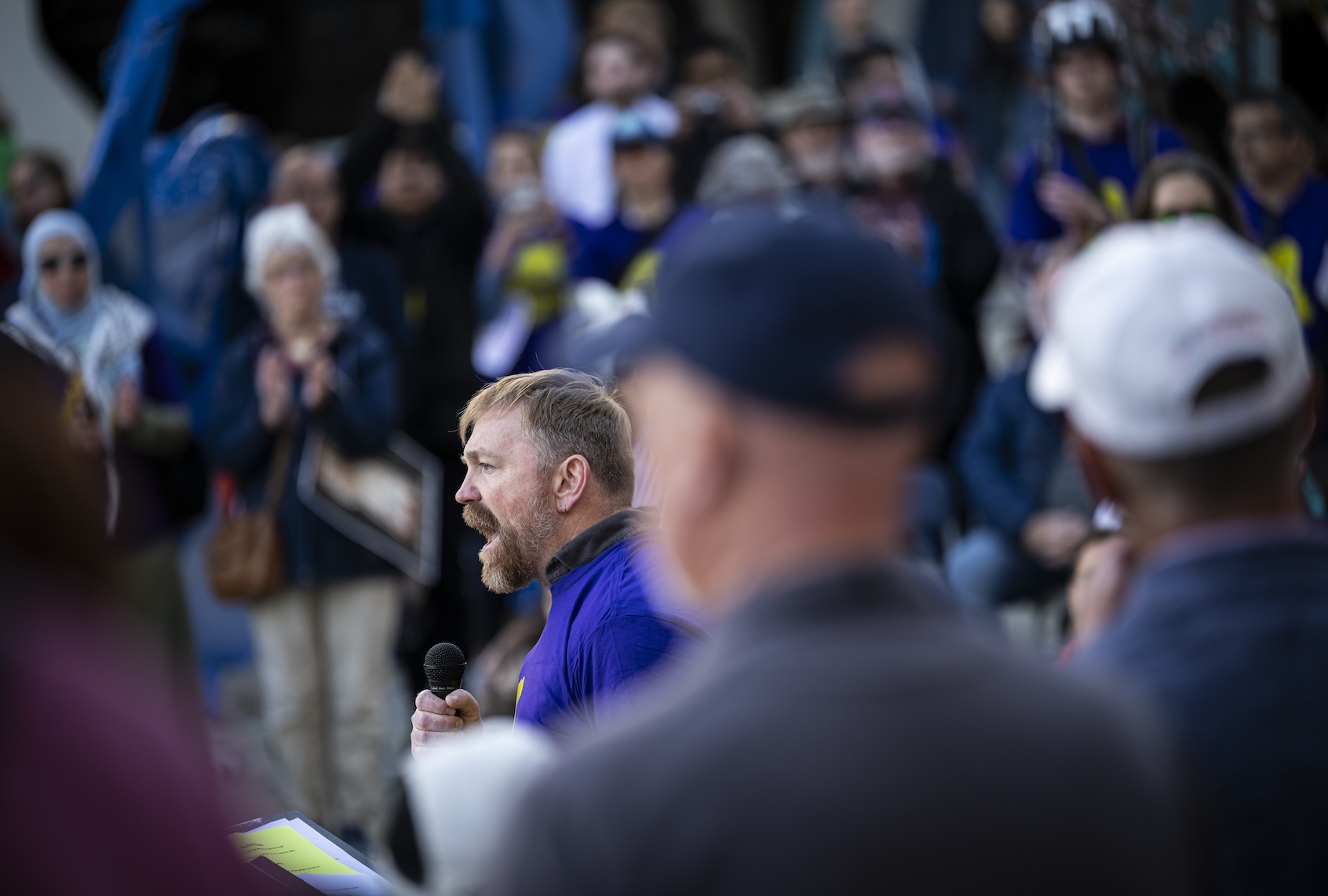

In Maine, sexual assault allegations against former Senate nominee Graham Platner prompted his abrupt exit from the race against Sen. Susan Collins. His departure has kicked off an impromptu race for the Democratic Senate nomination that could well be resolved before the convention even takes place, as campaigns make last-minute pushes to elect their preferred slate of delegates at the county level — and progressives believe they have the advantage.
In the primary election, Platner won 71% of the vote running on a progressive platform, including campaign finance reform, universal healthcare, ending mass deportations and ending billionaire welfare, among a broad slate of other policies. He also enjoyed the endorsement of prominent party leaders like Sen. Bernie Sanders, I-Vt., and Sen. Elizabeth Warren, D-Mass. However, his campaign was dogged by scandal, most notably including the revelation that he had a Totenkopf tattoo and allegations of “unsettling” behavior from past girlfriends. Platner also faced questions from fellow progressives regarding the time he spent employed as a security contractor associated with the mercenary force Blackwater.
Last week, Platner announced his withdrawal from the race, following an allegation of rape from a former girlfriend, Jenny Racicot. His exit from the race has, in turn, set off a flurry of political organizing from Democrats. The new nominating process will see the 16 county parties elect slates of delegates, 601 in total, who will in turn vote to select the new nominee at a July 25 convention in Bangor.
Ahead of this new process, a handful of candidates have gained the most traction, including Troy Jackson, the former president of the Maine Senate; Nirav Shah, the former principal director of the Centers for Disease Control and Prevention; and Shenna Bellows, Maine’s Secretary of State. Significant attention has been paid to Jordan Wood, former chief of staff to former Rep. Katie Porter, D-Ca., brewery owner Dan Kleban and environmental policy consultant David Costello.
However, the upcoming convention will look more like the sort of nominating conventions that dominated party politics prior to the widespread adoption of the primary election nominating process. The organizing around the convention process looks different, too.
The name of the game for the moment is for a candidate to get as many of their supporters at their respective county delegate elections as possible.
Whereas canvassing, mailers, rallies and TV advertising might rule in typical primaries, the short race ahead of the convention is currently focused on getting supporters to show up at the county-level delegate elections slated for July 18 and 19. To do this, campaigns have leaned on both digital ads and phonebanking, as well as pre-existing political relationships.
For example, the Shah campaign has been attempting to recruit former Platner supporters behind the scenes, while making clear publicly that they have a place in this campaign, according to Politico. Similarly, the group Our Revolution, which was founded as a way to carry forward the grassroots organizing behind Sanders’ 2016 presidential campaign, has thrown its organizing capacity behind Jackson’s candidacy.
The name of the game for the moment is for a candidate to get as many of their supporters at their respective county delegate elections as possible in order to elect the friendliest slate of delegates for their candidacy. The Jackson campaign, for example, has rolled out slates of delegates who promise to vote for Jackson at the convention in all of Maine’s counties.
One of the delegate candidates in Androscoggin County, Kiernan Majerus-Collins, who is also running for a state house seat, told Salon that he believes the current process benefits the four candidates — Jackson, Shah, Bellows and Wood — who already had campaigns in 2026, as well as those who already have connections in Maine politics. Considering Jackson and Bellows have the most experience in Maine politics, it likely means they’ll have a leg up, according to Majerus-Collins.
“Troy and Jenna have decades of relationships with those people that Dr. Shah, Wood and Kleban just don’t have,” Majerus-Collins said. “And it’s not to say that the political newcomers can’t make their case and don’t have a chance to win. They absolutely do, but it absolutely is going to be helpful to the candidates who are more familiar to the 600 most politically connected Democrats in the state.”
We need your help to stay independent.
Majerus-Collins added, however, that there are some complicating factors in the race as well. For example, while Jackson’s campaign is rolling out slates of delegate candidates, not every campaign is. And, though many delegate candidates are explicitly running on the basis of supporting a specific Senate candidate, others are running on a promise to use their best judgment at the convention, or on pre-existing political relationships with their communities. The races are also crowded. In Androscoggin County, 188 candidates put their names forward for just 31 county delegate roles.
“A lot of the delegate candidate statements are something like, ‘Susan Collins is terrible, and it’s very important to defeat Susan Collins,’ which, from just a perspective of someone voting, is not that useful,” Majerus-Collins said.
Start your day with essential news from Salon.
Sign up for our free morning newsletter, Crash Course.
John “Jak” Raymond, a delegate candidate in Hancock County, also underlined how the county delegate electorate differs from the primary electorate. Maine runs what are called semi-open primaries, in which unaffiliated voters can choose to vote in either major party’s primary. This nominating process, however, will include only Democrats who were registered with the party as of June 9.
“He found a way to pull those woods hippies out of the woods, and if we can keep them moving out of the woods, then that’s what’s needed, because we’re a purple state and it’s only becoming more purple every year,” Raymond said in an interview with Salon.
Jackson, in Raymond’s view, stands the best chance of keeping the coalition that supported Platner in the primary together, mostly because his platform has the most in common with what Platner ran on.
“Troy, I think, is the strongest. He’s got six years as president of the Maine Senate and another four years serving before that, so he has the tools and he knows the system,” Raymond said. “But he’s also a progressive with a platform that pretty much mirrors Platner’s, and Platner grew the grassroots.”
Read more
about politics
