
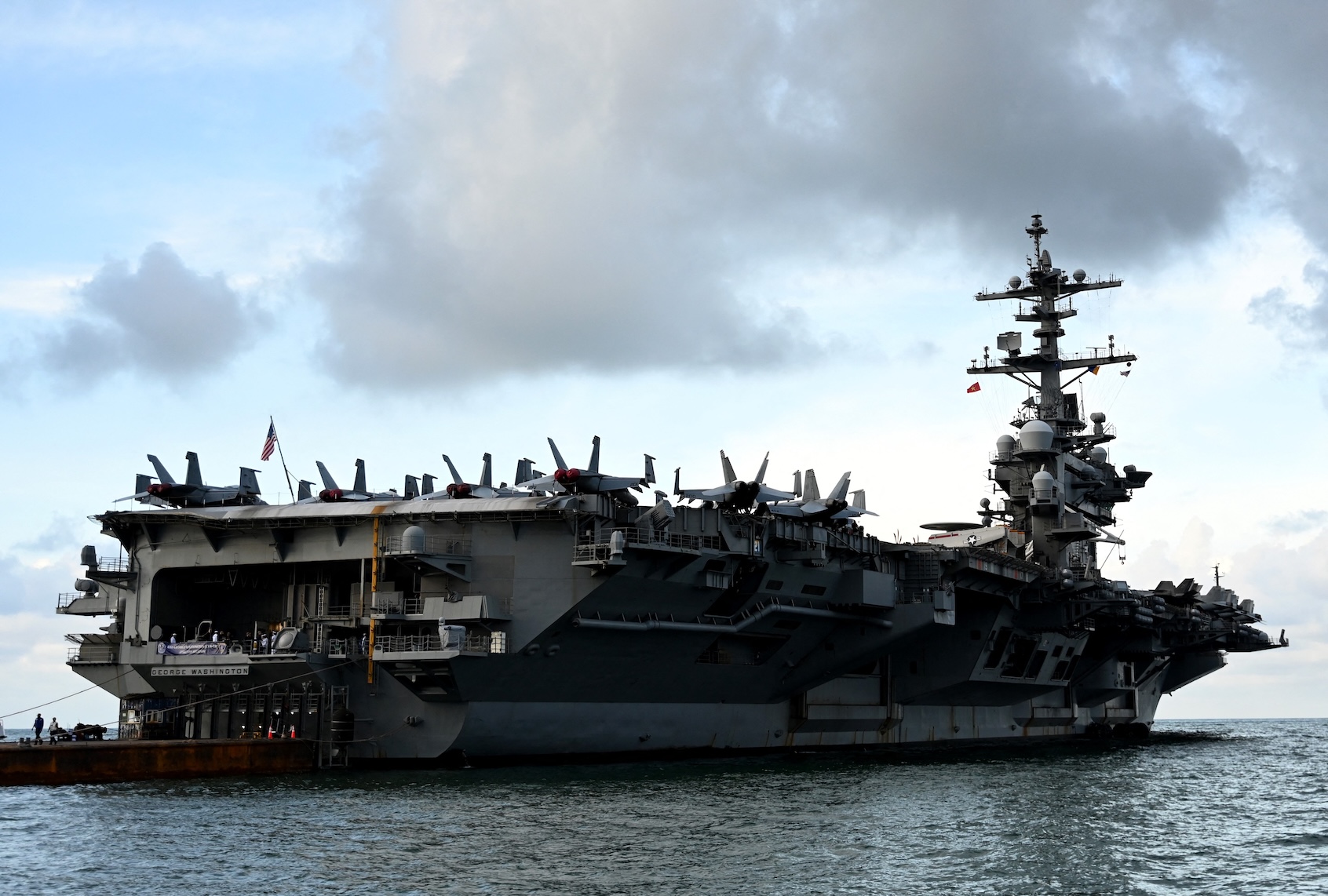

Donald Trump’s war against Iran is going so well that the U.S. is now yanking the USS George Washington from the western Pacific to relieve the beleaguered USS Abraham Lincoln, which is stationed off the Iranian coast in the Northern Arabian Sea.
The move is significant on both fronts. While the switch will be a godsend to the weary sailors aboard the Lincoln, who have faced deteriorating living conditions and reported suicide attempts during their historic deployment of over 260 days and counting, the Washington was the Navy’s last aircraft carrier stationed in Asia. Its exit represents a remarkable abdication of American military power in the region.
At the same time, the president has ordered the Pentagon to “substantially reduce” joint military exercises with South Korea. Seoul seemed blindsided by the announcement, but judging from Trump’s social media post, which underscored his “very good relationship with Kim Jong Un, of North Korea,” it appears that one reason for America’s diminishing military presence on the Korean Peninsula also has to do with Iran. The move reportedly came after the South Korean government refused to assist the U.S. in military actions in Iran. “I recently asked the President of South Korea if they would like to join us in the Denuclearization of the Islamic Republic of Iran,” Trump wrote in a Truth Social post, “and they said, ‘No thanks!’”
This is all great news for China, which has already dispatched its top envoy to South Korea, seemingly to fill the void Trump is creating. Chinese Foreign Minister Wang Yi will meet with Korean President Lee Jae Myung to discuss North Korea and global issues, creating an “unusually favorable moment for Beijing,” according to Han Lin, China country director at the Asia Group, who spoke to Bloomberg. “Washington is signaling flexibility toward Pyongyang while simultaneously creating uncertainty in Seoul,” he said, adding that “China can use that gap to bolster diplomatic influence.”
Once again, China embodies the pseudo-Taoist “Does nothing. Wins.” meme, but that hasn’t entirely mollified fears that Beijing will invade Taiwan. Those worries have caught the attention of The National Interest, a magazine founded in 1985 by neoconservative Irving Kristol and attached to a think tank established by former President Richard Nixon, who saw the potential for Chinese dominance in world affairs. The magazine, which has more recently become a mouthpiece for Russian concerns, has published hand-wringing features on how munitions depletions are putting Taiwan at risk. Such depletions are a consequence of the U.S. bombing campaign against Iran, of course, but it’s not clear that China wants or even needs to take advantage of this gap, at least not by dropping bombs.
Start your day with essential news from Salon.
Sign up for our free morning newsletter, Crash Course.
Beijing has watched closely as the U.S. and Russia, in its invasion of Ukraine, have damaged their economies, weakened their militaries and destroyed their global reputations while still losing the wars they started. No one wants to say that risk of a Taiwan invasion is completely gone, but China’s motivation to do so is likely pretty low. Why invade some place if you basically already control it? Just keep doing nothing and keep winning.
But more tangibly, it’s becoming clearer by the day that the bloated military machine the U.S. has run for decades is running out of steam. An exclusive report published Tuesday by the Washington Post details how the Pentagon is considering reducing its military footprint in the Middle East, notably because American military bases in the region have repeatedly gotten pummeled throughout the Iran war. If this happens, it would mark a substantial pivot from how American forces have operated in the region post-9/11.
We need your help to stay independent.
All of this may be welcome news to anyone who opposes the world police stance of the U.S., but Trump kicking out the crutches of our ailing empire could also swing in a disastrous direction. As former U.S. ambassador to South Korea Joseph Yun detailed to CNN, the void the U.S. leaves is prompting more countries, including North Korea, to look more toward nuclear weapons as a deterrent against future aggressors.
As anyone who has studied nuclear proliferation will tell you, this is a dangerous game: The more countries that rely on nukes for peace, the greater chance there is of a nuclear holocaust, whether it’s triggered accidentally or intentionally. The slow decay of American hegemony may be good news for many people in the world, but it could also create new existential risks as China reemerges as a global superpower.
In the meantime, it probably won’t hurt to start learning Mandarin on Duolingo.
Read more
about the Trump administration
