
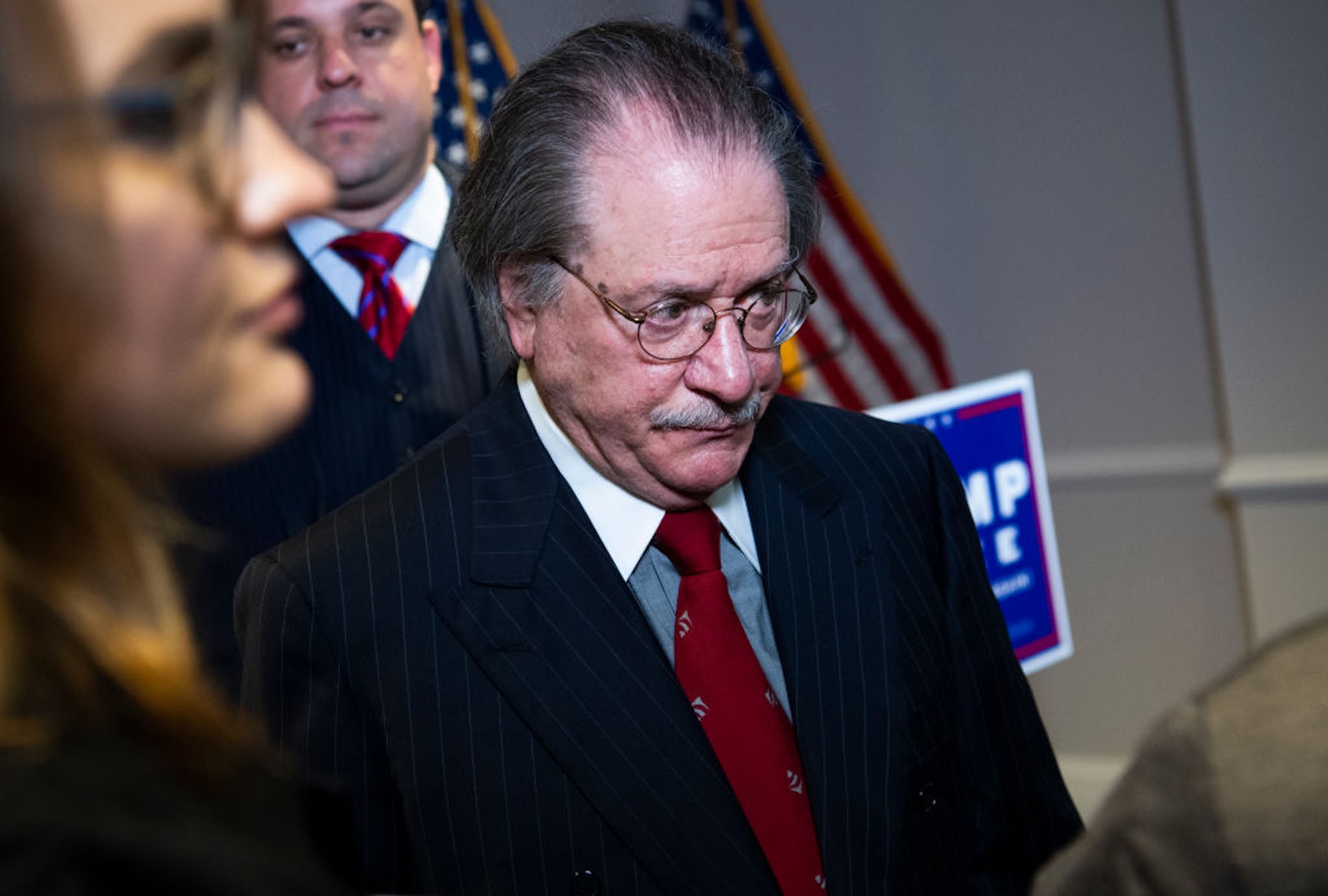

The definition of a Mafia made man is one who has Italian blood and is formally initiated into the “family,” having sworn an oath of omerta and promising to put the crime family above all else. Traitors take their lives in their own hands, and they often do not live to tell the tale, which means that it’s rare for anyone to go against the family, especially in public. That’s why it was so surprising to see longtime Republican operative Joe diGenova resign from his job as a top Trump consigliere — or, more formally, “special counselor to the attorney general” — on Thursday. If there was ever a GOP-made man, it is him.
DiGenova was appointed in April to oversee the Justice Department’s big inquisition in Florida after the career prosecutor who had been running it resigned over concerns that they did not have a prosecutable case against former CIA chief John Brennan. DiGenova, who had not prosecuted a case since his stint in the Reagan Justice Department, was a trusted GOP loyalist. He was involved in many of Rudy Giuliani’s crusades during Donald Trump’s first term, including the Big Lie court cases that went nowhere. This made him widely seen as the kind of partisan stalwart the administration needed to kick-start the investigation. Expectations in the MAGAsphere were high.
DiGenova and his wife, Victoria Toensing, have been fixtures in the Republican scandal-mongering business for decades, having first made their bones during the Clinton years. (Toensing was working with diGenova down in Florida and resigned last week as well.) They had both been intimately involved in the Giuliani-led schemes to prove that it was actually Ukraine that had interfered in the 2016 election on behalf of Hillary Clinton, so the administration apparently thought it made sense for them to work on the big “grand conspiracy” case that had stalled in the Sunshine State.
The U.S. Attorney in the Southern District, Jason A. Reding Quiñones, was reportedly dedicated to the cause. Still, the Justice Department needed someone to lead the investigation who would go the extra mile and prove what the previous Special Prosecutor John Durham could not — that the investigation into Russian interference in the 2016 election was a partisan hit job that was hatched by the Obama administration to discredit Trump. Since the department’s career prosecutors were unwilling to go beyond the evidence, which showed no such conspiracy, the administration needed someone who could make that happen.
Want more sharp takes on politics? Sign up for our free newsletter, Standing Room Only, written by Amanda Marcotte, now also a weekly show on YouTube or wherever you get your podcasts.
It’s unclear exactly how they settled on diGenova who, at 81, might not be the first person to come to mind when thinking of candidates to lead a sprawling international investigation. He and Toensing were not members of Trump’s inner legal circle; the president reportedly failed to hire them in 2018 as defense attorneys reportedly because “the chemistry” was off. Eight years later, something changed.
On April 2, eight days before diGenova received the appointment, he and Toensing appeared on Giuliani’s podcast. As CNN’s Evan Perez reported, the couple tore into then-Attorney General Pam Bondi for failing to appoint diGenova to head Miami’s civil rights division, claiming that if she had done so, he would have already brought indictments. DiGenova and Toensing said they would never have brought individual cases against former FBI Director James Comey or New York Attorney General Letitia James. Instead, they would have saved any indictments for the massive conspiracy the pair believed had been plotted by Trump’s enemies, apparently at every level of government. DiGenova told Giuliani that he favored going after former President Obama himself. “Put Obama in [front of] the grand jury,” he said, “and let’s have a fight over his testimony.”
We need your help to stay independent.
As it turns out, Bondi was fired that very day, so it’s a fair guess that these comments somehow got to Trump, perhaps via Giuliani himself. It was well known by that time that Trump was unhappy with Bondi’s inability to exact timely vengeance on his enemies, which is, after all, one of the president’s top priorities, along with redecorating the White House, destroying Washington, D.C., and corruptly enriching himself and his family. If he did hear diGenova’s comments, they were likely music to his ears.
Shortly after taking the job, according to Perez, diGenova vowed that he could bring charges in 30 days. Obviously, that hasn’t happened. He did manage to expand the probe to the Mar-a-Lago search and has issued subpoenas compelling familiar names from the Russia probe to appear before the grand jury empaneled in Miami. But diGenova’s investigation was apparently a chaotic mess.
In the end, he seemed to repeat some of Bondi’s failures, “[losing] the confidence of his superiors” because the investigation had more than a dozen prosecutors running around chasing different parts of the so-called conspiracy with little to nothing to show for it, except reported displays of kingly behavior.
In the end, he seemed to repeat some of Bondi’s failures, “[losing] the confidence of his superiors” because the investigation had more than a dozen prosecutors running around chasing different parts of the so-called conspiracy with little to nothing to show for it, except reported displays of kingly behavior. DiGenova reportedly antagonized and sidelined a team of career prosecutors, attempted to block the Justice Department from sending additional lawyers to help with the probe and demanded his own high-security room to store highly classified information, even though there was one at his disposal only two miles away.
When he resigned on Sept. 10, diGenova refused to keep his feelings to himself. He blasted the department to the New York Post, saying, “If you want indictments where there’s no evidence, you have an ethical problem.” But then he appeared to backtrack after his critique made headlines and ricocheted around social media. His comments, diGenova told the AP, had been taken out of context. “There’s plenty of evidence in all of these cases to prove the theories of prosecution,” he said. “It just takes time to get there, and some people want to get there a little faster than others — and you can’t do that.”
What’s clear from this episode is that Attorney General Todd Blanche — and, by extension, Trump — will take nothing less than indictments against his perceived enemies. And if they don’t materialize, he is ready to sacrifice even the mostly loyal MAGA foot soldiers.
When I wrote about diGenova’s appointment in April, I asked the question, “Can the TV hit man do what none of the other Trump lawyers before him have been able to do: put the president’s enemies behind bars?” Now we know the answer is no, and it’s not for lack of trying. It’s for lack of evidence. Even a made man can’t get that job done.
Read more
about the Justice Department
