
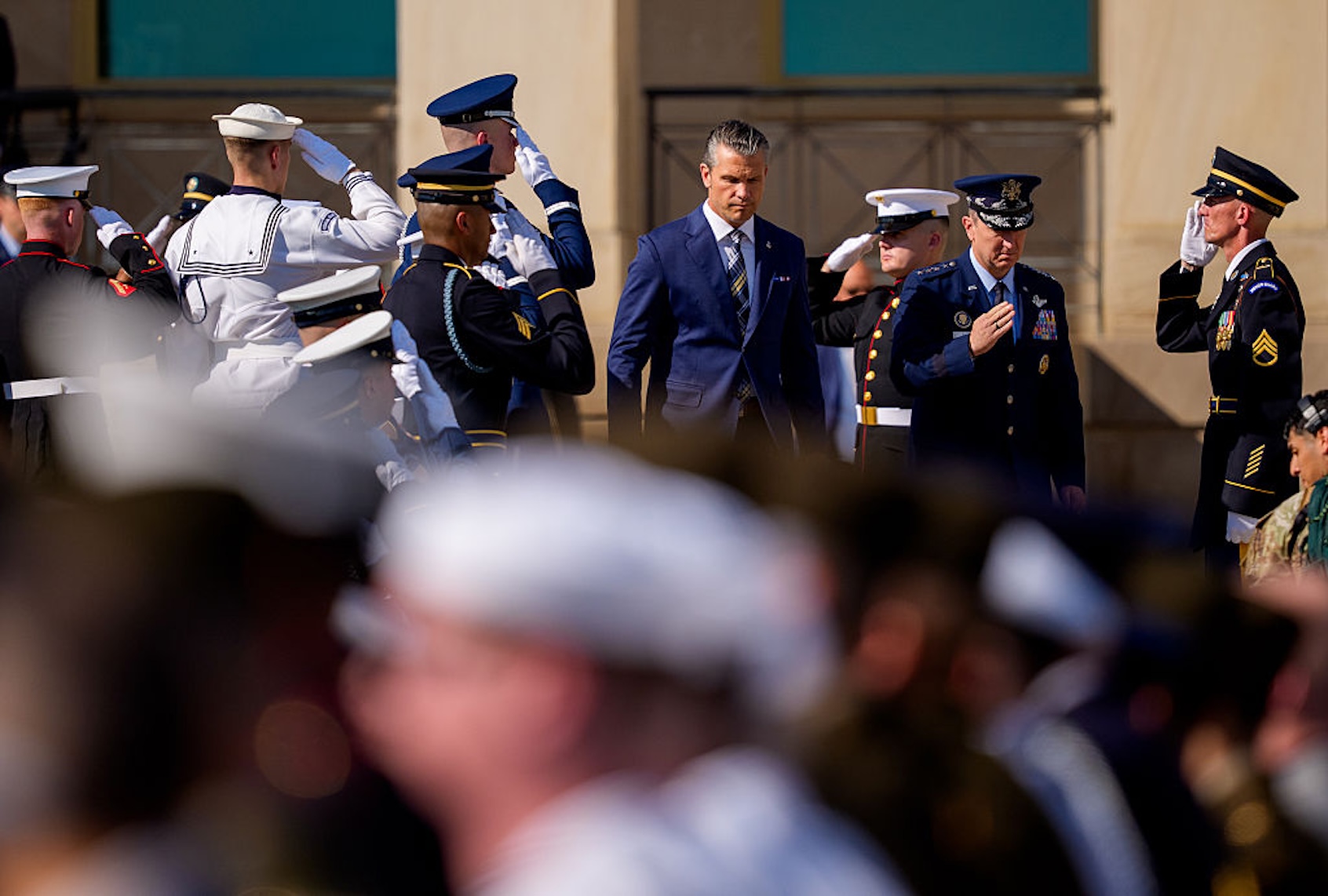

It should come as no surprise that wars break armies. The chaotic, destructive nature of battle tends to wound even the most highly trained armed forces. Today, however, the U.S. military is being impaired not by some determined overseas enemy but rather by its own leadership in a fratricidal war against imagined cultural bogeymen. The harm has become so discernible that Rep. Thomas Massie, R-Ky., called this week for an impeachment vote on Secretary of Defense Pete Hegseth.
Massie’s push for removal, while unexpected, is not without merit. In his crusade to decontaminate the ranks from the supposed virus of “DEI” — diversity, equity and inclusion — Hegseth is waging a malicious campaign against his own troops with little, if any, precedent in American history.
True, there have been moments in the nation’s martial past when social progress and military resistance sat in uneasy tension. The Truman administration’s desegregation of the armed forces or President Bill Clinton’s desire to allow gay and lesbian service members to serve openly exemplified clashes when the very meaning of American democracy seemed to be negotiated among those in uniform.
Previous American wars equally have highlighted both the fraught nature of serving in higher-level leadership roles and in lower ranks where war’s injurious effects are most grievously felt.
During the Second World War, for instance, the U.S. Army Chief of Staff George C. Marshall gained a harsh reputation for firing senior officers who didn’t pass muster in the crucible of combat. Yet the future secretary of state — and architect of the Marshall Plan — was most concerned with competence and candor leading to military effectiveness. As one account suggests, Marshall “was not looking for conformists. He believed in the respectful, confidential expression of dissent.” In a time of war, personal ideologies mattered little to national security.
If young Americans serving in uniform during World War II were unaware of how Marshall approached general officer accountability, they certainly felt war’s ravages up close and personal. Marine Eugene B. Sledge, a Pacific theater veteran, marveled at “the incredible cruelty that decent men could commit when reduced to a brutish existence in their fight for survival amid the violent death, terror, tension, fatigue, and filth that was the infantryman’s war.”
The Cold War experience would prove just as injurious, and on more than just the personal level. While veterans of the American war in Vietnam, like Lieutenant Philip Caputo, remembered his men being in a “permanent state of exhaustion,” more senior officers worried about the conflict’s impact on the very health of the U.S. military. Future Lt. Gen. Harold G. Moore, who commanded a cavalry unit at the late 1965 Ia Drang battle, fretted how the war was “devastating to the morale and effectiveness of every American unit in combat.” Might the armed forces not survive the ordeal of Vietnam?
Want more sharp takes on politics?Sign up for our free newsletter, Standing Room Only, written by Amanda Marcotte, now also a weekly show on YouTube or wherever you get your podcasts.
Such existential questions endured throughout the post-9/11 global war on terrorism. While pundits and correspondents alike compared the war in Iraq to Vietnam, soldiers and Marines on the front lines struggled to find meaning in their combat tours. As journalist C.J. Chivers, who interviewed scores of fellow veterans, wondered: “Had it been worth it? Have they helped? Why had they been ordered to fight the way they fought?” In such convoluted wars, easy answers were hard to come by.
As in Vietnam, larger questions about the impact of war on military readiness accompanied veterans’ soul-searching. Some wrote anxiously about the “strain . . . being felt throughout the services, in terms of wear and tear on the troops, their families, and their equipment.” Others opined that American strategy lay “dead,” the victim of a hyper-focused counterinsurgency approach that favored tactics over the more important challenge of matching national resources to policy aims.
If the wars in Iraq and Afghanistan had “broken” some American servicemembers serving overseas, making for a difficult reintegration back home, they apparently also had fractured the very organizations to which those in uniform belonged.
While the ongoing war in Iran consumes strategic military reserves for ostensibly little strategic gain, the defense secretary persists in targeting the very men and women tasked with carrying out the president’s foreign policy objectives.
Hegseth’s cultural war, however, is far different — and, potentially, far more damaging. While the ongoing war in Iran consumes strategic military reserves for ostensibly little strategic gain, the defense secretary persists in targeting the very men and women tasked with carrying out the president’s foreign policy objectives. The fratricide is nearly all-encompassing.
Unlike any defense secretary before him, Hegseth has inserted himself into promotion board decisions, especially when it comes to selection of officers for promotion to major general. By one account, he has blocked the advancement of more than 80 generals and admirals. His flurry of cashiering officers appears based on little more than targeting those who are not ideologically aligned with the secretary’s worldview.
On another front, his anti-diversity and inclusion crusade continues unimpeded. In a fiery speech to the West Point graduating class in May, Hegseth railed against “woke” and “anti-American ideologies” while castigating those who “embraced the DEI craze.” The message was clear: Only “warriors” need apply to the newly reconstituted profession of arms. Perhaps not coincidentally, adverse promotion decisions have fallen most heavily on Black and female officers.
The secretary’s constant refrain on what we might call “tactical masculinity” oversimplifies the true nature of modern warfare, which is far more complex and multifaceted than his vision of tough and fit infantrymen engaging in hand-to-hand combat. The increasing use of military drones is but one example. But Hegseth’s scorched-earth policies also run the long-term risk of weakening the nation’s armed forces by narrowing recruiting possibilities for an all-volunteer force. An all-white, all-male military is hardly representative of American democracy.
We need your help to stay independent.
All wars damage the armies that fight them. And, without question, some wars see armies turn against themselves, most infamously in Vietnam, when some 900 “fragging” incidents — attempts on the lives of fellow soldiers — resulted in the deaths of 99 American uniformed personnel.
Yet the current fratricidal war against the U.S. armed forces, championed by its own defense secretary himself, is a phenomenon unlike any other in the nation’s history.
Evaluating the present without the benefit of perspective from the past can be a risky business. At very least, though, Americans today should insist that their civilian leaders don’t wage war against those citizens who have pledged their service for no other cause but the nation’s defense.
Read more
about the Defense Department
