
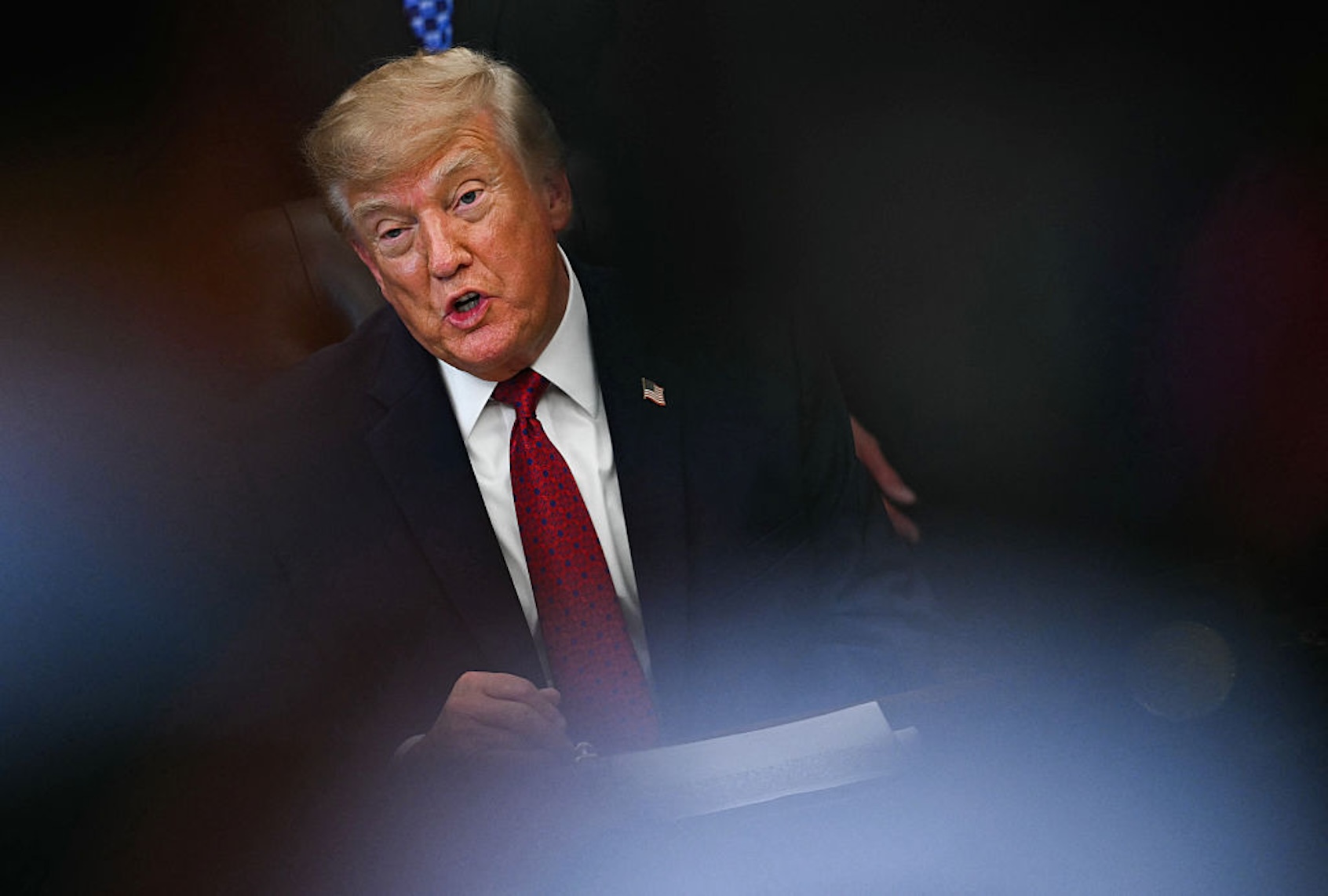

It seems like a million years ago now, but there was a moment back in 2024, in the heat of that weird presidential campaign, when everyone was talking about the radical blueprint for Donald Trump’s restoration. Project 2025 was so extreme, in fact, that his campaign had Trump disavow it publicly. He usually said that he hadn’t read the plan and didn’t intend to, but at times he went further. In Grand Rapids, Michigan, on July 20, 2024, Trump said, “Like some on the right, severe right, came up with this Project 25 . . . They’re sort of the opposite of the radical left. You have the radical left and the radical right, and they come up — I don’t know what the hell it is, it’s Project 25 . . . and then they read some of the things, and they are extreme, seriously extreme.”
Trump probably wasn’t lying when he said he hadn’t read it, but his advisers obviously believed he should keep his distance from the plan, which didn’t poll well, and when people found out what was in it, they were appalled. Project 2025 was a far-right manifesto, filled with the kind of pie-in-the-sky fantasies that denizens of conservative think-tanks had been churning out for decades in the hopes of influencing Republican administrations.
One such organization, the Heritage Foundation, had been publishing “Mandate for Leadership,” its so-called policy guide, since 1981 and updating it as necessary. But Project 2025 was different from the group’s previous effort. This time, the Heritage Foundation had organized a formal transition operation, created training sessions, personnel lists and a day-one playbook for Trump to hit the ground running with a flurry of executive orders and personnel changes.
This effort was largely guided by its co-author, Russell Vought, who served in the first Trump administration as the director of the White House Office of Management and Budget. Having worked for years for the Republican Study Committee in the House, a group of far-right members dedicated to social conservatism, tax cuts and the destruction of the federal safety net, Vought was an experienced bureaucrat with a specific vision: to shrink the federal workforce and bring as much power under the direct auspices of the president as possible. As a self-described Christian nationalist, he also believed that the U.S. should espouse fundamentalist Christianity, and that the country has no obligation to engage in global initiatives that do not directly benefit its own people.
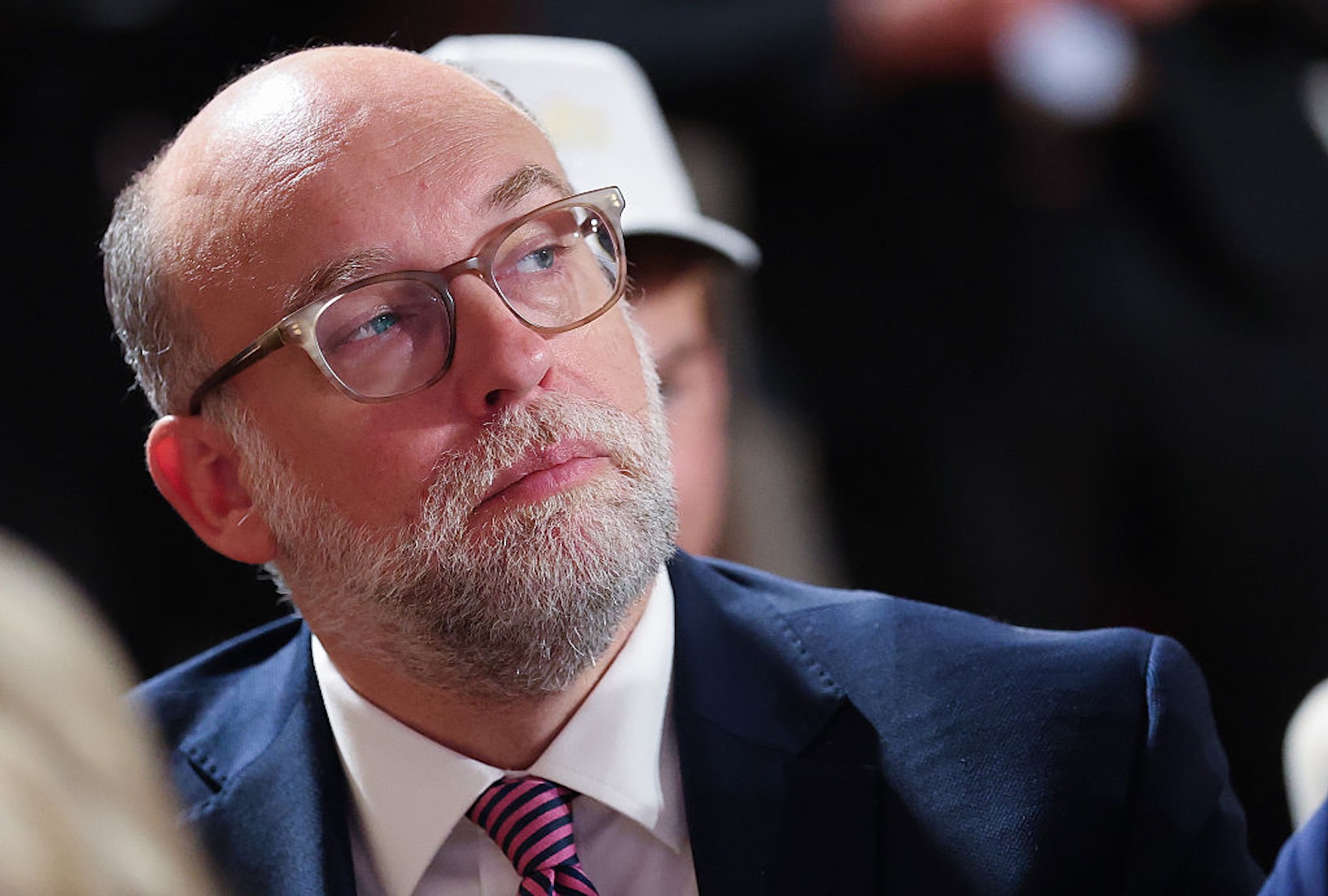
(Kevin Dietsch/Getty Images) Russell Vought, director of the Office of Management and Budget, listens as President Donald Trump speaks during the America.gov launch event on Sept. 29, 2026.
Vought was an active member of a group formed after the 2012 election called Groundswell, which included an eclectic group of influencers and activists such as Virginia Thomas, the wife of Supreme Court Justice Clarence Thomas, and far-right political operative Steve Bannon, who had come to believe that Republicans needed to be much more radical in their methods and their goals. Seeing the federal workforce as nothing more than sinecures for dangerous liberals, Vought and his comrades planned mass firings under new rules such as Schedule F, which would reclassify thousands of federal workers as at-will employees, making them exempt from civil service protections. And if they could not be fired, he would make their lives so difficult that they would quit. As Vought famously explained:
We want the bureaucrats to be traumatically affected. When they wake up in the morning, we want them to not want to go to work because they are increasingly viewed as the villains. We want their funding to be shut down so that the EPA can’t do all of the rules against our energy industry because they have no bandwidth financially to do so. We want to put them in trauma.
Vought believed that the way to secure a mandate for this agenda, even under Democratic presidents, was to cut the federal workforce so massively that the government would be unable to function beyond the most basic services. We will have to see just how well that works out for them in the future. But the destruction is already monumental.
In the months after Trump returned to the White House, Elon Musk’s Department of Government Efficiency wreaked havoc on the federal government. Thousands were fired and departments were shuttered, leaving chaos everywhere. That’s the tech-bro style.
Vought believes that we are living in a “post-constitutional” time in which the “precedents and legal paradigms that have wrongly developed over the last 200 years” must be thrown off.
But Vought is a different breed. He is a patient and methodical destroyer. Vought believes that we are living in a “post-constitutional” time in which the “precedents and legal paradigms that have wrongly developed over the last 200 years” must be thrown off. And even while Trump’s presidency appears to be on the verge of collapsing from the weight of historically low poll numbers, Vought is quietly accomplishing his mission of comprehensive deregulation mostly under the radar.
On Tuesday, the administration ended Title IX protections for LGBTQ+ students, effectively allowing them to be bullied and discriminated against in America’s schools. But since this is a man who joyfully prescribes “trauma” as a political tactic, it’s not entirely surprising that his crusade would eventually reach schoolchildren.
Vought’s influence is also being felt on Capitol Hill. As the chair of the powerful Senate Appropriations Committee, GOP Sen. Susan Collins of Maine has made her role a centerpiece of her reelection campaign. For years, she has argued to Mainers that her value lies in the seniority and influence she yields. But Collins should think again: One of Vought’s primary strategies for securing the unitary executive is through confrontation with the legislative and judicial branches. That conflict is currently playing out in the courts. But under a supine GOP congressional majority that has been willing to cede the powers granted to them by the Constitution, he is winning — and making more moves.
Want more sharp takes on politics? Sign up for our free newsletter, Standing Room Only, written by Amanda Marcotte, now also a weekly show on YouTube or wherever you get your podcasts.
According to the New York Times, an Oval Office meeting grew heated when Vought attempted to have the president rescind National Institutes of Health grants to universities that did not align with the MAGA agenda. Trump was on board with the idea, since it would have targeted Harvard University, an institution he sees as his enemy. After fierce pushback from members of both parties, the pair pulled back. But that reprieve could be temporary; conventional wisdom says they are likely to try again after the November midterms are over, when Vought’s new initiative to confront Congress begins in earnest.
Then, on Wednesday, Senator Ron Johnson, R-Wis., blocked a Democratic bill that would have stopped Vought’s recent pocket rescission of $810 million in domestic spending previously approved by Congress. (In a statement released days before the vote, Collins decried the move.) The money had been earmarked for programs focused on immigrants, refugees, civil rights, climate change and children. Johnson said the issue will likely have to be decided by the Supreme Court, which approved Vought’s rescissions in 2025 because they pertained to national security. These funds do not, but it won’t be surprising if the Court’s conservative majority, which has been largely sympathetic to the unitary executive theory, finds another reason to allow it.
We need your help to stay independent.
If Vought and the administration were to win at the Supreme Court, Congress might as well just go part-time to approve presidential appointments, name post-offices and pass one big pile of money for the presidential monarch to spend as he pleases. Article I of the Constitution will be effectively dead.
Under Vought’s leadership, the damage to the federal government is already overwhelming, and it’s unclear if a Democratic congressional majority or administration will be able to fix it. But then, that’s part of the plan too. Trump’s presidency may be faltering, but Vought’s dream is being realized every single day.
Read more
about Project 2025
