
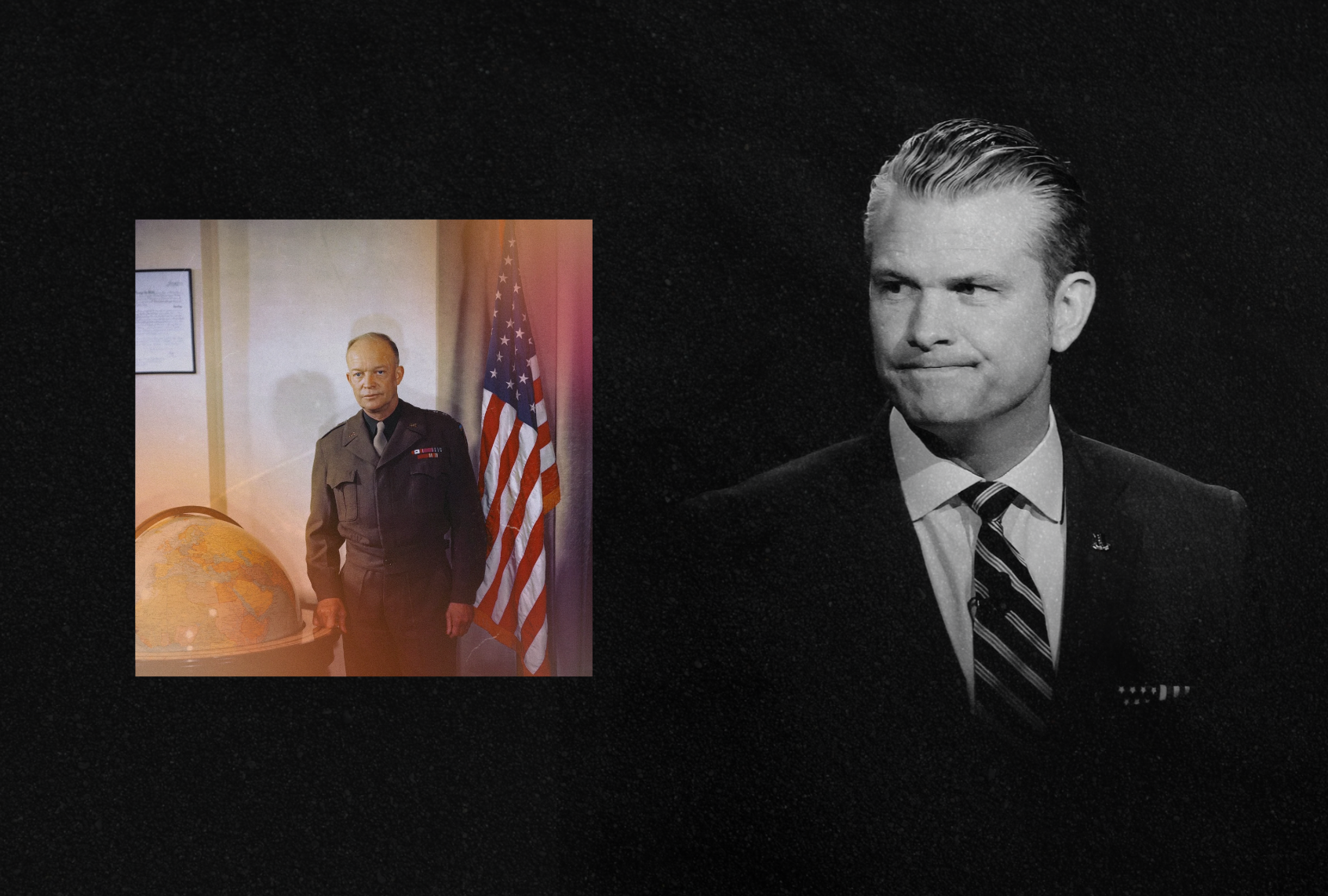

Gen. Dwight D. Eisenhower was not buff, at least to our knowledge. He didn’t exercise in public or show off his abs, and there is no record of him ever leading his troops in calisthenics or challenging his peers to a pull-up contest. As far as we know, he didn’t even have any tattoos.
Eisenhower may not have been a “beardo” or a “weirdo,” in the recent words of Pete Hegseth, but were he alive today he would in all likelihood call the defense secretary a wimp and possibly even a radical. The 34th president would almost certainly not see him as a “warrior,” a term Hegseth uses as shorthand for a muscled, tough bully who is ready to engage in hand-to-hand combat with the enemy at a moment’s notice.
Despite this, Eisenhower remains one of America’s most celebrated generals, the man who led the Allied invasion of Europe, served as Army Chief of Staff, helped create NATO and served as its first Supreme Allied Commander. While he never served in combat, Eisenhower rose in the ranks because of his exceptional talent for strategy, logistics and diplomacy, skills which used to be held in high regard in the military.
Not too long ago, it was once understood that, in the modern world, a “warrior ethos” is more a matter of brains than brawn, and it was Eisenhower’s gift for coalition management, logistical organization, discipline and strategic patience that made him a successful war-time leader.
But those qualities are now out of fashion. When Donald Trump tapped Hegseth, the “Fox and Friends Weekend” co-host, to be his defense secretary, it was largely because the president thought Hegseth looked like he came out of “central casting” — a square-jawed, Sgt. Rock-style cartoon hero. They had become acquainted when Hegseth had taken up the cause of a group of men accused of war crimes, and persuaded Trump to intervene on their behalf, which he did over the loud objections of the military brass.
Hegseth had the attitude Trump wanted to lead the military, a man who wouldn’t feel restrained by all those rules and regulations that had made America, in his view, a weak, loser country under previous presidents. Once installed at the Pentagon, the secretary began modeling his “warrior ethos” very quickly by personally leading the charge on the front lines of America’s most important battleground: the culture war. He vanquished diversity, equity and inclusion policies one by one, and got rid of any of the women and people of color who had been promoted over the butch white men. He called all the brass to sit and listen to him lecture them about what a true military leader should be. After all, Hegseth has served as a platoon leader in the National Guard and as a prison guard for a little while, so he knew what he was talking about. And he has demonstrated time and again that he is in pretty good physical shape by doing jumping jacks and jogging with enlisted men wherever he goes, which is apparently the only authentic test of military leadership.
Meanwhile, Hegseth has presided over a policy of murder on the high seas, ordering the military to summarily kill people in small boats in the Caribbean and Western Pacific who, according to the Pentagon, are suspected of running drugs. He is also in charge of the military that is losing the war in Iran, a conflict to which he seems oddly disconnected, busy as he is with planning a (later canceled) public execution, holding prayer meetings, mandating testosterone testing and all that jogging.
Even though Hegseth would surely have fired Eisenhower long before the future president ever became a five-star general for lacking the proper “warrior ethos,” he does seem to like the idea of basking in the reflected glow of the monumental victory Eisenhower led in World War II.
Even though Hegseth would surely have fired Eisenhower long before the future president ever became a five-star general for lacking the proper “warrior ethos,” he does seem to like the idea of basking in the reflected glow of the monumental victory Eisenhower led in World War II. The secretary is also clearly entertaining the idea of running for president, which Eisenhower successfully did twice, after helping to rebuild Europe. (Incidentally, Eisenhower fully endorsed changing the name of the War Department to the Defense Department in 1949, a decision Hegseth and Trump have attempted to reverse.)
Hegseth obviously sees himself as a modern leader of similar stature to Ike. According to The Washington Post, when Hegseth assumed the office, he spied a relic that once belonged to Eisenhower: a handmade globe the general had reportedly used during the war, which even bore some markings he may have placed there himself. Hegseth demanded that it be moved to his office. He had furloughed people who handled such things during the partial government shutdown over immigration, and since he famously lacks patience, Hegseth sent a couple of flunkies to retrieve the historic object immediately.
Not realizing its weight, and with no experience in caring for precious artifacts — or, according to the report, listening to words of caution — the crew dropped the globe and broke it. They ended up just leaving it where it stood, with a huge hole in it.
Want more sharp takes on politics? Sign up for our free newsletter, Standing Room Only, written by Amanda Marcotte, now also a weekly show on YouTube or wherever you get your podcasts.
There are metaphors, and there are metaphors, but this one is just too on the nose. Eisenhower and America helped rebuild the world after World War II, understanding that to survive in the nuclear age, the old, primitive ways were just too dangerous. They used diplomacy and alliances to build a bulwark against the kind of aggression that Germany and Japan had unleashed on the world, and despite some marked abuses and exceptions, that order largely held for 70 years.
Then Trump and his acolytes like Hegseth came along. With little care for the vast responsibility they held to keep the fragile planet stable and safe, and with no knowledge or experience of how to do so, they have broken the world order that Eisenhower led and represented. And it doesn’t seem as if they think it matters.
We need your help to stay independent.
These are reckless people who think the government is cosplaying reality television, where all that matters is looking tough and projecting strength through cartoon clichés and cheap propaganda. The symbolism of that globe and what it meant completely escapes them, just as Eisenhower’s legacy has been dismissed by them wholesale.
Other than winning D-Day and commanding NATO, Eisenhower’s most famous moment was perhaps his January 1961 farewell address as president, when he warned about the military-industrial complex, which he said could sap resources from the public, threaten democratic governance and social balance, and put profit ahead of national security. His warnings were realized long ago, but now the Trump administration is taking it to an entirely different level. Hegseth is demanding a total of almost $1.5 trillion dollars for the Pentagon in 2027, calling it a “generational investment.” And Elon Musk, with his Starlink system, now appears to be operating more or less on his own, putting global security at severe risk.
Sometimes a cigar is just a cigar — but sometimes it isn’t. This administration has broken the world, and nobody knows whether it can be fixed. But even if it can be pieced back together, it will never be the same.
Read more
from Heather Digby Parton
