
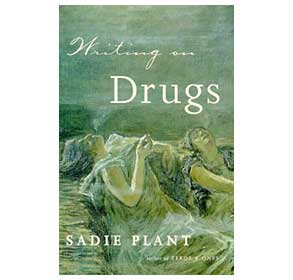

At first glance, “Writing on Drugs” would seem to have as much chance of success as a guy in a three-piece suit hawking cases of Jim Beam at a Grateful Dead concert. As anyone who has ever tried to write anything after partaking of psychoactive substances knows, altered states of consciousness go into words the way a tsunami goes into a squirt gun. Your synapses may be firing like Gatling guns, your mind may be soaring through the empyrean, but what you succeed in getting down on paper are incoherent gestures, endless digressions and fragments of fragments. And even when a writer, through discipline, talent or stoned luck, manages to capture something of the experience, who would want to read it? If you’re (as the late drug authority Jimi Hendrix delicately put it) “experienced,” why settle for a mere verbal representation of the real thing? And if you’re not, why bother with descriptions of an experience you’re axiomatically cut off from understanding?
But Sadie Plant manages to make her subject compelling. In large part, this is because she is intelligently agnostic about almost everything relating to drugs: She avoids falling into the almost inevitable banality that attends either Timothy Leary-style cheerleading or know-nothing moralizing. The fact that she doesn’t exactly deliver on her book’s title also helps her. “Writing on Drugs” does provide highlights from the extensive literature on drugs, but it incessantly meanders away onto other subjects, from the way that certain drugs reflect the obsessions of their eras to the possibility that broom-sitting witches absorbed psychoactive drugs through their vaginal membranes to the hypocrisy and self-defeating nature of assorted wars on drugs.
This somewhat invertebrate, not to say dazed and confused, approach prevents Plant from getting caught in the epistemological quagmires that trap those given to making sweeping theoretical pronouncements about drugs. But it also gives “Writing on Drugs” a free associative, at times anarchic, feeling that sometimes recalls, it must be said, certain conversations carried out in the shadow of the spliff. (This may be an occupational hazard of immersing oneself in drug writing, a kind of literary contact high.) As with those conversations, this is only intermittently a good thing. One wishes that Plant had pursued some of her suggestive ideas and themes more exhaustively and with greater rigor. Fortunately, however, she’s a smart and lively enough writer that most of the time, you don’t mind her flitting.
The book opens with a brief, autobiographical prelude that recalls an opium-fueled reverie in Thailand. Aside from this bit of poetic semi-confession, Plant does not divulge the extent of her own drug use, although her descriptions of the effects of ecstasy seem unusually vivid. This reticence is understandable: As she tersely notes, “Drugs take all authority away.” (Still, it would not seem amiss, in this exploration of the most subjective of literary genres, for the author to come clean about her own experiences and what they have meant to her.)
Plant begins her tour in the 19th century, in the golden age of drug writing, when writers like De Quincey, Coleridge and Baudelaire encountered opium. “There is something about opium, with all its varied properties and histories, that allows this drug to set the scene,” she writes, quoting Jean Cocteau as saying “Of all drugs, opium is the drug.” These artists’ experiences with opium encapsulate the dichotomies attached to all drug use: The ecstatic visions and shattering insights of the drug experience vs. the enervation, depression and sense of flatness that can follow; the persistent sense that neither reality nor the self is fixed — a radically relativistic doctrine that Nietzsche called perspectivism — vs. the equally strong sense that beneath the shifting veils lies one reality; the literally self-preserving impulse toward caution and measure, what Rimbaud called “a rational derangement of the senses” vs. Artaud’s Dionysian call for complete surrender to the unknown.
Cocaine, which followed opium, played an opposite social role, Plant argues, engaging people with the speeded-up world they had tried to escape by chasing the dragon. “If opiates had provided De Quincey’s generation with a means of escaping the ravages of the mechanical age, coca and cocaine woke everyone up to an era humming with new distributions of power and new forms of mass communication,” she writes. Some of the more entertaining passages of “Writing on Drugs” recall the grandiose health claims made by manufacturers and the medical establishment alike for cocaine, which was extolled as a supreme boon to health, vigor and happiness. Products like “Peruvian Wine of Coca” and “Vin Mariani” were said to fortify and refresh the body and brain. The architect who designed the Statue of Liberty raved that “Vin Mariani seems to brighten and increase all our faculties; it is very probable that had I taken it 20 years ago, the Statue of Liberty would have attained the height of several hundred meters.” A high achievement indeed.
Plant lingers over the case of Coca-Cola, whose “every bottle once contained the equivalent of a small, but respectable, line of cocaine.” After cocaine’s luster wore off, the “company feigned amnesia about cocaine and denied that its drink ever had a drug connection … But Coca-Cola would be nowhere if coca had not kicked it into life.” What replaced that “respectable line of cocaine”? Nothing less than our era’s own peculiar addiction, advertising: “In effect, the drink became a virtual cocaine, a simulated kick, a highly artificial paradise. Twentieth-century culture learned much from this sleight of invisible hand.”
One of Plant’s more audacious claims is that cocaine had a major influence on the creation of psychoanalysis. It’s well known that Sigmund Freud used cocaine, but Plant reveals that he just loved the stuff. The good doctor raved about “the stimulative effect of coca on the genitalia” and in a letter to his fiancie, Martha, “forewarned her of the pleasure she could expect from ‘a wild man with cocaine in his body'” — revealing him, interestingly, to be not just the father of psychoanalysis but a precursor of gangsta rap. Freud took cocaine to cure his tendency towards debilitating depression and restore what he called “the normal euphoria of the healthy person.” When its drawbacks finally became apparent to him, he looked about for a replacement and found the talking cure. “What began as his own search for a drug-free cure, some new method to occupy his mind, became a drug-replacement therapy for everyone. Analysis was Freud’s ‘natural’ high.”
Plant also looks at hashish, speed, LSD, mescaline, ecstasy and peyote, among other drugs. In a huge omission, she fails to discuss Jean-Paul Sartre, whose experiences with mescaline inspired “Nausea,” the novel that gave a popular, if weird, spin to phenomenology. In fact, she pretty much ignores contemporary fiction and the effect drugs have had on it, implying that the most important developments were avant-garde dead-ends like William S. Burroughs’ “cut-up” technique. This is unfortunate: Burroughs’ evocation of the drug universe remains unsurpassed, but the novels of writers like Denis Johnson and Robert Stone, to pick just two, are worthy of exploration as well.
Her analysis of LSD, arguably the most influential psychoactive drug in the contemporary developed world, is strong on history, in particular the story of the drug’s creation, but comparatively weak on its effect on the ’60s generation. Her sociological scene-setting falls into unenlightening clichis: “LSD challenged all accepted notions of sanity, normality and identity, presenting itself as a solution to the madness and alienation of … ‘bomb culture,’ an era that believed it was about to disappear into a mushroom cloud and was filled with demands for total revolution.” This passage reveals the shortcomings of Plant’s attempt to fit drugs like LSD into a larger social context. While her thumbnail sketches of historical eras aren’t wrong, they feel both inadequate and worse, irrelevant. The unruly, explosive subjectivity of drug experiences simply swamps attempts to give them epistemic meaning.
By the time Plant gets to postmodern French theorists like Deleuze and Guattari and Michel Foucault (who would without a doubt be the scariest person in history with whom to crack open a vial of nitrous), her book’s emphasis has shifted from literary descriptions of drug experiences to philosophies informed by a drug ethos, ideologies that aspire to a drug-like state of paradox, self-transcendence and mobility. The Foucauldean cast of her thought becomes clear: When she asserts that “even the most sober individual lives in a world in which drugs have already had profound effects,” one of the things she means is that “the confinement of drugs has also produced and multiplied the thrills it chased” — a classic Foucault move, in which prohibition and repression create the very pleasures they seek to forbid.
At other times, Plant seems to hint that drugs are actually responsible for modern culture. She speaks of the “dilemmas, contradictions, tensions, splits, writ large in the two-faced spectacle of a culture at war with the very stuff that kicked it into life.” Just how drugs kicked modern culture into life, however, is never explained. Indeed, she advances other arguments that seem to contradict this. Plant astutely points out that the entire Enlightenment was opposed to everything drugs represented:
If the witch-hunters drew the lines around life and death and put an end to return trips to the outer edges of the life-death border zone, these were parameters confirmed and solidified by the institutions of the modern state. Women were no longer allowed to heal the sick or deliver children; all drugs were now entrusted to the care of the Enlightenment’s new fraternity; and the shamanic narrative of flight, transformation, and return was abandoned in favor of a new sense of linear time. Now all the stories were supposed to go one way: progress, forward movement, full speed ahead.
Plant goes on to point out that modernity has never been “really free from its own shamanic past.” And she could argue, I suppose, that modern culture’s radical discontinuities and dizzying gulfs are a result of the clash between the linear Enlightenment narrative and the circular drug-inspired one. She doesn’t actually make that argument, and wisely so: It can’t be sustained. The fact is that drugs have a far greater impact on individuals, in the modern world, than they do on societies. In our rational, Apollonian world, Dionysius is pretty much off in a grape bower getting high by himself. (Or at most, spinning techno at raves.)
After a side trip into neuroscience and biochemistry, in which she points out the chemical relationship between drugs and the pleasure-giving substances manufactured by the body, Plant concludes with a restrained but withering account of the longstanding attempts to regulate psychoactive substances — attempts that have not only always failed, but have made the problems worse. “The war on drugs displays more excitement, confusion and paranoia than the drugs themselves,” she writes. Her account is damning, but one wishes she had confronted the issue of legalization directly. If she believes that it is a better solution, as it would seem she might, she should argue for it.
Plant eschews Grand Theories and keeps herself in the background, but by the end of “Writing on Drugs,” the basic contours of her opinions are clear. She believes that the use of psychoactive drugs is an integral, permanent part of the human condition, found in all cultures going back thousands of years, and that attempts to demonize that experience are both simplistic and doomed. Metaphysically and epistemologically, she is an agnostic: Drugs are part of reality, and so the familiar moralist’s slogan that they are radically “other” is simply wrong. “Psychoactive drugs defy all easy distinctions between organic and synthetic substances, natives and aliens at work in a nervous system that is always predisposed to receive them,” she writes. “Their introduction may disturb the equilibrium of the human brain, but they change the speeds and intensities at which it works rather than its chemicals and processes.” But, of course, changing “speeds and intensities” (Plant points out that the very word “intensify” was coined by Coleridge to describe his opium experiences) can cause you to crash and burn, too.
Plant is equally even-handed on the subject of the validity of what one learns or sees on drugs. The experience can be enlightening, even revelatory, but it can also be extremely dangerous — sometimes both simultaneously. The effects of drugs, she writes, have to be “taken on their own terms.” There is no master narrative, no single type of “right” thinking, no ultimately “normal” consciousness. A world with drugs in it is a stranger, but more interesting, world than one without them. “Writing on Drugs” captures that truth, and in this unusually hysterical age, it’s one worth remembering.
