

It’s official: The Aussies really don’t like the United States. Or at least, they’re sick of hearing about us. Either way, they sure as hell aren’t ever going to cheer for us.
I wanted to get a ticket for the U.S.-Spain semifinal men’s football match Tuesday night. The U.S. team had never gotten this far in Olympic competition, and being a moderately big soccer fan I wanted to go down to Moore Park and cheer the boys on. I didn’t have a ticket — the ducat I was holding was for boxing, which I was eminently prepared to unload. From what I remembered of Olympic boxing, it consisted of two guys armored like Tweedledum and Tweedledee jabbing away ineffectually at each other, under the eye of judges whose ethical role model was the Claude Rains character in “Casablanca.” This year, we were assured that to eliminate the nagging “your winnings, excellency” problem in the judging, the judges’ electronic scoring would be checked against the fight. And Don King has found God. Whatever.
I found a miraculously short ticket line outside the gymnastics venue and jumped in. (Logistically, they’ve handled everything perfectly at these Games except ticket sales — people are waiting in line for hours at understaffed booths at Olympic Park to buy tickets, often to discover when they get to the window that the event they want is sold out. One man standing in front of me became so enraged he smashed the wall with his hand.) But I was informed that they didn’t have any and I’d have to go down to the venue before the game. So an hour and a half before the match was due to start I jumped on my bike and rode through the drizzling dusk — the capricious Sydney spring has gone from glorious sun the first week to cold and rain for the last four days — in the general direction of the Sydney Football Stadium.
When I got there after an involuntary tour of some of Sydney’s less-glamorous districts, not quite wet to the bone, I started heading for the ticket booth, but was stopped by two shy teenage girls who wanted to know if I needed a ticket. They had five and couldn’t use them. Just then one of the ubiquitous Olympic volunteers came over, a sharp-faced middle-aged woman. There are something like 40,000 of these folks all over Sydney, all unpaid, wearing their blue and yellow uniforms and hats and handling everything from transportation advice to foreign translating, and every one of them is helpful and cheery. This one was the one exception.
“Are you selling tickets?” she squawked at the girls. “You can’t do that. You’ll have to leave.”
Even I knew this was a crock. This is a virulently anti-scalper Games, but of course they’re not worried about people selling their tickets at face value. I myself had wandered up and down the main boulevard in Olympic Park yelling “Who needs a badminton ticket?” and no gendarmes had hauled me off. Besides, you only had to look at these girls to know they weren’t scalpers. Scalpers as a rule bear a strong resemblance to the acid-throwing Pinkie in Graham Greene’s “Brighton Rock” — they’re ferret-faced denizens of the ninth circle of hell. These girls, on the other hand, looked like they’d have trouble getting up enough nerve to sell lemonade at a street stand. Somehow, this woman had failed to grasp that they were not the bad guys.
“Hey, they’re not scalpers — they’re just trying to get rid of tickets they can’t use,” I said. The volunteer was unmoved. “Well, you can’t do that here,” she said. “But we’re not making money on them,” one of the girls said. “We’re just selling them for what we paid for them.” The woman frowned, mumbling something about “I’ll get in trouble,” but finally she bustled disapprovingly off. I took the girls a little out of the way of the misinformed and misbegotten scold and we did the deal. It was a $60 ticket and I only had change for $55 — about $30 U.S. — so that’s what I paid.
This was a relatively cheap ticket. The sheaf of tickets I ordered back in the States from the sole U.S. ticket distributor, Cartan, cost an average of about $150 U.S. each, with some events like gymnastics going much higher. My supposedly “good” A-category (but in fact mile-high) seats for the track and field events cost $126; the opening and closing ceremonies about $800 each. Of course, these prices — and the fact that there are no discounts for children — make it impossible for families to go to glamour events, or even many events at all. An Australian family I was talking with in line a few days ago were searching through the schedule, trying to find handball or softball or table tennis or something they could take their kids to without spending hundreds of dollars.
Anyway, I was in! Olympics soccer semifinals with the home team, baby! I tried to find some ticketless person outside the venue who wanted my boxing ticket, but nobody was interested. Well, it wasn’t my money, home boy. Feeling in need of fortification after the wet, blind bike ride and the Mean Volunteer, I ordered a double scotch and a Foster’s and carried them up to my seat — which naturally, since it wasn’t Cartan, proved to be the best seat I’ve had the entire time I’ve been here. It was in its own little closed row, close to midfield and was even under the overhang. Ha! I got out the binocs, got out my notebook, took a soothing sip of the restoring fluid — and was almost deafened by a cascade of loud yells. They were coming from all over the stadium, but the loudest emanated from the row right behind me.
“Go Spain!” they brayed. “Go Spain!”
The chanters were, of course, Australians.
Being a guest in a foreign country, you tend to be on your good behavior. As an American, you especially don’t want to confirm unpleasant stereotypes. But being a fan at an Olympic sporting event gives you more latitude to support your team. And hell, I had more right to root for the U.S. than these clowns, who probably wouldn’t know a tapa from a beer tap, did to root for Spain. So after the guys behind me were done screaming for their close personal friends from Real Madrid, I cut loose with a lusty “Go USA!” — then turned back and looked at them with a smile.
It was nominally a good-sportsmanship smile, a since-we’re-neighbors-let’s-be-friends smile, a let’s-be-cool-and-enjoy-the-game smile, but actually I was pissed. Ever since the Cuba-U.S. women’s basketball game, when the Australian fans screamed and yelled for the Cubans, a country with whom they are linked by inseparable bonds of blood, history and ideology, I’d been brooding semi-bitterly over the openly anti-U.S. sentiment displayed by the Aussie fans. I knew my reaction was irrational, that I shouldn’t take it personally, but ridiculous as it sounds, it actually hurt my feelings. What had the U.S. done to Australia that every sports fan in the country — and that pretty much means everybody in this country — had it in for us? OK, we were a giant, an 800-pound gorilla on the world stage, but weren’t we a kindly giant, a big-hearted 800-pound gorilla? We might boast a little at times, have a tendency to smugness, sometimes be blinkered and provincial — but hey, nobody’s perfect! Couldn’t they at least try to hide their animus a bit, in the interests of the Olympic spirit? I mean, I wasn’t going to every event with the express purpose of rooting against one particular country.
The guys looked at me and they smiled uneasily, too, but for the rest of the game something felt slightly wrong, constrained and vaguely unsatisfying, in the atmosphere. Maybe their anti-U.S. howlings had depressed me, maybe I didn’t want to create bad feelings, but I felt too self-conscious to just cut loose and scream for the U.S. As for them, they too seemed more subdued the rest of the game. They now knew they had a Yank sitting in front of them — one with a notebook no less — and they were decent guys who weren’t going to go absolutely over the top in their Spain-rooting (although one worthy in a different section kept yelling “Yanks are wankers!”).
In this they were different from British yobs. Twenty years ago I lived in Birmingham, England, for a year, and there were guys in some pubs there who would have happily transferred a hatred of the U.S. into a personal hatred of me — I guess that’s what living on the dole in a barely-heated hellhole with no sun, bad teeth and no chance that your life can ever improve will do to you. But these guys weren’t yobs, they looked college-educated and middle-class, like a lot of Australians, and they seemed like good blokes — like most Australians I’ve met. But still, there was this funny feeling, knowing that they were holding back and I was holding back.
Australians, I have been told many times now, are much more comfortable with failure than success. They aren’t cocky the way Yanks are perceived to be: They get their ya-yas out in counterpunching, in cutting people down to size who have gotten too big for their britches (the “tall poppie syndrome”), using a relaxed, deflating wit to puncture pretension and keep everybody at the same level. Maybe these traits explain why the supposedly chest-pounding U.S. irritates them so.
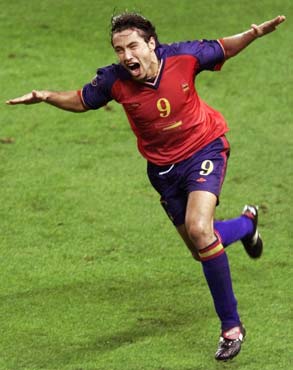
I never had time to do any chest-pounding even if I had been so inclined, because 16 minutes into the game, Spain scored and never looked back. In one of those innocuous transitional exchanges that so often decide matches, an American midfielder, unwisely challenging for control instead of just playing the ball out or away, lost the ball at midfield to a Spanish striker. As soon as the Spaniard took off down the right side with the ball, you could see the situation was dire. The midfielder was on an island, the U.S. defenders had pushed too far forward and were late getting back, and as the one fullback in decent defensive position raced to get between the striker and the goal, the Spaniard pushed a perfect lead pass to another striker rocketing down the middle a stride ahead of his defender. Blam! High into the back of the net. It was a gorgeous, textbook goal, the soccer equivalent of a long bomb from Kurt Warner to Isaac Bruce. And it must have rattled the U.S. fatally, because nine minutes later the U.S. defense broke down, allowing a Spanish player to come completely unmarked in the penalty area, from where he was easily able to pass off for another goal. The U.S. came back to 2-1 on a penalty kick, but for the rest of the game Spain went into a defensive shell and thwarted every attack. Spain, which won the gold in Barcelona in 1992, added a third goal in the game’s final minutes on a nice vulture shot off a deflection by the U.S. goalie. They’ll play surprising Cameroon in the final.
At the end of the game, I just had to ask. I turned to two of the go-Spain guys sitting behind me and said, “Why do so many Australians all root against the Americans?” One guy grimaced — caught! — then smiled sheepishly. He thought a minute and said, “I guess it’s American culture — it’s everywhere, you can’t get away from it.”
“I was pulling for Spain because I lived there,” said the other one.
“Yes, but I don’t think most of those people cheering for Cuba in the U.S.-Cuba game lived in Cuba,” I said.
He chuckled, then added, “Well, it’s the … I guess you could say arrogance. I mean, if in Spain they do something as well as the Dream Team, they don’t act the same way.”
He had a point there: U.S. star Jason Kidd unnecessarily insulted the Australian team, saying they weren’t good enough to play in the NBA. No class, Jason.
“Or Gary Hall,” said the first guy. Hall, of course, is the “we’ll smash you like guitars” American swimmer.
“Oh, I think Hall’s OK,” I said. “He was just spraying testosterone, the same way (Australian swimmer) Michael Klim was. He’s an OK guy.” They shrugged and said maybe.
“It’s really a love-hate thing with the U.S.,” the second guy said. He added that most Americans have never traveled and don’t have much of a sense of the rest of the world or how they were perceived. We exchanged have-a-good-Games pleasantries and left.
Riding back in a thunderstorm, I reflected on how hard it is for an American to understand how big and omnipresent we are, and how much resentment that breeds. I understood it, I thought, but I still didn’t like it. Anyway, the main thing, I told myself, was never again to be on my good behavior. It wasn’t any fun to be tasteful and sophisticated and cosmopolitan. They think we’re all arrogant, smug provincial blowhards anyway — so what difference does it make? My new motto: Dare to be an ugly American!
