
Olympics

All of us

Why the Olympics matter.

  • more
    • All Share Services

Topics:

All of us

I have seen the future of humanity, and it consists of the youth of the world standing on the field of a huge stadium listening to old, bad Australian pop hits and ogling Elle Macpherson.

And that ain’t such a bad thing.

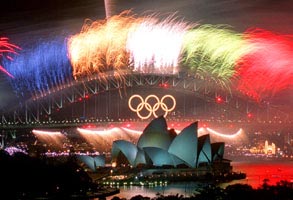
The Games of the XXVII Olympiad came to a close Sunday night at Sydney’s Olympic Stadium with a full display of Aussie irreverence, kitsch, partying spirit and forgettable rock ‘n’ roll. It wasn’t exactly a show to top the opening ceremonies — in fact, there were moments when it wasn’t even a show to top the opening of a car wash in East Lansing, Mich. But it wasn’t supposed to be. The crowd had a great time, the athletes from every corner of the globe broke out of their I don’t know anybody at this party shyness to form conga lines and retiring IOC President Juan Antonio Samaranch proclaimed the Games the best ever held. And when the prawn bicycles had wheeled off and Crocodile Dundee had cracked his whip and the crowd had sung “Waltzing Matilda” and the green and purple and white fireworks had exploded joyously and the 10,000 athletes reluctantly left the biggest stage of their lives, you walked out feeling the way you’re supposed to at the end of an Olympics: more hopeful about this amazing species we call the human race than you were before it started.

Closing ceremonies may actually be one Olympic ritual that’s better viewed on TV. Television picks out faces of individual athletes, so you can feel their emotions, their sense of the corny solemnity of the occasion. From the stands, it’s hard to see that. But what you do get is a majestic view of all of the athletes who took part in the Games, together in the same place. Theoretically, you may know the world is varied, but it isn’t until you see all those flags coming in that its full Noah’s Ark-like splendor is revealed. We have so many countries! So many languages! So many skin colors! So many customs, beliefs, religions! And all of them dissolved by the great universal solvent of synchronized swimming!

Looking at all of the athletes milling about on the field, united now in contemplation of Greg Norman driving golf balls off a float — at the end of history, do we all go to Disneyland? — it was impossible not to remember the battles they had engaged in for the past two and a half weeks. I had been privileged to witness hundreds of intense encounters, ferocious contests of will and skill and might. And to see all of the athletes together, rivals no more, celebrating with each other and the world the close of an ancient ritual of peaceful competition, was something rare and moving.

The United Nations, for all of its flaws, has a grandeur that derives from its role of resolving the world’s political issues. And the Olympic Games, for all of their flaws, have a grandeur that derives from their perhaps smaller, but more innocent role: bringing together the people of the world to play. It’s only sports, but the world finds no occasion to come together except this one. And you take brotherhood where you can get it.

For me, the high point of the last day came before the ceremonies began. The closing ceremonies always begin with the finish of the final Olympic event, the marathon, the runners ending their 26-mile run with a final lap in the stadium. The marathon may be the most unbelievable event of all. I was downtown at about 4 o’clock, riding my bike through Hyde Park, when a dragonfly-like swarm of helicopters overhead announced the marathon runners were going through. I had to catch the train to Olympic Park, which is 10 miles or so from downtown. I got right on and it blasted up there in 20 minutes. By the time I got through security, made my way into the stadium, bought a beer and found my seat, the leaders were nearing the stadium. Unbelievable — but I guess that’s what happens when you can run 26 straight five-minute miles.

The moment when Ethiopia’s Gezahgne Abera came running into the vast, roaring arena was epic, of course — the last and most grueling event of the Games, with its storied if dubious classical origins, ending under the Olympic flame. But the moment that stays with me took place about an hour later. Long after almost all the runners had completed the race, Elias Rodriguez, of the Federated States of Micronesia, came jogging wearily into the stadium. He was the last man in the field, and exhaustion was etched into his face. It is a tradition to cheer the stragglers, and the Aussies, with their great sense of sportsmanship and love of the underdog, had already given a fine ovation to Cambodian runner Rithya To, the next-to-last runner, who managed to stagger over the line before falling face-first to the track. And when Rodriguez began his final circuit, they clapped for him too.

But as he made his way around the track, something changed. The applause began to grow and swell, the sound cascading around the stadium as the lone figure trudged on. And then everyone was on their feet, cheering and clapping as Rodriguez went slowly by far below. It may not have been the loudest, but it was the deepest applause that I heard in the entire Games. We were saluting this one athlete, his effort, but we were saluting something more. We were saluting every athlete at the Games, the ones who won and the ones who lost, the great and the small, the famous and the obscure. And we were paying tribute to the best parts of ourselves, the elements that we had seen so nobly exemplified during these Games, the things that will endure when the world has long forgotten who won or lost a race: courage, tenacity and indomitable spirit.

And as the applause rang out, the sound falling like a waterfall or a hand on the shoulder, an odd refrain, a thought I’ve never had before, came into my mind: You can’t beat us, you can’t beat us. I don’t know who I was saying it to, but I know who I was saying it for. All of us.

Continue Reading Close

Gary Kamiya is a Salon contributing writer.

Pyeongchang awarded 2018 Winter Olympics

The South Korean city beat out Munich and Annecy, France

  • more
    • All Share Services

Topics: , ,

Pyeongchang awarded 2018 Winter OlympicsSouth Korea's figure skater and Olympic champion Kim Yu-na during the presentation of the Pyeongchang bid , in front of the 123rd International Olympic Committee (IOC) session that will decide the host city for the 2018 Olympics Winter Game, in Durban, South Africa, Wednesday July 6, 2011. The International Olympic Committee will announce the host city for the 2018 Winter Olympics in Durban, Wednesday, choosing between three candidates Annecy, France; Munich Germany; and Pyeongchang, South Korea for the 2018 host. (AP Photo/Rogan Ward, Pool)(Credit: AP)

The South Korean city of Pyeongchang was awarded the 2018 Winter Olympics on Wednesday after failing in two previous attempts.

Pyeongchang defeated rivals Munich and Annecy, France, in the first round of a secret ballot of the International Olympic Committee.

Needing 48 votes for victory, Pyeongchang received 63 of the 95 votes cast. Munich received 25 and Annecy seven.

The Koreans had lost narrowly in previous bids for the 2010 and 2014 Olympics.

Pyeongchang will be the first city in Asia outside Japan to host the Winter Games. Japan held the games in Sapporo in 1972 and Nagano in 1998.

Korean delegates erupted in cheers in the conference hall after IOC President Jacques Rogge opened a sealed envelope and read the words: “The International Olympic Committee has the honor of announcing that the 23rd Olympic Winter Games in 2018 are awarded to the city of Pyeongchang.”

The vote totals weren’t immediately released.

A majority was required for victory, meaning Pyeongchang received at least 48 votes among the eligible 95 voters.

It was the first time an Olympic bid race with more than two finalists was decided in the first round since 1995, when Salt Lake City defeated three others to win the 2002 Winter Games.

Had no majority been reached in the opening round, the city with the fewest votes would have been eliminated and the two remaining cities gone to a second and final ballot.

Pyeongchang had been determined to win in the first round after its previous two defeats. The Koreans had led in each of the first rounds in the votes for the 2010 and 2014 Games but then lost in the final ballots to Vancouver and Sochi.

Pyeongchang, whose slogan is “New Horizons,” campaigned on the theme that it deserved to win on a third try and will spread the Olympics to a lucrative new market in Asia and become a hub for winter sports in the region.

The Korean victory followed the IOC’s trend in recent votes, having taken the Winter Games to Russia (Sochi) for the first time in 2014 and giving South America its first Olympics with the 2016 Summer Games in Rio de Janeiro.

Continue Reading Close

Lindsey Vonn re-creates “Basic Instinct”

The Olympic skier pays homage to the famous cinematic crotch shot on the cover of ESPN

  • more
    • All Share Services

Topics: , ,

Lindsey Vonn re-creates

Olympic gold-medalist Lindsey Vonn has recreated that scene from “Basic Instinct” on the cover of ESPN magazine. And by “that scene” I do mean the one in which Sharon Stone infamously flashed her naughty bits to the world. It’s the magazine’s movie issue — why ESPN has a movie issue, I do not know — and it boasts a bunch of athletes reproducing classic film scenes. The headline accompanying the saucy cover photo is, wait for it, “Back to Basics.” Funny, I thought the magazine’s Body Issue — which came out just a few months ago and features exquisitely athletic naked bodies — was a return to “basics.” But it doesn’t get any more basic, or base, than paying homage to the most famous crotch shot in cinematic history.

Tracy Clark-Flory

Tracy Clark-Flory is a staff writer at Salon. Follow @tracyclarkflory on Twitter.

London 2012 plans for record 5,000 doping tests

Record number of athletes to be tested prior to 2012 games

  • more
    • All Share Services

Topics:

London Olympic organizers say a record 5,000 doping tests will be carried out at the 2012 Games.

The local organizing committee has signed a memorandum of understanding with Britain’s anti-doping body and will implement the testing program under the authority of the International Olympic Committee.

London 2012 director of sport Debbie Jevans says the size of the testing program will give a “strong message that drug cheats are not welcome at the London Games.”

UK Anti-Doping will train anti-doping officials and assist them during the event to carry out a 10 percent increase on the 4,500 tests conducted at the 2008 Beijing Olympics.

Olympic highlight reel

The most memorable moments of the Winter Olympics in Vancouver

  • more
    • All Share Services

Topics: , , ,

Olympic highlight reel

View the slide show

Raining on Canadian women’s parade

The gold medal winning hockey team boozes it up on the ice and sparks condemnation

  • more
    • All Share Services

Topics: , , ,

Raining on Canadian women's paradeCanada Haley Irwin, left, and Tessa Bonhomme, right, celebrate after Canada beat USA 2-0 to win the women's gold medal ice hockey game at the Vancouver 2010 Olympics in Vancouver, British Columbia, Thursday, Feb. 25, 2010. (AP Photo/Chris O'Meara)(Credit: AP)

Canada’s women’s hockey team has scored quite the controversy by daring to celebrate their win against the U.S. on Thursday by sipping beer, guzzling champagne and smoking cigars on the ice. After the fans filtered out of the stadium, the ladies returned to the rink still in uniform with gold medals draped around their necks. They laid on the ice, poured champagne in each other’s mouths and soaked up the Olympic glory. Their revelry hardly would have garnered any attention, except for one minor detail: there was an Associated Press photographer on hand to capture it all on film.

Now, the International Olympic Committee has reportedly written a letter to the Canadian National Olympic Committee “to find out a few more details,” and the team has issued a public apology. What’s the big deal, you might ask? For one, 18-year-old team member Marie-Philip Poulin was snapped holding a beer, and she’s just under the legal drinking age in British Columbia. OK, so that’s inappropriate, I guess — only, in her home of Quebec, the drinking age is 18. Are people really that scandalized that someone just weeks away from her 19th birthday was caught imbibing in Vancouver after winning an Olympic gold medal?

I suspect not. Judging by the online chatter over the “incident,” the age issue is but one more complaint shoveled onto the pile. Primarily at issue is that some perceive it as a display of poor sportsmanship, which I find kind of hilarious for two reasons: 1.) Ice hockey is one of the most impolite professional sports around (within five minutes of the first men’s hockey game I attended, two players had already resorted to fisticuffs on the ice), and 2.) Have these people never witnessed the hooting, hollering, fist-pumping, champagne-popping, and exclamations of “I’m goin’ to Disneyland!” at, like, any major sporting event? 

I hate to be predictable, but I gotta say it: I suspect there’s also a definite undercurrent of sexism here. For example, one blogger wrote:

My question is: Why ‘ladies’ play men’s sports and look so awkward (unlady like) in the process? Being a woman is all about being a woman (grace, softness…). Figure skating is by all standards a women’s sport, as we witnessed yesterday in Kim Yu-Na’s performance. Simply brilliant.

So ladies, make an attempt to look like females, stay away from men’s sports, don’t try to be like men, you know, that’s what the men are for.

Aw, I think he’s scared of the big bad lady athletes. Poor dude — we just aren’t used to seeing women engaged in such stereotypically manly celebration. Not only are they drinking beer, they’re also chugging champagne and smoking cigars. Looking through the photographs, you can almost hear their self-satisfied guttural belches — and, you know what? It makes me swoon in full-blown girl-crush mode. I mean, my cheeks actually ache because every time I catch a glimpse of those snapshots, I grin uncontrollably. Now these are some women I’d like to grab a beer with.

Why don’t all the haters take a note from these Canadian ladies: Grab a Molson’s and chill out, eh?

Continue Reading Close
Tracy Clark-Flory

Tracy Clark-Flory is a staff writer at Salon. Follow @tracyclarkflory on Twitter.

Page 1 of 37 in Olympics