
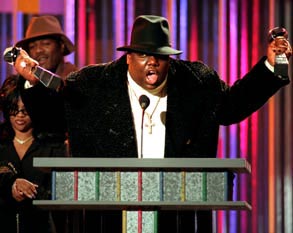

It was L.A.’s boldest gangland killing of the decade. On March 9, 1997, Notorious B.I.G. (aka Biggie Smalls, whose legal name was Christopher Wallace) was gunned down while he was leaving a star-studded Vibe magazine party after the Soul Train Music Awards. As hundreds of revelers poured into the streets, Biggie’s caravan entourage rolled out of the parking garage of the Petersen Automotive Museum in the mid-Wilshire district. The famed gangsta rapper, a former New Jersey crack dealer, was sitting in the shotgun seat of a green Chevy Suburban. Rap mogul Sean “Puffy” Combs was riding in the vehicle ahead of him.
When the cars stopped at a traffic light, a dark Chevy Impala pulled up alongside Biggie’s ride. The driver, a black male in a suit and bow tie, rolled down his window and fired seven shots from a blue steel 9mm semi-automatic into the green SUV’s front passenger door. Four of the bullets hit their mark. Biggie, 24, was pronounced dead less than an hour later, shortly after he arrived at Cedars-Sinai Medical Center.
Although there were a dozen witnesses and hundreds of clues, the Biggie killing remains one of L.A.’s most notorious unsolved homicides. Now, a former Los Angeles Police detective charges that the department’s failure to solve the case may be tied to an unfolding Rampart scandal coverup.
Last month, former LAPD Rampart task force Det. Russell Poole went public with charges that Chief Bernard Parks suppressed a report he had written on corrupt cops at the Rampart Division a full year before the scandal erupted. Poole, who resigned from the department last year after the LAPD brass ignored his complaints, also filed a lawsuit, claiming his career suffered as a result of his attempts to bring the scandal to light.
A member of LAPD’s Robbery-Homicide Division elite, Poole was one of the first detectives on the special Rampart task force. His work led to the arrest of officer Rafael Perez, the rogue cop whose confessions later triggered the worst scandal in LAPD history. But Poole charges that Chief Parks suppressed his early report on troubles in the Rampart Division, and that Parks and top LAPD brass refused to adequately investigate dirty cops, even when obvious clues pointed to them.
That reluctance to get to the bottom of police corruption, Poole says in his lawsuit, hampered his investigation of the Biggie Smalls murder. When he began turning up clues that pointed to involvement by David Mack, an LAPD officer and friend of Perez serving time for an armed bank robbery, he was prevented from aggressively pursuing the investigation.
Poole’s lawsuit has already made waves in Los Angeles. Days after he filed it, his attorney, Leo Terrell, presented his case at a hearing of the police commission, where he demanded Chief Parks’ resignation. Parks issued a statement denying the allegations.
Meanwhile, the Los Angeles District Attorney’s office, which has been conducting grand jury hearings on Rampart, called Poole in for more interviews. Prosecutors also filed court papers charging that the LAPD had intentionally hindered the criminal case against four officers in the first Rampart trial, which started last week. Echoing charges made by Poole, the court papers stated that LAPD detectives have failed to conduct thorough investigations and failed to turn over vital information to prosecutors, causing the exclusion of at least five prosecution witnesses. And in a development the DA’s office insists is unrelated, the head of its Rampart prosecution team, Dan Murphy, resigned from that post, citing health concerns.
What may be the biggest new Rampart development, however, is the allegation by a former girlfriend of Rafael Perez that she saw Perez and fellow officer David Mack kill two people in the mid-1990s when a cocaine deal went bad. Sonia Flores, 23, made the allegations in an interview with the Los Angeles Times; last week she traveled to Mexico with an assistant U.S. attorney and FBI agents to show them a dump in Tijuana where she said the pair disposed of the bodies.
Sources say federal authorities could seek an indictment against Perez, since the 1999 immunity deal he cut with the DA in exchange for his testimony on the Rampart scandal won’t protect him from prosecution if the FBI turns up independent evidence against him. Attorneys for Perez and Mack deny the allegations.
According to Poole, the trail to Rampart, and the Biggie probe, actually started with his investigation of the March 1997 shooting death of Officer Kevin Gaines. Gaines was killed by an undercover narcotics cop, Frank Lyga, after Gaines threatened Lyga with a gun during a traffic altercation. In the ensuing police investigation of the unusual cop-on-cop shooting, Poole uncovered evidence that Gaines was corrupt.
An informant told Poole that Gaines was moving money and drugs for rap music czar Marion “Suge” Knight of Death Row Records. A Death Row insider told him that Gaines and another cop, David Mack, were “confidants” of Knight’s. Gaines had been living with Knight’s ex-wife Sharitha, who was rapper Snoop Dogg’s manager. He was living large — nice clothes and cars, nightclubs, women — and had dropped $952 for lunch at a gangster hangout shortly before his death. Gaines was already under investigation by the LAPD’s Internal Affairs Division, and would have been fired had he not been killed by Lyga.
Despite what he learned, Poole says in his lawsuit that LAPD higher-ups prevented him from investigating Gaines any further. “I wanted to do a financial investigation on Gaines,” says Poole. “You know what the department said? ‘No. He’s dead. This case is closed.'”
His superiors also kept Poole from taking a harder look at David Mack and his friend, Rafael Perez. Like Gaines, Mack and Perez were living way too well for police officers. Their player lifestyles included fancy clothes, expensive cigars, nightclubs and frequent trips to Las Vegas. Mack was later arrested in December 1997 for the armed robbery of a Los Angeles bank. Mack’s two accomplices were never caught and the $722,000 stolen from the bank has never been recovered.
Investigators suspected that Mack’s buddy Perez might have had some involvement in the crime. (Perez admitted to partying in Las Vegas with Mack after the robbery but said he knew nothing about the crime.) The ensuing LAPD task force probe led to Perez’s arrest on charges of stealing cocaine evidence in August 1998. The Rampart scandal erupted a year later when Perez cut a deal for leniency and agreed to talk.
Meanwhile, Poole and his partner at Robbery-Homicide, Fred Miller, were given the Biggie Smalls case in April 1997, shortly after they started investigating Kevin Gaines. They pursued over 250 leads and interviewed dozens of witnesses, informants and Biggie associates. They began turning up clues that pointed to David Mack. But Poole charges that he was prevented from following these leads because of the LAPD’s reluctance to examine even a known dirty cop.
Mack’s apparent ties to Suge Knight were part of the puzzle. Many of Biggie’s associates believed the rapper was killed on orders from Knight, as retaliation for the September 1996 killing of Death Row’s star rapper Tupac Shakur in Las Vegas. Knight was also wounded in that shooting, which remains unsolved. Knight had been engaged in a long-running feud with New York rap mogul Puffy Combs. More than a dozen gangsters had died in this feud, including three of Knight’s “executives,” his bodyguard Jake “The Violator” Robles as well as, it was widely believed, Tupac.
While some speculated that the murder of Biggie Smalls, who was the top rapper on Puffy’s Bad Boy label, was the Death Row clan’s payback for Tupac’s slaying, another theory held that the killing was related to the ongoing conflict between the rival Crips and Bloods gangs. Some investigators believed these alternate theories could be connected, since Knight was a Mob Piru Blood, their investigation showed, and Combs had ties to LA’s Southside Crips.
As in most gangland disputes, drugs may also have been part of the mix. A cop who worked for Death Row security but was in fact an FBI task force undercover agent reported that “Los Angeles Crips and Bloods [including some who worked for Death Row] were transporting kilos of coke to the East Coast, buying them for $18,500 in LA and selling them for $26,000 in New York.” Numerous disputes had resulted in the course of this trade.
Another informant told the LAPD that Kevin Gaines and other LAPD officers “provided security for members of Death Row Records during various criminal activities. The officers accompanied the members during drug deals and acted as lookouts and advisors. The officers monitored police frequencies, assisted in choosing locations for drug transactions and gave information on police tactics.”
Mack had come to Poole’s attention when a Death Row insider identified him and Gaines as “confidants” of Knight. (An attorney for Knight disputes that the rap mogul, now in prison for a 1992 attack on two rappers, even knew Mack.) Poole learned that Mack had grown up in the same Compton neighborhood as Knight. He often sported the same fancy red suits as Knight. After Mack was arrested for the bank robbery in December 1997, he admitted to being a Blood, like Knight. Soon more clues surfaced that pointed to him playing a role in the Biggie killing.
For a variety of reasons, Biggie’s murder appeared to be very well planned and not a chance encounter by some rival. For one thing, the shooter, who pulled up alongside Biggie a block away from the museum, was alone in his car. He had to know which vehicle of the motorcade Biggie was in, which seat in that vehicle (it had tinted windows) and in which direction the caravan was headed. Amid the noise and hubbub of Biggie’s departure, witnesses also reported hearing police radios, held by unidentified males, which might explain how a lone shooter, a block away from the museum, could know Biggie’s location when he came upon the car.
According to police investigative files, Mack was placed at the scene by a member of Biggie’s entourage, Damien Butler, who picked him out of a photo lineup. Butler, who walked in and out of the party with Biggie and drove in the same car with him, positively identified Mack as one of the men standing by the carport entrance of the Petersen Auto Museum. Poole discovered from department logs that Mack took a series of “family sick days” off prior to and during the weekend Biggie was killed, just as he had when he committed the bank robbery. (Mack had employed police radios for the bank job, which was also meticulously planned.) Later, when Poole served a search warrant at the home of Mack’s close friend Rafael Perez, he seized a number of police scanners and radios.
Some witnesses reported the shooter’s car was a dark green Impala, while some said it was a black Impala. The most reliable witness, an Inglewood cop working security for Biggie who followed the car, described it as black. David Mack owned a black Chevy Impala.
Eyewitnesses identified the shooter as a bow-tied African American dressed in the conservative style favored by Black Muslims. Mack was a Muslim, but he didn’t match the composite drawing of the shooter made by witnesses. An informant had previously told investigators that Biggie’s killer might have a Middle Eastern name, possibly Amir. Investigators noticed that the first person who visited Mack in jail following the bank robbery happened to be a man named Amir Muhammad (also known as Harry Billups). The fact that Billups/Muhammad gave a false address and false Social Security number on the visitor form heightened their suspicions about him.
So did a 20-page police computer search on Muhammad, which turned up a string of eight prior addresses, all with no forwardings. These included addresses in Las Vegas and Eugene, Ore., where Mack and Muhammad went to college. Finally, the ID photo on Muhammad’s driver’s license (which also had a wrong address) looked like a possible match to the Biggie shooter composite made from two eyewitness accounts: a medium-skinned African American man with a long, angular face.
With all these pieces in front of him, Poole felt it was imperative to at least find Amir Muhammad and interview him. His superiors disagreed. They did not want to pursue a theory that pointed to a cop, he says. The bank robbery detectives who searched Mack’s residence discovered a large stash of guns and ammunition and a black Chevy Impala, as well as what they described as “a shrine” to Tupac Shakur at his house. Poole wanted to get a search warrant to seize Mack’s car and ammunition, which had been left behind by the bank robbery investigators, but he was not allowed to.
“They told me, ‘We’re not going to get involved in that.’ Their attitude was, ‘Mack had already gone down for bank robbery. Let’s not get involved in more controversy.'”
Former LAPD Deputy Chief Steve Downing, like many current and former officers, is appalled not only by Poole’s allegations, but a growing chorus of similar complaints. A class action whistleblower lawsuit against the LAPD has now been signed by as many as 109 plaintiffs, all of them cops who claim they were punished or harassed for trying to bring attention to officer misconduct. “Anytime you have leads in a case pointing to a cop,” says Downing. “it’s even more important that it be pursued to the absolute end. And you also have to ask the question: who else is involved? Have any other officers been infected by these activities?”
Indeed, Poole thought it was important to interview Muhammad because he suspected Mack was involved in other crimes besides the bank robbery, and the detective thought Mack’s old friend might have useful information. After he went to jail, Mack had attempted to arrange the murder of a girlfriend, a bank teller who helped him plan the bank robbery but then turned on him. He also told an inmate: “I can do my eight years and the money (nearly three-quarters of a million dollars, none of which has been recovered) will be waiting for me when I get out. I’ve got somebody investing it for me.” Whatever the LAPD might learn about David Mack from Muhammad would be useful, Poole reasoned. But the department, he says, didn’t want to learn anything.
So after conducting their initial computer search for Muhammad, which turned up the string of false addresses, the LAPD task force did not continue to look for him. “Nobody at LAPD made a real effort to find Billups (Muhammad),” he complains. “They didn’t pursue him aggressively the way they should have.” Instead, police investigators pursued other theories, but only half-heartedly. “We had hundreds of clues,” says Poole, “but we were constantly diverted by stupid clues that were nothing.”
Citizens often become police suspects due to as little as one piece of circumstantial evidence linking them to a crime, such as owning a rare make and model car, or having a relationship with a victim and no alibi the night of the crime. By contrast, Poole gathered more than 20 solid clues pointing to Mack, including Mack’s relationship with Suge Knight; their ties to the Bloods; Knight’s war with Puffy Combs; the sudden sick days Mack took around the time of the murder; the use of police radios; and the fact that Mack was seen at the scene of the killing.
Then there was Mack’s black Impala, the stockpile of ammunition at his house and even the shrine to Tupac, discovered by robbery detectives after Mack was arrested. More clues pointed to his friend Billups/Muhammad, including Muhammad’s resemblance to the composite drawing of the shooter, the informant’s tip that the shooter had a Middle Eastern name, possibly Amir, as well as the long train of false information Muhammad left in his wake.
There were inconsistencies in the evidence in the Biggie killing, Poole admits, as well as in the stories told by witnesses. Some thought the shooter was in his 20s, while Muhammad was in his late 30s at the time of the killing. Other informants suggested the killer was a member of the Southside Crips, not someone affiliated with Knight and the Bloods, and that Biggie was killed in a dispute over money. Even the informant who said the killer might be named Amir also listed Abraham and Ashmir as other possible names.
For his part, Amir Muhammad has vehemently denied playing a role in the killing. “I’m not a murderer, I’m a mortgage broker,” he told the Los Angeles Times when he finally surfaced earlier this year. But sources say he has yet to be interviewed by police. (His attorney did not return calls to Salon.)
Poole doesn’t claim he knows who killed Biggie Smalls. But he has firm ideas about which leads should have been followed. Based on his detective work, he says, Mack and Muhammad qualified as reasonable suspects who deserved to be investigated.
Some suspects in the Biggie killing were eliminated for good reason, like having alibis. According to Poole, Mack was dropped because he was a member of the Los Angeles Police Department. And investigators stopped looking for Amir Muhammad because of his ties to Mack.
While there has been no loud public outcry to solve the crime, friends and family of Biggie Smalls have expressed frustration over the lack of progress in the case.”I’m sick to my stomach over the way this case has been handled,” Voletta Wallace, the slain rapper’s mother, told the Los Angeles Times late last year. “There is a murderer out there laughing at my family and laughing at the cops. And it makes me furious. I’ve held my tongue for months now, but I’m fed up with the police just pussyfooting around.”
