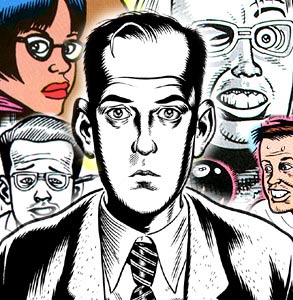

Daniel Clowes opens the door to his Berkeley, Calif., house, and the image of him standing there — as if in wary anticipation of some unforeseen but likely horror — recalls at least half a dozen of his comic book characters in action. Clowes himself is ethereal in a way that makes you wonder if his feet are actually touching the ground. He resembles one of his creations, with their neatly pressed, buttoned-down clothes and tentative, slightly anxious eyebrows hovering in mid-forehead. Framed by the straight lines of the doorway, it’s almost as if he has drawn himself — just before finding Tina, the potato-headed mutant from his first serialized story, “Like a Velvet Glove Cast in Iron,” naked and sobbing on the steps.
Clowes — whom fellow cartoonist Chris Ware calls “easily the best cartoonist in America” — is probably most famous for his original comic book series “Eightball.” “Eightball” has been variously described as a “cult,” an “alternative” and an “underground” comic — meaning that Clowes doesn’t draw mutants, aliens or men in tights. Or rather, when he does, his mutants are lonely teenagers working as waitresses at roadside diners, his aliens — sports fans, New Agers, stockbrokers, idealists — are terrifyingly terrestrial and his spandex-clad crime fighters pop up primarily in the ardent fantasies of Young Dan Pussey (pronounced, of course, “Poo-say”), superhero comic book “penciller” and recurring “Eightball” underdog turned insufferable success.
Success spoiled Dan Pussey, but it definitely hasn’t spoiled Dan Clowes. If Clowes is a cynic, then a cynic is a disappointed romantic who takes the world very, very personally. Twice a year for the past 11, “Eightball” has mercilessly taken on middle-class conformity, artistic pretension, teen angst, cartoonists, hipsters, the horrors of adulthood, proselytizing Christians, sports fans, sexual banality and desperation, advertising, consumerism, the entertainment industry and, perhaps most consistently, Clowes himself — in haunting, hilarious and beautifully rendered stories of every length. While his drawings are darkly beautiful and eerily precise, typically the characters of “Eightball” fall somewhere between plain and repulsive. “My mom would always say, ‘Why are your people so ugly?’” laughs Clowes, whose take on his characters has softened somewhat over the years. The sharp, scathingly misanthropic energy of the early-’90s “Eightball” has mellowed into a moodier, more melancholy empathy without losing any of its satirical bite.
“Somehow,” says colleague Ware (whose graphic novel “Jimmy Corrigan: The Smartest Kid on Earth” was recently published), “he’s able to blend satire and sympathy, two sensibilities which are generally mutually exclusive.”
Now on issue No. 21, “Eightball” is one of Fantagraphics’ bestselling titles (along with Ware’s astonishing, hyperelaborate “Acme”). In his 15 years as a professional cartoonist, Clowes has won numerous Harvey Awards (including ones for best writer, best continuing series and best single issue); published seven graphic novels, among them the recent “David Boring”; and written the screenplay for the upcoming Terry Zwigoff-directed feature film “Ghost World” — which is being produced by John Malkovich and will star Thora Birch and Steve Buscemi — from a story first serialized in “Eightball” and later published as a graphic novel of the same name.
Clowes’ house is calm, quiet and crammed with meticulously arranged and organized stuff that makes you want to sit on the floor immediately and start rummaging through it. His office, in particular, is an art director’s dream. Books line the wall-to-wall shelves, and freshly drawn panels rest on a wooden drafting table, patiently awaiting ink. Clowes and his wife, Erika, whom he met on a small-scale California signing tour in 1992 (“I had just gone through a depressing separation from my first wife, and was trying to escape from the grim horribleness of Chicago; a beautiful young woman in Berkeley asked me to sign her underwear, and the rest is history”), will soon vacate the house for a larger one not far away. When I remark on the enviable order of the place, Clowes tells me it is neater than usual because he’s expecting movers, who will be arriving soon to give him an estimate.
“Actually, they’re packers,” he amends. “Did you know that those are separate jobs? I didn’t know until a good friend of mine turned out to be a packer.”
Packer or mover, it’s hard to imagine either would require a customer’s folders to be labeled in artful, award-winning lettering and arranged by date. Then again, the kind of movers Clowes would create just might. And then they might tie him up, carve a supermarket logo into his heel and make rare Asiatic sea crustaceans come out of their eyes. When I point this out, Clowes admits to his penchant for structure. “I whipped my wife into shape,” he says. “She got tired of having me ask, ‘Why is this not in alphabetical order?’”
“Ghost World,” which gradually took over the pages of “Eightball” before “David Boring” almost entirely engulfed it, was a marked departure from the nightmarish underworld of Clowes’ first serial, “Like a Velvet Glove Cast in Iron.” For one thing, the protagonist of “Ghost World” is a teenage girl; for another, the sense of horror that pervades “Ghost World” did not depend on strange, supernatural happenings or secret parallel worlds.
There has always been a feeling of jittery unease underscoring Clowes’ work, but in “Ghost World,” the sense of dread and horror emanates more from the real world than from the supernatural one. The creepy disquiet of “Ghost World” is nourished by television, suburbia and the soul-sucking banality of both. The serial’s panels are cast in the eerie blue light of the television — which is always on, always talking, never saying anything.
“Ghost World” is the melancholy story of the tail end of a friendship between two alienated teenage girls, Enid Coleslaw (her name is an anagram of “Daniel Clowes”) and Becky Doppelmeyer, who live in a strip-mall-studded, palm-tree-lined, undifferentiated world of fake ’50s diners and existential pain. Whatever hurt they don’t experience themselves, they cruelly inflict on others. Enid, in particular, does not suffer America quietly. She mercilessly baits and humiliates the disenfranchised and disappointed adults she sees all around her while narrowing her world of acceptable people to two.
Clowes doesn’t even exempt himself from the ranks of creepy adults who seem to exist only to let down Enid and Becky. In one episode, when Becky accuses Enid of being a man hater, Enid defends herself by claiming that her ideal relationship would be with the “famous cartoonist David Clowes.” Yet when she shows up at a comic book store where he’s scheduled to make an appearance, she finds a vaguely creepy guy sitting alone at a table in the back of the room, hiding behind a stack of comics.
“I felt I had given myself a privileged position to eavesdrop on her world, and it was only fair that she should hold me to the same scrutiny that she does everyone else,” says Clowes on why he chose to make himself repulsive to his favorite character. Disappointed, Enid takes off without meeting him.
Clowes’ knack for capturing this particular brand of arty teen-girl angst was so uncanny that he has since been accused of following young girls around and spying on them with a tape recorder. But like most of his characters — some of whom make no bones about being just “another transparent D. Clowes stand-in” — Enid is a fully realized character whose struggle to define herself and understand the seemingly unreal world around her reflects her creator’s main preoccupations. As Enid embarks on the painful quest to become her adult self, she leaves the more passive Becky behind.
“When I started out I thought of her as this id creature — totally outgoing, follows her impulses. Then I realized halfway through that she was just more vocal than I was, but she has the same kind of confusion, self-doubts and identity issues that I still have — even though she’s 18 and I’m 39!”
In “Ghost World,” Clowes captures the way real teenagers simultaneously devour and reject the bogus images of themselves produced by the media. In the first episode, Enid chastises Becky for reading Sassy magazine, which is staffed by “trendy, stuck-up, prep-school bitches who think they’re ‘cutting edge’ because they know who Sonic Youth is.” At the end of the episode, Enid is kicking back on her bed, flipping through the magazine’s glossy pages and muttering, “God, look at these stupid cunts.” (“She loves it,” says Clowes of Enid’s closet Sassy obsession. “She can’t stop reading, but she hates it.”)
Clowes had problems with Sassy too. The magazine once swiped a frame from “Eightball,” used it as an illustration and never paid him for it, despite his polite requests. So by the time he began work on “Ghost World,” he was a man with a mission: “I want to create two girls who are much cooler than anything in Sassy, and who will make people not like Sassy.” Ironically, Clowes’ own experiences in Hollywood dispelled any notions he may have had about the movie industry being any more clued in to the way teenage girls think than the magazine world is. Even Clowes, a professional cynic, was taken aback by the sheer weight of the institutional mediocrity and lack of insight that daily threaten to crush any and all fresh ideas that manage to crawl into its sight.
“The things that happened were all the things you would think of. You think the fiction of Hollywood has to be exaggerated, and it’s just not. I was shocked. I always thought there were really smart people working in Hollywood who were just really cynical, and they knew that the movies they were making were not that good, and they were doing it because they tested well. But mostly it’s a very middlebrow to lowbrow kind of town. And they’re making films that they approve of.
“It’s also a very parochial world. If you have any sort of outsider’s vision at all — and I consider ‘Ghost World’ to be just a hair outside something that anybody could understand; this is not exactly a Samuel Beckett play — they treat it like you are turning in ‘Gummo’ or ‘Last Year at Marienbad.’ They treated ‘Ghost World’ like it was this outrageous art film that nobody would get. And it’s just a coming-of-age story that’s only slightly different than what they’re used to. They would say, ‘Oh, it’s great, we’ll get Jennifer Love Hewitt.’ And we’d think, ‘Wait, that’s what this is opposed to!’ I’m sure she’s a nice person and everything, but she’s got the opposite personality than these girls have! And they would say, ‘Oh. I thought she was supposed to be really pretty.’”
Clowes and director Zwigoff met with a lot of resistance, mostly from men, who argued that Enid and Becky were not representative of real teenage girls. “They’d say, ‘Girls don’t talk like this. Girls don’t swear.’ It’s like this weird patriarchal thing that goes down the line. The guys in charge are very concerned with that. They really refused to believe that these were realistic characters. And then, of course, all the 20-year-old women there were like, ‘No, these are realistic characters.’”
It took Clowes and Zwigoff years to get enough money to make “Ghost World” right. Raising the money and finding someone to finance their vision were “an ordeal, such a chore.” There were years of sitting by the phone every day, of big meetings at which someone would say, “I love it! You have to change this and this and this.” “Ghost World” was paraded by every studio in town before an acceptable deal was made.
On the bright side was working with Zwigoff, which Clowes says was what it must have been like to work with hands-on, visionary directors such as Alfred Hitchcock or Stanley Kubrick. “He was not so much a writer as the guy I had to please. So I would write all this stuff and he would say, ‘I like this, I don’t like this.’ It was all sort of filtered through him. It’s very much his work. We had a blast working together.”
Clowes wrote “David Boring,” his newest graphic novel, while he was working on the “Ghost World” movie. The book traces the operatic final months of a tortured 19-year-old security guard turned screenwriter who meets the girl of his dreams (she had a precursor, of course, a Nabokovian forbidden cousin in childhood) only to lose her to a cult. His quiet life gets progressively weirder, and after a variety of bizarre twists and gunshot wounds Boring winds up stranded on an island with his cousin as the world comes — or does it? — to an unclimactic end.
“I wanted the story to end with an explosion of happiness that was ultimately really depressing — which is hard to do,” says Clowes about his bittersweet ending.
“Stories come from whatever your psychological state is at the time of writing. A lot of it came from my situation of working on this movie. There’s a lot of subtext about movies throughout the whole thing. I was working on ‘Ghost World’ with this female producer [Lianne Halfon] and Terry [Zwigoff], and we had this sort of family dynamic going the whole time. I was the son who was both the gifted genius and the ignored nobody. And I realized this producer was extremely hard to please. We’d do our best work and she’d find something wrong with it. And that all started coming out in these characters — David’s mother and distant father.”
Boring is one of the few major Clowes characters who doesn’t represent part of himself. “I was actually trying to create a character thinking, ‘What if I had a kid? What if I had a son and he turned out to be like these horrible kids in Berkeley that I see every day — these pot-smoking and skateboarding guys who listen to bad music?’ I started thinking, ‘God, I’d be so embarrassed! That would really be painful for me.’ I thought, ‘What kind of son would I like to have? Who would be a guy I would actually like?’”
Clowes was also thinking about the process of creating comics. “It’s like these characters come alive from a kind of marriage between the cartoonist and the reader. And this merging of them is what created the character David Boring.” He invented for David a mysterious, God-like cartoonist father and a cold, disapproving mother — “sort of a stand-in for how I view the audience, as this cold, disapproving outside entity,” he laughs.
The aesthetic that runs throughout Clowes’ work seems to borrow heavily from a dim Chandler-esque vision of ’50s urban decay and despair. The look has been described as “noir,” but Clowes, who grew up on Chicago’s South Side, says, “I grew up in a very urban neighborhood that had absolutely no qualities of suburbia, so I think my frame of reference was decaying old buildings and water towers, and it just all seeped into my consciousness. When I started drawing comics, and I thought about where a person would be walking around, it was like, ‘Oh, a horrible-looking, graffiti-covered alley!’ As a result, it seems like I’m trying to go for some kind of film noir look, but it’s really just the world I’m familiar with.” Even living in Berkeley — which to Clowes is absolute suburbia — for the past eight years hasn’t influenced his vision. “When I close my eyes,” he says, “I still see Chicago.”
Clowes was born in Chicago in 1961, and his childhood was “perfect if you want your child to grow up to be a cartoonist.” He was a “shy, loner, bookworm kind of kid” who liked to sit in his room and do comics. His parents, an auto mechanic and a steel-mill worker (“who made things in the basement in his spare time, including, for five years, stuff from the unassembled parts of an airplane — the wings and part of the fuselage — and a harpsichord”), divorced about a year after he was born. His father now makes furniture on commission, while his mother, who is 70, attends law school in Chicago.
“I remember never having got what had happened, and never having a sense of my parents’ ever having been together. It was just this big mystery; nobody ever talked about it.”
Clowes inherited his much older brother’s bedroom along with a giant stack of comic books, long before he could read. Clowes remembers looking at them and trying to figure out what was going on in the stories and trying to decipher the coded message that his brother surely had left for him to unravel.
“I remember feeling like he was trying to tell me something — as if by selecting these particular issues to buy, he was illustrating some psychological state. I was just picking this up intuitively. I always thought about it when I grew up. The comics all had these really specific images running through them that really haunted me.”
When Clowes was 2 years old, his mother married a stock-car racer and opened an auto repair shop “in the worst neighborhood” on the South Side of Chicago. Not too much later, her new husband was killed in a race, and Clowes’ mother sent him to live at his grandparents’ house.
“I remember this big tumult as a kid. I had a long time during my childhood where I would spend each night at a different house, my dad’s, my mom’s and my grandparents’. It was really disjointed. It was a horrible childhood in that regard. It felt like I was in a suitcase. I remember a couple of times going to sleep at my dad’s, and my mom would carry me to her house while I was asleep — and I’d wake up at her house and be totally disoriented.”
Clowes’ grandfather, James Cate, was for three decades a professor of medieval history at the University of Chicago. His close friends included Robert Maynard Hutchins, Edward Levy, John Hope Franklin and Norman Maclean, and he was famous among students for his west Texas drawl and storytelling abilities. Clowes’ grandmother was a “faculty wife” and the person to whom he was closest during his childhood. Clowes spent his summers at their house in Michigan, in a little cottage where there were no other people for two miles in any direction.
“That’s where my imagination developed,” he says, laughing. “I’d be playing with sticks and rocks, pretending they were my friends — so if you want to turn your child into a cartoonist, lock him in a room with a bunch of sticks and rocks.”
After graduating from high school, Clowes attended art school at Pratt Institute in New York. (“You’ve heard of it?” he asks, surprised.) He chose Pratt because “it was the only art school that had a dorm, and I couldn’t afford an apartment in New York.” Of his experience there he says, “I didn’t learn anything, but my worst fears about art were confirmed — that it was all about who you know and had a lot to do with having the gift of gab and being able to talk yourself into getting a gallery show and all that. I knew I didn’t have that. So I trained myself to do what I wanted, which was to do comics.”
His professors, many of whom he immortalized in the caustic and extremely funny “Art School Confidential” (which appeared in “Eightball” No. 7 and is the basis for the screenplay he is currently working on), were not supportive. “Every professor I had discouraged me and said, ‘You’ll never make a living from that; nobody cares, nobody will think of you as an artist.’ And now I realize, when I look back on them, that they were absolute failures.”
After art school, Clowes remained in New York and tried to get work as an illustrator. He would make a little money, then wait around for the next job. “It was hard. I started doing comics to keep my sanity. When Fantagraphics decided to publish ‘Lloyd Llewellyn,’ I was shocked.”
“Lloyd Llewellyn,” a ’50s pulp-inspired private-eye parody series first published by Fantagraphics in 1985, was canceled after just six issues. “When ‘Lloyd Llewellyn’ was canceled,” says Clowes, “I thought, ‘Oh well, there goes my career.’”
He then started work on “Eightball,” which was just the sort of multicharacter, multistory book he’d been wanting to do. “I thought, ‘Well, here’s my chance to do whatever I want, and nobody will buy it, but at least I’ll do a couple of issues.’”
When issue No. 1 of “Eightball” — which was then subtitled “An orgy of spite, vengeance, hopelessness, despair and sexual perversion” — first hit the shelves in October 1989, its scathing, misanthropic indictment of the banal horror of American life was bound to strike a chord. (“I wasn’t filtering myself at all. I was very depressed and I did the angriest, most obsessive stuff and, of course, it’s what people responded to.”) Though Clowes feels he was dragged “somewhat against my will into this youth culture/postmodern counterculture,” he acknowledges that “there was a sort of zeitgeist going on and ‘Eightball’ spoke for people.” If its nightmarish story lines weren’t exactly exercises in realism, the queasy, unsettling feel of the series definitely reflected a collective sense of anger, resentment and dread. By issue No. 3, “Eightball” had caught on big.
When not railing at anyone who is not just like them, impaling frozen carp on their permanently erect penises, critiquing pure capitalism in “Richie Rich” parodies, running from their mothers or contemplating the ideal suicide scenario, the assorted freaks, misfits and misanthropes who populate “Eightball” spend a lot of time searching for their elusive ideal mate, often with horrific unintended results. Clowes has had experience with this, “though not in the past eight years.” But he also thinks his characters’ punishing search for perfection is somewhat of a metaphor (albeit, in most cases, unconscious) for “the endless frustration involved in trying to achieve that unnameable goal — some combination of truth, beauty, perfection — in my art.”
“Eightball” has evolved, he says, to keep him interested. After having devoted much of the past few years to the apocalyptic story of “David Boring,” the upcoming issue will consist entirely of two-page stories. “It’s just gone through so many phases now. I’ve gone through probably five sets of readers. You get sort of identified with an era like that, and then that era passes and you have to either stick with it and hope it’ll come back into vogue or go on your way and change a lot over time,” says Clowes. “Different kinds of stories interest me. I think a lot of cartoonists get into something that they’re really successful at and they stick with that, and then they’re not that interested in it after a while and that comes through.”
When fellow cartoonist Ware moved to Chicago in 1991, he was invited by Clowes and a group of other local cartoonists — Gary Leib, Archer Prewitt and Terry Laban — to join them in drawing improvisatory comics (which they called “minis”).
“It was a welcome diversion, since I didn’t really know anyone in town,” says Ware. “Plus, I also got to see how they all worked, particularly Dan. It seemed as if he could draw anything, and whatever he did was always perfect — not overdone, forced or uncertain. It all made me initially simply want to give up cartooning; but eventually I realized that I had to work much, much harder at it.”
“‘Eightball’ is the greatest comic book of the last two decades,” Ware adds, “and every issue is a huge step forward from the last — which always seems to be an impossibility. I don’t think that a statement like that can easily be applied to many other cartoonists’ work. It’s inspiring and comforting to know that he’s always forcing himself to improve. His stuff makes the rest of us reconsider our own, and moves all sorts of subject matter that had seemed impossible before into approachable range.”
Clowes is “painfully aware of the disregard and lack of respect that the rest of the world has for our chosen profession,” Ware says, “but he also takes what he does very seriously. He once made me buy a huge book that lists hundreds of mostly obscure cartoonists, illustrated by self-portraits and hopeful autobiographies, which, he confessed, actually had made him get misty-eyed one day because of its undeniable grimness. I knew he wasn’t kidding, as his eyes sort of went off in two different directions with the memory of it. He said I should have a copy so that he could call me up anytime and say, ‘Look at Page 334,’ and I’d know exactly what he was talking about.”
Clowes’ tortured but hilarious forays into self-exploration are well-documented in the pages of “Eightball,” perhaps most brilliantly in the story “Just Another Day,” in which young Clowes brushes his teeth, flosses, shaves and sniffs a dirty sock. The “real Clowes,” who is directing this pathetic scene from a soundstage, interrupts the action to mock the reader and call his agent from his convertible. Then the “real real Clowes,” who is drawing all this, is suddenly gripped by self-doubt — he is really just a self-hating, sensitive “artiste” whose opinion of himself shifts with the breeze. This confession prompts the Operation Desert Shield T-shirt-wearing “actual really real Clowes” to come out and take charge. Or maybe that’s not quite right. The story spirals into a hilarious slide show of possible identities. Who is Clowes? Is he a revolutionary? A scholar? A boring Midwestern cartoonist? A cross-dressing necrophiliac?
“It’s hard to have any self-image when you do something like this, because I get no feedback for what I do until it’s long finished. And then I don’t really care. I’ll work on something for six months just in this room, and I don’t even let my wife read it. She has to read it when I’m not around and not talk about it or I get really angry,” he says, laughing. “So I don’t have any feeling of my place in the world; it’s just like I’m living with this blank slate. Of course, I grew up thinking of myself as an outsider because I wasn’t in the in crowd in high school like everybody else, but now I don’t know what I’m in.”
I get the feeling, though, that it doesn’t really matter. In or out, the sense of discomfiture that permeates “Eightball” is all his own — which is lucky for us, because if success hasn’t spoiled Dan Clowes, total peace of mind just might.
So I’m somewhat relieved when he says, “You know, I’ll get a call from the New Yorker or something, and I’ll think I’m a big success! And then two minutes later I read a bad review and I think I’m the biggest loser! My wife goes crazy because I change so drastically. I’m like, ‘Honey, we’re rich! We can get whatever we want.’ And then the next day, it’s like, ‘We have to really tighten our belts; my career is going down the toilet.’”
Imitation is the sincerest form of flattery, unless the copycat has mixed feelings about the cat, in which case it can also be fairly handy as an embarrassing mistake. “Kingpin,” NBC’s new six-episode miniseries about a drug cartel-running Mexican family, which debuted last night, is neither an homage nor a mockery, but that most dispiriting of all blatant rip-offs — the blatant rip-off that doesn’t get it. “Kingpin” borrows so heavily from recent and classic crime-family films that you wonder how it will ever pay them back. Nevertheless, it’s clear that the inspiration behind this story of a morally conflicted drug trafficker told from the morally conflicted drug trafficker’s point of view comes from one show and one show only. Capiche?
Packed with as much sex and violence as standards and practices will allow, “Kingpin” was still a glimmer in NBC’s eye two years ago, when chairman and CEO Bob Wright wrote that well-publicized bash-slash-mash note to executives, studio heads and producers. His missive was accompanied by a tape of a particularly violent episode of “The Sopranos,” which he denounced as something “we could not and would not air on NBC because of the violence, language, and nudity,” while at the same time urging his people to come up with a critically acclaimed scourge and highly rated menace of their own as soon as humanly possible. So here it is. “Kingpin” is what you get when you suck the soul (and the fat) from “The Sopranos,” throw in some movie references and crudely stitch it all together: Aaron Spelling’s “The Godfather IV: Stuck in Traffic.”
In an attempt to discourage unflattering comparisons, both creator David Mills and NBC entertainment president Jeff Zucker have been diligently working the “Macbeth” angle in the press lately, wisely trying to draw comparisons to productions most viewers are unlikely to have seen. (Zucker told TV critics last month: “Where some see ‘The Sopranos,’ I see Shakespeare.”) But they really needn’t bother. If it weren’t for the fact that there are lots of drugs lying around and idealistic DEA agents getting shot, you’d never know anything all that fishy was up.
The kingpin of the title is a suave Mexican drug lord named Miguel (Yancey Arias), the Cadenas family’s answer to Michael Corleone. (Just to prove it, he has the same name, a similar hairstyle and a WASPy, well-educated American wife.) A slick Stanford-educated MBA, Miguel yearns to run the business like a corporation (though maybe yearns is too strong a word; Arias’ taut, chiseled face registers only the tiniest of emotions, which are known to cause wrinkles).
Given the way corporations are run these days, Miguel’s dream seems comfortably within reach. His power-hungry American wife, Marlene (Sheryl Lee), is the perfect horny helpmeet. They share approximately half a scruple between them, but Marlene lets Miguel hold it. The problem is that, while Miguel bribes judges and makes charitable donations like a legitimate businessman, his Tio Jorge becomes an opium addict and puts his crazy son Ernesto (who appears to reside in the Versace flagship store) in charge. Ernesto feeds a DEA agent to his pet tiger, Marlene becomes sexually aroused when Miguel orders his uncle killed and some jealous voodoo cousins start infiltrating their son’s dreams and experimenting with magic spells that are supposed to make people immune to bullets, but don’t. ¡Ay, Lucy! ¡Que familia!
Oddly, Miguel glides through the wackiness and the bloodshed without ever messing up his hair, but his general air of distraction, and his guilt about not joining his son in a game of backgammon, hint at some emotional discomfort somewhere — or maybe there’s a piece of gravel in his shoe. Given the couple’s utter lack of affect, it’s not surprising that Zucker recently described the dramatic conflict of “Kingpin” as “far closer to the conflict and internal guilt that a Hamlet or Macbeth feels.”
Of course, internal conflict is a lot more interesting when paired with brooding soliloquies than with facial near-paralysis. Aside from occasionally losing his temper (say, when crazy cousin Ernesto shows up at his house with a dead DEA agent in the truck), Miguel seems about as conflicted as a buttered turnip. Marlene, too, is fine, thanks. They are so fine with everything, in fact, that they don’t appear to have bothered to come up with any sort of “waste management”-type lie to tell the kid, who, young as he is, is probably going to start asking where daddy got the private jet with the hot stewardess any day now.
Obviously, “Kingpin” exists in a more rarefied world than “The Sopranos,” but it would still be nice if the family could display a few recognizable human characteristics. Also nice would be any sort of insight on what it’s like — you know, emotionally, psychologically, socially, whatever — to be a big drug lord. Isn’t it a stressful job? (Then again, Tio Jorge describes it by saying, “I have seen the flames of hell! I have swum through rivers of blood!” so maybe we don’t want to know.) Still, when you think about how much sleep Tony Soprano has lost over some stolen fiber-optics cable, and then compare it to Miguel Cadenas’ discreet wince as he watches his cousin feed a federal leg to his cat, it’s hard not to wonder what his secret is.
How does Miguel manage to look as vacant and pretty as a male underwear model while his relatives run around declaring war on the United States government? How does Marlene manage to stay so focused and calm? Does she visualize FBI agents in kilts? And just how do Miguel and Marlene, who display no chemistry, remain so blissfully free of conjugal issues? It may be because Arias is about as expressive as a tuning fork, and may be because Lee has what has to be the most confounding, bizarre and ridiculous role in recent television history. She is at once a steely Lady Macbeth (50 bucks says there’s a vigorous hand-washing scene coming up soon) and a perennial newlywed who has apparently never moved beyond the honeymoon stage with her attractive but emotionally distant husband.
Which must be tough because the entire family openly hates her for being American, which would be ludicrous even if she weren’t their attorney and they were in a different line of work. You’d think a crime family would know better than to alienate their lawyer. But then again nothing about this particular family rings true. Hispanic media watchdog groups worried about “Kingpin” portraying Latinos as murderers and drug-pushers; now it’s clear they should have worried about being portrayed as laughably one-dimensional plot-pushers, albeit ones with nice, Pilates-toned abs.
- – - – - – - – - – - -
“Dragnet” is the old-but-new procedural crime drama from Dick Wolf, a man who has given us more procedural crime dramas than Nebraska has crimes. “Dragnet,” as most everybody knows, is a remake of the classic TV detective drama in which Sgt. Joe Friday rids Los Angeles of human vermin while tossing off zingy, deadpan, mordant and often strangely disjointed observations in voice-over. Like this one, after he is called to investigate a noise complaint that turns out to be coyotes making a ruckus in broad daylight for no apparent reason:
“We smelled the reason before we could see it. A white Jane Doe decomposing. My name’s Friday. I’m a cop.”
“Dragnet,” which premiered last night on ABC, opposite “Kingpin,” is refreshingly retro, if, that is, you are refreshed by musty smells. The old theme song returns as an extended dance remix, and each episode ends with a mug shot and a coda. In between the song and the sentencing, Joe Friday (Ed O’Neill of “Married With Children”) and his young partner, Frank Smith (Ethan Embry), solve crimes by faithfully following clues the old-fashioned way.
At first, a lot of things seem funny: O’Neill’s face, the fact that everyone enunciates pretty clearly, the fact that an autopsy scene in the first episode plays like one of those drinking games where everyone has to do a shot every time someone says “vagina,” “anus” or “semen” and everyone winds up drunk.
Then, after a while, everything still seems funny, but it isn’t as clear whether it’s intentional. Like the part where a serial killer kills two prostitutes and a woman who isn’t a prostitute, and Frank asks Friday whether he sees a connection between the three “vics,” and Friday replies: “Between [the two prostitutes], no doubt. With the woman in the car, no, I don’t see a connection.”
Anyway, it all gets less funny as it goes along, while becoming more oddly comforting, because it is, after all, so retro, and retro is all about certainty and a clear distinction between right and wrong and good and bad. For a show full of rape, murder and larvae, it’s reassuring, sort of. Like when Friday goes to the house of one suspected killer, and he meets with a smart psychologist and says: “I read some stuff you wrote on criminal disassociative behavior when you were with the FBI. Pretty impressive stuff.”
And she smiles and thanks him, and then his boss says, “Take a look, satanic iconography, deviant pornography … It’s the right fit.”
Just in case you had any doubts, a young policewoman walks out of the room with whips, chains, restraints and handcuffs, and someone suggests, “You might want to get those to the lab, ASAP.”
And when it turns out that this guy, though he did kill someone, was not the guy they were after, they find the right guy, anyway — and he turns out to fit a profile, too! To the letter! And then Friday predicts he will get the death sentence, and the murderer disagrees but in the end he does. And it’s really nice to know, in this uncertain world, that for at least one hour out of the week you can park yourself in front of the TV and know exactly what’s going to happen next.
Continue Reading
Close
Despite the looming threat of repeated failure, people as a people are wildly optimistic about their prospects for love. In fact, get enough drinks in them, and just before they try to hug you, a surprising number of people will confess to a heartfelt belief that love is all there is in this crazy, mixed-up slag heap of a world.
While this belief is not entirely our fault, it’s nothing to be proud of, either. Children who watch too much television harbor similar beliefs about sugary breakfast cereals, and we don’t think them adorably romantic. What is love, anyway, aside from a liquor-fueled period of psychosis counteracted with a lifetime’s worth of received romantic notions and a tingling sensation in the pants? Of course, it’s love’s mysterious qualities that account for a large part of its enduring entertainment value. Most of us are attracted to rare and mysterious things, like truffles and Greta Garbo. Too much information is almost always a turnoff. (Note how “Foie Gras” sounds delightful, yet “Spreadable Ruptured Liver” does not.) In fact, love is a nightmare of compromise and generosity.
Still, when it goes wrong, when it fails to appear, or when it comes home blind drunk at three A.M. and pees on the bed, we experience disappointment and a crushing sense of failure. This causes many of us to suffer from what my mother (a picturesque foreigner) amusingly calls “low self-steam.” We blame ourselves. We vow to embark on a vigorous self-improvement program the very next day. We may even purchase a self-help manual, or maybe a mug with an encouraging saying on it. But the path to self-improvement can be an expensive and hazardous row to hoe, assuming one would even want to hoe a row in the first place. Most of us, on consideration, would prefer not to.
In such a climate, it is not easy to talk about serial monogamy. For one thing, we don’t have the words. Look up the word “relationship” in the thesaurus, and right away you’ll see the problem. “Blood relation” doesn’t do it, unless you have an attractive cousin and have decided to take advantage of recent changes in the law. “Connection” seems a weak and rather tepid alternative, given the highly volatile nature of this particular type of “connection.” “Dating” — an antiquated word that refers to something people did in the fifties and stopped doing once it became okay to openly sleep around — doesn’t describe it either. Relationships can begin as early as the first “date,” even if that “date,” as such, never takes place.
But where are the words for that thing that happens when you meet someone (say, in college or at your first job or through a friend), hang out for a few weeks, keep hanging out for a few more years, and move in together, making sure not to purchase any big-ticket items together without holding on to the receipts? And what box do you check on your insurance forms when you’ve been living with the same person for five years but still aren’t sure you want to get married because there are some things you have to work on first?
You know. Relationships. What’s another word for them? It may very well be a semantic problem. As words go, “relationship” is conveniently elastic, and can be used to describe any number of associations, connections, affiliations, dalliances, flings, flirtations, long- and short-term bonds. In almost every instance, it is used to describe ambivalent sexual liaisons that are neither legally binding nor particularly exciting.
It is not known, exactly, when the word “relationship” came to replace other, more descriptive, terms like “courtship,” “engagement,” “marriage,” “illicit extramarital love affair,” and “rebound.” Experts trace its modern usage back to a time when people were no longer forced to conduct their love affairs in private, but were still too embarrassed to use the word “lover” in public. Thankfully, this is still the case.
I do not claim to be an expert in the field of successful relationships. But if any subject lends itself to the sort of indolent, poorly researched, and whimsically half-cocked theories I will put forth in this mercifully slim volume, it’s the practice of segueing from one committed relationship to another without pausing to consider why one is segueing from one committed relationship to another.
Is there advice contained in this book? Yes, but it’s terrible. On the other hand, it’s probably just the sort you generally give yourself, so there’s no hard work involved. If you follow it, you will learn how to leap blindly from relationship to relationship, how to ignore your better instincts, how to drag out a doomed affair, how to enter into an exciting rebound, how to make the most of your ex-girlfriend persona, and more — just like you’ve been doing all along. The fact is that serial monogamy is now the norm. Consequently, there’s no reason to keep looking upon it as some kind of repetitive failure pattern. Maybe we should just start regarding it as a flower pattern or paisley.
So, whether you’re sticking it out in a halfhearted entanglement or jumping into the arms of the next emotional disaster to come along, just remember: whatever your justifications for choosing “toxic,” “dysfunctional,” or just “long, difficult, and ultimately doomed” relationships over fun, supportive, carefree love romps, an unbroken string of failed relationships will not earn you frequent flier miles, but it is not without rewards.
The world is a treasure trove of possibility. Perhaps you will inherit a million dollars someday and spend your life traveling to far-flung, exotic locations. Until that happens, however, why not make the most of traveling to exotic emotional states and flinging yourself face-first on the bed? After all, if it weren’t for so-called “bad” relationships, many of us would have no relationships at all.
Someday your prince will come. And if he doesn’t, some other dude will. In the meantime, why not milk the drama for all it’s worth?
Bend Over: Assuming the Position of Compromise
As with most things in life, relationships are a series of compromises. If you find it easy to compromise your desires, your ideals, and your judgment, you’re well on your way.
Step 1: Lower Your Standards
A general rule of thumb when it comes to looking for love in the modern world is to stop being so picky. If you include your nightmares, the person of your dreams is within your reach. Once you’ve expanded your horizons to include people you formerly deemed “unacceptable,” including bosses, therapists, spiritual and political leaders, sworn enemies, and distant cousins, you’ll find a whole universe opening up to you and you’ll be well on your way to a series of delightful adventures, unexpected surprises, and astonishing displays of bizarre behavior. If you’ve already done this, do it again. You’ll be amazed at the sheer number of unsuitable matches to be made right in your neighborhood.
Start by asking yourself the following:
Does he really have to be attractive?
Does he really have to be smart?
Does he really have to be financially secure?
Does he really have to be funny?
Does he really have to be clean?
Does he really have to be sane?
Step 2: Question Your Instincts
Your gut is telling you to run far away. Pretend not to hear it. If it insists, pretend not to speak gut. Conveniently store your better judgment under the bed until next needed, usually when the relationship starts to sour.
Step 3: Accentuate the Positive
Don’t get bogged down in your negative emotions and judgments, as negativity may obscure a potential boyfriend’s boyfriend potential. Before dismissing someone as “ugly” or “crazy,” take the time to examine his positive qualities:
Is he wonderfully weird?
Is he thrillingly obsessive-compulsive?
Is he expertly medicated?
Is he relaxingly boring?
Is he delightfully clueless?
Is he charmingly vain?
Is he adorably childlike and helpless?
Step 4: Adjust Your Mental Image
It is important to avoid formulating any sort of mental image of an ideal mate, as this may prevent you from falling for the first person to come along. Having nothing to compare actual partners to, your standards will be more malleable, and with any luck will evaporate entirely.
Step 5: Keeping the Ball Rolling
In Mandarin, the word for “I want your things out of here by tomorrow morning” is the same as the word for “opportunity.” A true serial monogamist never looks upon a breakup as an end, but rather as a shiny new beginning. She also plans in advance whenever possible. Below are some tips from the pros.
The Marathon
However exhausting and emotionally draining, dragging out a doomed liaison does have its advantages. It provides an excellent excuse for shirking actual paying work in order to “work on the relationship” and is useful in helping to extract large quantities of attention from family and friends in the form of meals, interim lodging, tea, and pity. Also, drawing out an inevitable breakup over a period of several years is an excellent way to avoid being single. In order for this method to work, your partner must be as insecure and dysfunctional as you are. How can you tell if your partner is in it for the long — but not permanent — haul? Various behaviors can tip you off, including a willingness to enter couples counseling in order to gain an ally and the habit of making popcorn at the beginning of each argument.
The Relay
Some people prefer to seek out their next relationship while securely ensconced in the old one. This is not unlike going out to lunch right after breakfast, just in case locusts decimate the crops. Because this practice is generally frowned upon, it is recommended that you display some serious agony over the shift. Explain that your new affair “just happened,” despite your best efforts to the contrary. No one will believe you, but you should never admit the truth until your new boyfriend has become a permanent fixture at family functions and your old boyfriend is nothing more than a hazy memory. Once your old boyfriend has been forgotten by your friends and family, you can laugh about the whole crazy situation, coming across as adorably madcap and romantic. Everybody loves adorable madcap romantics, especially when the adorable madcap romantics’ ex-boyfriends keep calling them in tears, searching for answers.
The Sprint
If the prospect of looking for a new relationship from the security of your old relationship makes you queasy, you might consider sprinting. Sprinters dash from one relationship straight into the next without so much as a backward glance. Sprinting has none of the ethical disadvantages of the Relay, while yielding similar results. On the downside, sprinters have less time to do their homework on new lovers, leading them to form dubious commitments very quickly. On the upside, arranged marriages aren’t usually preceded by long getting-to-know-you periods, either, and they are proven to last longer and be more satisfying. Furthermore, sprinters will find that they can easily shift into marathon mode when the relationship begins to go south.
Singlehood and You
Maybe you are languishing in a monogamous relationship, toying with the idea of taking the leap into the yawning chasm of single life. Or you have already made the leap and are about to land in the outstretched arms of someone new. Naturally, you want to make sure to avoid mistakes. Any decision you make at this critical juncture will factor heavily in your future happiness, or at least in your happiness over the next two weeks, which could feel like forever. Meanwhile, you keep hearing things about the advantages of taking a long break between lovers. Friends begin to suggest that you consider “taking some time” to “focus on yourself,” “reevaluate your priorities” and “heal.”
Should you listen?
First, ask yourself who is doling out the advice. Chances are these people fall into one of three categories: single people who don’t have your many opportunities and would sooner eat their own livers than see you fall in love again, single people in desperate need of other lonely single people to fill up their free time, and miserable couples with a stake in your unhappiness. Angrily reject their guidance, taking the opportunity to list their many failings in the arena of love and romance. Be sure to point out to them they are just jealous, as they may not be aware of it.
Next, try to determine whether you have the skills it takes to be single. Not everyone is equipped to handle the arduous task of tending to themselves without any outside assistance.
Can you reach all the high places in your apartment? Are you handy with a drill? Do you take life’s little obstacles in stride, or do you crumble in the face of adversity? At parties, are you skilled at looking people in the eye and enunciating clearly? Or do you have a tendency to drink until you cry? Do you enjoy exciting hobbies like mountain biking, kayaking, and volunteering? Or do you prefer to spend Sunday afternoons curled up on the bath mat, getting angry all over again about the time your dad gave you an eleven P.M. curfew on prom night?
It is important that you answer these questions honestly before taking the big step into single life. The decision to become single is not a step to be taken lightly, as it can lead to all sorts of problems that could become serious down the road. Try to picture yourself, single, at a variety of functions such as siblings’ weddings, high school reunions, and your own funeral. Do you like what you see? In your mind’s eye, are you interacting graciously with others, with no regard to their availability? Or are you glued to the buffet table, interacting with the cheese selection? Do you look okay? What are you wearing?
If the images that have just run through your head give you pause, perhaps you should reconsider “taking that time for yourself.” Let’s be honest, you’re lucky that anyone wants to take that time away from yourself in the first place. No matter how trying the company of your current partner, it is important to remember that your own company, undiluted, may be even more loathsome.
Behold the Wrong Boyfriend
Maybe you are wondering, “What if I have committed to the serial monogamist lifestyle, and suddenly, out of nowhere, I happen upon my soul mate? What should I do? How can I ensure that I don’t start a relationship I can’t finish?”
This is an excellent question. Nothing is more embarrassing to a serial monogamist than finding true love. The best way to avoid this is by repeatedly falling in love with one of the following types:
The Mingler
Charming, funny, and impressively skilled at working a room, the Mingler is a snappy dresser with a mouth that more than makes up for that nose/bald patch/walleye/gout. While you never thought you could feel sexually attracted to a guy like the Mingler, his puckish charm will grow on you. You find yourself gradually warming to the idea until you thaw completely and leave an embarrassing puddle on the floor, at which point the Mingler will excuse himself and move on.
Mr. Crusty
A proponent of the view that beauty is on the inside, at least when it comes to him, Mr. Crusty always has several projects of a creative nature cooking at once. He doesn’t have time to shower, so don’t hassle him. In fact, it is possible that Mr. Crusty may not yet own a shower. This is because Mr. Crusty lives in a warehouse, loft, or other formerly industrial, now stealthily toxic “space” with inadequate heating, which he is remodeling himself. This accounts for his interesting coloring, which is actually ground-in soot, and his shortness of cash.
The Trust Fundamentalist
The Trust Fundamentalist is very intense, having had years of leisure to devote to honing his intensity. Like many rich people who have never worked a day in their lives, the Trust Fundamentalist may have a slightly skewed view of the glittery universe that revolves around him. It’s not his fault if he is easily distracted. He may ask you to marry him on the first date, a sure sign that he will not ask you out on a second.
Johnny Hurt
Johnny Hurt can trace the roots of his anguish for three generations. Naturally, he is cautious. Though willing to “do the work” from the second date forward, he is, unfortunately, far less willing to “do the fun.” While at first you will want to care for and nurture Johnny Hurt, you will soon want to hurt him, too.
Mr. Successful
Are you the other half in the power couple he envisions? Are you beautiful enough to make his friends want to rip their own heads off? Does your father own a media empire? Does your mother own a Brazilian coffee plantation? If you cannot answer yes to any of these questions, you might want to reconsider your interest in Mr. Successful. Mr. Successful does not fool around. That’s why he’s Mr. Successful.
The Urban Outdoorsman
The Urban Outdoorsman loves nothing better than being alone in the woods, which is why he moved to the city. Clearly, the urban outdoorsman has many issues, which will not soon be resolved. Do not be confused if the Urban Outdoorsman expects you to keep up his jaunty pace while you are shod in heels. The Urban Outdoorsman is a great believer in sensible footwear, even when attending well-heeled events at well-paved locales.
Child of the Universe
The Child of the Universe is a great person to meet after life has beaten you down. He will impress you with his willingness to ask the universe for everything and anything he needs. Unfortunately, the universe is usually busy and rarely gets back to him. He will then impress you with his willingness to ask you for anything and everything he needs, including the rent money.
The Aspiring Genius
The Aspiring Genius has certain priorities, none of which include you. Highly sensitive and emotional when it comes to his art, his greatest and most lasting passion will always be reserved for his critics, especially when they act as though he doesn’t exist. If you are interested in an Aspiring Genius, you would do well to follow this example. If your lack of interest fails to arouse his, try giving him a nasty review. This will never fail to elicit a passionate response.
The Drummer
Any person who enjoys hitting pot-shaped things with sticks has not managed to make the transition from the anal to the oral stage.
“Do You Love Me or Am I Just Paranoid? The Serial Monogamist’s Guide to Love,” by Carina Chocano, is excerpted with permission from Villard Books.
Continue Reading
Close
If Super Bowl ads express the collective male mood, then this year they were like a monosyllabic grunt. Pepsi traded Britney for Ozzy. Honda featured boys who didn’t but said they did. Chrysler — in a move apparently calculated to have the same effect as thinking about baseball — featured Celine Dion driving a big, vanlike thing and singing. Dodge wooed us with a close-up of regurgitated beef jerky. Anheuser-Busch achieved near-hegemony with a series of disjointed ads that ranged from gross to goofy to glazed and defeated. Aside from Coors’ suggestion that everybody just fast-forward to the booby portion of the familiar “twins” ad (and remember to thank the remote), sex was mostly just that thing blocking the TV.
Is it weird that the bad butt jokes outnumbered the bikinis? I don’t know. But between the rueful financial services ads, the wistful, down-to-earth job-board commercials, the histrionic, “Reefer Madness”-style public service announcements and the triumph of the beer-for-beer’s-sake ethos, a weirdly dispirited message emerged: Get a job, any job, because the fact that your stock portfolio sucks doesn’t mean you won’t be audited at any minute. So don’t smoke, don’t do drugs and … buddy, you look like you could use a beer!
Several advertising trends emerged last night, although it’s unclear exactly why. They went something like this:
When making a cultural reference, make sure it’s outdated and/or irrelevant.
Two ads borrowed heavily from feature films long since available on video. An anti-drug public service announcement paid homage to the 1999 ghost thriller “The Sixth Sense,” and a FedEx spot resuscitated the 2000 Tom Hanks one-man show “Cast Away.” Not to be outdated, a third commercial, for AT&T’s mLife, exhumed the 1964 hit show “Gilligan’s Island.” Curiously, both the mLife spot and the FedEx spot riffed on the ways in which technology improves our lives. AT&T imagines what would have happened if Gilligan had owned a cellphone (he would have gotten off the island much sooner), and FedEx wonders what would have happened if the package the castaway neglected to open in the five years he was marooned had contained a satellite phone, a GPS locator, a water purifier and some seeds (he would have felt like an ass).
Ass may be a thing of the past, but butt jokes are the future.
Bud Light embraced the trend by betting, not once, but twice, on the universal appeal of gluteal comedy. In one ad, a young man is preparing to meet his future mother-in-law for the first time, when a friend reminds him to scope her for physical flaws the bride-to-be may soon inherit. Presently, the women arrive and the young man is relieved to find that the mother is reasonably attractive. It’s only after he opens the door that he discovers that she has a comically large, protuberant hindquarters. That’s when beer comes to the rescue.
The second ad features a man in an upside-down clown suit walking into a bar and ordering a beer. He takes the bottle and starts to drink. Unfortunately, the trompe-l’oeil structure of his costume makes it appear as though he is self-administering a Bud Light enema. This upsets the establishment’s other patrons, so, naturally, when the man in the upside-down clown costume asks for a hot dog, the bartender refuses to serve him.
A Reebok spot starring NFL linebacker Terry Tate stood out as one of the funniest of the night (as well as the least germane to the product), but even it couldn’t resist a sly reference to rectal mischief. In the ad, a company president talks about his decision to hire the linebacker as a sort of office efficiency expert. (Tate handles office slackers by tackling them in the halls.) The company is called Felcher and Sons. Is it A) simply a humorously unappealing surname, or B) a coy allusion to deviant sexual practice? You decide!
Talking animals are finally out.
The talking-animal era has drawn to a merciful close. Critters were as popular as ever this year, but, happily, they kept their yaps shut. One highlight: A Budweiser spot spoofs the NFL instant replay by showing the famous Clydesdales standing by while a zebra obsessively studies the monitor and cowboys look on. (“That referee’s a jackass,” says one. “No, I believe that’s a zebra,” the other replies.) Pepsi’s ads for Sierra Mist feature clever animals finding innovative ways of refreshing themselves.
Two spots, one for Trident and another for Bud Light, showed the fun side of attacking animals. The Trident spot explains the mysterious “four out of five dentists” claim. (A deranged squirrel surreptitiously crawls up the fifth dentist’s leg and bites him just as he is about to concur with his colleagues.) And the Bud Light shows what happens when a sexually unattractive young man tries to emulate the suave flirting techniques of a more attractive counterpart. (A lobster crawls out of a conch shell and attacks his face.) In another Bud Light ad, a man in want of a Bud Light overcomes a seemingly insurmountable obstacle (no pets allowed in the bar) by placing his long-haired dog on his head and adopting a Rastafarian speech pattern.
In an unrelated note, if there were a prize for most faithful use of a thesaurus when brazenly ripping off its own product, the honors would go to the Pepsi Corporation for its lemon-lime creation, Sierra Mist. Think all the good names are taken? Think again. If you like Mountain Dew and Sierra Mist, you’ll love Hillock Moisture!
Getajob.com
Not only were Monster.com and Hotjobs.com the only dot-coms advertising during the Super Bowl this year, but they had two of the best commercials of the night. The Hotjobs spot was a montage of (mostly blue-collar) workers singing the famed Kermit the Frog ballad “The Rainbow Connection” while dreaming of a better job. There’s something weirdly melancholy about the ad, which is shot in muted colors on humble-looking sets. As the hopefuls dream of better jobs, it’s hard not to wonder if they might not be, in fact … kidding themselves.
The Monster ad features a truck without a driver careening down the highway, while a trucker without a truck sits in a diner, drinking coffee. Monster plays matchmaker. It’s a clever concept, executed beautifully, and the message is refreshingly clear. But what really made it stand out was the tagline (“Blue collar, white collar, no collar … Now Monster.com works for everybody”), which either hearkens the return of Depression-era values, like the Hotjobs ad, or else just decided to take the opportunity to rub it in.
Some of the best:
The Pepsi Twist ad featuring the Osbournes: The “twist” has been around for a while, but the casting made it fun (if predictable) again. As Ozzy fumbles with a garbage bag, Jack and Kelly approach him with cans of Pepsi Twist and announce that they are not the Osbournes, but the Osmonds. The upside: Watching Donny Osmond almost crack himself up as he and Marie launch into a rendition of “A Little Bit Country, a Little Bit Rock-and-Roll.” The downside: Ozzy wakes up from this nightmare screaming for Sharon and finds he is actually married to Florence Henderson. The second twist can’t compete with the first.
All the ESPN spots, the “Coach” one in particular: It’s hard not to sound maudlin when describing the ESPN spots as offbeat little insights into the ways that spectator sports influence the culture, but they really do that. The best one cuts between different families watching the game and yelling at the TV. The tag line reads, “Without sports, there’d be no one to coach.” It’s one of the only spots that manages to be smart, funny and touching, even if you’re not a sports fan. Which I guess makes it persuasive, too.
The Master Card check card ad featuring the dead presidents: The “priceless” campaign has been around long enough that it can afford to get weird. So it does. In the spot, a guy goes on a date and uses his check card to pay for everything. Meanwhile, George Washington, Abraham Lincoln and Andrew Jackson sit around, waiting for him to come home. The “priceless” part: Leaving your cash at home. It makes no sense at all, but it has a pleasantly nightmarish quality.
Some of the worst:
Nissan Frontier: What goes into making a Nissan Frontier? Steak, the head of a Viking and, no kidding, brass balls. How does one know they are balls of brass? Because they are brass-colored metal balls with the words “100% Brass” stamped on them. All these manly totems, as well as some others, are smelted and forged to create one really dumb-looking truck.
Sony: An older gentleman trains for a space ride, thereby blowing his children’s inheritance on the new millennial equivalent of a red Ferrari acquired in middle age. “When your children ask where the money went,” goes the tag line, “Show them the pictures.” They forget to add: “And run.”
Dodge: A young construction worker gets in a Dodge truck while eating beef jerky. He teases the driver of the truck about his diet. The young guy then chokes on beef jerky, so the driver of the truck drives recklessly until the regurgitated wad of meat is dislodged from his throat and lands with a “thwap” on the windshield. The older man studies the wad from a distance, a look of restrained displeasure on his face.
Gatorade: Michael Jordan takes on his digitally re-created younger self on the court. Then his even younger self shows up and … um, what?
Levi’s: Skinny urban couple clad in denim tuxedoes confront a stampeding herd of urban buffalo. They stand still, tears streaming down cheeks, as the buffalo politely stream around them. One advertising site calls it “Euro, sexy, cool.” But it’s more like “Stupid, unintentionally funny, crap.”
The Don’t Smoke Dope Ad: Kids shouldn’t smoke pot because it affects their memory, damages their lungs, reduces their fertility, etc. But grown-ups who want to be taken seriously when they tell kids not to smoke pot should consider ditching the “Reefer Madness”-style ads. The current anti-marijuana campaign focuses on the connection between pot-smoking, date rape and teen pregnancy. It’s really weird … like they got the stoners mixed up with the football players and pot confused with beer.
Continue Reading
Close