
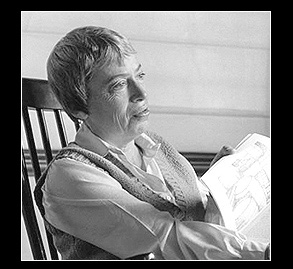

As a reader, I have a complicated relationship with Ursula Kroeber Le Guin, the writer. It seems she’s always one step ahead of me, reflecting my feelings and passions in her fiction. I read the young-adult “Earthsea” books while grappling with adolescent angst. I found my own deeply held social justice convictions explored in her science fiction of the 1970s and ’80s. Her collections of short stories were required vacation reading, when I had the leisure to admire her lyrical style and glory in how she puts words together. Le Guin once said, “The writer cannot do it alone. The unread story is not a story; it is little black marks on wood pulp. The reader, reading it, makes it live: a live thing, a story.”
Given the way her stories have fired my imagination, it’s vaguely disappointing to meet Le Guin. She stands a trim 5-foot-4, with white hair and a ready smile. I expect a literary giant to be bigger somehow, to take up more space and oxygen. I expect erudite conversation, but she peppers her speech with “ums,” run-on sentences, fragments and common phrases like “Oh, golly!” just like the rest of us.
The disappointment fades as I talk to her about the boys throwing snowballs in front of her house and the destruction of Taoism in China. I realize she’s no icon with a muse whispering in her ear; she watches, listens, thinks and feels, then reflects those observations and feelings in her art. “Authors are writing artists,” Le Guin says. “I think people restrict the term ‘artist’ to mean painters and sculptors, but you can practice art in whatever medium you choose. Words are my medium.”
And Le Guin is a master. Over nearly 50 years she’s published 17 novels, 11 children’s books, more than 100 short stories, two collections of essays, five volumes of poetry, two volumes of translation and screenplays of her works. She’s received the National Book Award, five Hugos, five Nebulas, the Kafka Award, a Pushcart Prize and several “lifetime achievement” awards among dozens of other honors.
In contrast to her extraordinary career, Le Guin’s life seems staid and ordinary; she’s been married to historian Charles Le Guin for 47 years, and they have three children and three grandchildren. Le Guin and her husband have lived in the same house in Portland, Ore., for 40 years. She writes on a computer but refuses to “get connected.” She strolls down to the local Minuteman Press to send and receive faxes. When she’s not writing, she teaches it to others, and she serves on the board of her local library.
During our conversation, Le Guin chats easily about literary criticism and her newest work and how exhausting book tours are, but she leaves me to discover her heart and soul in her nonfiction, such as “Dancing at the Edge of the World: Thoughts on Words, Women and Places.” There I trace the roots of her feminism to a disastrous relationship with a “prince” in graduate school, see her patient humor in her description of eating cold mashed potatoes in take after take as an extra on the set of “The Lathe of Heaven” and dissect her feelings about utopias.
Le Guin has accepted a few labels over the years as “approximately accurate”: novelist, radical, feminist, Taoist and, more recently, Western writer. Born in 1929, she is of that misnamed “Silent Generation” — those Americans who were children during World War II — but Le Guin is anything but silent. She was on the leading edge of the civil rights, feminist and antiwar movements of the 1960s. Through her tales and complex characters, she has explored the themes of sexism, racism, nationalism, unchecked technological progress and the flaws in popular utopian visions. Wherever I looked a generation later, she had already blazed the trail.
Le Guin is a product of both her times and her unusual family. Her father was anthropologist Alfred Kroeber, who developed the anthropology department at the University of California at Berkeley and was known for his work among Native American tribes. Today, Kroeber is perhaps most famous for his close association with, and study of, Ishi, the Yahi Indian who wandered out of the Northern California wilderness in 1911 and spent the remaining years of his life residing at the University of California’s anthropology museum — where Kroeber was the curator. (Ishi died of tuberculosis in 1916, though he was in the news again in August when his brain was moved from the Smithsonian Institution and properly buried in his ancestral homeland, the foothills of Mount Lassen.)
Le Guin’s mother, Theodora, trained as a psychologist and wrote the bestselling biography “Ishi in Two Worlds,” as well as a number of children’s works. Observation and analysis, words, myth and storytelling were an integral part of Le Guin’s life from an early age. And given the themes and preoccupations that permeate her fiction, it’s interesting to speculate about the influence the story of Ishi has had on her work.
The facts of Ishi’s life and his intersection with the white man’s world resulted in one of the more remarkable anthropological cases of the 20th century, and its elements seem to echo through many of Le Guin’s stories — from “Planet of Exile” and “City of Illusion” to “The Word for World Is Forest” and “The Dispossessed.” It would be surprising if that weren’t the case — what artists do, among other things, is use the raw material of their own life to make a universal statement that, when most successful, resonates across time and cultures.
But she didn’t spend her youth reading only anthropological texts and high literature, or immersed in her parents’ interests. Le Guin admits she and her brother devoured the pulp science fiction magazines of the ’30s and ’40s. “Kids need to read a lot of dumb stuff,” she says, “roughage in the diet. But there are ethical questions when you’re writing for kids. You have to stand back from the work and say, ‘Could this scare an 8-year-old? Could it do any harm?'” Her own children’s books, such as the “Catwings” series, are beautifully illustrated, gentle fantasies of the Beatrix Potter stripe.
Intellectual refugees from the universities of war-torn Europe, her parents’ extensive library, and storytelling around the campfire at the Kroeber summer home in California’s Napa Valley helped nurture her native talent. At the age of 11, she submitted a piece to Astounding Science Fiction magazine (which later became Analog) that was rejected. In 1947, she left her Berkeley home to attend Radcliffe College. She continued her studies in Romance literature at Columbia University, where she earned an M.A. and a Fulbright scholarship.
On her way to study in France in 1953, she met fellow Queen Mary passenger Charles Le Guin. They married in Paris a few months later. Over the next 10 years, she and her husband, a professor, settled in Portland, and their three children, Elisabeth, Caroline and Theodore, were born.
Le Guin wrote after the children went to bed and, when they got older, during their school hours, but initially her work met with little acceptance. Her poems were regularly published, but she couldn’t find a market for her short stories or fantastical historical novels set in a fictional analogue of Czechoslovakia, a country she named Orsinia. She describes her earliest work as being “just a bit off,” containing some oddity or fantasy element that prevented editors from labeling her work, putting it in a literary or genre box.
She received love letters about her writing skills and style, but literary editors rejected her stories as “not quite right for us.” Le Guin still maintains a dispute with critics and academics who insist only realistic fiction can be literary fiction. She says, “That attitude knocks out about nine-tenths of all American literature. Once we had the South American magical realists you couldn’t say only realism is literary.”
In 1961 her mother’s book “Ishi in Two Worlds” made the bestseller list. (Still in print, it has sold over a million copies.) Theodora Kroeber started writing in her 50s, “after my children left to have children,” and her work struck a chord with the market that surprised her family and her publisher. Le Guin’s turn came the next year, when two of her stories sold. She sold an Orsinian tale to a small literary magazine (with payment in copies of the magazine) and a time-travel story, “April in Paris,” to Fantastic for $30. Looking at the proceeds from both markets, Le Guin decided to focus her writing where it paid. She let loose her formidable imagination on the science fiction world and later earned the acceptance of mainstream readers as well.
In quick succession, Le Guin published “Rocannan’s World” (1966), “Planet of Exile” (1966) and “City of Illusion” (1967). Those early works articulate mythic themes of the journey/quest, combined with the Taoist motif of a balanced and ordered wholeness and the literary convention of a stranger in a strange land. They’re the first in what became known as Le Guin’s “Hainish Universe.” The common background in this set of novels, novellas and short stories, which cover about 2,500 years of future history, is that people from a planet named Hain seeded this part of the galaxy with human life. Under pressure of different environments and some direct genetic intervention, they evolve a diversity of human physical forms and social structures.
In 1969 critics hailed “The Left Hand of Darkness” for its feminist themes and mythic storytelling. In the book, Le Guin conducts “a thought experiment” on the effects of gender (or lack of it) on society by exploring the implications of an androgynous race. In those early days of the feminist movement, she was forcing people to examine the roles of men and women in society. Le Guin wasn’t sure she could sell the book or the idea. She thought men might feel figuratively castrated by the androgynous characters. Yet it became the best known and most honored of her works, winning a Nebula, a Hugo and a James Tiptree Jr. Retrospective Award.
Le Guin admits that in her earlier works she “wrote like an honorary man.” She was initially cautious in her feminism. Even in “The Left Hand of Darkness,” she still used “he” for the androgynous characters and rarely showed them in feminine roles. She told me that she regrets having allowed her characters only heterosexual relationships. But she feels she wrote the best book she could given the times. Le Guin credits reading “The Norton Book of Literature by Women” and her literary inspiration, Virginia Woolf, for allowing her to write like a woman and to feel liberated in doing so.
Leading the life of an academic family, the Le Guins took two sabbaticals in England, because “it’s easier on the kids to go where they speak the same language.” The first, in 1968, was at the height of the Vietnam War. Le Guin, a pacifist and Taoist, was “angry and frustrated.” That year she wrote “The Word for World Is Forest,” a story of brutal Terrans colonizing a planet occupied by a race of peaceful, green-furred natives. She was “a little uneasy that ‘Word’ was a preachy book and it would die with the cause. It is certainly the most overt political statement I have made in fiction.” It won the 1973 Hugo Award.
Spurred by the social optimism of the late ’60s and early ’70s, Le Guin took a crack at utopian fiction. Her Hainish book “The Dispossessed: An Ambiguous Utopia” (1974) won both the Hugo and the Nebula, giving Le Guin the distinction of being the only author to twice win both awards in the same year for a novel. “The Dispossessed” is her most densely textured work. Another thought experiment, it plays anarchism against capitalism. By sending a dissatisfied inhabitant from one society to the other, Le Guin examines how both work — or don’t. “They’re imperfect utopias because the people in them are just people.”
Le Guin has studied Laotzu and the Tao Te Ching since age 14, when she discovered her father’s old edition. She has been seeking out and comparing translations ever since, captivated by the book’s practical, nontheistic, easygoing approach. She finds the tenets “endlessly fruitful and nourishing to me as an artist,” and she published her own translation, “Lao Tzu: Tao Te Ching: A Book About the Way and the Power of the Way,” in 1997. She describes the book as “the most lovable of the great religious texts, funny, keen, kind, modest, indestructibly outrageous and inexhaustibly refreshing.” Her fascination with Taoism shows up early in her writing, most notably in her series “Books of Earthsea.”
In the late ’60s, Herman Schein, her mother’s publisher at Parnassus Press, approached Le Guin about writing a young-adult novel. “A Wizard of Earthsea,” which won the Boston Globe-Hornbook Award, came out in 1968, followed closely by 1970’s “The Tombs of Atuan,” winner of the Newbery Silver Medal, and 1972’s “The Farthest Shore,” which won the National Book Award for Children’s Books. On the surface these are coming-of-age stories, each featuring an adolescent who struggles to learn life’s lessons and set in a fairy tale, pre-industrial, vaguely medieval world. But Le Guin’s artful storytelling and complex underlying themes elevate the works beyond mundane fantasy and the young-adult audience for which they are intended. “To light a candle is to cast a shadow,” one of the wise characters says, and the protagonists spend the rest of their journey learning the need for balance — light/dark, male/female, action/inaction.
At the time I read it, I didn’t notice Earthsea’s distinctly male bias. Nearly all fantasy fiction, from C.S. Lewis’ “Narnia” to J.R.R. Tolkien’s “Lord of the Rings,” featured male protagonists. Le Guin acknowledges, “That’s how hero stories worked.” She started on a fourth book in the mid-’70s to correct the imbalance, but put it aside. “Tehanu: The Last Book of Earthsea” finally appeared in 1990 and won the Nebula. In this story Le Guin shows the underside of Earthsea from the point of view of a mature woman and a battered girl. Although billed as the last book of the series, Le Guin has a collection, “Tales of Earthsea,” coming out in the spring. “I thought after ‘Tehanu’ the story was finished, but I was wrong. I’ve learned never to say ‘never.'”
Le Guin writes a loving homage to Taoism in her most recent Hainish book, 2000’s “The Telling,” again using the future as metaphor. “In China they’ve been practicing Taoism for two or three thousand years and apparently nearly wiped it out in only 20 years under Mao,” she says. “It survives only in Taiwan and a few little exile colonies in North America. This whole thing haunted my imagination. It was a very hard book to write. I was playing with things that sort of scare me about our world.”
The Taoist theory of inaction, that people should take action only when necessary, is shown best in “The Lathe of Heaven” (1972), in which Le Guin creates Everyman George Orr, who can do what we all wish we could — make dreams real. But Orr falls under the control of a do-gooder psychiatrist, Dr. Haber, who realizes that Orr can change reality and tries to control those “effective dreams” to make the world better. These efforts lurch from inconvenience (no rain) to disaster (an alien invasion), an object lesson in unintended consequences for those who want to change the world.
Le Guin consulted on a 1980 PBS made-for-TV movie version of “Lathe” and chronicled her adventure in “Working on ‘The Lathe.'” When David Loxton of the TV lab at WNET called and said he wanted to come to Portland and talk to her about making a TV movie of one of her books, she replied, “No you don’t!” Loxton persevered, overcoming Le Guin’s objections one by one: He could indeed fly all the way to Oregon and, yes, they could “melt” Portland, “especially if we film that bit in Dallas.”
Le Guin admits to a certain amount of calculation in including an interracial relationship in “Lathe.” “If you look at my books, you’ll find that most of my central characters aren’t white. You don’t see it on the cover, because they refuse to put people of color on book jackets. But I’ve always done that deliberately because most people in the world aren’t white. Why in the future would we assume they are?”
Regionalism is the most recent influence on Le Guin’s work. After her second sabbatical in England, she looked around her Oregon home and made a commitment to “my dirt,” shedding the last vestiges of what she calls “Europe-centeredness.” She joyously returned to the anthropology and Native American tales of her childhood in the Napa Valley in her second utopian novel, “Always Coming Home” (1985), winner of the Kafka Prize for Fiction and short-listed for the National Book Award.
In this novel, Le Guin tries to “make a world that is a little less cruel and hard on the people who live in it than our world is.” The book is remarkable for its structure and its content. Le Guin abandons the traditional narrative form and creates a fictional anthropology of a people far in the future, the Kesh, who have adopted a distinctly Native American way of life. Our dysfunctional historical era is referred to as “the time when people lived outside the world.” It’s a remarkably rich collection of short stories, myths, poems and music, held together by a central novella and explained by more traditional anthropological “back matter.” In this work Le Guin brings together all her passions — the balance of Taoism, an anarchic “feminine” style, environmentalism and great storytelling.
While chronicling her life and work, I realized my relationship with Le Guin has shifted through the years. I started as a reader inspired by her stories and her insight into the human condition, and I finish as a writer inspired by her artistry, style and continual innovation. I am not unique in feeling this connection to Le Guin’s work.
“Boy, it makes you feel fairly humble and it’s a little scary when you realize you influence people. But when I’m writing, nothing affects me, I’m just trying to do the story,” Le Guin says. And as she has explained, “These are human stories. I’m using the other worlds and the other races as metaphors. All I know how to write about are people and animals — and trees. Still, nothing that is alien.”
