
Books

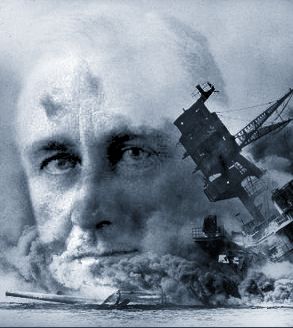
Dive-bombing FDR

With the release of "Pearl Harbor," conspiracy theorists have resurrected the canard that Roosevelt had advance warning of the attack.

On many mornings during the late 1980s, when my husband and I drove down to Hickam Air Force Base, the luminous view from the road above Pearl Harbor made us think of how it must have looked when the torpedo planes came buzzing in on Dec. 7, 1941.

It was “a date which will live in infamy,” President Franklin Delano Roosevelt declared before Congress the next afternoon, and 60 years later, Americans are talking about that infamous event again. Not because the anniversary has inspired a thoughtful reconsideration of midcentury America’s racist assumptions about the Japanese, or a review of the military and diplomatic miscalculations leading up to the debacle, or an attempt to address tricky strategic questions of isolationism vs. engagement. No, we’re discussing Pearl Harbor because of the hype surrounding a technically brilliant but soulless movie.

Only in America could such a terrifying, humbling historical event become little more than a deus ex machina plot device, a thunderbolt from the blue that conveniently resolves a hackneyed romantic rivalry. Haven’t we seen this before? Explosions, sinking ships, tremulous avowals of love …? Oh yeah, now I remember — but this time there’s no iceberg.

To avoid giving offense to any group of potential ticket buyers, “Pearl Harbor” gives us a new, anxiety-free, “shit happens” version of the disaster, a no-fault view exemplified by the movie’s portrayal of Adm. Husband Kimmel, the senior Navy commander in Hawaii. In the movie, Kimmel — a dark, stooped, doughy figure in real life — becomes a clean-cut, prow-faced golden boy who had all the right instincts, but was somehow helpless to escape his destiny. Like all the other pretty heroes and heroines in the movie, Kimmel ended up as a blameless victim of, like, you know, fate.

In contrast, most of the long history of Pearl Harbor revisionism has concerned itself with nailing a scapegoat. The sheer scale of the screwup guaranteed that shrapnel dodging and finger-pointing would ensue, and it became a matter of some political desperation to name one person or group of persons who could take the rap and — not incidentally — let the rest of America off the hook.

The most persistent of the various mythologies that grew out of this frantic buck passing was the belief that FDR not only deliberately provoked the Japanese attack but knew when and where it would occur. The story goes that FDR deliberately kept that information from his commanders in Hawaii so the attack would sway American public opinion from its intransigent isolationism. (No one has quite explained how being alert and prepared to beat off the attack would have significantly diminished its political effect.)

The “FDR knew” conspiracy theory was revived again last week in a tendentious article in the New York Press by the left-wing contrarian Alexander Cockburn, who also revives the usual dishonest rhetorical habits of FDR’s accusers. Cockburn cites, for example, a 1999 article in Naval History magazine that claims to “prove” FDR’s prior knowledge by citing the fact that the Red Cross secretly ordered large quantities of medical supplies to be sent to the West Coast and shipped extra medical personnel to Hawaii before the attack.

These facts, like so many of those cited as proof of FDR’s vile plot, can be explained quite readily without resort to the idea of a conspiracy. FDR had pledged to keep America out of foreign wars. At the same time, he was aware that our diplomatic efforts with the Japanese were only likely to buy us time, not permanently prevent war. No responsible leader could neglect the responsibility to be ready for any eventuality, but FDR also wouldn’t have wanted the press to become aware of the necessary preparations. That would have been a political disaster and might have derailed his effort to quietly enhance our capabilities before war broke out.

Populist horsefly Gore Vidal, in the course of a book review in the Nation in September 1999, and again in a November 1999 (London) Times Literary Supplement article titled “The Greater the Lie,” also lent credence to the “FDR knew” theory by praising — I can only assume without having read — the most notorious recent restatement of the theory, Robert B. Stinnett’s book “Day of Deceit: The Truth About FDR and Pearl Harbor,” first published in 1999 and new in paperback this month. (Vidal also presents the theory in his latest novel, “The Golden Age.”)

Stinnett — whose previous historical work was a suck-up treatment of the elder George Bush’s war years — purported to have new, recently declassified documents to support the idea that FDR was involved in a depraved political plot against our brave boys in uniform. But despite the book’s surface appearance of being an earnest and meticulous investigation — complete with lengthy footnotes and reproductions of dozens of important-looking bits of paper — it’s not hard for a careful reader to see the bilge water pouring out of it.

It’s not just that Stinnett’s “evidence” — if it can be dignified as such — is at best ambiguous and circumstantial. It’s not just that his theory, like most classic conspiracy theories, conflicts with reams of other available evidence and tries to make us believe two or more mutually exclusive things before breakfast. It’s also not just that he — for all his apparently knowledgeable blather and the truckload of “documentation” he dumps on us — apparently doesn’t understand some important realities of cryptology and signals intelligence. It’s not even that it is impossible to believe that Roosevelt — who was, without a doubt, wily and subtle — might have perpetrated such a Machiavellian plot. No, the real reason to think there’s no pony in this pile is Stinnett’s relentlessly dishonest — dare I say “deceitful”? — characterizations of documents, incidents and testimony.

As with other such conspiracy books, “Day of Deceit” received reviews in responsible academic journals like Intelligence and National Security that demolished it, citing its nonexistent documentation, misdirection, ignorance, misstatements, wormy insinuations and outright falsehoods. The consensus among intelligence scholars was “pretty much absolute,” CIA senior historian Donald Steury told me in an e-mail. Stinnett “concocted this theory pretty much from whole cloth. Those who have been able to check his alleged sources also are unanimous in their condemnation of his methodology. Basically, the author has made up his sources; when he does not make up the source, he lies about what the source says.” In other words, even if Roosevelt were genuinely guilty of these charges, “Day of Deceit” couldn’t possibly convict him.

Typical of the kind of porous and dishonest evidence “FDR knew” theorists promote are the “coded naval intercepts” Vidal praised Stinnett for having “spent years studying.” Again, Vidal either never actually read Stinnett’s book or was — in spite of his intellect — somehow dazzled by the book’s hurricane of bullshit exhibits. Stinnett’s supposedly assiduous study of Japanese intercepts amounts to only a series of rhetorical scams. The most contemptible of these comes during his jumbled discussion of whether the Japanese maintained radio silence during the approach to Hawaii. (It is a crucial argument of conspiracy theorists that the Japanese fleet was detected on its way to Pearl Harbor by radio direction finders around the Pacific, and that FDR supposedly deliberately withheld the location and movements of the Japanese carrier task force from his Hawaii commanders. But if the Japanese did not use their radios en route — and they have always insisted they didn’t — they couldn’t have been found by the radio direction finders.)

After noting several incidents that prove little more than that there could have been a late transmission on Nov. 26, Stinnett goes on to say that he, the intrepid investigator, discovered 129 intercept reports that indicate that the Japanese didn’t maintain radio silence during the approach to Hawaii. (None of them are reproduced in the book.) Stinnett then blandly states that these intercepts came from a three-week period from Nov. 15 to Dec. 6. In other words, all of them could have been obtained before the fleet ever left Japanese waters, and before radio silence was imposed. I don’t know how Stinnett could believe that his readers wouldn’t notice this critical detail, but then, most of the book displays little respect for our intelligence.

Nevertheless, like other conspiracy books before it, Stinnett’s was eagerly clasped to heaving right-wing bosoms from sea to shining sea. One enthusiastic reader at Amazon.com, for example, opined that people who could not accept Stinnett’s thesis were obviously “brain-washed with liberal red fascist, left-wing extremist, pagan atheistic infanticidal merchant of death beliefs that won’t let them face the real ugly truth.”

There is probably little hope of reasoning with people like this, but the real problem is that despite dozens of careful debunkings of Stinnett’s book and others like it, the “FDR knew” idea still retains its currency with people like Cockburn and Vidal — who certainly share neither the rabid rage nor the right-wing ideology found in many of their fellow believers. Cockburn (perhaps tellingly) does not even mention Stinnett in his column, yet repeats as gospel many of his most questionable contentions, like the claims of one Robert Ogg — who is linked by marriage to Adm. Kimmel’s family — to have pinpointed Japanese radio traffic from the Hawaii-bound fleet in the North Pacific.

Cockburn and Vidal are certainly intelligent enough to recognize the holes in a poorly supported thesis if they choose to educate themselves about it. But they seem to want to believe it anyway — and, worse, to actively promote it. Many other ordinary people I talked to about the theory also seemed to implicitly believe it, most of the time without having read a single book outlining the accusations.

Why? One theory is that conservative hostility to FDR’s New Deal continues to the present day, and has over time succeeded in slipping the meme of Roosevelt’s political depravity in under the radar of our national consciousness, sabotaging our ability to apply logic to the situation.

Given FDR’s notorious “government interference” initiatives like Social Security, banking and securities regulation, farm price supports and — worst of all — that pesky minimum-wage and collective-bargaining legislation, it’s not surprising that conservative capitalists in the ’30s and ’40s felt a level of hatred for him that wouldn’t be matched until the days of Bill Clinton. (My grandmother, the daughter of a banker ruined in the crash, once told me that the sulfuric name of “Roosevelt” was never uttered at her family’s dinner table. Like Clinton in many ’90s households, FDR was always referred to only as “that man in the White House.”)

To make matters worse, when Roosevelt emerged after Pearl Harbor as the “one who’d been right all along” about our vulnerability to fascist militarism, the isolationist Republican Party — already staggered by the commie horrors of the New Deal — was banished to the ninth circle of political hell for the duration (and then some). It accordingly launched an effort to transfer the ultimate responsibility for the debacle at Pearl Harbor from the military commanders in the field, Adm. Kimmel and Lt. Gen. Walter Short, to the Roosevelt administration.

But given that one of the most fundamental duties of military command is ensuring readiness to meet attack, the only way to completely exonerate Kimmel and Short was to make a case that they’d been deliberately set up. Thus was born the first wave of Pearl Harbor conspiracy theory, which was America’s favorite paranoid fantasy until the Kennedy assassination. It became such a cherished conservative myth that Sen. Strom Thurmond, R-S.C., instigated yet another official investigation of Pearl Harbor (the 10th) in 1995.

Despite that 1995 investigation coming to much the same conclusion as all others before it, the contrarian “FDR knew” meme lived on, and reached its apogee of respectability when the new Republican-dominated Congress recently passed a resolution absolving Kimmel and Short of any responsibility for the tragedy and restoring them posthumously to their highest ranks. It was a move that many people believe was extremely unwise. Military tradition, which runs much deeper than military law, has always held that whatever happens on your watch is your responsibility and that it is your duty to accept the consequences, however unfair they may seem. Congress’ official endorsement of buck passing has not gone over well with everyone.

Truth be told, there was plenty of blame to go around, both in the field and in Washington. The constant tension between ensuring secrecy and giving operational units access to essential intelligence may not have been resolved in the best possible way before Pearl Harbor, and in any case, intelligence functions were tragically fragmented and dispersed. Robin Winks, professor of history at Yale University and author of “The Historian as Detective: Essays on Evidence,” agrees with the conclusions of other investigators that there was a “massive operational failure” to use the intelligence we did obtain to good effect. “I believe we had the information, that it was not understood by those who had it, that those who most needed to have it didn’t see it, and that FDR did not know, though perhaps by only the margin of a very few hours.”

Yet the rumor persists, and is usually based on the idea that we had access to the Japanese navy’s operational codes and not just the “Purple” diplomatic code that was the basis for the famous “MAGIC” intelligence reports. Vidal, for example, makes a typical flat-footed declaration about it (based on the Stinnett book) in his discussion in the Nation: “Although FDR knew that his ultimatum of November 26, 1941, would oblige the Japanese to attack us somewhere, it now seems clear that, thanks to our breaking of many of the 29 Japanese naval codes the previous year, we had at least several days’ warning that Pearl Harbor would be hit.” The idea that we were reading more than consular communications is also obliquely alluded to but not developed in the movie “Pearl Harbor.”

But researcher Stephen Budiansky, in an article for the Proceedings of the Naval Institute, details evidence rebutting that contention, which he found while researching his book “Battle of Wits: The Complete Story of Codebreaking in World War II.”

In March 1999, Budiansky found documents that had been declassified some years ago but not yet processed by the National Archives staff, and thus not listed in the finding aids for researchers. The papers turned out to be contemporaneous, month-by-month reports on the progress of the Navy code breakers, each date-stamped, covering the entire period from 1940 to 1941. They showed, Budiansky said, that the first JN-25 code (designated “Able,” or JN-25-A) was laboriously cracked with help from the new IBM card-sorting machines (and some lazy Japanese encoders) in the fall of 1940.

But then, heartbreakingly, the Japanese switched to a new version of the code (“Baker” or JN-25-B — in a typical display of ignorance, Stinnett claimed in his book that there was no such thing as a JN-25-B code) in December 1940, a year before the attack on Pearl Harbor. At that point the code breakers completely lost their ability to read the operational communications. Going back to the drawing board, and with the aid of a supersecret collaboration with British cryptologists in Singapore, the Allies managed to recover a small fraction of the code groups and additives (which changed again that summer) by Dec. 1, 1941 — but most of what they could read by then was numerals, not words.

Yet, in classic conspiracy theory fashion, the rumor that we had access to Japanese naval communications has been sustained down the years by portentous reference to documents like a March 1941 message from Adm. Thomas Hart, commander in chief of the U.S. Asiatic Fleet, which Stinnett reproduces in “Day of Deceit.”

Stinnett claims the message indicates “solutions” to the JN-25 code were being shared with the British. Clearly, however, what is being shared is only preliminary data and some bits and pieces recovered from an accumulation of old communications in earlier additive groups. The admiral, encouraged by the prospect of British help, directs his code breakers at Cavite (Corregidor) to work exclusively on JN-25. The only thing this document proves, then — other than Stinnett’s dimwittedness — is that this crucial Japanese operational code was not solved once and for all in 1940.

Another of the common tricks used to sustain the “FDR knew” theory is the publication of supposed “smoking gun” diplomatic messages in the “Purple” code (a more “routine” consular code) that naval intelligence often waited days to read. These messages were regarded as relatively unimportant and weren’t decoded or translated until after the Pearl Harbor attack — sometimes not for years afterward. It’s a phenomenon Budiansky is familiar with. “It became a joke at the Archives,” he wrote in a message to a military history mailing list, “to see how many people would rush to show John Taylor, the national security archivist, their ‘discovery’ that the U.S. was reading JN-25 before Pearl Harbor … John would point to the date of decryption at the bottom of the sheets and watch the researcher’s face fall.”

One of the things that is most notable about the way the “FDR knew” theory is sustained is that its methodology parallels that of so-called creation science. The trick in both instances is to assiduously ignore all the mountains of evidence in favor of the theory you are trying to disprove and to focus instead on tiny apparent discrepancies and supposed “missing links” in the record. “True to the M.O. of all conspiracy theorists,” Budiansky notes, “the ABSENCE of further documentary evidence actually confirms [the] thesis by proving that a ‘cover-up’ has taken place.”

The conspiracy buffs always point to the fact that there are apparent gaps in numbered message series, that the National Archives has not gotten around to declassifying all the millions of pieces of paper from the war, that certain material provided to congressional investigations in the early days of the Cold War was perhaps too compulsively censored and that some supposedly crucial material is missing, such as the log of the passenger liner SS Lurline’s radioman Leslie Grogan, who claims that he heard Japanese radio traffic in the North Pacific just before the Pearl Harbor attack. (“They were just blasting away.”)

But the SS Lurline was on a southerly route to Honolulu from Long Beach, Calif., so the radio signals Grogan heard coming from the northwest could have been from Japan’s shore-based radio facilities, not the carrier task force. Grogan claims he took his original log to naval authorities in Hawaii after the Lurline arrived on Dec. 3, but they didn’t seem particularly interested. The Lurline’s radio log was checked out of the National Archives without a date or signature sometime in the ’70s, about the time another Pearl Harbor conspiracy theorist, John Toland (“Infamy”), was doing his original research.

But this “mysteriously” missing material could just as easily provide definitive proof that the “FDR knew” gang is full of it. Given that conspiracy theory has become, in the words of Paul Miles, Tomlinson Fellow in the History of War and Society at Princeton, a “cottage industry,” it struck me that some of the documents in question could have been spirited away by people with another agenda entirely. Look at me! I can concoct conspiracies too!

“Anyone who does intelligence history (as I do),” says Robin Winks, “knows it is very difficult, highly technical and open to conspiracy theory, because inevitably some material is missing, and at times some material deliberately lied with a view to disinformation.” For example, and apropos of the SS Lurline material, the Japanese later stated that they attempted to produce bogus radio traffic right before Pearl Harbor in the hope that it would confuse intercept agencies about the location of the silent fleet. It might not have fooled military professionals, but Leslie Grogan was an amateur.

The conspiracy theorists, in parallel with the creationists who maintain that God must have placed fossils in the ground to test his people’s religious faith, also think that Roosevelt and his political allies managed not only to cover up their dastardly deeds but to fabricate thousands of linear feet of documents in order to camouflage the truth. It is perhaps remotely possible that some kind of massive effort of that kind was instituted here in America in the midst of wartime, but unless we want to believe that our former enemies have destroyed or manufactured material to burnish Roosevelt’s reputation, evidence from Japanese archives also backs up the idea that the attack was a surprise to FDR.

Linda Goetz Holmes, for instance, a Pacific war historian with the Interagency Working Group at the National Archives and author of the book “Unjust Enrichment: How Japan’s Companies Built Postwar Fortunes Using American POWs,” told me about the findings of a Japanese historian whose research in his country’s recently declassified files only became available in the U.S. in 1998. He revealed considerable documentary evidence of Japanese satisfaction with how well “our magnificent deception” was working in Washington.

Yet the “FDR knew” meme continues to thrive with supporters like Cockburn and Vidal, whose credibility should suffer from such carelessness, but somehow never does. The case of Vidal is particularly shocking, because he prides himself on demolishing cultural mythology, debunking “court historians” and pursuing the truth. Yet he embraces a dishonest “researcher” like Stennitt and lends his literary aura to a tissue of lies.

In 1941, both military and civilian authorities were operating from extremely bad — and, it’s important to note, very racist — assumptions when it came to the Japanese. We simply couldn’t believe that the “little beasts” had gotten the drop on us, or as Stanford historian David M. Kennedy indicates in his book “Freedom From Fear,” that we as a people had made “systematic, pervasive and cumulative” mistakes that led to the disaster.

That there are rational, wide-reaching and comprehensible reasons for our failure to be prepared at Pearl Harbor is not an idea that sits well with most Americans. We’d much prefer to believe that the calamity wouldn’t have happened if we weren’t deliberately set up. In that sense the “FDR knew” theory is very comforting. It essentially absolves everyone except the nefarious Roosevelt and his diabolical cronies; it implies that everyone else, and all their procedures, decisions, organizations and attitudes, were impeccable. If only a better man had been in charge, this fairy tale goes, the yellow horde wouldn’t have succeeded.

Such a view handicaps our ability to learn desperately needed lessons from the debacle. I’d much rather we admitted our mistakes — all of them — so that when future military men and women look out over Pearl Harbor in the morning they will be reminded, as I always was, of how quickly our smug assumptions can be blown out of the water.

Judith Greer is a writer who lives near Charleston, S.C. She is a former Air Force officer and graduate of the University of Southern California's School of International Relations.

“People Who Eat Darkness”: The disappearing blonde

A true crime story set in Tokyo illuminates the complicated truths behind media cliches

Joji Obara and Lucie Blackman (Credit: Estate of Lucie Jane Blackman)

Lucie Blackman, 21, went out for the afternoon in 2000, phoning her roommate and best friend Louise to arrange a meeting later that night. Lucie never showed up, and within a few days she’d become one of those vanished blondes whose fates fuel headlines and hours of speculative media coverage. She was British, a former flight attendant, and she and Louise were living in Tokyo. They were also bar hostesses, a profession with a very specific meaning in Japan, difficult to explain to foreigners and not entirely clear to the Japanese themselves. Lucie both did and didn’t match the classic Missing Blonde profile, and for a while the mystery of what happened to her threatened to lapse into permanent obscurity.

One thing made a difference: The actions of Lucie’s father, Tim Blackman, who arrived in Tokyo to join his other daughter, Sophie, in publicizing the search and prodding the police. Richard Lloyd Parry, Tokyo bureau chief for the Times of London, covered the case as it unfolded, first over the course of several months while Lucie’s whereabouts and abductor remained unknown, and finally for the six years it took to try the man accused of killing her, Joji Obara. The book Parry wrote about the case, “People Who Eat Darkness,” is an exceptionally perceptive and nuanced look at a terrible crime, one that put nations, institutions and family members at odds, and often into bitter and toxic conflict.

Unlike Truman Capote, author of “In Cold Blood,” the most celebrated true crime narrative of all, Parry is in essence a reporter; this is no “nonfiction novel.” But like Capote, he’s less interested in dishing the eerie or lurid details than he is in exploring the penumbra of the crime, the complex factors that fed into it and the unpredictable effects it had on an ever-spreading network of people. The true crime genre has a (mostly well-earned) reputation for trashiness, but it fascinates for legitimate reasons, as well. Transgression, justice and punishment speak to the very heart of what a society is, how it holds its people together and how they decide who lies beyond the pale.

Because Lucie Blackman was a foreigner, and one employed in an industry that the Japanese view as disreputable, the Tokyo police were inclined to dismiss her disappearance. Bar hostesses get paid to talk to and flirt with customers, and they are expected to go on (paid) dinner dates with them outside the clubs where they work, but it’s an arrangement that usually stops short of actual sex. Nevertheless, the Japanese think of most foreign hostesses as irresponsible, drug-loving backpackers who might well run off without telling anyone or get mixed up with dangerous people. Whether or not a Westerner would call what bar hostesses do a part of the sex industry, for the Japanese, these women belong to that category of “bad” girl who can expect little help or concern from authorities should she get into serious trouble.

Crime is not what it was in Capote’s day. In addition to finding and building a case against the perpetrator — jobs for law enforcement authorities — there’s handling the media, a task usually left to the victim and his or her relatives. Lucie’s father proved, initially at least, to be a master at this. Tim could detach himself emotionally from the horror of his situation and strategize. He was able to capitalize on a G-8 summit meeting being held in Japan around the same time Lucie vanished and parlay it into the intervention of British Prime Minister Tony Blair. Blair publicly asked Japan’s prime minister to front-burner the investigation, and met with Tim and his younger daughter Sophie while he was in Tokyo.

The police, who had been dragging their heels on Lucie’s disappearance, found this development (which made perfect sense in the political context of Britain) flabbergasting. Still, it worked: Lucie, who might have been written off as one of those “disposable” women of dubious virtue, was conclusively cast as an innocent girl, “naive perhaps, out of her depth,” but an adventurous daughter rather than a reckless slut. Tim was driving the narrative, as an electoral campaign manager might put it, and he was good at it. He liked talking to the press, even the tabloid press, and they liked him.

But if Tim was good at telling Lucie’s story, he was less successful at telling his own. Some of the most penetrating passages in “People Who Eat Darkness” concern what Parry refers to as the “script” expected from bereaved parents. Years later, Parry covered a press conference given by the father of another murdered girl and recognized in him “everything the world expected of a man in his situation: broken, helpless, turned inside out by loss.”

Tim, however, was composed, which aroused a formless popular suspicion regarding his sincerity. In similar cases, this uneasiness frequently takes the form of outside observers suddenly deciding that the parents might be implicated in their child’s disappearance or death. Tim, halfway around the world when Lucie vanished, was immune to that, but when he quarreled with the rich businessman funding the private search for his daughter, accusations of self-interest and even exploitation surfaced.

Lucie’s mother, Jane, on the other hand, behaved exactly as a grief-stricken mother is supposed to. In some respects, the truth about her parents’ failed marriage is as unknowable as the events of Lucie’s final hours. Unamicably divorced, Tim and Jane avoided even being in the same room together throughout the crisis. Was Jane, who seems to fall for every kind of supernatural hokum that crosses her path, pathologically vindictive, or was Tim as big a shit as she claimed? Just when you think you’ve made up your mind on that question, a new development comes along to knock you into the other camp.

As for the perpetrator himself, he remains something of a cipher to Parry, who was never able to interview him. Obsessively camera shy, Obara deftly avoided being properly photographed even after his arrest. He was clearly demented, as a long, self-justifying self-published book (disguised as the work of concerned supporters) amply demonstrates. Resolutely confident and unrepentant, Obara was also utterly unlike the vast majority of Japanese criminal defendants. (Parry explains that the justice system there depends almost completely on the ability of police investigators to shame suspects into confessing.) They simply didn’t know what to do with him. The Japanese blamed Obara’s recalcitrant behavior on his Korean ethnicity.

The Blackmans and Obara, Western-style players, descended on a criminal justice system unprepared to cope with them. “The inadequacy of its police force is one of the mysterious taboos of Japanese society,” Parry writes, “a subject that the media and politicians strain to avoid confronting, or even acknowledging.” The blunders of the police were many, but they could also be dogged investigators. Their real problem, according to Parry, is that they are good at dealing with “conventional Japanese criminals,” but when faced with the unexpected, they’re “sclerotic, unimaginative, prejudiced and procedure-bound.”

Obara behaved like a British or American criminal — taking charge of his defense, actively contesting the prosecutors, formulating a counternarrative to account for Lucie’s death. Watching how Japanese institutions responded to him, as well as to the Blackmans’ efforts to influence the investigation, proves fascinating. Since true crime, at its best, serves as a window on what a society cares about — how it constitutes not only what’s right and wrong but what’s sympathetic, reasonable, acceptable and important — the Obara trial was a most illuminating culture clash.

Parry doesn’t, however, forget what lies at the root of this drama: the death of a young woman who, whatever her doubts or flaws, had every reason to hope for a wonderful life. As the investigation would eventually reveal, this tragedy was eminently preventable. The people who tried to tip off the police about Obara were dismissed as not worth listening to. Let’s hope they’re not the only ones to learn from that mistake.

Continue Reading Close
Laura Miller

Laura Miller is a senior writer for Salon. She is the author of "The Magician's Book: A Skeptic's Adventures in Narnia" and has a Web site, magiciansbook.com.

Corporate criminals gone wild

The maker of the documentary film "Inside Job" has a new book excoriating Wall Street -- and President Obama

A detail from the cover of "Predator Nation"

“Inside Job,” Charles Ferguson’s Oscar-winning documentary film on how government, Wall Street and academia colluded to deliver us the worst financial crisis since the Great Depression, made a powerful case that something was very very rotten at the heart of the American political/economic nexus. His follow-up book, “Predator Nation: Corporate Criminals, Political Corruption, and the Hijacking of America,” can be considered the legal brief that dots every “i” and crosses every “t” in his argument. A tightly argued, profusely footnoted and deeply enraged castigation of everyone involved, “Predator Nation” isn’t just a factually unchallengeable account of how Wall Street blew up the global economy. It’s a denunciation, a call for justice and a warning: After getting away with the crime of the century, Wall Street still isn’t satisfied.

“If you have already got 96 percent of what you want,” Ferguson told Salon, “why not take the remaining 4? That’s where the culture of American finance is right now, and I think it’s really dangerous for the country.”

For at least 30 years the United States has been headed on the wrong track, handing over more power and wealth to a tiny percent of the American population at the expense of everyone else. But Ferguson’s story isn’t just focused on the greed and recklessness of the elite. It’s also about their criminality. The bankers who wrecked the financial system broke the law. And yet, amazingly, not only have the vast majority of responsible parties not been convicted of any crime — they haven’t even been charged. There have been a few settlements of fraud allegations with the Securities and Exchange Commission and other regulatory bodies and a smattering of slap-on-the-wrist fines, but nothing that comes close to a proper reckoning for the massive hardship and economic destruction that they caused.

Ferguson’s glowering rage spares neither political party. Clinton gets the blame for completing the process of financial sector deregulation, and George W. Bush is lacerated for his general incompetence. But Barack Obama is showered with a particularly aggrieved contempt. Obama, writes Ferguson, came into office with more hope invested in him than in any recent leader, and then proceeded to “betray” and “screw” his supporters by declining to bring Wall Street to account for its misdeeds.

“Predator Nation” hits bookstores on Monday, just in time to cash in on the headlines generated by the latest banking atrocity — JPMorgan Chase’s massively failed derivatives bet.

“Predator Nation” is an angry book. Were you this angry before you started making the film “Inside Job”?

No, I absolutely was not. I remember the first time I got any kind of inkling of what was to come was in August or September 2007, when Charley Morris sent me a copy of a galley proof of his book, “The Trillion Dollar Meltdown.” It was scary and powerful, but I couldn’t bring myself to believe it. I remember calling Charley and saying, “You lay out a very convincing case but really, these people aren’t that crazy, they aren’t that stupid. They are regulated. Can it really be this bad?”

And he said: “You just wait.” And boy, he was right.

It’s not that I thought that investment bankers were like Mother Teresa. I knew that they weren’t. But the degree of nakedness and extremity of the dishonesty and its pervasiveness was a huge shock to me. It turned out that many banks, on a very large scale, and without any disclosure, had created and sold securities with the intent of betting on their failure. And this was done with the knowledge and approval of senior management of all these banks, including the oldest and most traditional.

How do you explain this behavior? How did we get to a point where it was routine for Wall Street bankers to behave in ways that most Americans would consider frankly immoral?

I think this has its roots all the way back in the 1970s and the beginning of the era of deregulation. But there was a kind of inflection point during the five-year period between 1997 and 2003 — the late Clinton and/or early Bush administration — when all the rules just went away. You went from a period, a regime, where people did have at least some concern about going to jail, to a point where everything is legal, and derivatives couldn’t be regulated at all and nobody went to jail for anything. And looking back I would say that this period definitely started under Clinton. You absolutely cannot blame this on George W. Bush.

You say that everything is now legal, but in your book you dismiss Obama’s argument that he could not prosecute Wall Street bankers for criminal behavior because what they did was technically not illegal as “complete horseshit.”

I should be more precise. I should have said, “where everything was perceived as being legal.” There was no perception that, even when you were in fact violating the law, that there would be any legal jeopardy or legal consequence to what you were doing. And that was part of my surprise when I was making “Inside Job.” I really was surprised that people would so overtly and explicitly do things that 20 years previously probably would have gotten them landed in prison.

One can certainly argue that the penalties and prosecutions following the S&L [Savings and Loan] and insider scandals of the 1980s were vastly insufficient. No doubt about that. But there still were consequences. I don’t know whether [junk bond king] Michael Milken would have still done everything he did, if he knew that he was going to spend two years in prison and have about half of his wealth confiscated. Maybe he still would have made that bet, but still, clearly he had a few unpleasant days. And now, nothing, just nothing.

In your book, you have a laundry list of things you believe the bankers could be prosecuted for, everything from securities fraud to perjury to RICO Act violations. And then you point out, more than once, that during the Obama administration there have been no arrests or indictments of any firms or senior executives “related to causing the bubble or the crisis.” What’s your explanation for this? Is it as simple as the Obama administration being captured by the financial sector?

I’m not President Obama’s psychoanalyst, so I can’t speak to what goes on inside his head. But that is what I would say of the Obama administration generally. In the book I go through the list of his personnel appointments and it’s pretty clear.

But how do we square that with the negative Wall Street reaction to bank reform? You devote only one sentence in your entire book to Dodd-Frank, calling it “weak and ridiculously complicated.” But even so, House Republicans have introduced nine bills trying to repeal parts or all of it, Romney is campaigning on repealing the whole thing, and Wall Street hates it and has tried to kill every last part of it. There is clearly antipathy against Obama from the financial sector now, from Jamie Dimon on down, that wasn’t there when he got elected. If he was truly captured, why the antipathy?

Well, there is some antipathy. But he just held a very successful fundraiser at the home of the president of private equity group Blackstone. So the antipathy is not universal.

But you know, when I was in academia and also when I was running a software company I had a fair amount of contact with portions of the financial sector, investment banking industry, and the venture capital sector. And certainly they were already pretty rapacious and pretty politically conservative. But they would never then have said and done the things that they say and do now. I recently was at a dinner in New York City and one of the people there was a very, very successful man who is on the borderline between venture capital and private equity. And this guy went into an extended rant about how he was at a disadvantage because he had to pay 15 percent capital gains taxes. When I was first dealing with venture capitalists in a significant way, the capital gains tax rate was 28 percent, and nobody was complaining. Then they got them reduced to 20 under Clinton, and then later 15 under Bush. Plus, they got a rollover provision so if they took the proceeds of a venture capital investment and rolled it over into a new venture capital investment it was tax-free. At that point, we’ve reached nirvana, what more could there be?

But now we’re in this environment where this guy was loudly and aggressively complaining that he has to pay 15 percent to the government. And if that’s where you’re at, then of course you are going to complain about Dodd-Frank. You are going to complain about everything. If you have already got 96 percent of what you want, why not take the remaining 4? That’s where the culture of American finance is right now, and I think it’s really dangerous for the country.

Do you find it alarming that even after this huge crisis and even with a lot of populist anger on both the right and the left focused on Wall Street, Mitt Romney is running for president while promising to further deregulate Wall Street and repeal Dodd-Frank, and the polls show him neck and neck with Obama?

That is true, but I don’t think that Romney is going to get votes primarily or even secondarily for that. Most of the votes he is going to get will be because he’s religious, he’s against gay marriage, et cetera, all of these allegedly “values” issues — things like that and wanting to reduce taxes. That’s why he is going to get a substantial fraction of the popular vote. The reason he says he wants to roll back Dodd-Frank is not to get votes, it is to get money.

Ninety-nine percent of your book tells a story of how we’ve gotten ourselves into a bigger and bigger mess, and then you’ve got about a page and a half discussing what could be done to fix it. But your solutions — a legitimate third-party alternative, controlling the influence of money in politics, real tax reform, fixing education — it’s just really hard to see how we get from our current problems to those bullet points.

Yes. And we’re not. Not right now. I think it’s going to take things getting worse, either slowly or fast. Either we continue to melt away for another 25 years and then finally people wake up, or there might be another crisis. And maybe that will be sufficient. We’ll see. I don’t know. I’d be interested in your own view of this. I’ve had debates with several of my friends on this question. If Obama had really had the balls to try to do the various kind of things that he’d promised to do, or kinda sorta almost promised to do during his campaign, if he really made an effort, how far do you think he could have gotten in 2009?

At this point, I’m in the camp that believes that American government is completely broken. And we didn’t really find out how broken it was until Obama came in. In your book, you talk about Obama coming in withoverwhelming majorities, but he really only had 60 votes in the Senate from July 2009, when Al Franken was finally sworn in, to January 2010, when Scott Brown took over Ted Kennedy’s seat. And even the things that Obama did get through had to pass muster with a handful of very conservative Democrats. Nebraska’s Ben Nelson had control over the entire government. It’s a completely dysfunctional system. I think Obama severely underestimated what he was facing when he came in, and picked the wrong strategy of trying to go bipartisan, but it’s not as if he had the freedom to do what he wanted that Roosevelt enjoyed when he became president in 1932.

But there are an awful lot of things that the president can do even without the Congress. He didn’t have to choose the people he chose. He didn’t have to choose the attorney general he chose or the head of the criminal division of the Justice Department that he chose. I think that if he had said, I’m going to allocate $500 million to a special prosecutor’s office, and we’re going to find out what the fuck happened here, he could have done that.

There’s some talk now that JPMorgan’s disastrous bet on credit default swaps might lead to tighter regulation. I have to say, it was bizarre to be speed-reading your book while the Morgan news was causing post-traumatic stress flashbacks to the worst days of the financial crisis. Does what happened there fit into the narrative of “Predator Nation”?

I rather think so, yes. Mr. Dimon has long been largely correctly regarded as the best, most judicious, most careful steward of a major global bank. That he and his bank could make a mistake like this does not bode well. One thing that has actually not been widely discussed, somewhat to my surprise, in the commentary about all of this, is that this mistake — which it appears will cost them between $2 billion and $5 billion — this occurred in a very forgiving economic environment. If they made a mistake like this in September 2008, then things could look really quite different.

Does it qualify as criminal behavior?

There is some suggestion of criminality in the lack of honesty on disclosure of the positions and their potential implications. I can’t say; we don’t know enough yet. It certainly is the case that JPMorgan, although more prudent than many other banks over the last decade, has frequently been just as dishonest. It has done a number of extremely unethical things, some of which I mention in the book. So it wouldn’t be a surprise if they had not been forthcoming about this.

Do you think it will make any difference in how banks are regulated?

I fear not. Honestly. I’m sure that Mr. Dimon is momentarily chastised, and that JPMorgan will not be making any similar bets in the next couple of years. But is it going to change the overall posture of bankers and banking and is it going to change the regulatory environment in any significant way? I tend to doubt that. Unfortunately.

So where does this leave us? Your book is filled with a strong sense of personal outrage. How do you personally feel about the prospect that the only thing that could get us out of the mess we’re in is yet another crisis, perhaps even worse than the one we just lived through?

Personally, I am very fortunate. I have a very blessed life. I made some money earlier, I’m basically pretty financially secure. I can’t have private jets and private islands but I don’t have to worry about having a roof over my head or being able to eat well, unlike many people in this country going forward. And I do work that I love. I love making movies, I love writing books. Personally I’m fine.

But the country is not. But this happens to countries. This is not the first country it’s happened to. It’s not even the first time it happened to the United States. We’ll see whether we come out of it. Last time it happened we came out of it, eventually. It took a long time and it was very painful but eventually we came out of it. Will that happen again or not, I don’t know, I honestly don’t.

Continue Reading Close
Andrew Leonard

Andrew Leonard is a staff writer at Salon. On Twitter, @koxinga21.

Can you identify?

Science shows that the only way around some readers' prejudices is to trick them

(Credit: Shutterstock/Salon)

The news of recent research documenting how readers identify with the main characters in stories has mostly been taken as confirmation of the value of literary role models. Lisa Libby, an assistant professor at Ohio State University and co-author of a study published in the Journal of Personality and Social Psychology, explained that subjects who read a short story in which the protagonist overcomes obstacles in order to vote were more likely to vote themselves several days later.

The suggestibility of readers isn’t news. Johann Wolfgang von Goethe’s novel of a sensitive young man destroyed by unrequited love, “The Sorrows of Young Werther,” inspired a rash of suicides by would-be Werthers in the late 1700s. Jack Kerouac has launched a thousand road trips. Still, this is part of science’s job: Running empirical tests on common knowledge — if for no other reason than because common knowledge (and common sense) is often wrong.

A far more unsettling finding is buried in this otherwise up-with-reading news item. The Ohio State researchers gave 70 heterosexual male readers stories about a college student much like themselves. In one version, the character was straight. In another, the character is described as gay early in the story. In a third version the character is gay, but this isn’t revealed until near the end. In each case, the readers’ “experience-taking” — the name these researchers have given to the act of immersing oneself in the perspective, thoughts and emotions of a story’s protagonist — was measured.

The straight readers were far more likely to take on the experience of the main character if they weren’t told until late in the story that he was different from themselves. This, too, is not so surprising. Human beings are notorious for extending more of their sympathy to people they perceive as being of their own kind. But the researchers also found that readers of the “gay-late” story showed “significantly more favorable attitudes toward homosexuals” than the other two groups of readers, and that they were less likely to attribute stereotypically gay traits, such as effeminacy, to the main character. The “gay-late” story actually reduced their biases (conscious or not) against gays, and made them more empathetic. Similar results were found when white readers were given stories about black characters to read.

What can we do with this information? If we subscribe to the idea that literature ought to improve people’s characters — and that’s the sentiment that seems to be lurking behind the study itself — then perhaps authors and publishers should be encouraged to conceal a main character’s race or sexual orientation from readers until they become invested in him or her. Who knows how much J.K. Rowling’s revelation that Albus Dumbledore is gay, announced after the publication of the final Harry Potter book, has helped to combat homophobia? (Although I confess that I find it hard to believe there were that many homophobic Potter fans in the first place.)

Absurd as this tactic may sound, many publishers are already kind of doing it — and catching hell. Although the term “whitewashing” is most often used to describe film and TV adaptations in which white actors are cast as characters who were people of color in the original book, something similar also happens with book graphics. Novels about black or Asian characters have been given cover art that features white people.

Controversies over cover-art whitewashing, and other attempts by agents, editors and publishers to downplay or even eliminate minority characters, have roiled the world of young adult literature in recent years. The author Justine Larbalestier (who is white) wrote a YA novel, “Liar,” with a black heroine in 2009, but her publisher insisted on using a photograph of a white teenager for the cover. Larbalestier took their disagreement public and the ensuing scandal persuaded the publisher to back down. Ursula K. Le Guin, a revered science-fiction and fantasy author who has often chosen dark-skinned people as her protagonists, has had to put up with seeing them depicted as white in cover art and film adaptations for decades.

Publishers argue that they’re only trying to make sure their authors’ books find the widest possible audience. What they mean is that a certain percentage of white (or straight) readers will summarily conclude a book isn’t for them if the face on the cover fails to resemble their own. Sad to say, the publishers are probably right about that. While the readers in the Ohio State study didn’t get to choose the stories they read, many of them were deciding how much to invest in the protagonist and his experiences — how much to identify — on the basis of his sexual orientation or race.

Authors, fans and observers are rightly disgusted by the practice of cover-art whitewashing. It shouldn’t have to be that way. But some commentators on the controversy seem to think that if publishers act as if race or gender or sexual orientation isn’t a factor in what many people decide to read, somehow it will simply stop being a factor. This seems unlikely. If it were so easy to rid people of their prejudices, the world would already be a much pleasanter place. It takes regular exposure to different types of people in the course of everyday life — at school and in the military, the workplace and the neighborhood — plus a whole lot of time and peer pressure to wear bias down.

Well, it takes that — and maybe the magic of storytelling? The readers in the Ohio State study did become more understanding of gay and black people after they were (let’s not put too fine a point on it) tricked into identifying with them. This type of sleight-of-hand is something only a non-visual medium like prose fiction can pull off. It can firmly lodge readers inside an imaginary person’s head without ever showing them his or her face. In Neil Gaiman’s “Anansi Boys,” for example, the narrator never explains that all the principle characters are black, and each reader will come to that realization at a different stage in the narrative. It’s Gaiman’s way of tweaking the very common readerly assumption that defaults all major characters to white unless their race is otherwise specified. (And sometimes not even then, as quite a few young fans of “The Hunger Games” demonstrated by being astonished when a supporting character, clearly described as black in the novel, was played by a black actress in the film.)

Of course, not all readers are white or straight, and the ones who aren’t deeply appreciate novels that advertise the diversity of their characters. It’s about time they got heroes and heroines who looked like them, and novels that speak to their distinctive experiences. They have been identifying with characters across the boundaries of race, gender and sexual orientation from time immemorial, and are masters of the art, but understandably they’d like to give their ninja skills a rest. Furthermore, there are also white readers who prefer variety in their fiction or are deliberately trying to correct the imbalances of the past.

Nevertheless, if you believe, as many Americans have since the days of the Puritans, that books ought to morally improve their readers, then maybe there’s a place for a little judicious whitewashing in the writing and publication of fiction. It has literally been demonstrated to change hearts and minds, at least for a while. That’s more than many consciousness-raising efforts — including righteous lectures delivered by the enlightened — can say.

Further reading

Ohio State University’s research blog on the study of the experience-taking while reading stories

The Booksmugglers blog on notable recent instances of book-cover whitewashing in YA.

Ursula K. Le Guin writes for Slate about the changes made to the race of major characters in the TV adaptation of her “Earthsea Trilogy.”

Hunger Games Tweets, a Tumblr compiling and discussing the response of some fans to the casting of a black actress as a supporting character in the film version of Suzanne Collins’ novel.

Continue Reading Close
Laura Miller

Laura Miller is a senior writer for Salon. She is the author of "The Magician's Book: A Skeptic's Adventures in Narnia" and has a Web site, magiciansbook.com.

“The Aleppo Codex”: The bizarre history of a precious book

A reporter traces the shadowy fate of the definitive version of the Hebrew Bible

Matti Friedman

An ancient and priceless book, a murky history of evasions and coverups, an underground of sinister and possibly violent dealers, a former spy who drops tantalizing hints and a wily 84-year-old millionaire who says stuff like, “The problem with this story is that it could damage your health”: Are these the ingredients for a cheesy, improbable historical thriller? Yet “The Aleppo Codex,” Matti Friedman’s account of his attempts to learn the history of one of the world’s most precious books, sports all of these assets, and it’s nonfiction. If reporting this story damaged Friedman’s health, it probably happened when he realized what he’d stumbled into and his reporter’s heart started beating in doubletime.

The Aleppo Codex is the most authoritative version of the Hebrew Bible, produced in the 10th century by the great rabbi Aaron Ben-Asher and the scribe Shlomo ben Buya. Friedman, who lives in Israel and has covered the Mideast and the Caucasus for the Associated Press and other publications, explains that the codex’s significance to Jewish faith and identity is more than symbolic. As a people scattered across the globe, “instead of being bound by a king, a temple, or geography, [Jews] needed to be bound by something else, something portable. What emerged was the idea that a people could be held together by words.” Yet in the centuries before printing, when words were transmitted orally and by copyists, it was all too easy for mistakes and variations to creep in, and “Jews could not be held together by a book if they were not reading precisely the same one.”

The codex was the perfect version of the Bible, a sort of atomic clock of Judaism, and intended to be the model for all subsequent copies. Its early history was fraught: captured by Crusaders in the fall of Jerusalem, ransomed by the Jewish community in Cairo and consulted by the fabled sage Maimonides, it was eventually taken to the Syrian city of Aleppo. There, it resided for half a century. Although it was well-cared-for by Aleppo’s Jewish community, it had come to be revered as a relic or treasure; few were allowed to see it and no one was allowed to copy it.

All that changed in 1947, when the establishment of the state of Israel by a United Nations resolution led to unrest in the Arab world and the harassment and persecution of Jewish communities in Muslim nations. In Aleppo, this took the form of riots and the sacking of the synagogue. The codex — commonly referred to as the Crown — was supposed to have been consumed in a fire set by the mob.

It was not, and in 1958, the Crown was smuggled into Jerusalem by a cheese merchant who was one of the few Syrian Jews to receive official permission to emigrate to Israel. Friedman became interested in this “lonely treasure and millennium-old traveler” in 2008, when he decided to write an article about it. He imagined the piece would be “an uplifting and uncomplicated account of the rescue of a cultural artifact,” but what he discovered instead was a thicket of conflicting reports, missing records, puzzling omissions, stonewalling officials and obsessed amateur sleuths.

The mysteries surround not the ancient history of the book, but what happened to it between 1947 and the mid-1970s, although even establishing where things got dodgy proved to be a challenge. Friedman relates each piece of the story as he untangled it himself, and part of the pleasure of “The Aleppo Codex” is getting to tag along on the heels of a real-life investigative journalist as he does his detective work. Those years spent writing wire copy have not eroded the author’s eloquence, either, as the book’s headier touches attest: “Down in those streets, the stores now shuttered, the women of the manzul were receiving clients, and the men were submerged in cafe smoke like deep-sea divers, tubes between their lips, inhaling the rose-scented oxygen of water pipes.”

While the official story simply states that the Crown was presented to the president of Israel, Itzhak Ben-Zvi, upon its arrival in Jerusalem in 1958, Friedman unearthed evidence that this was no simple handoff. Most of the Jewish community of Aleppo had immigrated to Israel, and their rabbis insisted that the Crown was supposed to have been delivered to them. The cheese merchant maintained that the rabbis still living in Aleppo, the ones who had passed him the book, told him no more than to give it to “a religious man.” (The Syrian government prevented communication with the Jews in Aleppo, so his story could not be confirmed or disproved.) The Aleppo rabbis decided to take their complaint to court.

This dispute embodied major tensions within the newly formed state. The Aleppo rabbis had presided over what was, as Friedman writes, “an old community by the time Roman legions destroyed the Jewish temple in Jerusalem in AD 70.” The Israeli leadership, “largely secular European socialists,” did not strike the Aleppo Jews as “representing the entire Jewish people.” Why should these interlopers be allowed to appropriate a book that had been the focal point of Aleppo’s venerable Jewish community for half a millennium?

The codex lawsuit was also a dramatic example of what Friedman describes as a “largely untold story” concerning the migration of the Jewish Diaspora to Israel after the formation of the state. Along with the movement of people, there was also a “great migration of books.” Jews from all over the Muslim world were forced to leave neighborhoods their families had inhabited for centuries. Not only did distinctive local cultures vanish overnight, but so did many of their treasured texts, left at docks and airstrips with the promise that they would be forwarded on to their owners in Israel, and then never seen again. Well, not exactly never: Some of these books and scrolls turned up later in state archives and even in booksellers’ shops.

If that were all there was to the story of the Aleppo Codex, it would be fascinating (and dismaying) enough, but after wrestling with the shadowy story of how the Crown got to Jerusalem, Friedman turns to a second and even more disturbing question: Where is the rest of it? About 200 pages, some 40 percent of the Crown, are missing. These are the most important parts of all: the first five books of the Bible, also known as the Pentateuch and the Torah. Again, the official story holds that portions of the Crown were burned in the 1947 fire, but this has since been disproved. A couple of single pages have been found in places as far-flung as Brooklyn, N.Y., where they were carried around by Aleppo old-timers as good-luck charms. The bulk of the Torah, however, remains MIA.

This is where Friedman’s investigation gets especially lively, as he consults with a former Mossad case officer and secretly records an impromptu interview with one of the dozen or so men rich enough to have bought the missing pages. Supposedly, this collector and his daughter were approached by two dealers with a briefcase at a Jerusalem book fair in the 1980s. They were shown an old codex identified as part of the Crown, but the collector says he refused to buy it because the price was too high. One of the dealers later turned up dead in a Tel Aviv hotel room registered to a man who didn’t exist.

Friedman has his suspicions about the collector’s story: Would this man really consider $1 million too much to pay for a supposedly priceless text? He devotes most of his energy, however, to getting to the bottom of who is responsible for ripping out the heart of the Crown and selling it on the black market. As he settles on three likely culprits, “The Aleppo Codex” builds to a moral crescendo more impressive than the climactic fight scene in any thriller. “A volume that survived one thousand years of turbulent history was betrayed in our times by the people charged with guarding it,” Friedman writes. “We might file this tale between Cain and Abel and the golden calf, parables about the many ways we fail.”

Continue Reading Close
Laura Miller

Laura Miller is a senior writer for Salon. She is the author of "The Magician's Book: A Skeptic's Adventures in Narnia" and has a Web site, magiciansbook.com.

Augusten Burroughs: Conquer trauma by letting it go

Salon exclusive: The best-selling memoirist says past horrors haunt us because we think about them too much. Stop

Augusten Burroughs
Excerpted from "This Is How" by Augusten Burroughs. Copyright © 2012 by the author and reprinted by permission of St. Martin’s Press, LLC.

Many people continue to feel influenced and even controlled by the things that happened to them a long time ago. Sometimes, people harbor dark, traumatic memories from childhood. Or fragments of memories — incomplete scenes, uncomfortable feelings, perhaps even a sense of certainty that something specific and terrible happened to them, but little more than this.

Others experienced something traumatic in adulthood that continues to affect them day to day many years later. Maybe an assault has left a person afraid to leave their home or enter a particular neighborhood.

For a certain kind of person this will be the end of the story. What ever experience they endured essentially continues to this day, ever present in the background, shaping the choices made on a daily basis, affecting the quality and range of their life. This kind of person might be angry all the time or feel guilty or afraid. They just accept these states as a part of themselves.

Then there are people who are keenly aware of their experiences, who are psychologically ambitious; they wish to “get over” these historical traumas and might see a therapist to help them.

The therapeutic process takes time, commitment, and funding. Then, insight leads to understanding, which leads to choice. At last, they are free to move on.

It’s such a clean, well-defined structure for the process of healing. Almost like a paint-by-numbers portrait where all those black outlines are confusing at first, but in time, as you apply the correct colors in the right areas, the tangle of lines resolves into a perfectly clear image.

Unfortunately, our brains tend to color outside the line. First, there is the matter of understanding our past and the events that transpired.

Understanding what happened in the past is rarely truly possible. Because true understanding must incorporate context. Not merely what we experienced, but why. And the why requires knowing the motivations of the other people involved. Without the perspective of this context, our understanding will always be biased; it will be from a single perspective: Ours. And therefore, not necessarily accurate or true.

If you are on a highway and you drive past a car accident so severe that the hood of the car has been crushed up against the windshield, you may very well assume the occupants are dead. And perhaps this will haunt you because as you passed by the car, you glimpsed a little girl’s doll on the shelf behind the backseat. One look at that accident was all anybody would need to know what “unsurvivable” looked like. And you have never been able to forget that doll or the little girl who must have loved it and who died in such a terrible crumple of steel and glass. Let’s imagine that you are haunted by dreams where you come upon the accident and you see the doll and you do nothing.

Let’s say that what was unknown to you was that the car was a high-end Mercedes that featured crumple zones designed to absorb the impact of a crash while protecting the occupants within a safety cage. And let’s say that the two occupants inside the car were sitting there as you drove by and the man in the driver’s seat was on his cell phone.

“No, I mean totally like, trashed, totaled. We’re waiting; they’re supposed to send a tow truck. She’s good except she has to pee so she’s—”

“Oh my God, did you just tell Jason that I have to pee? Now he’s going to imagine me peeing. Don’t forget to tell him we found the doll at a tag sale but we need to buy wrapping paper. At least we think it’s the doll.”

“You hear that? Yeah, don’t think about her peeing. And we’re pretty sure it’s the right doll; we had to spend like three hours on Craigslist to find one.”

Imagine that after the tow truck arrives and our couple has been safely installed into a rental vehicle, they don’t really ever think about that crash again except both are pleased with the new car’s color. Neither liked the wrecked Mercedes’ particular shade of red.

In this example, you can see how your entire perception of what happened — and you were a witness — is completely distorted by your point of view.

So, if you were to enter therapy over being disturbed by this wreck, you could spend years discussing why the sight of the doll was so upsetting, and how impotent you felt being unable to stop and help but even if you could stop, what could you have done?

Possibly, the therapist would have you write letters to the dead little girl.

What this really accomplishes is the creation of a sort of personal myth. A series of well-remembered events with finely honed details. As accurate as they may be, they are accurate from only one perspective.

For many years, I believed that one’s past had to be fully understood in order to move through and beyond it. I see now that I was wrong about this. I know now that scrutinizing one’s past and trying to gain understanding and “make peace” with it is a kind of addiction that keeps one focused on the past and not on the present.

As with any addiction, the first step to overcoming it is to see it.

And once you see it, you have to stop it.

- – - – - – - – - – - – - -

Once the current moment moves into the past, it is entirely gone. It ceases to exist except in documents, photographs, and an impression left in a sofa cushion. The past — and all the moments it contained — are no longer sharing this world with us.

They are no more real than Cinderella.

To spend time — year after year — in therapy or on your own thinking about your past and forming conclusions and stitching the elements into a narrative that you can name, “the truth,” in order to be “free” of it, is not how you become free from your past.

The past does not need to be reconsidered in the present and given a structure. The events of the past cannot be understood when you are the only element of the past actively engaged in reliving it.

When somebody says, “Therapy has been really helpful to me in terms of resolving some of my issues from the past,” what does this actually, in practical terms, mean?

Or somebody is “haunted” or controlled by their past. How is this possible?

When I first moved to New York, I became friends with a guy who seemed to be exactly the guy I wanted to be. He was very outgoing and had lots of friends and they probably all felt as I did: Like his best and closest friend.

After we’d been friends for almost a year, one night we were out drinking and he told me he had a confession to make, something he wanted me to know about himself.

I nodded and tried to look very sincere and open, while inside my mind it was the Kentucky Derby, with most of the money being placed on female-to-male transsexual. That wasn’t it.

He proceeded to tell me in great detail about the utterly atrocious physical abuse he’d experienced at the hands of his father and mother during his childhood. It was well beyond anything I myself had ever come close to experiencing.

After this evening, my friend spoke of his past abuse frequently. And I realized that all the time we’d been friends, all those moments prior to his revelation had probably been, in his mind, moments leading up to The Telling.

Only after The Telling could he be fully himself with me. His story of his past abuse was a large part of his identity. It was a protected secret that was kept out of view for acquaintances and coworkers. Only after a measure of trust and intimacy had been formed would there be almost a ceremony in which he detailed his abuse. Rather like unwrapping, slowly, an extravagant gift one knows is going to blow the mind of the recipient.

When we first became friends it had amazed me that he was single. I now understood that he was single because of
how guys reacted when my friend finally revealed his history. It was like encountering a new person. And my friend’s abuse was now like a third person with us wherever we went.

Who could blame him? It was a wonder he was still alive.

Today, I see it differently.

My friend is a dramatic example of somebody who is haunted by their past. But because the past is gone, how does it haunt? Of course, it does not. The past does not haunt us. We haunt the past. We allow our minds to focus in that direction. We open memories and examine them. We re-experience emotions we felt during the painful events we experienced because we are recalling them in as much detail as we can.

We enter therapy and discuss our past. We formulate opinions about what happened. We create a rich, detailed world. In therapy or on our own, we focus our attention on something that no longer exists in order to understand or have perspective or acknowledge or own what has happened. And only after we decide this understanding or recognition has taken place do we stop worrying that particular tooth with our tongue.

For years, I believed this was how to live.

I was wrong. It’s how to stagnate.

I know now how to get over the past. It has worked for me in a deeper, more enduring way than any therapy I have ever had.

Writing six autobiographical books is what freed me from my past.

If the books had been cookbooks I expect I would feel just exactly as free. That I wrote six books about my past is the red herring; nothing I have written has in any way altered the past or healed me clean, so no scar remains.

Perhaps the process of writing — being fully in the moment, while I write letter by letter — has soothed me because it’s kept me busy. When you’re busy, you lack the time to fondle your emotional baggage. And if that sounds too reductive, remember we crawled from the swamp. Simple isn’t such a terrible thing to be in this respect.

For the same reason, being out of a job and just hanging around is depressing in a thousand different ways. All you have is time. Sooner or later, you end up wandering around bad neighborhoods inside your head. Neighborhoods like, “They never should have fired me, those assholes.” Which may be true or it may be untrue but it’s irrelevant to everything. It is through work that challenged me and required continuous freshness that I began to occupy not the past but this, right now. My advertising career had not been challenging. Being busy is not the same as being focused. Being focused means being here.

And this, here, this line, that comma.

That’s what freed me from the past. The present kidnapped me. I climbed into its car when it held up its hand and showed me the candy. I hopped right in.

When something from my past upsets me here in my present, it’s because I let my mind think back to the past and grab hold of something.

This is how the past haunts us. We think about it.

Therapy could be of tremendous benefit to “getting over” one’s past if the therapy is focused on specific ways to stop submitting to the temptation to obsess.

Many people with difficult histories carry these histories with them, burnishing the past with each retelling. Sometimes, a particular trauma may be the largest thing we have ever experienced. So we kind of move into it, make it our home. Because there’s nothing in our lives on the scale of that loss or that trauma.

So, you need a larger life. Something that can successfully compete with your past.

To live with your mind in the past — in the name of healing or understanding or overcoming — is to live in a fantasy world where nothing new or original is created. To “understand” one’s past is to handle clay that no longer exists and shape it into a bowl nobody can ever see or touch.

Denial of the painful events in one’s past is the same as obsessing over one’s past. To actively refuse to discuss or think about, if need be, what happened is to imbue it with power. Recycling the past into a new business, a not-for-profit to help others, a workshop, a painting, a book, a song — these are ways to explore the past in the context of the present. These are things people who are actively alive do.

You must never allow something that happened to you to become a morbidly treasured heirloom that you carry around, show people occasionally, put back in its black velvet pouch, and then tuck back into your jacket where you can keep it close to your heart.

Then, when asked to join the pole vaulting club, pull the coach aside and whisper, “I can’t. See” — and remove your gem from your pocket — “this is my terrible thing and as I expected, showing it to you has taken your breath away and made you sympathetic. So I will be excused, I assume?”

Other people will allow you — they will never blame you or challenge you — to use your past as an excuse to not face the normal fears everybody has when facing their future. Even if you were brutally physically assaulted, you must not withdraw because you are afraid it will happen again. This is not a valid exit.

Your fears that it might happen again are perfectly reasonable and justified: It might happen again.

Many people believe that if something really bad happens to them, they have paid their dues and nothing else really bad can happen again. But on the day you attend your mother’s funeral or declare personal bankruptcy, there is no law in the universe that prevents you from also getting a speeding ticket and your first grey hair.

When multiple bad things happen, it can feel like “life is out to get you.” It’s not. And it’s not a sign, either. What you do is, you keep going. You stop waiting for fairness.

- – - – - – - – - – - – -

You do not need to work through your past so you can heal. You need to move forward and then you’re as healed as you’re likely to be.

Unless.

Unless you experienced something so unspeakably terrible, something so out of scale in magnitude that it simply doesn’t fit into the past. It is too large to be contained by time or space. And if this is you, the thing you can do for the duration of your existence is to tell your story over and over. So that other people can hear you tell it and they can be moved, changed by it. This can help others.

Which is the single comfort for people who will always remain locked in their history, inside something that is really a different species of awful.

I met somebody whose grandfather had survived the death camps in Germany.

He told me that his grandfather was a very quiet, broken man. He rarely spoke and when he did, he told the same stories about how he survived.

I told him, “Do you listen, every time he tells you?”

He said, “No, I just kind of let him talk and do my thing; I’ve heard it all a thousand times.”

I wondered if he had ever truly heard it once. I suggested he listen, hang on every word and try to see visuals in his mind of the story his grandfather was telling him.

Some stories must be carved into the present and the future by telling and telling again and then again until the story is part of us.

From “This Is How” by Augusten Burroughs. Copyright © 2012 by the author and reprinted by permission of St. Martin’s Press, LLC.

Continue Reading Close

Augusten Burroughs' many books include "Runnning With Scissors," "Dry," "Sellevision," "Magical Thinking" and "Possible Side Effects." His latest book is "This Is How."

Page 1 of 984 in Books