
King Kaufman

Women’s football: Ready for prime time?

When teams like the Vipers and the Slammers mix it up, it's the real deal. And they're hoping recognition is just a chip-shot field goal away.

  • more
    • All Share Services

Women's football: Ready for prime time?

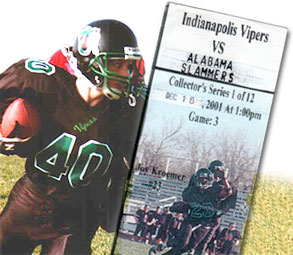
The Indianapolis Vipers have just beaten the Alabama Slammers 44-8 on the muddy but not quite frozen tundra of the Arlington High School field, and fullback Jodi “Moose” Armstrong is talking about the state of women’s professional football.

“There’s the WAFL,” she says, citing the league in which the Vipers, the Slammers and 14 other teams play. “There’s the NWFL, there’s the WSFL, there’s the WFA, there’s something else in the West, I forget what it’s called. It’s alphabet soup.”

She’s forgotten the IWFL, the WPFL, the LTFL and maybe a few others. But the point is: You probably didn’t even know there was such a thing as women’s professional tackle football, and if you talk to a woman professional tackle football player, she’ll tell you the problem is there are too many teams, too many leagues. And if you ask her to explain how we got to this point, how the Women’s American Football League, for example, came about, your head will soon be hurting like an offensive lineman who’s spent a long afternoon getting helmet-slapped by Warren Sapp, who plays over in the men’s league.

The WAFL is in its first season. It grew from the ashes of the Women’s Professional Football League, though a remnant of that league still exists, with four teams and a spring schedule. The WPFL, in turn, grew out of a 1999 barnstorming tour of two teams, the Minnesota Vixens and the Lake Michigan Minx, who were formed for the purpose of the tour. (The Vixens-Minx enterprise was chronicled in a documentary called “True-Hearted Vixens,” which aired on PBS over the summer.)

Moose, whose nickname comes not from her small-town Minnesota background but from her on-field resemblance to former Dallas Cowboys fullback Daryl “Moose” Johnston, is not only a running back for the Indianapolis Vipers, she is also the director of operations, as she puts it, for the Minneapolis Vixen, who used to be the Minnesota Vixens, and who aren’t actually in the WAFL, but did play three exhibition games against WAFL teams that counted in the WAFL standings. The Vixen are sort of on hold, waiting for an infusion of cash, and hope to play in a league next year.

Have I lost you? Let’s back up a little.

The Women’s American Football League consists of 16 teams playing in five divisions coast to coast. The teams play tackle football in full pads, under NFL rules, during the fall. Six games into the 10-game season the undefeated Tampa Bay Force and the Vipers are shaping up as the contenders for the Atlantic Conference championship, and the powers in the Western Conference are the division-leading Seattle WarBirds, Sacramento Sirens and California Quake, along with the San Diego Sunfire. The conference champions will play in the World Women’s Bowl championship game on Feb. 9.

The players, says Vipers coach K.C. Carter, come from all walks of life. “They’re a range of women who come from all over,” he says, “from Division I [in other sports] to your local housewife to a novelist who’s watched football and has probably played pick-up games with her brothers.”

Some of them have played flag football in organized leagues, and there are quite a few from the world of women’s rugby. But tackle football experience is rare. There have been attempts at women’s pro football leagues since the ’60s, and the original National Women’s Football League formed in 1974. Who can forget the Oklahoma City Dolls, the Toledo Troopers, the Los Angeles Dandelions? But the league began to falter in the late ’70s and eventually disappeared, and no league since has reached even its modest level of success. (A 1981 TV movie called “The Oklahoma City Dolls,” starring Susan Blakely and Eddie Albert, was not about the real Dolls team.)

Dana Miller, a 35-year-old physical therapist and the Vipers’ starting quarterback, ticks off her athletic background: basketball, softball, volleyball, track, karate, kickboxing, boxing. She says she was the first female Golden Gloves champion in Indiana, at 156 pounds. “Just a lot of contact sport stuff,” she says. “I’ve always really been into it. I of course played in the yard a lot with all the neighborhood boys.”

Miller heard about tryouts for the new league from teammates on a summer softball team.

“I told Coach, I’ve been dreaming about this kind of opportunity since I was probably 6 years old, but athletics like that, for girls, was just unheard of,” she says. “It’s like a high, just being out here and playing football, something I never thought I’d be able to do.”

The Vipers practice three nights a week at an Indianapolis park. On the night before Saturday’s Slammers game, assistant coach Cedric Markes is leading the various units in a walk-through as head coach Carter tries to jury-rig Miller’s helmet with a one-way walkie-talkie device so he can relay plays to her from the sidelines during the game without resorting to hand signals or courier players. He tapes the receiver into the helmet, then has her put it on and walk about 50 yards away. “If you can hear me, raise your hand,” he says into the microphone several times. She finally does give a little wave. She jogs back and reports that the speaker’s digging into her ear. “If I get hit it’s gonna take my ear off,” she says matter-of-factly.

Carter says he’ll work on it some more. He’ll have time. “If I get to bed before 4 the night before a game, I’m in trouble,” he laughs.

Carter is 36 years old and a Marion County special deputy sheriff. After an injury kept him from competing for a roster spot at Indiana State, he played semipro football for 11 years as a wide receiver. “My wife made me retire,” he says. He’s coached from youth leagues on up to semipro. He saw an article about the barnstorming tour and began making inquiries, eventually becoming involved with the new WAFL after talking to the league’s founder, Carter Turner.

He says coaching women is a lot like coaching men. “When I’m talking to the ladies out here, I’m pretty much talking to them like I’m talking to guys,” Carter says. “If they mess up I jump on their butt just like you would any other athlete, and at the same time I’ll build them up and pat ‘em on the back when they do something right. When you’re on this field you’re an athlete. Male, female. Don’t matter.”

Game day dawns cold and cloudy. Several days of rain have left the field muddy. The Vipers, in their black uniforms with green trim, do calisthenics in the west end zone. In the muck of the east end zone, assistant coach Brian Watson leads the Alabama Slammers, in red and white uniforms, through their drills. He tells them to get down in the mud for stretching.

“We’re gonna wallow in it,” Watson bellows. “We’re from Alabama! We know what mud is!” As they hold a stretch he asks his players, “Is it burning yet?” One of them yells back, “It’s squishing!”

But despite the levity, this is going to be a long day for the Slammers. They’ve come north with only 14 players.

“It’s tough, they have to play both sides of the football,” Watson says. “But they’ve got heart. That’s all you need.” Watson is here because he was asked to help out as an assistant by his wife, Mandi, an offensive tackle, and by head coach Mark Leslie, a soft-spoken youth league coach. Though the league envisioned a team in Birmingham, the Slammers split their games between Birmingham and Huntsville, and they’ve been drawing poorly, fewer than 500 fans a game. They have one win in their first five contests, and they’ve already taken a beating from Indianapolis, 52-6.

The Vipers are 3-2, including a forfeit win over the Jacksonville Dixie Blues, who didn’t make their trip north, the sanction for which is that they will also forfeit their scheduled home game against Indianapolis. The Vipers figure to win the Atlantic Conference’s Central Division unless the New Orleans Voodoo Dolls go on a major hot streak.

Having to send the same players out on both offense and defense against the Vipers, who have dressed 32 and play in platoons, the Slammers pretty much have no chance.

“Basically we just tell the players to pace themselves, try not to do more than they would normally do,” Leslie says softly. “Just play the game.”

The Vipers’ marquee player is Joy Kroemer, who was a member of the first professional women’s baseball team, the barnstorming Colorado Silver Bullets. Kroemer is a cornerback, though she also sometimes plays in the offensive backfield. The Slammers mostly avoid her, rarely even lining up a wide receiver on her side of the field, but she still manages to intercept a pass and make seven tackles, including a textbook, bone-crunching hit that stops a ball-carrier at the line of scrimmage late in the game.

Though the talent level varies from world-class athletes like Kroemer or Tampa Bay’s Sabrina Kelly, whom Carter calls “the Walter Payton/Barry Sanders of our league,” to women who cannot be mistaken for athletes at all, they produce pretty good football.

“I think the quality of play has gone up every week,” says Chuck Townsend, the referee for the Slammers-Vipers game. “I just think that once this catches on, more and more people get involved, the talent level will increase, but it’s exciting football. I think it’s on a par with high school football. Maybe a little better than that. Some aspects yes and some aspects no.”

Townsend leads a five-man crew that officiates high school games. They pick up another two to form an NFL-style seven-man crew for work in WAFL games, for which they’re paid expenses. “We do it because we love the game. It extends our high school season,” he says. I ask him if officiating women is different than officiating for men.

“The ladies seem to have a different demeanor about them out there,” he says. “They seem to be more helping each other along. It’s more cutthroat with the guys. [In their first game against Indianapolis] Alabama came down here and scored a touchdown. It was their first touchdown of the year. The Alabama team was thrilled, but I think even the Indianapolis team was thrilled. They were up by 40 points, you know. It wasn’t that they tried to let ‘em in, but they were like, ‘Good job, you guys got a touchdown,’ where guys would have been, ‘Daggone, we actually let ‘em score.’”

That difference is evident during the game. Players help each other to their feet more often then men do, and when receivers and defensive backs jaw at each other, they’re not talking smack. They just seem to be joking around a little, enjoying their time together on the field.

The Slammers put up some resistance. It’s not easy for the Vipers, but things are going their way. Coach Carter speaks into the microphone that relays the plays to Miller’s helmet speaker, saying things incomprehensible to nonfootball people, things like, “Seven, stay-five-stay.” At one point, the system breaks down. Miller holds her hands out, palms up. She can’t hear him. Carter shouts to her, “Seven, five, zero.” She goes back to the huddle, brings the team to the line, drops back to pass and hits wide receiver Virginia Hicks in stride for a 48-yard touchdown and a 12-0 lead. It’s the first of Hicks’ four TD catches of the day, the second of a league-record six touchdown passes for Miller. That kind of day.

At halftime, Indianapolis leads 24-0. The Vipers are standing around outside their locker room, which is locked for the moment, as the 14 Slammers trudge by on the way to theirs. The Vipers players make an alley for them. As the Slammers walk through, each one gets a series of encouraging slaps on the shoulder pads from their opponents. “Good job, ladies,” the Vipers players tell them. The players all refer to each other as ladies or girls.

The second half is more of the same, with Indianapolis scoring three more touchdowns — and their only successful two-point conversion; the kicking game is one of those aspects that seems to be lacking — and Alabama getting into the end zone once, for the final score of 44-8. The Vipers attracted about 3,000 fans for their opening game, and have since had crowds of about 1,000, but on this chilly late fall day there are only about 120 people in the stands, mostly friends and family of the players and coaches. In the fourth quarter they get on the officials for throwing too many flags and on the hometown team for throwing too many passes, both of which extend the game, and their shivering.

“It’s a little discouraging,” receiving star Hicks says about the small crowd, “but you know, the die-hards are out here.”

Hicks, 30, is a veteran of four years of flag football. Though she’s a bit of a joker off the field, she’s also an upbeat team leader and one of the Vipers’ best players. I ask her if she thinks the WAFL can succeed, a term defined in the league’s promotional materials as reaching the level of the WNBA, the women’s pro basketball league, which has backing from the NBA.

“I definitely think we can get to that level,” she says, “especially if we can get the NFL to back us at some point in time. I know lots of people who, next year when we have tryouts, they’re like, ‘I’m there.’ Since people have heard about it now, we have a lot more people interested in it. I think if we can continue to get the fans involved and get the community involved, it’s definitely going to succeed.”

That sentiment is echoed by the league’s founder, Carter Turner, in Daytona Beach, Fla. Turner promoted the 1999 barnstorming tour. “That developed into the WPFL. We played a limited season there. We got about halfway through that season.” Then, he says, “What they call ‘fraudulent investors’ came in.”

“The funny thing about women’s football is that it’s attracted about 99 percent really good people, but it has attracted some people who think they can make fast, easy money off of women and football, and that’s what happened in the WPFL,” he says.

Catherine Masters, who runs an entertainment marketing company in Nashville, spun off a new NWFL, which plays in the spring. The Philadelphia Liberty Belles are the current champions, and there are 21 teams set to play in 2002, all of them east of the Mississippi.

Turner, 48, who has a master’s degree in sports administration and has worked in both women’s and men’s sports on the college and pro level for many years, decided to stick with an autumn schedule for the nationwide WAFL.

“We feel that playing traditional fall football, for traditional reasons as well as health reasons, is the way to go,” he says. And this is the time of year, he says, when it pays off. “Our window of opportunity, we felt, was when college and high school football wound down, and the only football programming available now is the NFL and us.”

Turner says the difference between last year’s WPFL and the WAFL is that the former had a centralized structure, with one investor setting up all the teams and taking the lion’s share of the profits. That didn’t work out, he says, because first one investor and then a second “never performed.” So he decided the WAFL would be decentralized, with the teams responsible for their own outfitting, upkeep and travel, and keeping any profits. “That’s worked out really well.”

It hasn’t been without a few bumps. Turner cites San Diego as the attendance leader, with crowds of up to 5,000 people, with Sacramento and Oakland not far behind. But there are teams that aren’t drawing well, and there was some fractiousness in late October when Turner, who is listed as the director of league operations and media relations, fired commissioner Cindi Dwyer. “Not only has Ms. Dwyer failed to achieve any of the goals and objectives for which she was brought on board,” read an unsigned league statement, “but she has contributed negatively with actions detrimental to the welfare of the league and has actively sabotaged business operations of the league while promoting discontent amongst member teams with false information.” The statement said that no legal action would be taken. Asked if there was wrongdoing, Turner says no.

Dwyer couldn’t be reached for comment.

Turner also says, “We don’t say disparaging things about other leagues because they’re all pushing women’s football forward in their own way,” but he feels the WAFL, with its fall schedule and nationwide, decentralized structure, is the best of them.

“History’s repeating itself. Back in the ’70s, the old NWFL had the same problem, where they split into several different leagues and, well, the country really just wasn’t ready for women playing full contact sports back then,” Turner says. “But the same thing has happened now where people have come along who say they can do it better or have a better way to do it, and we’ve stayed the course and been pretty much successful throughout.”

Turner also insists the WAFL has the best talent. “We’re getting the top athletes, and that’s what we’re touting ourselves as, the top professional league,” he says. It should be noted that the term “professional” is thrown around loosely in the world of women’s football. No one draws a salary, and WAFL players will get paid only if there’s profit left over at the end of the season. Turner says that’s likely for any team that can pull in more than 1,000 or so fans a game, but it doesn’t figure to translate into anything like a living wage. The women are required to have jobs and their own health insurance in order to play.

The world does seem to be ready for women to play football, though. While local media has for the most part ignored the games, the coaches and players I talk to all say that response to the new league has been positive, both in the scant media coverage and just around town. “You know, we don’t hear a lot of the negative parts, people saying, well, women shouldn’t be playing football,” Carter says. “We probably heard that maybe when we first started, but we don’t hear that anymore. Everybody says, ‘Man, women playing football. That’s cool.’”

Boo Hunter, an offensive lineman for the California Quake in Long Beach, is the unofficial online chronicler of women’s pro football at her Unofficial Guide to Women’s Pro Football site. Though she plays in the WAFL, Hunter says, via e-mail, that while the NWFL “may be growing too fast, adding 11 new teams for 2002 … if they pull off another successful season, they will have established themselves as the premiere women’s football league.” Hunter, like Turner, dismisses the various other leagues as having “not really played serious league games.”

Jodi Armstrong — “Moose,” the Vixen official and Vipers fullback — has been part of this adventure for three years. As much as she loves the game, this longtime St. Paul Pioneer Press copy editor is realistic about what she’s seen.

“There’s more women playing, there’s better athletes being attracted, but as far as the overarching: We need some national unity, we need a major financial backer, we need some corporate sponsors to take us seriously,” she says.

As for all the competing leagues, “They all believe their management system is going to win out in the end and they’re so frustrated with each other that they won’t talk to each other, which is what has to happen if we’re going to be nationally successful,” she says. “The Nikes and the Reeboks and the people who we need to have behind us in order to have people at the NFL take us seriously, I just worry that they look at us and think, ‘Huh, no way.’ Too bush, too fractured, too, just, risky. I mean, you saw the game. We’re not putting on bad football. We’re just not making sure that we crawl before we walk.”

While Turner insists, “We feel we’re just right on the edge now of the big sponsors coming in,” Armstrong says, “Carter Turner could sell ice cream to Eskimos,” and expresses some misgivings about Turner’s ability to lead the league to success.

I ask Armstrong why she’s involved.

“I think that even if this is going to run into the ground, for as long as it lasts, it deserves to be given every chance to be legitimate,” she says. “And there are some bright spots. The West Coast teams in the WAFL are going strong. I mean, there are bright spots, and I want Minnesota to be one of the bright spots, and we are one of the charter members of this whole frickin’ thing, and to let us fall by the wayside is, I think, in some ways, to admit defeat, and I’m just a stubborn Minnesotan who doesn’t — I will not go down without a fight.”

Back on the muddy field at Arlington High School, after the players had congratulated each other and made arrangements to meet at a local chicken wing joint, an exhausted Dana Sanders, Alabama Slammers quarterback/defensive back, assesses her afternoon.

“Very long game,” she says. “We had a few girls couldn’t make it because of their jobs and different things like that, childcare, so we’re a little bit short-handed. We were playing with 15.”

Actually, 14. I ask her the same question I’d asked Armstrong. Why stay with it?

“Oh, I love it,” she says, still panting from her efforts. “I love playing. If we have 15 or 50, I still love it.”

The Year in Sanity: Jim Joyce

His blown call cost Armando Galarraga a perfect game. But from the moment he realized his mistake, he was golden

  • more
    • All Share Services

The Year in Sanity: Jim Joyce** CORRECTS PERFECT GAME TO WEDNESDAY, NOT TUESDAY ** Home plate umpire Jim Joyce calls a strike during the first inning of a baseball game between the Detroit Tigers and Cleveland Indians in Detroit Thursday, June 3, 2010. Tigers pitcher Armando Galarraga lost his bid for a perfect game with two outs in the ninth inning on a disputed call at first base by Joyce on Wednesday night. (AP Photo/Paul Sancya)(Credit: Paul Sancya)

Armando Galarraga was a journeyman Detroit Tigers right-hander who shocked the baseball world on June 2 by throwing a perfect game against the Cleveland Indians. Except, of course, the game wasn’t perfect, because with two outs in the ninth inning umpire Jim Joyce called Jason Donald of the Indians safe at first base when Donald clearly should have been called out to end the game.

Galarraga responded with a you’ve got to be kidding me smile for the ages, then retired one more batter for a one-hit shutout. He later said he hadn’t argued because he was in shock.

But it was Joyce’s response that turned this terrible tale into one that’s almost heart-warming. Not as heart-warming as a journeyman pitcher tossing a perfect game, mind you, but pretty toasty.

Having asked to see the video replay after the game, an emotional Joyce spoke to reporters: “It was the biggest call of my career and I kicked it. I just cost that kid a perfect game,” he said. “I missed it from here to that wall. I had a great angle, and I missed the call.” He also asked to speak to Galarraga, apologized to him and hugged him. Offered the next day off by his superiors, Joyce declined, saying he was ready to face what he assumed would be a hostile reaction from the Detroit crowd.

This eminently reasonable, grown-up reaction stood out because baseball umpires are ordinarily cloistered. They have what amounts to lifetime tenure. They don’t face reporters, rarely admit mistakes publicly and are not held accountable for their actions in any way that’s visible to the players or public. Don’t like that call? Replays showed the ump got it wrong? Tough.

Galarraga said he’d forgiven the umpire, and Joyce’s response to his error has been widely praised beyond baseball. He’s become a go-to example of how to handle mistakes in politics, religion and — especially because his straight-forward behavior came in the midst of BP’s oil-spill debaclebusiness.

Less than two weeks after the blown call, ESPN surveyed major league players for their opinions about umpires. Their overwhelming choice as the best in the business: Jim Joyce.

Continue Reading Close

Why I’m against baseball’s instant replay

The technology won't necessarily rob the game of heart, but it definitely won't fix what's wrong

  • more
    • All Share Services

Why I'm against baseball's instant replayThe Major League Baseball instant replay display is shown in the umpires room before the National League baseball game between the Philadelphia Phillies and Chicago Cubs in Chicago, Illinois August 28, 2008. REUTERS/Steve Green/Pool (UNITED STATES)(Credit: Reuters)

For the third straight baseball postseason, umpires have been making critical, high-profile mistakes in game after game, and there’s a growing drumbeat among media and fans that Major League Baseball has to do something about it. And not just any something, but one specific something: instant replay.

The entire conversation about umpiring has been predicated on the assumption that the only solution to the problem is a technological one, which is fascinating — and maybe just a little troubling — because everyone in the conversation knows two things: There are acres of room for improvement that has nothing to do with technology, and the technology itself is far from perfect.

We know from other sports, especially NFL football, that video replay is hardly perfect. Putting aside the unnecessarily long delays that accompany video replay in the NFL, it’s a simple fact about video that it does not always provide conclusive evidence of what happened. Camera angles can be as deceptive as the naked eye.

And more important, the NFL’s replay system is a laboratory of unintended consequences. Introduced for the same reason many people want to introduce replay to baseball — to put an end to egregious officiating mistakes — it has become the lord of officials. It has changed the way officials call games. Refs now err on the side of the reviewable call, or make no call at all so replay can be possible. They have changed the way they call fumbles and completions. Watch an old NFL game from before replay and you’ll be struck at the difference in officiating and rules interpretation.

People will argue over the specifics of those last two paragraphs, but there’s no one familiar with replay who doesn’t know that replay is far from perfect, that despite — I would say because of — replay being entrenched in the NFL for years, officiating is still such a problem that a huge number of fans can convince themselves that a recent Super Bowl was fixed by the refs.

Yet the only anti-replay argument that ever sees the light of day is the Luddite one: Instant replay would rob baseball, that most human of games, of an essential human element.

That’s a valid argument, but it’s a religious one. No one is ever going to be argued off of it, and if you don’t buy it, you’re not going to be talked into it.

But it’s interesting that the argument against it goes like this: Instant replay might not be perfect, but it’s better than what we have now, so we should use it. That argument ignores a vital question. Is instant replay better than some other solution?

If you’ve been around as long as most of the people who are in the most public part of this argument — media figures and baseball officials — technology has been a series of miracles in your life. You can carry a supercomputer in your pocket that connects you to anywhere in the world all the time? Are you kidding? I’m not even 50 and I remember when it was a big deal that someone could leave you a taped message when they called your house — the only place you could have a phone — and you weren’t there.

Got a problem? Technology can probably fix it, and if not, just wait a little. It’s coming. Marvelous times.

But I think we sometimes forget that technology isn’t the only fix, and it isn’t always the best one, and not just for squishy reasons having to do with idealizing human error. Human error is a bad thing, and technology is often fantastic at doing away with it. But it can also do away with some good human things, like judgment and holistic problem solving.

Think about law enforcement for a moment — and sports officiating is essentially law enforcement. Which is more effective at fighting crime, an elaborate system of video surveillance or a program of job training, substance abuse education and treatment, community investment and so on? Or if that’s too liberal-sounding for you, focus in tighter. If you’re a parent, which is more effective at getting your kids to behave like solid citizens, spy cams around the house or engaged, loving parenting?

If you wanted to design a system that would result in poor umpiring, you would design Major League Baseball’s system. It’s positively medieval. Umpires essentially have lifetime tenure. They are sequestered from the media and answer only to a review system that is as secretive as it is pointless, since it hardly ever results in umpires losing their jobs. Instant replay won’t change that lack of accountability.

“We never know why or when they are fined, or reprimanded or held accountable,” Oakland A’s pitcher Brad Ziegler told ESPN’s Amy K. Nelson last week. “Any time a player is punished, suspended or sent down to the minors, the public knows about it. It would be a lot easier to communicate with umpires if everyone was held to similar standards. Our statistics as players are a lot more quantifiable than the umpires’.”

I am something of a Luddite when it comes to instant replay, not because I’m anti-technology — I have a long-distance line to New York in my pocket, and the call is free? Score! — but because I think baseball has been smart about being slow to change over the last century-plus. Replay would suddenly, irreversibly alter a game that has a pretty good history of solving its problems without radical, game-altering solutions.

I don’t believe baseball should absolutely avoid instant replay because instant replay is evil. I believe it should try to tackle the organizational problems that are leading to the poor umpiring rather than slap an electronic band-aid on them.

Nelson’s ESPN story is about a planned winter meeting between the grumbling players association, baseball officials and the umpires. Nelson describes such a meeting as “rare,” which is a problem right there. Shouldn’t the three parties involved in this major issue for Major League Baseball talk to each other more than rarely?

It’s a good step. I’m not too hopeful it’s going to lead to a new era of transparency and reform. No one from the umpires or Major League Baseball would comment for the story.

Continue Reading Close

Hard times? TV can be your lottery ticket

If you can get your sob story on the tube, you're gold. But what about the other millions of desperate Americans?

  • more
    • All Share Services

Hard times? TV can be your lottery ticketA food line at the Community Kitchen in Harlem

A tweet from NBC reporter Ann Curry:

Ok, here’s a smile: update on our doc on recession/poverty. I love America

http://bit.ly/btt50h

Here’s the text you get when you “share” the video report Curry’s tweeting about:

Overwhelming response to Dateline’s poverty report

A development to the story we brought you about struggling families in Ohio who have been pushed over the edge by this recession. ††There’s been a response from people wanting to help.

http://bit.ly/btt50h

So it’s that old TV thing. NBC does a story on “Dateline” about families struggling through the recession in rural Ohio, and letters and donations and job offers come pouring in from all over the country.

The retired Air Force vet has “job offers in Pennsylvania, Virginia, Arizona, Iowa.” Someone sent him $5,000. A woman reads through tears from a letter she’s received: “In a couple of weeks I will be able to send you some money to help with expenses. I hope this letter raises your spirits and that you know I really do care. Most of all, you have a friend in me. You are going to be OK, and so are your children. I will be thinking of you, sweetie, and praying that lots of other people send you much-needed money.”

She says, “It’s really hard to believe that someone you’ve never met could actually care that much.”  

The food pantry lady has gotten 500 phone calls and donations from Texas, California, Florida, Iowa, Massachusetts, Maine and Canada. She says, “I just can’t even describe how good it feels to know that there are so many people out there that really do care.”

This is absolutely par for the course, it’s what happens every single time there is a sob story on the TV, but here’s the thing: People don’t care. They just respond to what’s on television.

There are folks right down the street in Texas, California, Florida and Iowa who need food and basic supplies. There are good, capable people, some of them retired military, right down the street in Pennsylvania, Virginia, Arizona and Iowa who are looking for work. And, after NBC’s report, those people still need the basics and are still looking for work. And those people who sent the heartfelt letters and the donations and the job offers likely never moved a muscle for those people down the street.

A guy who drove to the food pantry with a Hefty bag of donations tells the food pantry lady, “Cincinnati Ohio’s thinkin’ of ya,” and she gives him a big hug. Really, guy who drove 170 miles to Lottridge to find someone to give your Hefty bag of stuff to? Because where were you and the rest of Cincinnati before NBC aired its report?

Curry, who is among the best in the business and whom I don’t mean to beat up on, gets “a smile” out of this, as she should. She did a good piece about people who are struggling, her viewers responded in overwhelming fashion and the people she reported about are deeply moved by their good fortune.

If you focus in tightly enough, it really is a wonderful thing. That a relatively tiny group of people in Ohio actually did get a lot of help they weren’t going to get without that TV report. It was like a little miracle, and you’d have to have a hard heart indeed not to be touched by the young mom reading the letter or the hardworking food pantry lady who is suddenly able to provide so much more help to so many more people. I love America too.

But back your view out to the larger picture and what you see is something much more depressing.

Obviously, the people who sent money and goods and job offers had both the means and willingness to help their neighbors in need, but instead they helped some people they saw on TV. Now, I suppose it’s possible that every one of them, from the donor of $5,000 to the Hefty bag guy from Cincinnati to the job offerers in Pennsylvania, Virginia, Arizona and Iowa, is doing just as much for lots of other people closer to home and not on the TV.

I would just be willing to bet a lot that they aren’t.

What Curry’s story suggests is that the generosity of the American people can solve the problems of a lot of folks who need help — as long as they can get on TV. Getting on TV is a lottery ticket, and the depressing part of it is that if you’re in trouble, your chances of getting on TV are about the same as your chances of winning the lottery.

What about all the desperate people who didn’t have a TV network drop out of the sky into their local food pantry? How do we turn their story into “a smile”? Because there are clearly people out there willing to help. There just isn’t enough TV to go around.

Continue Reading Close

Worst! Calls! Ever!

Slide show: Umpire Jim Joyce's error ruined Armando Galarraga's perfect game. How does it stack up against history?

  • more
    • All Share Services

Worst! Calls! Ever!Dallas Stars Brett Hull (22) raises his arms after scoring the game winning goal on Buffalo Sabres goalie Dominik Hasek in the third overtime of Game 6 to win the Stanley Cup Finals in Buffalo, NY, Sunday, June 20, 1999. (AP Photo/Charles Krupa)(Credit: Associated Press)

Umpire Jim Joyce’s blown call Wednesday night, which cost Detroit Tigers pitcher Armando Galarraga a perfect game, is already the stuff of legend. Was it the worst blown call in history?

It was the worst blown call in Jim Joyce’s history, that’s for sure. And surely the worst in Galarraga’s until-now ordinary baseball career. Because it merely affected a line in a record book — Galarraga would have been the 21st pitcher in MLB history to throw a perfect game, dating to 1880 — it lacks the historical heft of the greatest officiating mistakes.

View the slide show

Remembering Ernie Harwell

To know the longtime voice of the Detroit Tigers, through the radio or in person, was to love him

  • more
    • All Share Services

Remembering Ernie HarwellFILE - In this Oct. 3, 1993, photo, Detroit Tigers broadcaster Ernie Harwell pauses during a break in the action in the Tigers' baseball game against the New York Yankees at Yankee Stadium in New York. The Tigers say Harwell has died. He was 92. (AP Photo/Paul Hurschmann, File)(Credit: AP)

The best three days I ever spent on the clock were the three days I spent in Detroit with Ernie Harwell, the longtime voice of the Detroit Tigers, in 2002, his last year in the broadcast booth.

Harwell died Tuesday at 92, eight months after announcing that he had terminal cancer that he would not treat. John Lowe of the Detroit Free Press, in what will surely be the definitive obituary, quotes Harwell at the time: “I’m ready to face what comes. Whether it’s a long time or a short time is all right with me because it’s up to my Lord and savior.”

I grew up not listening to Ernie Harwell but to the man who replaced him in the Brooklyn Dodgers booth in 1950, Vin Scully. I hadn’t come to know Harwell until 1999, when baseball broadcasts were still streamed online for free and Harwell had returned to the radio side after five years on TV. Like generations of Michiganders, I quickly fell for his warmth, his charm, his knowledge of the game, his old-timey broadcast voice.

When he announced that 2002 would be his last season, I wanted to write about him, so I got in touch with him through the Tigers, asking if I could come to Detroit for a few days, hang out with him, shadow him. A day or so later there was a voicemail message. That incredible voice was right on my phone! I saved it for as long as I could. I wish I still had it:

“King, this is Ernie Harwell from Detroit. I don’t know that there’s much to write about me, but sure, come on up.”

I had planned to write about a fundamental shift in the way people follow baseball, about how Harwell was one of the last of the old radio men who were identified with a team as much as any player, often more than any player. Now, with most games on TV, far more games on national TV, larger squads of announcers and the Internet providing more baseball information than any one person could ever absorb, fans weren’t dependent on that one broadcaster to serve as the conduit to their team.

Yes. Well, it seemed interesting in my head. A little of that stuff made it into the piece, but after about 10 minutes with Ernie Harwell, I knew that my story couldn’t be about anything but Ernie Harwell.

It’s hard to talk about what kind of guy Ernie Harwell was without sounding like you’re talking about a guy on the night of the day he died. But it was just as hard when he was still alive. I spent three days with him, and he was unfailingly kind, generous, cheerful, energetic, positive and humble. And not just with me. At 84 years of age, he was tireless, making sure as he roamed the ballpark — which he did a lot — that every fan who wanted a moment with him — and there were many — got the moment he or she wanted.

I talked to a lot of people about Ernie Harwell that summer, and in the eight years since then I’ve talked to more people about him and I’ve heard and read many things said about him, and I’ve never heard a hint that the man I came to know in those three days wasn’t the genuine article. It may be that there has never been an unkind word said about Ernie Harwell.

Jon Miller, the ESPN and San Francisco Giants announcer, was hurrying across a field when I sidled up to him asking if I could talk to him for a minute. He kept walking as he asked what I wanted to talk about. “Ernie Harwell,” I said, and he stopped on a dime. All of a sudden, I had his attention and he grew animated as he told stories about Ernie.

Mike Shannon, the longtime St. Louis Cardinals broadcaster, was pressed for time just before a game one day but he told me to sit in the press box and wait for him. Minutes before the first pitch, he leaned out the door of his radio booth. “Where’s the guy who wanted to talk about Ernie Harwell?”

Ty Cobb liked Ernie Harwell, for crying out loud. Ty Cobb didn’t like anybody.

“He’s so generous with his time,” I wrote back then, “that a reporter in town for three days to research a story on him confesses on the third day that he’s just about run out of questions to ask.” That reporter was me, of course. We were sitting in an empty broadcast booth in the Comerica Park press box when I told him that. He looked out at the field for a few seconds, then started throwing out some suggestions, things I might want to ask about.

It sounds silly to say, but after spending time with Ernie I told myself that I would try to be a better person, more generous, more cheerful, more optimistic, more kind. More like Ernie Harwell. I failed miserably at this, of course, but I’ve returned to that thought fairly often over the years, and I like to think I’ve moved just a tiny bit in an Ernie-like direction.

Here’s the story I wrote about Ernie. I think I worked harder on it than on anything I’ve ever written. I did things I never do. I made outlines, wrote things on index cards and arranged and re-arranged them.

I swung for the fences, wanting to do justice to the living legend and the time I’d had with him. I used a flamboyant structure, organizing the piece around Ernie’s call of a single game, weaving his epic story between snippets of a thoroughly ordinary contest between two lousy teams, the Tigers and the Kansas City Royals.

I’m not sure it worked. But you don’t get to hang out with the greats that often, and it’s less often that you end up liking them. I wasn’t going to write just another piece about Ernie Harwell in his last year.

A few days after it ran he sent me an e-mail thanking me for the piece. “Best thing that’s ever been written about me,” he wrote. I’m sure he said that to every single person who ever wrote a story about him. And here’s the thing: I’m sure he meant it every time.

Continue Reading Close

Page 1 of 111 in King Kaufman