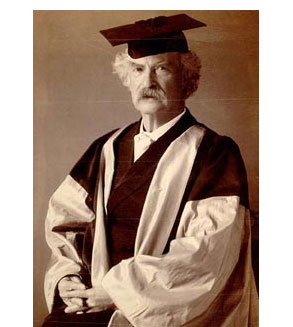

During Ken Burns’ lifetime tour of all things archetypally American, it was probably inevitable that he make a stop at Mark Twain. Twain may or may not be our greatest writer, but he is unquestionably our most beloved — and the most quintessentially American. He grew up on the banks of the great river that flows through the heart of the country, and after a self-inventing career as a printer, riverboat pilot, prospector and newspaperman, ended up a New England grandee and the nation’s gaudiest literary legend — a picaresque red, white and blue life made even more familiar by the fact that he then squandered it all. But above all, Twain is ours in a way no other American writer is because of his language — that is, our language. If Twain single-handedly invented American literature, as Ernest Hemingway and a number of other people who have some standing to say such things have claimed, it was because he heard our voices true and gave them back to us.
Burns’ “Mark Twain” makes this essential point clearly and forcefully. At the beginning of the film (which is in two parts, each two hours long), Ron Powers, a Twain biographer who is one of the most eloquent of the film’s many experts, says, “[His] genius was for speaking the voice of America.” The playwright Arthur Miller comments that Twain “wrote as though there had been no literature before him” — a marvelous and marveling tribute from one great writer to another. Hal Holbrook, longtime star of the famous one-man stage show “Mark Twain Tonight” — whose almost personal relationship with Twain gives his comments emotional force — says, “He made American speech something to be admired.” And so the stage is set for the story of a writer whose swaggering mastery of the vernacular and willingness to talk about America’s hidden shame, race, not only changed our literature but, as the film observes, changed the way we think about ourselves.
“Mark Twain” gives a vivid sense of this screamingly funny, deeply sad, daughter-worshipping, money-mad, unbelievably fortunate, tragedy-plagued border ruffian and genteel New Englander who gave American literature — to use the highest term of praise in Huck Finn’s lexicon — its “sand.” Though it is not without flaws, it leaves you, like all good biographies, with the paradoxical feeling that its subject can’t really be summed up, but that you know him anyway — and that you know him in a way that he didn’t, couldn’t, know himself.
“Mark Twain” will inevitably be compared to Burns’ larger documentaries. This is somewhat unfair: “Jazz,” “Baseball” and “The Civil War” were not only much larger subjects, Burns had the advantage of being there first. Mark Twain, a legend in his own lifetime and the subject of a torrent of biographies and scholarly and critical works, is well-trod ground indeed. A fairer comparison would be to Burns’ “Thomas Jefferson.” Both are fine films — well-researched, solidly written, accompanied by Burns’ usual well-chosen selection of fascinating and sometimes remarkable archival photographs. But “Mark Twain” — at least its first episode — is more gripping, if only because Twain is a far more robust (if not more complex) character than the elusively cerebral Jefferson.
“Mark Twain” succeeds in pulling off a difficult task: bringing together popular history and the subtler genre of literary biography. Burns, his longtime collaborator Geoffrey Ward and co-writer Dayton Duncan are sophisticated enough, and have assembled a smart enough team of Twain scholars and writers (the commentators include Russell Banks, Shelley Fisher Fishkin, John Boyer, Jocelyn Chadwick and Dick Gregory) to convey the drama and pathos of his creative struggles and successes without resorting to simplistic pop-psychological analysis.
From the start, the emphasis is on Twain the humorist. This makes sense, since whatever else he is, Twain is the funniest major writer in the history of world literature. “I was born the 30th of November, 1835, in the almost invisible village of Florida, Monroe County, Missouri,” “Twain” drawls at the beginning of the film. “The village contained 100 people and I increased its population by one percent. It is more than many of the best men in history could have done for a town. There is no record of a person doing as much — not even Shakespeare. But I did it for Florida, and it shows that I could have done it for any place — even London, I suppose.”
The film deals sensitively with Twain’s early life in Florida and Hannibal, Mo., revealing his early and crucial exposure to black slaves on his uncle’s farm, including one named Uncle Dan’l. “I think that race was always a factor in his consciousness, partly because black people and black voices were the norm for him before he understood there were differences. They were the first voices of his youth and the most powerful,” says the writer David Bradley. (The film glosses over the fact that Twain acknowledged that there was an unbridgeable gulf between him and the black friends of his youth.) It moves on to his job as a printer’s apprentice at age 14, his grand achievement in becoming a Mississippi pilot and his agony — the first of many sorrows that would befall this fearless, restless, softhearted genius and glorified scam artist.
The stagecoach trip he took out West with his brother Orion (that years later was completely transformed for his comedic purposes in “Roughing It”) is dealt with gloriously: as the narrator reads a wonderful passage in which the stagecoach-riding Twain extols the virtues of “ham and eggs and scenery,” along with a good pipe, as all that is required for human happiness, we see the open West rolling by. Then come his rollicking days as a newspaperman in Virginia City and San Francisco (described by Powers as a “great proto-psychedelic, counterculture newspaper society out West”), followed by his weeks of slinking about in shame and his near suicide after being fired from his San Francisco newspaper job. (The “slinking” days are accompanied by what appear to be some of those wonderful misty, murky Arnold Genthe photographs of Chinatown.) He gets his big break with “The Celebrated Jumping Frog of Calaveras County” — his first review describes him as “foremost among the merry gentlemen of the California press.”
Twain began the lecture career that was to save him financially after a trip to Hawaii. His advertisements use the portentous five-stacked-headlines style of the day to excellent effect:
A splendid orchestra
Is in town, but has not been engaged.
Also,
A den of Ferocious Wild Beasts
Will be on exhibition in the next block.
Magnificent Fireworks
Were in contemplation for the occasion, but the idea has been abandoned.
Twain followed his lectures, which were a smash hit, with a trip to Europe that yielded “Innocents Abroad.” He met his sweet, frail wife, Livy, from a wealthy East Coast family, and wooed and won her despite the reasonable suspicions of her family that he was a drunken, lecherous frontier bum. The film gives an extraordinary account of his encounter with an old ex-slave named Mary Ann Cord, whose story of having her children taken from her Twain turned into his first “serious” piece.
But the heart of “Mark Twain” comes when it turns to “The Adventures of Huckleberry Finn.” Everyone weighs in: Dick Gregory points out that before “Huckleberry Finn” nobody “had to listen to a conversation from a black person.” The eloquent Russell Banks, discussing the famous passage in which Huck says “All right, then, I’ll go to hell” after he defies his conscience and decides not to turn Jim in, says that that single line offers “the possibility of redemption” from America’s founding sin of racial injustice and “makes the hair on the back of my head stand up.” Arthur Miller, quoting Twain’s dictum that “the difference between the right word and almost the right word is the difference between lightning and the lightning bug,” celebrates Twain as a writer whose apparent easy mastery of language conceals a poet’s meticulous craft. (One of my personal Twain hair-standers: As Huck searches his memory for reasons to turn in Jim, Twain writes: “But somehow I couldn’t seem to strike no places to harden me against him, but only the other kind.” Twain came to hate Christianity, but is there a more deeply Christian — or Jewish, or Muslim, or Buddhist — sentence than that in literature?)
But it is perhaps William Styron who says it best. Pointing out that for some reason no one has ever been able to completely explain, this story of a white derelict and a black runaway slave going down a river on a raft resonates with people everywhere, Styron says that “out of his genius, Twain found a metaphor for the tragicomedy of life” — and, in the end, created “a hymn to the solidarity of the human race.”
At times, the analysis in “Mark Twain” seems slightly superficial. Addressing one of the major issues in Twain criticism, the famous dialectic and tension between “Samuel Clemens” and “Mark Twain,” Ron Powers points out that the bourgeois Samuel Clemens used the disreputable “Mark Twain” as a kind of dark power he would summon up to do his creative bidding. But the schism between the two sides of the writer, the toll it took, its possible relation to both Twain’s creative decline and his peculiar obsession with fame and wealth, aren’t explored in any depth. Twain’s humor offers a similar case: The film treats it as a kind of displacement or compensation for his darkness and bitterness. While there is no doubt some truth in this, it’s a bit facile.
Of course, it isn’t easy to incorporate literary criticism into a television biography — or, for that matter, into biography of any kind. Still, there are ways to do it. Burns likes to use on-camera commentators, and they are effective here (in fact, they’re more eloquent, by and large, than the commentators in “Jazz”), but one wonders why he didn’t make judicious use of more written Twain criticism. Neither nonspecialists like Ward and Duncan nor any on-camera commentator is going to be able to match the eloquence of, say, E.L. Doctorow’s introduction to “Tom Sawyer” in the Oxford edition of Twain’s collected works.
But these are minor quibbles, easily forgotten in the pleasure of seeing a prime-time television show that gives the process of artistic creation center stage. Take the scene when Twain, working in his cottage at Quarry Farm, suddenly taps into a treasure trove of long-lost boyhood memories. “The fountains of my great deep are broken up,” Twain (as read by Kevin Conway) says in wonder. “The old life has swept before me like a pageant. The old faces have looked at me out of the mists of the past. Old hands have clasped mine …” Our awareness — and perhaps Twain’s — that the discovery would fuel his major works, providing him with what the great Twain biographer Justin Kaplan memorably called a “usable past,” gives this scene a sense of joy touched with grandeur.
And, of course, there are many “Burns” moments — those times when a perfect visual image and a telling narrative come together, allowing you to simultaneously grasp the arc of his life and imagine you’re seeing through Twain’s eyes. It’s an epiphany unique to this form, at once conceptual and visceral. When the young Samuel Clemens talks about how when he was young all he wanted to be was a Mississippi steamboat pilot, for example, an exquisite shot of a faraway steamboat at dusk fills the screen — the image at once an embodiment of metaphorical, disembodied memory, like Proust’s madeleine, and a real image such as Twain really saw, a life he really lived.
And there is Twain’s face. It’s an extraordinary face, familiar, likable, wise, brash, tender, irascible — a face that seems almost infinitely expressive, that you can read almost any emotion into. When Clemens sets off to be a riverboat pilot, we see a photo of his face at age 22 — a big, fearless, rough-and-tumble, get-out-of-my-way beefsteak of an American face. When the narrator describes how the young Clemens felt responsible for the death of his younger brother Henry, who was scalded to death when the boiler of his steamboat exploded, and we hear Clemens’ anguished words, we see the same image again — and suddenly it is the face of a young man with a broken heart . The face of the old Twain, too, lives on the edge between utter sadness and irrepressible feistiness.
The film doesn’t duck Twain’s dark side. It acknowledges that he had a violent temper (a neighbor was shocked when he threw dozens of shirts out the upstairs window because one was missing a button) and, more troublingly, hints that he wished his beloved daughters would remain children forever. (A photo of him at his daughter Clara’s wedding is frightening: dressed to upstage the bride in his honorary Oxford gown, he looks as grim as death.) The man who would for hours tell his three little girls stories based (in prescribed order) on certain items in the library was also the man who vanished for months at a time, who could be distant and cold, who demanded adulation. To their credit, the filmmakers allow these contradictory elements to stand, without trying to explain them.
The only serious criticism of “Mark Twain” concerns the arc of its story, which emphasizes Twain’s ultimately tragic later life at the expense of a deeper exploration of his most important and dynamic creative and personal period. Episode 1 ends in 1885 with the U.S. publication of his masterpiece, “The Adventures of Huckleberry Finn,” when Twain was almost 50 years old and had written virtually all of his major work — “Innocents Abroad,” “Roughing It,” “Life on the Mississippi,” “Tom Sawyer” and “Huckleberry Finn.” All of Episode 2, therefore, takes place when Twain’s creative career was in decline — a slow decline, one punctuated by highlights such as “Pudd’nhead Wilson” and the bitter, fantastic outbursts of his God-detesting old age, but decline nevertheless.
The second part deals with a sadder man than the lovable picaro who muscled his way on pure, irrepressible talent to the top of America’s literary heap. We see Twain’s obsession with becoming even richer than he was, his abysmal business sense (Arthur Miller has some perspicacious comments on why artists are too imaginative to ever be good businessmen) and, above all, the heartrending deaths of his beloved daughter Susy and wife, Livy. We also witness one of the great stories in American literary history, the grueling around-the-world lecture tour that the 60-year-old Twain undertook to pay off his enormous debts — a tour that ended four years later with the 64-year-old writer returning home to a hero’s welcome, acclaimed as “the bravest writer in America.” But mostly, we witness a man whose lights, as the novelist Russell Banks puts it, have been going out as he got older. (Banks notes memorably that in his early days, when he shed light in all directions, Twain was a “wise guy who’s wise.”)
In short, it’s a long downer, and maybe longer than it needed to be. On the other hand, it’s true. Burns and his collaborators’ approach implicitly asserts that a writer’s personal life is just as worthy of interest as his work. It’s a perfectly reasonable position — and certainly Twain’s entire life was remarkable. And from a practical point of view, the “tragic fall” of Twain’s later life makes it a good story — where else were they going to break Part 1 to keep viewers coming back for Part 2?
Still, I can’t help but wish that Twain’s creative decline had been condensed and that some of Episode 2 had been devoted to taking deeper looks at books like “Life on the Mississippi,” “Innocents Abroad” and “Roughing It” — all masterpieces in their own right that don’t quite get their due here. A discussion of “Life on the Mississippi” could have provided an opportunity to examine both the muscular rightness of Twain’s descriptive prose and his irritating tendency to pad great books with inferior material. (Every Burns film is always going to be just a tiny bit sentimental: Just as Twain’s racial attitudes are slightly elevated, nothing is said here about how Twain, even at his best, had a wee admixture of the hack in him. Hence the lame ending of “Huckleberry Finn.” Actually, it’s an endearing trait. Would we want “the Lincoln of our literature” to be an ice machine like Flaubert?) “Innocents Abroad” is noteworthy for its created persona, the smartass rube who allows Twain to crack wise without missing a beat. And “Roughing It” remains quite simply one of the weirdest and wildest books ever written, a ridiculous “true” romp of a memoir whose tour de force balancing of fact and fiction, real self and bogus “reality” anticipates gonzo journalism. Both of those books could have grabbed more of the spotlight.
Instead, we are told more about Twain’s harebrained business schemes than we need to know. Visually too, the film falls off in the second part: There are endless shots of Twain’s Hartford mansion, inside, outside, in fall, in summer. Mostly, though, we watch the unutterably sad story of the tragedies that befell Twain in his later life, and his anguished and, frankly, rather bizarre literary reaction. “Mark Twain” never quite explains just why the death of his wife and his daughter destroyed Twain’s belief in a benevolent God and led him to write the weird, hopeless, clunkily metaphysical tales of his late career — but I’m not sure that any other biography has, either.
He went down to silent sadness in the end, even his Lear-like rages falling from him. But that isn’t what one remembers, or should remember. One should remember Twain the irrepressible, the life force, braggard and trickster and bully-ram blowhard and great poet of our tongue, bouncing off fate’s ropes like Muhammad Ali, again and again.
“Mark Twain” does justice to this great, flawed, deeply lovable writer and great, flawed, deeply lovable man. And it leaves the viewer just a little bit prouder of, and more filled with wonder about, the strange country, maybe still young, that could produce a man who did so much, and lived so long.
Here’s a startling news item: “The Intouchables,” a lively if largely predictable Parisian comedy about a wealthy quadriplegic and his ne’er-do-well immigrant caretaker, has become the biggest international success in the history of French cinema. Indeed, according to some sources — and these things are notoriously difficult to measure on a global and historical scale — “The Intouchables” is now the biggest non-Anglophone film of all time, with a worldwide gross approaching $300 million.
But beyond the business headlines, what’s really fascinating about “The Intouchables” is the way it exposes the gulf in racial attitudes between France and the United States, along with another gulf that’s just as wide, the one that has film critics and cinephiles on one side and popular audiences on the other. Viewers in numerous countries have eagerly devoured this feel-good fable about two men of different races and classes who forge an improbable friendship (dubbed by some wags “Driving Monsieur Daisy”). While the audience for foreign-language film is inherently limited in America, there’s no reason to believe it won’t do well here also. At the same time, heated transatlantic debate has erupted over whether “The Intouchables” traffics in offensive racial stereotypes, with Variety critic Jay Weissberg writing an uncharacteristically angry review that accused the film of “Uncle Tom racism” and compared the Senegalese caretaker character to a “performing monkey.”
When Harvey Weinstein first acquired “The Intouchables” in the wake of its smash success in France, he clearly imagined another dark-horse Oscar contender, in the wake of “The Artist.” The film has racked up audience awards at film festival after film festival, and currently stands at No. 93 on IMDb’s user-generated “Top 250″ list. Omar Sy, the charismatic Afro-French actor who plays Driss, the caretaker, won this year’s César award (the French Oscar equivalent) for best actor, beating out actual Oscar winner Jean Dujardin. But with the looming possibility that “The Intouchables” could spark a divisive, soul-searching racial debate — which was precisely what squelched the Oscar hopes of “The Help” — those expectations have been downplayed. (That isn’t why “The Intouchables” is being released this week, with Weinstein and most of the film-biz aristocracy in Cannes, but the coincidence is oddly useful.)
Let me come clean right now and tell you that I enjoyed “The Intouchables” quite a bit. If you’re looking for a lightweight summer change of pace, with just a smidgen of Continental flair, here it is. Both Sy and co-star François Cluzet (of the hit thriller “Tell No One”) are marvelous, the former playing a guy who’s constantly in motion, both physically and psychologically, and the latter playing a depressed and repressed guy who literally can’t move, but whose real imprisonment has more to do with his spirit than his spinal cord. Don’t go expecting serious French art cinema, please; those who have described this movie as something like a mid-’80s Eddie Murphy comedy dressed up with classy Parisian settings are correct. But here’s the question, and I can’t answer it for you: Is that such a bad thing, in itself?
Once is not enough for a movie that’s made this much money, of course, and Weinstein already has an American remake in the works, possibly to star Colin Firth as stick-up-butt wheelchair dude. The real Eddie Murphy has gotten too old to play the loosey-goosey, pot-smoking sidekick, but there’s no shortage of guys who could do it: Jamie Foxx is the default setting these days, but I’d go for the suddenly hot Kevin Hart from “Think Like a Man.” I’m not claiming it’s aesthetically or sociologically valid to remake a French movie that already feels like a reheated Hollywood throwback, by the way. I’m saying it’s a cruel reality, like Dutch elm disease or Adam Sandler, and there’s no way to stop it.
To get back to the case at hand, I do understand what the haters find so offensive about “The Intouchables.” (The infelicitous English title, by the way, reflects the fact that they couldn’t really get away with calling it “The Untouchables,” could they?) I was pretty taken aback by Weissberg’s vituperative review, and I tend to believe that “Uncle Tom” is one of those expressions that white people should pretty much never use. On the other hand, I can only applaud him for abandoning the balanced, analytical mode of trade-magazine criticism and saying exactly what he damn well thinks. (As for comparing a black man to a monkey — well, I understand what Weissberg was getting at, but it’s an error of rhetoric, the sort of comment that makes nuance and context disappear.) And I know for sure, from hearing friends and acquaintances in and around the movie business complain about this film, that Weissberg is not alone.
I believe that Olivier Nakache and Eric Toledano, the writing-directing duo who made “The Intouchables,” are innocent of any bad intentions. In fact, “innocent” isn’t a bad word overall, for this movie and the worldview it represents. The French may pride themselves on being the most worldly and sophisticated of all people, but the debate in France about race and immigration and multiculturalism — which ramped up sharply after the suburban riots of 2005 — can sometimes sound strikingly naive to American ears. Until very recently, mainstream French opinion has resisted thinking about the nation in anything except homogeneous terms, despite growing Arab and black minorities (both immigrant and native-born) and evident social problems with segregation and discrimination. (The French census, for instance, is prohibited from collecting data on race or religion, so no one really knows how many French people are black or Islamic.)
There can be no question that the characters in “The Intouchables” are stereotypes, in the broad sense. Cluzet’s character, Philippe, is an aristocratic zillionaire who lives in an astonishingly luxurious flat in central Paris. Since being injured in a paragliding accident, he’s lived inside a cocoon of money and privilege, surrounded by antiques and modern art and a bevy of assistants. Sy’s character, Driss, is easygoing, good-hearted, lustful and uncultured, and his passions run toward pretty girls, getting high and vintage American R&B. Philippe hires Driss specifically because Driss doesn’t particularly want the job — he only shows up to get a signature for his benefits card — and feels no pity for Philippe.
Which is actually a pretty good reason. You get where this is going, most likely: Driss is a pretty inept caretaker, at least at first, but is the only person Philippe knows who will relate to him man to man. There’s a bit of borderline-homophobic humor about their enforced intimacy; there are interludes with hookers and fast cars and late-night conversations fueled by booze and marijuana. Driss learns to like Mozart and modern art; Philippe learns to get down with Earth Wind & Fire and gets some valuable tips about chicks. It’s probably fair to summarize this movie as being the story of a paralyzed white man who needs the help of a younger, stronger, more virile black man to reconnect with his own masculinity, and if you want to say that narrative reflects an underlying latticework of racist attitudes, I won’t argue with you. Then there’s the complicating factor that in the real-life story on which “The Intouchables” is based, the caretaker was of Algerian origin, and hence Arab rather than black. (The filmmakers have said they wanted to cast Sy, and built the story around him, but it’s certainly possible to render other interpretations.)
But one can concede all of that while still agreeing with French historian and multicultural activist François Durpaire, who has responded to Weissberg by arguing that the huge success of “The Intouchables” is likely to have positive effects in Europe’s emerging discussion of race and culture, even if the movie relies on crude generalizations. (Durpaire adds that if “The Intouchables” is offensive, so were the “Beverly Hills Cop” movies.) Movies are not meant to be seminars in sociology, after all, and most viewers will receive “The Intouchables” as an upbeat story about two guys from vastly different circumstances who turn out to have a lot in common and help each other, etc., rather than a lesson in racial semiotics.
Perhaps the strongest endorsement for “The Intouchables” has come from aging French ultra-nationalist Jean-Marie Le Pen, who has described it as an allegory about how the future of his nation depends on disenfranchised young immigrants from the suburbs. He thinks that’s a “dreadful” vision, mind you — but, seriously, who knew that guy was so smart?
“The Intouchables” opens this week in New York and Los Angeles, with wider national release to follow.
Continue Reading
Close
The news of recent research documenting how readers identify with the main characters in stories has mostly been taken as confirmation of the value of literary role models. Lisa Libby, an assistant professor at Ohio State University and co-author of a study published in the Journal of Personality and Social Psychology, explained that subjects who read a short story in which the protagonist overcomes obstacles in order to vote were more likely to vote themselves several days later.
The suggestibility of readers isn’t news. Johann Wolfgang von Goethe’s novel of a sensitive young man destroyed by unrequited love, “The Sorrows of Young Werther,” inspired a rash of suicides by would-be Werthers in the late 1700s. Jack Kerouac has launched a thousand road trips. Still, this is part of science’s job: Running empirical tests on common knowledge — if for no other reason than because common knowledge (and common sense) is often wrong.
A far more unsettling finding is buried in this otherwise up-with-reading news item. The Ohio State researchers gave 70 heterosexual male readers stories about a college student much like themselves. In one version, the character was straight. In another, the character is described as gay early in the story. In a third version the character is gay, but this isn’t revealed until near the end. In each case, the readers’ “experience-taking” — the name these researchers have given to the act of immersing oneself in the perspective, thoughts and emotions of a story’s protagonist — was measured.
The straight readers were far more likely to take on the experience of the main character if they weren’t told until late in the story that he was different from themselves. This, too, is not so surprising. Human beings are notorious for extending more of their sympathy to people they perceive as being of their own kind. But the researchers also found that readers of the “gay-late” story showed “significantly more favorable attitudes toward homosexuals” than the other two groups of readers, and that they were less likely to attribute stereotypically gay traits, such as effeminacy, to the main character. The “gay-late” story actually reduced their biases (conscious or not) against gays, and made them more empathetic. Similar results were found when white readers were given stories about black characters to read.
What can we do with this information? If we subscribe to the idea that literature ought to improve people’s characters — and that’s the sentiment that seems to be lurking behind the study itself — then perhaps authors and publishers should be encouraged to conceal a main character’s race or sexual orientation from readers until they become invested in him or her. Who knows how much J.K. Rowling’s revelation that Albus Dumbledore is gay, announced after the publication of the final Harry Potter book, has helped to combat homophobia? (Although I confess that I find it hard to believe there were that many homophobic Potter fans in the first place.)
Absurd as this tactic may sound, many publishers are already kind of doing it — and catching hell. Although the term “whitewashing” is most often used to describe film and TV adaptations in which white actors are cast as characters who were people of color in the original book, something similar also happens with book graphics. Novels about black or Asian characters have been given cover art that features white people.
Controversies over cover-art whitewashing, and other attempts by agents, editors and publishers to downplay or even eliminate minority characters, have roiled the world of young adult literature in recent years. The author Justine Larbalestier (who is white) wrote a YA novel, “Liar,” with a black heroine in 2009, but her publisher insisted on using a photograph of a white teenager for the cover. Larbalestier took their disagreement public and the ensuing scandal persuaded the publisher to back down. Ursula K. Le Guin, a revered science-fiction and fantasy author who has often chosen dark-skinned people as her protagonists, has had to put up with seeing them depicted as white in cover art and film adaptations for decades.
Publishers argue that they’re only trying to make sure their authors’ books find the widest possible audience. What they mean is that a certain percentage of white (or straight) readers will summarily conclude a book isn’t for them if the face on the cover fails to resemble their own. Sad to say, the publishers are probably right about that. While the readers in the Ohio State study didn’t get to choose the stories they read, many of them were deciding how much to invest in the protagonist and his experiences — how much to identify — on the basis of his sexual orientation or race.
Authors, fans and observers are rightly disgusted by the practice of cover-art whitewashing. It shouldn’t have to be that way. But some commentators on the controversy seem to think that if publishers act as if race or gender or sexual orientation isn’t a factor in what many people decide to read, somehow it will simply stop being a factor. This seems unlikely. If it were so easy to rid people of their prejudices, the world would already be a much pleasanter place. It takes regular exposure to different types of people in the course of everyday life — at school and in the military, the workplace and the neighborhood — plus a whole lot of time and peer pressure to wear bias down.
Well, it takes that — and maybe the magic of storytelling? The readers in the Ohio State study did become more understanding of gay and black people after they were (let’s not put too fine a point on it) tricked into identifying with them. This type of sleight-of-hand is something only a non-visual medium like prose fiction can pull off. It can firmly lodge readers inside an imaginary person’s head without ever showing them his or her face. In Neil Gaiman’s “Anansi Boys,” for example, the narrator never explains that all the principle characters are black, and each reader will come to that realization at a different stage in the narrative. It’s Gaiman’s way of tweaking the very common readerly assumption that defaults all major characters to white unless their race is otherwise specified. (And sometimes not even then, as quite a few young fans of “The Hunger Games” demonstrated by being astonished when a supporting character, clearly described as black in the novel, was played by a black actress in the film.)
Of course, not all readers are white or straight, and the ones who aren’t deeply appreciate novels that advertise the diversity of their characters. It’s about time they got heroes and heroines who looked like them, and novels that speak to their distinctive experiences. They have been identifying with characters across the boundaries of race, gender and sexual orientation from time immemorial, and are masters of the art, but understandably they’d like to give their ninja skills a rest. Furthermore, there are also white readers who prefer variety in their fiction or are deliberately trying to correct the imbalances of the past.
Nevertheless, if you believe, as many Americans have since the days of the Puritans, that books ought to morally improve their readers, then maybe there’s a place for a little judicious whitewashing in the writing and publication of fiction. It has literally been demonstrated to change hearts and minds, at least for a while. That’s more than many consciousness-raising efforts — including righteous lectures delivered by the enlightened — can say.
Further reading
Ohio State University’s research blog on the study of the experience-taking while reading stories
The Booksmugglers blog on notable recent instances of book-cover whitewashing in YA.
Ursula K. Le Guin writes for Slate about the changes made to the race of major characters in the TV adaptation of her “Earthsea Trilogy.”
Hunger Games Tweets, a Tumblr compiling and discussing the response of some fans to the casting of a black actress as a supporting character in the film version of Suzanne Collins’ novel.
Continue Reading
Close
Cory Booker’s failed 2002 campaign for mayor of Newark heralded a new type of black politician. Booker was an outsider with Ivy-league credentials who was trying to unseat a veteran urban politician who had made a name for himself during the civil rights movement. Like other “new black politicians,” Booker’s appeal granted him entry to the political world and helped him circumvent long-standing black democratic machines. But what does this process, which has been repeated everywhere from Washington to Alabama, tell us about our country’s changing attitude towards race — and politics?
In her new book, “The New Black Politician,” Andra Gillespie follows the career of Cory Booker, from his start as a lawyer and community organizer through his successful run for mayor and his reelection, in order to illustrate what separates the new generation of black politicians from other black leaders before them. These new black politicians seek to create the same multicultural coalition that propelled Barack Obama to the presidency, but many lose their black support and fade from the political scene.
Salon spoke with Gillespie about racial electability, Cory Booker’s senate prospects, and what black politicians have in common with Will Smith and Tyler Perry.
How have new black politicians used what you call “elite displacement” to win elected office?
It’s a theory that’s transferable to other minorities as well, be they racial or religious — basically, groups that have experienced stereotyping in the past and have been marginalized because of these stereotypes. Elite displacement is what happens when an older generation of politicians who have largely come to power despite the stereotypes levied at them have a new generation of leaders, who are more assimilated into mainstream culture and who don’t necessarily wear the same type of ethnic or racial veneer as their predecessors, now running against them — particularly in cities where the majority is from that same racial group. What I’m interested in is how these young politicians break through. They normally have not been socialized within the institutions in that community. They’re outsiders to that community, and they’re trying to figure out a way to break into politics when all the traditional paths to power have been shut off.
What elite displacement describes is the practice by which these young African-American politicians try to circumvent the black political establishment to reach office for the first time. What they take advantage of is their access to mainstream institutions and culture, and they use that as their calling card. They may not get the support of the older black congressman, the city council, or the local political bosses, but they have access to mainstream media and their friends who have money, and they use that to amass a resource that can overwhelm the existing structure of the black political community.
Part of the reason they get so much interest and their story is so compelling is because people think of these older black politicians in terms of stereotypes. They are viewed as corrupt, ineffective, criminal and incompetent — not quite up for technocratic leadership. And this younger group of politicians, because they bring the right qualifications and pedigree to the table, fit the bill. They fit the archetype of what white audiences want to see black leaders look like, which would be very well-spoken, not talking about race all the time, and having credentials from the right schools, and that gives them a certain cache which makes their story very compelling. It helps them get on television and helps them attract volunteers to come from outside the communities to help them out. In my book, I explore the consequences of this strategy. It’s very hard for young black politicians to develop a deep connection to their constituency. Does their strategy help them build a broader base of support? Does it help them win over some of their critics, who will still hold on to some positions of power? And what does this portend for long-term governance?
One of the things in African-American communities that should be noted is that there are tons of problems. African-American representation of those communities have not ameliorated those problems. In the 40 years of black government in Newark and similar cities, you still see high rates of unemployment, high dropout rates and very paltry health indicators. The idea that putting blacks in power will act as a panacea, will help blacks improve their physical and emotional health standing, is not really true. The subsequent question becomes: Are these new black leaders the magic bullet to gain on the progress of political equality that was achieved in the 1960s?
How are civil rights leaders — the politicians who emerged from the civil rights movements — limited in their ability to govern and seek higher office?
Part of this has to do with the moment that they were elected to office. They were elected because of demographic changes in the communities in which they lived. As early as the 1930s, there was a mass exodus of whites from the cities to the suburbs because of deindustrialization, but it was hastened by the riots in 1967. The white and black middle class left, leaving a city that was predominantly African-American. So the demographics of the city gave the opportunity for a black politician to win elected office. But there were other things that happened. Just because blacks were able to win positions in the city doesn’t necessarily mean that blacks in the ’70s, ’80s, and ’90s were going to be able to win statewide office. There’s no state in the United States that is majority African-American. It creates a very hostile environment for blacks to be able to run for higher office. On top of it, there is evidence to suggest that even when blacks have held positions of power or leadership, they haven’t always been taken seriously. Earlier generations couldn’t do what President Obama has done. You can look at members of Congress who couldn’t even get their hair cut in the capitol, couldn’t eat at the dining hall where all members of congress were allowed to eat. There was still a caste system that wouldn’t even let them dream of being president.
What is a “black political entrepreneur”? Which politicians embody this term?
A black political entrepreneur is a type of young black politician who is most likely to use elite displacement. They are the type of politician who is de-racialized and who doesn’t have demonstrable ties to the black political establishment. They would be the type of person who would not be a child of the civil rights movement and wouldn’t be the mentee of a civil rights politician. We’re not talking about Jesse Jackson Jr. or anyone who inherited their political role. A black political entrepreneur is different from other types of black politicians because they have very progressive political ambitions. They are clearly itching to run for higher office. You can look at them and say, “That’s a senator, or a governor, or maybe even another president.” Black political entrepreneurs are the ones who take the most risks when running for office. They usually try to challenge older black politicians for power when most others would argue that it’s ill-advised. If you contrast Cory Booker with former Tennessee congressman Harold Ford Jr. , for instance, Harold Ford Jr. inherited a congressional seat. Black political entrepreneurs challenge strong incumbents for power instead of waiting their turn.
You compare black political entrepreneurs to Will Smith and civil rights politicians to Tyler Perry.
I’m not talking about ambition. I’m talking about crossover appeal, the degree to which people are de-racialized, and where their power comes from. Will Smith built his acting career as someone who started off in hip-hop but never had a hard edge. He was, arguably, on the cornier end of the hip-hop spectrum. When he moved into Hollywood and became an A-list star, everyone knew he was African-American, but he wasn’t cast as a black actor. He was a comedic actor, an action hero. He was somebody who wasn’t threatening and whom everybody loved. And because of that, he was able to build this amazingly successful Hollywood career.
Tyler Perry, on the other hand, is somebody who, if you look at his net worth, has done better than Will Smith, but who has been unabashedly black in terms of self-presentation and the types of projects that he’s chosen. Today, people pay attention to him in Hollywood because he was the highest-grossing actor in Hollywood last year. But he’s made that money almost solely in the African-American community. He’s been able to be successful in this niche market, and people take him seriously because he’s made a lot of money, but he’s still on the margins. The fact that he’s based in Atlanta and that he’s regularly panned by movie critics proves he’s not fully mainstream. He needs to be contended and dealt with because you cannot deny his success. There are black people who have problems with how he presents his characters. People think Madea is a stereotype and that his television show is also a stereotype. Will Smith and Tyler Perry are very powerful in their own right, but they get their currency from very different sectors of the American public, and that helps to contribute to their persona.
You provide some examples in the book of where, while vigorously campaigning against the incumbent, new black politicians end up reinforcing some negative stereotypes.
If you look at how the story usually gets framed in the media when the black political entrepreneur runs against the black incumbent, it’s usually cast in stark terms. Good versus Evil. It also gets cast as the anachronistic civil rights warrior going against a fresh person who doesn’t wear race on their sleeve. Given some of the stereotypes that exist of blacks in terms of their intelligence and corruption — and sometimes admittedly, the connection of some of these incumbents to corruption and incompetency — it ends up reinforcing stereotypes of the average black leader. The stereotype is that they should not be trusted, that they can’t lead. New black politicians continually reinforce the stereotype because they keep talking about the incumbents in those terms.
The consequence of this is twofold. In these minority communities — places where the black political entrepreneur is usually not needed — you will see the black constituencies rally around the incumbent because they believe the attacker is racially motivated or that the fight has a classist tinge to it. They are very resistant to having their leaders attacked.
Usually the younger black politician has something very valuable to offer their community. But eventually this notion that “this person is so much better than other black leaders” ends up being constraining for the black political entrepreneur. He or she gets held to incredibly high expectations. It becomes about how fast they can commit to change. And it reinforces the idea of the black political entrepreneur as a “magical black person,” as a black superhero. And the black superhero is the foil to the black villain — instead of transcending stereotypes, we end up reinforcing them. I think the notion of the black political entrepreneur as a black superhero who is going to save inner-city communities from blight and destruction ends up reifying this notion that normal black people are too stupid to run their communities and hold office. This ends up hurting everybody. If the black political entrepreneur can’t turn a community around very quickly, then it ends up looking bad for him, and it ends up reinforcing the idea that black people cannot govern themselves.
Do you see a backlash against black political entrepreneurs happening? I think of Adrian Fenty losing his reelection race for Mayor of D.C.
Absolutely. What’s really interesting about de-racialization theory, which underlies a lot of my work, is the strategy of black politicians reaching out beyond the black community to try to create a multiracial electoral coalition. People have always been concerned about the multiracial coalition falling apart because you can’t help but avoid race. We saw that happen with David Dinkins in New York City. Dealing with the Crown Heights riots and the Big Apple boycott, we see what would be a traditionally democratic voting bloc fall apart over race. One of the underlying assumptions of de-racialization is that black voters support black politicians. That’s a little harder to untangle when you have black-on-black elections where blacks are running against one another. And the assumption is that the two black candidates split the black vote, and the de-racialized new politician makes it up with the non-black vote.
What we’ve seen with Booker’s first mayoral race and Adrian Fenty’s loss is that you can lose enough of the black vote to lose an election. It’s a question of what the sweet spot is. Black political entrepreneurs should be comfortable not winning over some blacks. It’s just a question of how many black votes you lose. In Adrian Fenty’s case, he lost too much of the African-American vote. It then becomes a question of why. It wasn’t because of his technocratic leadership, because by all accounts he was a great leader. He left D.C. in better shape in 2010 than when he received it in 2006. He underestimated the extent to which style would be important and the extent to which people had a problem with Michelle Rhee. Style becomes really important. People don’t think that it should be important, but it is.
Black political entrepreneurs have national political ambitions. You can afford to lose some of the black vote, but if you alienate too much of it, you can lose a statewide election, which is what happened when Artur Davis ran for the Democratic nomination for Governor of Alabama in 2010. Black political entrepreneurs, at the end of the day, are still very very dependent on black votes. You can’t alienate the black voters, even when you disagree with them, and you can’t come off as disrespecting them or condescending to them. Especially if they would have been sympathetic and voted for you, if only you hadn’t disrespected them.
It strikes me that these politicians are setting themselves up for disappointment by promising so much change and progress during their campaigns.
I don’t know if you’re setting yourself up for failure, but I would warn black political entrepreneurs to tone down on the messianic rhetoric and to try to separate themselves from it, because it puts undue pressure on them. One of the things that I wanted to do in the conclusion of the book is to address the aspiring Cory Booker’s out there. I want them to understand that there are consequences, both positive and negative, for every type of political decision one makes. I’m not here to tell anybody, “No.” If you’re running against somebody who you truly think is incompetent, then you should point that out. But you should definitely be more circumspect in how you criticize them, and you should do it in the most respectful way. Booker learned that between his two campaigns. They toned down the stupid rhetoric a lot between the elections because they realized how much it harmed them.
Another thing I would tell budding Cory Bookers is to really assess the resources they have at their disposal. There are people who want to be black political entrepreneurs but who don’t really have access to the Stanford and Yale and Oxford alumni directories the way Booker does. They might not have friends in high places. They might not have the same fundraising capacity. It might not make sense to use the elite displacement election strategy if you don’t have the resources. Booker could overcome a lot of the negative externalities that come with elite displacement because he had this very, very deep base in mainstream culture. If other people don’t have that, because they didn’t go to Yale or Harvard, then you might want to cultivate a different sort of persona.
Where does Cory Booker go from here?
This is my observation: At one point, it looked like people were toying around with the idea of running him for governor. But, based on the decision last year to create the Federal PAC, I surmise that now they’re looking more at Frank Lautenberg’s senate seat. I think that’s a great idea. I think Booker would be a great senator. He could have the potential, with some longevity, to have a huge impact on the Senate. He could be Ted Kennedy-esque. As long as New Jersey residents are comfortable with both of their senators not being white (and hopefully no one brings that up or reminds them of it), then that’s actually really cool. If Cory were sitting with me right now and asked me, “Andra, what should I do?” I would tell him to go run for the Senate, without hesitation.
Continue Reading
Close