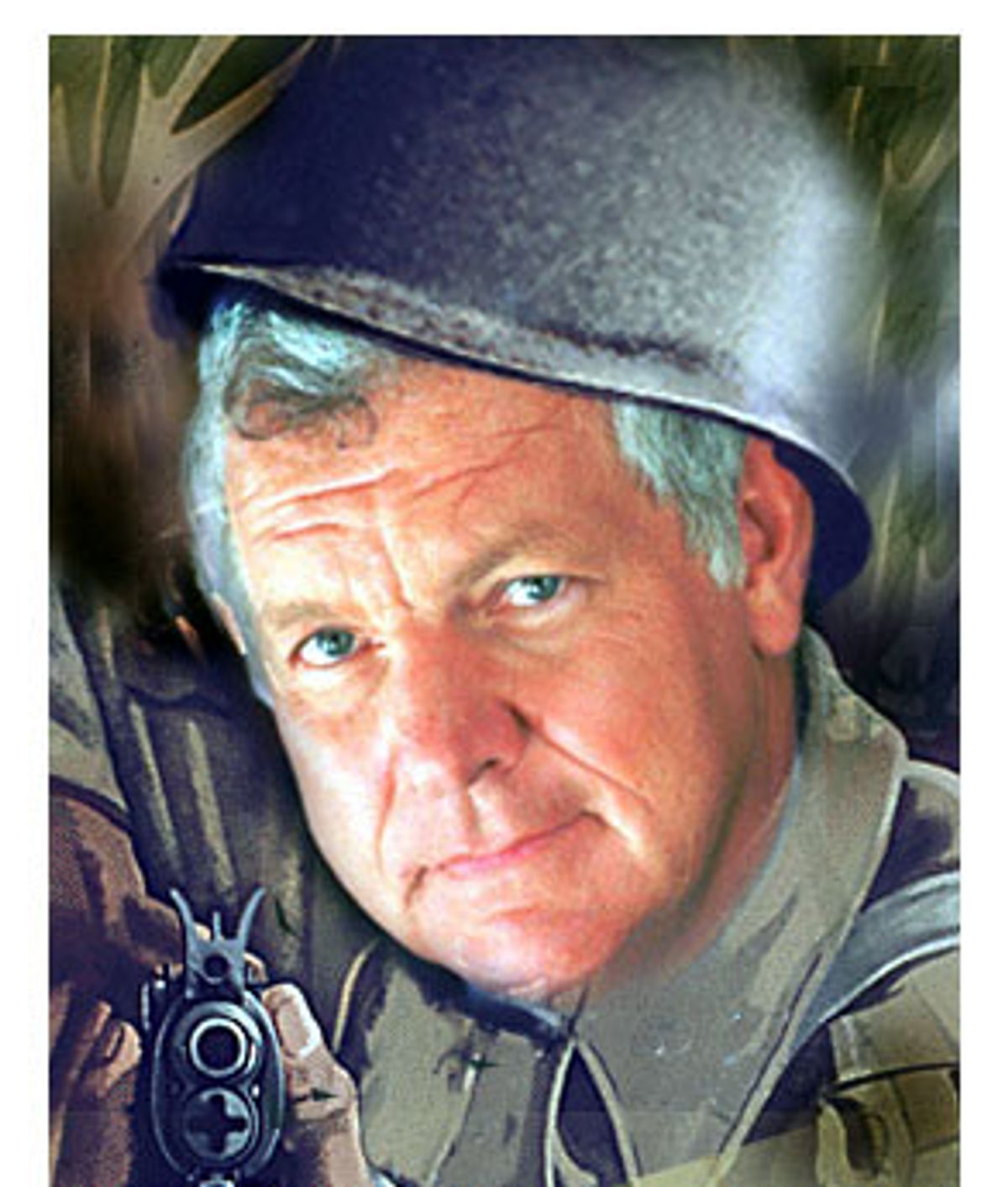
The scene is a jungle battlefront: humid, malarial, rustling with enemy boots. Crouched beneath a thatching of palm fronds lies Sgt. Bill Bennett, grizzled, iconic veteran of the Culture Wars. Alone, he cradles a rifle in his armpit, takes deep contemplative drags on a cigarette.
Suddenly there comes a thrashing in the foliage. Leaping to his feet, he raises the rifle to his shoulder, squints into the gun sight. His arm tautens ... his finger closes round the trigger ... tighter, tighter ...
But wait! It is only young Private Polis, dashing over with the latest dispatch from HQ.
"Good news, Sergeant Bennett! General Bush has declared the Culture Wars over. Americans have discovered a renewed moral purpose in the face of disaster. We can all go home to our families now!"
The veteran scowls ... spits out his cigarette ... hawks a derisive gob of saliva into the air.
"Your work may be done, son. Mine isn't."
"What do you mean, Sergeant?" (The private asks this with some degree of foreboding. It's well known among his fellow recruits that Sgt. Bennett is a bit of a windbag.)
"What do I mean, son?" the veteran asks. "I mean that as long as there's a diversity-monger out there, as long as there breathes a multiculturalist or a relativist or a just plain old anti-American, then this war's not over. And this soldier's not leaving the trenches. Let me tell you something, son ..."
Settling himself in the brush, Private Polis recalls too late the wisdom passed on to him by his bunkmate: "You can always tell a moralist ... but you can't tell him much."
- - - - - - - - - - - -
Maybe it's because I'm a novelist and not a moralist, but William J. Bennett just makes more sense to me as a fictional character. Unfortunately, every time I set up the scene, it keeps dissolving into a scarcely less fictional reality. "Why We Fight," the latest mini-tome from our nation's leading moral agonista, is about how Bennett's fondest, most long-cherished wishes for his country have at last come true -- a just war, a united citizenry, a new civic tone -- and he still can't lay down his private stock of weaponry.
Oh, Bennett is the first to admit that the events of Sept. 11 created "a spontaneous upwelling of national feeling." "Quite suddenly," he writes, "as if in the twinkling of an eye, everything petty, self-absorbed, rancorous, decadent and hostile in our national life seemed to have been wiped away. Suddenly, our country's flag was everywhere, and stayed everywhere. Suddenly, we had heroes again ... Righteous anger had joined in support of our leaders, our armed forces, our country." Loss and suffering had produced "a moment of moral clarity -- a moment when we began to rediscover ourselves as one people ..."
The signs of that resurgence are too large for even Bennett to ignore. Surges in charitable giving. Waves of patriotism sweeping college campuses. Renewed calls for the Pledge of Allegiance in schools. Overwhelming public support for the president and the war in Afghanistan. "Cynicism and irony were declared out," Bennett writes, "simple love of country in. Rock stars who only yesterday had been me, me, me-ing us to distraction fell over themselves to donate their time and their talent and their profits to aid the victims of the attacks, and sang their lungs out for America the beautiful."
So if even rock stars are dutifully busting their lungs in tribute to our fruited plains, what's the problem? Simply that this cultural retrenchment, while heartening, is still too fragile, too fledgling to trust on its own legs. Yes, Americans are slapping flag decals on their car bumpers, but how long will the decals stay there? Yes, students across the land have decided their country is cool again, but how long before something else is cooler? "It is not enough," Bennett argues, "for our students to have the right instincts. They have to have knowledge, too. A vast relearning has to take place ... How can we expect our children to meet tomorrow's hour of emergency as we would wish them to if we neglect to instruct them in civic devotion, and love of country, and in the certitude that the United States is one nation, indivisible?"
So there you have it. In a time of crisis, Americans young and old took their moral bearings from their own souls, rather than Bill Bennett's books. And without more Bill Bennett books, who's to say we can stay the course?
That possibility of relapse is what makes our former drug czar kinda grumpy. It's funny, Ronald Reagan used to go on about "gloom-and-doom Democrats," but I don't know if I've ever met a Democrat who was gloomier or doomier than Bennett. Part of this, of course, is the rankled sense of disenfranchisement that powers most right-wing cultural critiques. Hence, Bennett, in contemplating the near dead heat in the last presidential election, somehow manages to wangle his crowd minority status. "In terms not of number but of sheer cultural weight and prestige," he argues, "the flag-wavers [which, through some syllogistic sleight of hand, he apparently equates with Bush voters] represented a large but dissenting minority."
Very well, a minority coup. I don't think there's a silver lining anywhere that he can't shoot full of clouds. Look how he swoops down on an elementary school "just outside Washington, D.C." that teaches its children "that you should always find a peaceful way to solve your problems because you should never be violent." Sound policy, one would think, for the conflagrations of 11-year-old boys, but under Bennett's scowling inspection, it becomes "a preemptive judgment against the president, to prevent another generation of young people from learning the proper uses of righteous anger, and to throw dust in the eyes of the American people."
All that treachery from a single elementary school. But there's more where that came from. Mind you, Bennett doesn't actually task himself with gauging the extent of liberal error. He simply gathers his press clippings and rocks his head in despair. A Columbia University sophomore brandishing an "Amerika" sign ... aargh! Harry Belafonte urging respect for international law ... grrr! The Madison, Wis., school board voting to ban the mandatory recitation of the Pledge of Allegiance (and then backtracking under pressure) ... when will it end?!
All I can say is if that's the enemy, he's pretty damned pathetic. And yet Bennett keeps stamping down these tiny embers of paleoliberalism as if there were a whole forest at stake. Yes, yes, the head of Reuters was stupid to propose expunging the word "terrorist" from press coverage. But how many news organizations followed suit? Yes, yes, literary theorist Stanley Fish propagates nonsense, but why bother correcting him? Who, outside an exceedingly narrow band of academe, even cares what Stanley Fish thinks?
We must remember, though, that the fight for academia's soul has uniquely personal resonance for Bennett: It is ground zero in his private war against the liberal establishment. Still, I can't help thinking that if he'd gone to college within the last 20 years, he'd be holding his fire a little more often than he does -- only because he'd know how ineffectual the leftist movement really is. I speak as a good Mondale liberal who, in four years of undergraduate study, attended precisely one anti-government rally: something about El Salvador. It attracted perhaps 30 students -- most of them, like me, drawn by curiosity -- and it was closer in feel to a Civil War reenactment than a genuine protest. It ended; we returned to our dorms; the beating of our butterfly wings caused scarcely a sniffle on the other side of the world. We never expected it to.
As for the liberal professors who were supposedly controlling our minds, how many of us brought enough of our minds to the classroom to be controlled? How many of us even came to class? (And while we're on the subject, did Bennett skip a class or two of his own? Is that why he renders Lincoln's "mystic chords of memory" as "mystic cords"?) The point is that education is just one of many crucibles in which people's characters are forged. Students today, much like the students of Bennett's generation, arrive at their political and moral calculi in a variety of not-always-inspiring ways -- with a lot of help from parents and friends and a little help from, yes, teachers, and, OK, left-wing movie stars and right-wing columnists and taxi drivers and that guy around the corner who sells cheese dogs.
Unfortunately, that multiplicity of perspective is the very thing that keeps Bill Bennett up at nights: "What I fear is the erosion of moral clarity, and the spread of indifference and confusion, as a thousand voices discourse with energy and zeal on the questionable nature, if not the outright illegitimacy, of our methods or our cause." This is John Stuart Mill's marketplace of ideas turned on its head: a Babel of mutually canceling opinion. But in fact, those thousand dissenting voices stem from the very feature that Bennett identifies as the defining glory of Western civilization -- "the open, curious, free spirit of sic et non," "the habit of self-criticism" which is "the one irreplaceable engine of human progress."
Look how quickly, though, that "habit of self-criticism" metamorphoses -- in the same sentence, actually -- into a "self-destructive fetish." Bennett has a knack for trivializing even the most legitimate exercises in national self-criticism. Let's pause to observe the way he dispenses with one shameful episode of American history: "In an action that has been a source of controversy to this day, and for which our government has apologized, substantial numbers [of Japanese-Americans] were placed in internment camps for the duration of the war." See, class? Begin with disclaimers ("source of controversy"), qualify in advance ("our government has apologized") and then lay out the troubling fact in the most denatured and passive voice you can manage ("substantial numbers were placed"). That wasn't so bad, was it?
Evasions aside, it takes courage to be Bill Bennett. To castigate Americans for questioning and Muslims for not questioning. To classify Islam as a warrior religion and then speak wistfully of "the martial spirit that was once routinely associated with American Christianity." To denounce the "triumphalist habits of thought" that abound in Islamic schools and then laud the United States as "the marvel and envy of the ages." To lionize the heterosexual heroes of Flight 93 and leave out the gay one. To call for moral clarity when all he really wants is moral unanimity.
What are we to do with such a man? By ending where we began. By recasting all his contradictions, his hypocrisies, his aversion to nuance as the nuance and complexity and contradiction of a "character" (fictional, nonfictional, it makes no difference). This character, this William Bennett, is a sad man: He was born 200 years too late to write the Federalist Papers, and he can't find a cause equal in stature. He is a worried man: scared of modernity, scared of a world that has been unshaped by Jesuits. He needs reassurance. And so we un-Jesuits, we bastard children of modernity, address him:
"We know why America is fighting, Mr. Bennett. Many of us, indeed, support that fight. But why, apart from theological directive, is the other side fighting? That is the question that some of the liberals and academics you deride have been trying, however awkwardly, to answer. They recognize that answering it has not just intellectual but strategic value, and so they call on the very disciplines you despise -- value-neutral analysis, relativist casts of mind. Isn't America strong enough to handle that? Isn't the questioning of received wisdom -- even your wisdom -- as much a part of the war effort as waving a flag or blowing a horn? Or writing a book? Or calling for moral clarity?"
Shares