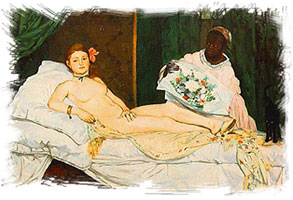

She was unlike any naked lady who’d ever gone before. She wasn’t Eve in the Garden or Venus on a foamy bed of waves. She wasn’t a goddess or an angel or a shy bather caught off guard. She was a contemporary woman — unabashed, unclad, unmistakably unallegorical. Her name was Victorine Meurent, but Édouard Manet called her Olympia. And she changed everything.
On first inspection, one might wonder what all the fuss was about. Manet considered himself a painter of still life, and perhaps that’s why Olympia has such a quiet mystery about her. She lounges serenely, starkly unclad but strategically adorned — a black ribbon around her throat, a single slipper on her left foot (the right one has dropped carelessly off), a voluptuous pink flower at her ear. Her hand is firmly clamped over her sex. The outer corners of her mouth are raised just a fraction, a moment away from a smile or a sneer. Her eyes are drowsily heavy-lidded but her posture is unmistakably alert. Compare her to any overheated, dishabille nymph of the baroque or rococo eras and she seems positively demure.
But there’s something different about this female. For one thing, she’s pointedly not doing anything. She ignores the bouquet that her black maid offers, and the kitten, tail at a highly suggestive full attention, that peers from the foot of her bed. She isn’t bathing or dreaming or dressing. As we take her in, we realize that she’s a woman naked and in bed for exactly the first reason a woman might be naked in a bed. She’s there for sex, and she regards the viewer with a look that’s part invitation, part dare. She’s a mistress, or more likely a prostitute, but she sure as hell isn’t a sprite named Springtime.
Manet was perhaps the world’s first shock artist. Every modern provocateur who slices up a cow or assembles a Lego death camp owes him a debt of hype-making gratitude, but his influence exceeds his infamy. Well-bred, elegant and gentlemanly, Manet was as horrified by the response to “Olympia” as his critics were by the work itself.
He was a painter trained in the staid academic tradition but too exuberant to be constrained by it. Inspired by the audacious realism of Gustave Courbet and the otherworldly darkness of Spanish masters like Velázquez and Goya, the young Manet was inevitably drawn to less conventional themes than the gentle, drawing-room-ready tableaux of the Salon artists. But just because his style didn’t run toward chubby cherubs didn’t mean that Manet fancied himself an outsider. He maintained that he simply painted what he saw, and he showed his work because he sought acceptance. What he got was more vitriol, more fame and more lasting power than he’d ever dreamed.
When “Olympia” was exhibited at the Paris Salon of 1865, it ignited a scandal over art and decency that has rarely been paralleled. Think Rudy Giuliani invented outrage? Critics eviscerated the work, and the crowds almost did the same. Antonin Proust later recalled that “If the canvas of the Olympia was not destroyed, it is only because of the precautions that were taken by the administration.”
Victorianism wasn’t strictly for the British, and no serious artist dared to paint a woman of such obvious ill repute without at least draping her in the exotic garb of harem girl. Yet here was a courtesan glorified in an homage to Titian’s “Venus of Urbino” that was so obvious spectators called it parody. But it wasn’t — Manet didn’t merely expose the prostitute to the eyes of the world, he had the audacity to worship her. It was blasphemy. How unfortunate for Manet’s detractors that it was also exquisite.
It starts with the woman herself, and the fascinating face of Victorine Meurent. Meurent was Manet’s longtime model, muse and companion, the subject of numerous canvases. Over the course of more than a decade, Manet invented her again and again as a boyish bullfighter, a street musician, a gracious lady in pink robes. In 1863, the same year he wed his wife Suzanne, Manet did two nudes of Victorine. The first, “Le Déjeuner sur l’herbe,” he exhibited at the Salon des refusés after being rejected by the official Salon.
But the sight of Meurent’s naked presence at an otherwise buttoned-up picnic party proved too alternative even for the alternative crowd, and the work was thumped as “bizarre” and “risqué.” Perhaps chilled by the reaction to “Le Déjeuner,” Manet waited two years to show the other nude. But “Olympia,” to whom not even an innocent skinny-dipping motivation might be ascribed, caused an even greater furor. In no other canvas did the collaboration between Manet and Meurent unleash such fervent response, and in none were they as hauntingly dazzling.
What upset everybody so much? It may be that she seems so unaffected herself. She stares placidly at the viewer, putting us in the uneasy role of client to an alluring, if bored-looking, whore. Manet inhabited a world in which it was generally assumed that a woman existed to nurture, comfort, inspire or arouse, all in relation to her place in society and family. But Olympia, for all her blatant accessibility, is tantalizingly self-sufficient. There’s nothing supplicating or humble about her. To the wealthy collectors of art and women, who regarded both as possessions, Olympia stripped them of their illusions. Her body is ripe for the taking, but everything else, including the meaning behind that enigmatic almost-smile, she’s keeping for herself.
For all the great paintings in the history of art, few show a woman whose gaze is so startlingly direct and defiantly unaccommodating. Mona Lisa shyly glances to her left. So does Vermeer’s “Girl with a Pearl Earring.” Botticelli’s Venus looks out dreamily into the middle distance, lost in her own thoughts, while Sargent’s Madame X turns her head away completely. And scores of Virgin Marys glance rapturously up at the angels or tenderly down at their babes.
When a woman does face front in a painting, it’s likely to be a portrait of a queen, not a canvas of a concubine. Olympia meets us eye to eye. It’s an ingenious and unsettling device, a bit of artist’s revenge. The image in the frame is the one doing the sizing up, and it is we who are left feeling appraised — and potentially rejected. The critics, unaccustomed to having the tables so turned on them, were quick to serve up rejections of their own. They hated the subject matter. They hated the flat, primitive style. They hated everything about it.
“What’s this yellow-bellied Odalisque, this vile model picked up who knows where, and who represents Olympia?” demanded one writer. “Inconceivable vulgarity,” declared another, while yet another proclaimed that “art sunk so low does not even deserve reproach.”
Manet was devastated. “The insults rain down on me like hail,” he complained to his friend, the poet Baudelaire. Yet while many looked upon Olympia as a symbol of depravity or a slattern, others recognized her as a triumph. The writer Émile Zola called it Manet’s “masterpiece,” declaring, “It will endure as the characteristic expression of his talent, as the highest mark of his power … When other artists correct nature by painting Venus they lie. Manet asked himself why he should lie. Why not tell the truth?” But the truth came at a cost.
Though he continued to paint and exhibit for the rest of his life, Manet remained a frequent target of public disdain, forever misunderstood and tainted by the scandals of his youth. He hadn’t sought to offend; he simply painted the best way he knew how, in bold strokes and unexpected contrasts. And he wasn’t alone — his innovative techniques and unconventionally ordinary choices of subject matter eventually ignited a new generation of artists. Though he refused to label himself as such, his successors hailed him as the father of impressionism. He was among the vanguard to glorify not the figures of myth, but the radiance of absinthe drinkers, suicides and prostitutes.
In the artist’s lifetime Olympia never received her due, but she aged remarkably well. Years after Manet’s death, Claude Monet offered the work to the French government, and it’s been a Parisian museum fixture ever since. Manet would have been pleased. He knew that to appreciate her, we just needed to look a little longer. “Time itself imperceptibly works on paintings,” he said, “and softens the original harshness.” The shock she provides now is one not of outrage but of awe.
One need only bask in the heady loveliness of Olympia, the shadows between her fingers, the curve of her belly, the contrasts of light and dark, to understand the depth of Manet’s talent. But when we look deeper — at the complexities and contradictions and beauty and brutality of his work — his true genius emerges. Art to Manet wasn’t a story about gods or saints or kings. It was about real life, as ordinary as commerce, as easy as sex.
To worship a goddess is easy, but to love a human — especially one who offers no hint of reciprocation — is far more work, and infinitely more thrilling. Manet brought the hidden world of the everyday into the light and made it remarkable. For all that’s reserved about Olympia’s demeanor, the passion of her creator is there in every stroke and every line. She may withhold her heart, but we, helpless, are under her spell forever.
It was 33 years ago today that Etan Patz left his home in New York’s SoHo neighborhood to walk to his school bus. He was never seen again, and was declared dead in 2001. Two years ago, his case was reopened. And on Thursday, with little physical evidence to corroborate, police commissioner Ray Kelly announced that Pedro Hernandez had confessed and was being charged with the child’s murder.
There were other stories of children who’d gone missing before Etan Patz. Sometimes even sensational cases. But this one was different. He wasn’t a famous person’s son, like Charles Augustus Lindbergh Jr. He was just a kid doing what kids did back then. Roaming freely on his street. And unlike the nearly 30 children who disappeared and were murdered during the same period in Atlanta, Patz had a father who is a photographer. Overnight, New York City was plastered with images of his sweet-faced little boy under the chilling word “Missing.” Eventually that face became the first to appear on a milk carton.
Two years later, when 6-year-old Adam Walsh was abducted and murdered in Florida, it seemed that children were disappearing everywhere. And with them, childhood itself. Walsh’s father, John Walsh, went on to found the Adam Walsh Child Resource Center, which eventually paved the way for – and merged with — the National Center for Missing and Exploited Children. And he became the host of a show on the fledgling Fox network, a show dedicated to tracking down fugitives and closing unsolved cases. “America’s Most Wanted” would go on to become the network’s longest-running series.
In the years since Etan Patz never made it to school, we’ve endured other nightmarish tales of abduction and murder, like that of Polly Klaas, Leiby Kletzky and most recently Sierra LaMar. And surprising recoveries, like those of Jaycee Dugard and Elizabeth Smart. And through it all, the “parents’ worst nightmare” story has proven itself a reliably sensational basis for the evening news or Nancy Grace’s entire career. The truth is that a stranger abducting a child, horrifying as it is to consider, is a very rare event. But it taps into our absolute most primal dread — the wolf at the door, coming not for you but for a vulnerable child. Your child.
I was 13 when Etan Patz disappeared, little more than a child myself. I’d been walking to school unaccompanied since second grade. I played in the streets with my friends during afternoons and summertimes, with a total, mindless freedom I can’t give my own children. Not that I really think somebody’s going to snatch them up, but that fear is always there, lurking. It’s a possibility that never once crossed my mind as a child, nor, do I imagine, my mother’s.
Hernandez’ arrest seems to promise a closure to his story, even though Patz’s own family have long believed another man, Jose Antonio Ramos, actually killed him. There’s the hope of answers, of justice. But there’s no real closure when a child is murdered. There’s no closure when his body is never found.
As my children grow, their borders expand. I let them go, exploring their own limits, as healthy, self-reliant children must. But I think about the face on the milk carton. I don’t know any mother who doesn’t. I instinctively hold my breath a little in the moments before my children come through the door after school, and I hug them tightly when they come home, safe and sound. And on this National Missing Children’s Day, I remember the little boy who didn’t.
Continue Reading
Close
It’s not as if one expects subtle political discourse from Hustler. But come on.
Larry Flynt’s venerable publishing enterprise has, throughout its history, championed freedom of expression in its own unique way. In 1984, Flynt famously went all the way to the Supreme Court over the right to run a parody ad of inexhaustible loon Jerry Falwell reminiscing about losing his virginity to his mother in an outhouse. Tasteless? Yes. An obvious lampooning of a public figure? Also yes. But when Hustler recently ran a photo of conservative writer S.E. Cupp Photoshopped to look like she was performing oral sex, that was something altogether different.
The Cupp photo exists as a “celebrity fantasy” – i.e., an imaginary hate bang. And though Hustler takes pains to cover its butt, noting that “No such picture of S.E. Cupp actually exists. This composite fantasy is altered from the original for our imagination, does not depict reality, and is not to be taken seriously for any purpose,” it ponders, grossly, “What would S.E. Cupp look like with a dick in her mouth?”
Of course, the usual conservative suspects have come out of the woodwork for this one, pointing an accusatory finger at what the Blaze helpfully refers to as “the liberal media” for this. Yes, the American Prospect, Mother Jones, Hustler – it’s all the same to us! On Wednesday, Glenn Beck begged, “Is this wrong, Democrats? Is this wrong?” — as if Democrats were responsible for what Hustler publishes. Who put that penis in that lady’s mouth? Probably Obama. And Cupp herself, on Beck’s show, seized the opportunity to condemn the National Organization for Women, and to add, “I wish that these media entities that perform this kind of misogyny would just come out and do what Hustler did, instead of beating around the bush and pretending to be fair, pretending to be above that. They’re not above that. This is exactly what they do every single time.”
Way to seize the moment, Cupp — except that liberals don’t like fake blow-job putdowns either. Nor do you see a lot of them out there in, say, the Nation. Want proof from the despised “liberal media”? How about how Audrey Ference explained in the L Magazine, “It’s Not Cool to Photoshop a Dick into a Woman’s Mouth, Even if You Disagree With Her Ideas. In These Times’ Lindsay Beyerstein, meanwhile, condemned the photo as “beneath contempt.” And on Jezebel, Erin Gloria Ryan noted that “More than 50 years after the women’s movement began, we’re still trying to silence women with dicks.” Even the always combative hosts of “The View” unanimously welcomed Cupp Thursday, with Whoopi Goldberg saying, “This is offensive. This is not the dialogue that we have when we disagree.” So Cupp and company, please extend your detractors the courtesy of believing that we think this is gross too? True liberals don’t pretend that degradation is social commentary.
Flynt, for his part, defends the photo, saying “That’s satire” in an email to the Daily Caller. That “satire,” by the way, consists of the aforementioned blow-job pic, accompanied by the sad commentary that Cupp’s “hotness is diminished when she espouses dumb ideas like defunding Planned Parenthood. Perhaps the method pictured here is Ms. Cupp’s suggestion for avoiding an unwanted pregnancy.”
It’s pretty obvious that a company whose porn movies are cleverly titled “This Ain’t” – as in “This Ain’t Celebrity Apprentice” and “This Ain’t Dancing With the Stars” — is not trying terribly hard to distinguish itself from the people it’s lampooning. Also: apparently “Dancing With the Stars” porn is a thing. So Hustler may hide behind the false equivalency that sticking a penis in Cupp’s mouth because she hates Planned Parenthood is the same as its movie parodies or its glorious, long ago triumph of putting Jerry Falwell in an outhouse. But it’s not. It’s a photo of a real person, for starters, which means it can and likely will be distributed across the Internet pell mell and willy nilly without its disclaimer. Second, it’s exactly the kind of crap women have to contend with on a near constant basis — that we exist to be objectified, screwed and shut up.
Sticking a penis in the mouth of a woman whose opinions you don’t like isn’t satire, especially when you’re in the business of putting penises in women’s mouths all the time. It’s aggressive. Worse, it’s stupid. But at least both the image and the lame excuse for it achieve something Hustler and editors know a lot about. They suck mightily.
Continue Reading
Close
It’s adorable the way Old Media keeps forgetting that we live in the age of transparency. Hey, Sony Pictures Television, your metaphoric fly is undone.
You’d think that after that ranting, complaining voice mail that “Community” star Chevy Chase left showrunner Dan Harmon went viral this spring they’d have learned. Or maybe after Harmon responded to his dismissal just last Friday by spilling his guts on Tumblr. You’d think the muckety-mucks would have figured out by now that the best you can do when there’s tension in your little creative family is to be forthright and creative about it.
Note, for example, how the show’s star Joel McHale spent the spring diplomatically – and wittily — handling the talk-show circuit after Chase’s meltdown, joking that the voice mail had to be fake because “there’s no way Chevy could figure out voice mail.” See, it’s glib and funny and sounds magically off-the-cuff! Get it? The cast of “Community” — which includes the incredibly on-the-ball Danny Pudi, Alison Brie and Donald Glover – knows how to handle itself.
So here’s what you don’t do. You don’t send an email saying you “wanted to forward some messaging we hope our cast will find helpful as they navigate questions that will undoubtedly come up.” Oh God, “forward some messaging.” This won’t be good. And sure enough, in a memo obtained Wednesday by the Hollywood Reporter, the talking points sent from Sony to the cast reads like a ransom note. A poorly written one. My friend Jay at the Takeaway suggests reading it in the dean’s voice, but in my head, I can’t hear anyone but Chang.
“We’re hoping that the news will lose some steam over the next day, especially if we’re not perpetuating the topic in any way,” it reads. Then it goes on to suggest the cast just tell the press, “We’re also excited that we’ll be back on NBC’s schedule in the fall and are looking forward to working on those episodes,” “I am looking forward to starting our next 13 episodes of ‘Community,’” “We’re looking forward to working with David Guarascio & Moses Port on a new season of ‘Community.’” Also, guess what? “We’re looking forward to the stories our characters will find themselves in come Sept.” I’m not sure I even understand that last sentence, but you get the gist. Coming this fall! “Community”! REMAIN CALM AND STOP PERPETUATING THE TOPIC.
As one Hollywood Reporter commenter brilliantly opined, maybe now “the cast will all recite the entire memo, verbatim, in interviews. Like hostages reading off cue cards.” It’s just like when Avery Jessup had to do the news in North Korea! Wait, what well-regarded yet low-rated NBC sitcom are we talking about here?
This kind of thing is insulting on so many levels. Primarily, it’s a dis to the cast and team of “Community,” who this weekend managed to tweet gracefully their gratitude to Dan Harmon and his “dementedly awesome brain” without coming off like network-destroying loose cannons. And don’t even get me started on how idiotic Sony must assume the press is to send out something like this. Guys, it’s not all one big Mario Lopez-fueled parade of butt-kissing out there. Worst of all, it’s a shameless slap to fans, who expect that the people who give us a weird treasure like “Community” know how to be funny and sarcastic and sad and real when there is a major shakeup in their ranks — oh, and who also know enough about social media to know you can’t stop a dumb email from getting around. It’s not about sticking to some rote company line. It’s about cultivating the very authenticity that makes “Community” so friggin’ special, and respecting the fans who watch it. And it’s about getting that the title of the show isn’t just about a mythical college. It’s about us.
Continue Reading
Close
It’s a general rule of thumb that a grown man doesn’t get a lot of support for knocking out a 10-year-old child’s teeth. But Yong Hyun Kim has won himself a few fans lately for doing just that.
Back on April 11, the 21-year-old Washington state man settled in with his girlfriend to enjoy “Titanic” in 3D — right in front of a boy known only in police documents as KJJ. What ensued led to a night in jail and a charge of second-degree assault.
According to the Associated Press, the boy, who was at the theater with three friends and his mother, says “they were watching the movie and talking when Kim told them to be quiet.” KJJ maintains that they settled down, but when he later whispered something to a companion, Kim “jumped over the seat, threw an iced drink at them and punched KJJ in the face.” He says Kim told him something like, “You know what, I paid a lot of money to see this movie.”
Kim, however, insists that the boys “were hitting him and his girlfriend with popcorn, running back and forth in the aisle and bumping him with their arms.” He says that when he confronted the group, “they started laughing at him,” provoking him to take a swing at the boy. “I got so mad that it just happened,” he told police, adding that he didn’t realize his tormentors were children. He now faces the possibility of up to nine months in jail. When police arrived at 10:40 p.m., they found the boy in the lobby “bleeding from the nose and missing a tooth.”
What really transpired that night is still under investigation. I do know that, as a parent, I would never take a group of 10 year olds out late on a school night to see Kate Winslet’s boobies. Nor would I, under any circumstances, let them talk through a movie, as KJJ himself admits he and his friends were doing. I’ve suffered through too many other families and that precise brand of self-centered behavior. And that’s why Kim’s assertion that a bunch of kids wouldn’t stop wrecking his movie-going experience has struck a powerful chord of recognition among moviegoers.
Among the online commenters horrified that an adult would physically assault a child instead of just getting a manager, there have been plenty of folks who seem to know exactly where the guy was coming from. On USA Today, commenters have called Kim “a hero” and even offered “to pay for the man’s defense.” The more level-headed commenters suggest he should have hit the parents instead. And on the Seattle Post-Intelligencer’s site, comments have been flooded by those who admit they’ve “wanted to do that” themselves and “understand the guy’s feeling behind it.”
As ticket prices skyrocket, the movie-going experience continues to deteriorate. If you’ve gone to a film lately – or for that matter, any public entertainment — you’ve likely experienced the astonishingly rude behavior of individuals who seem unaware that they’re not in their own living rooms. Texting. Talking. Kicking seats. It’s exasperating and sometimes outright experience-ruining. And we rarely get the satisfying experience I once had when a row of rowdy teens were talking and texting during the film and a patron with roughly the dimensions of the screen barreled over, leaned down and whispered something to the group. I don’t know what he said, but the kids all got up and left. When they did, there was a palpable exhalation of admiring relief in the theater. And when an Austin, Texas, woman was kicked out the Alamo Drafthouse last year for texting, the theater’s cheeky pride in her outrage promptly went viral.
It’s inexcusable to assault someone for being annoying or disruptive or even for laughing at you. Furthermore, Kim’s assertion that he couldn’t see how young the kids were – when he saw well enough to land a face punch — seems a little shaky. Don’t knock out little boys’ teeth. In fact, don’t knock out anybody’s if you can help it. If you applaud hitting kids, you’re probably a bad person. But the lesson here – whether you’re a child or a grownup — is pretty simple. If you don’t know how to behave in public and you don’t like losing teeth or going to jail, for God’s sake, just stick to Netflix.
Continue Reading
Close
My doctor always walks into the exam room smiling. It’s not necessarily the countenance you’d expect from a man who spends much of his time working with people with Stage 3 and Stage 4 cancers — the kind that haven’t responded to other forms of treatment. Yet even when we speak on the phone, I sometimes swear I can hear him smiling. Granted, I’ve given my doctor something to smile about – I’ve been doing spectacularly well in my Phase I trial, delivering CT scan results that he appreciatively refers to as “neat.” Yet the extraordinary thing about my doctor is that he was smiling the day I met him, when I was facing a diagnosis that put my long-term odds of survival in the “probably not going to happen” range. And from that first grin, he deflated my terror and made me believe I was in the hands of someone not just invested in my wellness, but downright optimistic about it.
A natively cheerful demeanor isn’t a requirement for being a competent healer. But what is far too often lost in our grueling, impersonal and cost-driven healthcare system is the basic fact that a human being in the chaotic and scary world of injury or illness deserves sensitivity and compassion. That a shivering person in a paper dress deserves dignity. So if you’re a doctor, nurse or technician, here’s your reminder. And if you’ve ever been a patient, we’d love to read your own additions to the list.
Take your hand off the goddamn doorknob already.
We know you are incredibly busy and important and that your office has wildly overbooked your schedule today. You know what, though? It’s not our job to streamline your day. Conveying information while you’re walking out the door may work if you’re a character on “Revenge,” but it’s a crummy way to have a conversation with a person about his or her health. We just sat out in the waiting room for 45 minutes reading last week’s hype-trolling issue of Time magazine; we’ve sat here in a robe for a half-hour looking at the pain assessment chart. Now you can at least pretend to give us your full attention for the five minutes you’re prodding our vulnerable, unclad bodies. You’ll immediately rise in our esteem.
Dr. Carma Bylund, director of the CommSkil program at Memorial Sloan-Kettering, notes that studies have shown that “when a doctor comes into the room and sits down with the patient, the patient perceives the visit as longer. The doctors are at eye level; they’re attentive — and they can’t put a hand on the doorknob.”
Remember that this random collection of faulty parts is a person.
At a Times talk last winter, Will Reiser, the writer of “50/50,” admitted he’d loosely based the poker-faced oncologist of the film on his own doctor, referring to him as “a mechanic” who saw him as the car he had to fix. It was a generous assessment of clinical sangfroid, one that acknowledged that nobody wants a doctor who’s lacking in the professional boundaries department. But that doesn’t mean you should let yourself turn into a robot.
Early in my treatment, I had a doctor on my clinical trial bring in a team of research fellows to look at “the tumor.” That the tumor had a sentient human host seemed utterly irrelevant to him. And when my friend Ariel had a miscarriage, the sonogram technician confirmed it by briskly announcing, “Yup, no heartbeat,” and walking out of the room. This is what is known, in medical terms, as a nightmare.
You may deal in tumors and miscarriages in a revolving door of horrible things all day long, but your patients live in a very different world. Their tumors and miscarriages and dying parents are pretty important to them. The moment they become trivial to you, seriously rethink why you ever wanted to do this for a living.
Consider that the patient is telling you something the charts don’t.
“I had one endocrinologist clearly point out during my exam all of the physical characteristics that lead him to believe I was hypothyroid and had adrenal function issues,” says my friend Alice. “He pointed out stretch marks (without childbirth). He pointed out dry skin. He pointed out my premature gray hair (specifically a prevalent streak near my forehead). My weight gain and inability to lose weight. Quite a few other characteristics. But the lab tests came back ‘normal’ and that is literally what he offered me. ‘Your tests say normal so there is nothing wrong.’” Can you understand why Alice was exasperated?
Most of us truly get it that doctors don’t know everything. We don’t expect all-seeing miracle workers. And we understand that some patients are either incapable of giving accurate information or are just plain wrong about what they believe they have. But a person who is suffering, who is symptomatic, is entitled to a fair and thorough investigation – and if you can’t provide it, please, suggest somebody who can. Don’t shrug off pain with a blasé suggestion of Tylenol or cutting out dairy and not even look at the person. Instead, be like the doctor who once told me, “There’s always something more we can do for a patient.” Do something more.
Accept that we didn’t go to medical school
You know how you’re rattling off protocols and surgery plans and fancy words for body parts we didn’t even know we had? Whoa whoa whoa – slow down there, partner. You’re talking to someone who may not know a colostomy from a semicolon. Your rapid-fire delivery is intimidating and scary. It makes us feel stupid and bothersome, like we should know all this stuff and not ask questions.
“Doctors forget that the minute a patient hears bad news or that there’s a problem, patients stop listening,” says my doctor friend Joe. “Or if they hear anything, they’re hearing incomplete info. The onus then is on us to find ways to help patients understand what just happened, whether it’s writing down instructions, calling a patient later in the day after the dust settles, or simply asking a patient to repeat something back.”
“Healthcare providers often have a kind of script,” adds Dr. Bylund. “They may have certain things they may always say to everybody. We teach doctors to check patients’ understanding and use that to tailor consultation to the person’s needs. Say things like, ‘Tell me what you know about your disease,’ or ‘Tell me what your last doctor said.’ And we show them how people’s past experiences may impact their choices now.” Maybe we don’t know anything about Parkinson’s. Maybe we know a harrowing amount because of what Mom went through, and we’re frightened to death of it. Start with what we know before you dump everything you know on us.
Leah Berkenwald, a health communication student and writer, says, “What good is the diagnosis or treatment if a patient cannot understand it or follow instructions? What is often deemed noncompliance is often a result of a failure to communicate.” And, she says, “It doesn’t matter how good a physician is at diagnosis or treatment if the patient doesn’t understand what they’re supposed to do, how to do it, or why it matters. Medical knowledge and clinical skill become moot when a physician makes assumptions about their patients’ cultural values, beliefs and practices.”
Talk frankly about how we’ll pay for this – and don’t assume anything
As Salon reader Lila says, “The calculation about what choices are available to me seems to be made before I hear the medical advice … Don’t get me wrong, it can be tricky for individuals to figure out how to afford healthcare, and I’m glad for healthcare professionals’ sensitivity to that. But when my husband was being sent home from the hospital — too early, we felt — a problem came to light: The doctor finally said she too felt it was too early but said the insurance wouldn’t pay another day. In fact she was wrong (and the insurance ultimately did pay another day), but more problematic is that she made a decision to discharge based upon something other than medical reasons — and we didn’t know that was happening.”
Nobody – on either the medical or patient end – wants to get walloped with a contentious bill. So talk to us so we can work together to get the most care for the buck. Don’t treat us like dirtbags if we’re out of network or uninsured, either; work with us to find other options. And you can pass that tidbit on to your office staff. Imagine what it feels like to be both sick and poor — now imagine what it’s like to add “demeaned” to your list of problems.
All of us, even the strongest among us, find ourselves on the business end of the stethoscope sometimes. And though it seems pretty basic, I’ll let a real doctor say it so you take it seriously: “Ultimately, health and wellness have a lot to do with the comfort a patient has with a doctor. You’ll give better information when you have a doctor who makes you feel secure,” says Dr. Bylund. When you’re compassionate to us, we’ll show up for our checkups. We’ll be honest about conditions and circumstances, because we aren’t afraid of being shamed or judged. We’ll still put our faith in science, and accept that pain and sickness are sometimes unavoidable. But we’ll be less scared when we walk through those very scary doors. And though we’ll do our best to ward off disease, we’ll gladly submit to something infectious – the power of being decent, and your faith in us.
Continue Reading
Close