
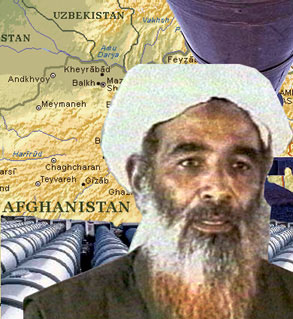

A 1998 memo written by al-Qaida military chief Mohammed Atef reveals that Osama bin Laden’s group had detailed knowledge of negotiations that were taking place between Afghanistan’s ruling Taliban and American government and business leaders over plans for a U.S. oil and gas pipeline across that Central Asian country.
The e-mail memo was found in 1998 on a computer seized by the FBI during its investigation into the 1998 African embassy bombings, which were sponsored by al-Qaida. Atef’s memo was discovered by FBI counter-terrorism expert John O’Neill, who left the bureau in 2001, complaining that U.S. oil interests were hindering his investigation into al-Qaida. O’Neill, who became security chief at the World Trade Center, died in the Sept. 11 attack.
Atef’s memo shines new light on what al-Qaida knew about U.S. efforts to normalize relations with the Taliban in exchange for the fundamentalist government’s supporting the construction of an oil and gas pipeline across Afghanistan. As documented in the book I coauthored with Guillaume Dasquie, “Bin Laden: The Forbidden Truth,” the Clinton and Bush administrations negotiated with the Taliban, both to get the repressive regime to widen its government as well as look favorably on U.S. companies’ attempts to construct an oil pipeline. The Bush White House stepped up negotiations with the Taliban in 2001. When those talks stalled in July, a Bush administration representative threatened the Taliban with military reprisals if the government did not go along with American demands.
The seven-page memo was signed “Abu Hafs,” which is the military name of Atef, who was the military chief of al-Qaida and is believed to have been killed in November 2001 during U.S. operations in Afghanistan. It shows al-Qaida’s keen interest in the U.S.-Taliban negotiations and raises new questions as to whether the U.S. military threat to the Taliban in July 2001 could have prompted al-Qaida’s Sept. 11 attack.
Atef’s memo is not about the pipeline alone, though it mentions the project several times. It is an analysis of the political situation facing the Taliban. It documents the movement’s rise, its leadership, the geopolitical importance of Afghanistan, the Taliban’s relationship with Pakistan, as well as the movement’s relationship with the Arab mujahedin. The document’s intended readership is unclear. But it reveals that the pipeline was seen as a strategic offering toward the West, in order to make the Taliban government acceptable to the United States and Pakistan, as well as to reduce military and investigative pressure on the country to rein in or even extradite bin Laden.
Atef explains that the United States wants “to take control of any region which has huge quantities of oil reserves,” and “the American government is keen on laying the oil and gas pipelines from Turkmenistan through Afghanistan to Pakistan.” Atef concludes that al-Qaida’s “duty toward the movement [Taliban] is to stand behind it, support it materially and morally, especially because its regional and international enemies are working night and day to put an end to it and make it fail.”
It seems clear the military chief didn’t expect the pipeline negotiations to bear fruit. Referring to Pakistanis as “nonbelievers,” and noting that the pipeline “will be under American control … and it also goes through the territories of Pakistan which are allied to America,” Atef implies that the Taliban has no intention of ultimately cooperating with the project, but is trying to string along the Americans and Pakistanis to win some breathing room for its unpopular government.
The Atef memo is the latest piece of evidence documenting a murky chapter in recent American history — the overtures of the last two American administrations to the repressive Taliban regime. Several U.S. oil companies, most notably Unocal, had been advocates of diplomatic overtures to the Taliban, in order to facilitate the building of a pipeline from the Caspian Sea region to Pakistan and the Persian Gulf through Afghanistan. In 1996, Unocal vice president Chris Taggart described the fall of Kabul to the Taliban regime as a “very positive step” and urged the U.S. to extend recognition to the new rulers in Kabul and thus “lead the way to international lending agencies coming in.”
Just 10 days after the Taliban seized power in Kabul, Zalmay Khalilzad, former National Security Council official and Unocal consultant who was appointed special envoy to Afghanistan by President George W. Bush at the end of 2001, argued in a Washington Post opinion article that the U.S. should try to work with the mullahs and form a broad-based government that included other factions. “The Taliban does not practice the anti-U.S. style of fundamentalism practiced by Iran — it is closer to the Saudi model …” Khalilzad contended, concluding that “we should use as a positive incentive the benefits that will accrue to Afghanistan from the construction of oil and gas pipelines across its territory … These projects will only go forward if Afghanistan has a single authoritative government.”
Soon after, the State Department spokesman Glyn Davies told the New York Times he had hope that “the new authorities in Kabul will move quickly to restore order and security and to form a representative interim government that can begin the process of reconciliation nationwide.” Davies also said the United States “wanted to send diplomats to Afghanistan to meet with the Taliban and held out the possibility of re-establishing full diplomatic ties with the country,” according to the Times.
In November 1997 Unocal invited a Taliban delegation to Texas and, in early December, the company opened a training center at the University of Nebraska, to instruct 137 Afghans in pipeline construction technology. The company also donated to the university’s Center for Afghanistan Studies. Unocal CEO John Imle estimated that the company spent between $15 and $20 million on its Central Asia oil pipeline (CentGas) project — on preliminary feasibility studies, humanitarian projects and other efforts to lobby the Taliban (Unocal equipped the regime with satellite phones, for instance.)
In February 1998, Unocal’s vice president for international relations, John Maresca, told a House subcommittee hearing on U.S. interests in the Central Asian Republics that an oil pipeline “would benefit Afghanistan, which would receive revenues from transport tariffs, and would promote stability and encourage trade and economic development.” Emphasizing that “the proposed Central Asia Oil Pipeline (CentGas) cannot begin construction until an internationally recognized Afghanistan government is in place,” he urged the administration and the Congress “to give strong support to the United Nations-led peace process in Afghanistan.”
Until the 1998 al-Qaida embassy bombings, the Clinton administration’s approach toward the Taliban was much the same as Unocal’s: All parties agreed that the political stabilization of Afghanistan was crucial to the region, and was also a way to gain access to oil reserves of the Caspian Sea region. Though bin Laden had been in the country since 1996, the U.S. had not pressured the Taliban to hand him over.
The embassy bombings in August 1998 changed everything. The Clinton administration denounced the regime and Secretary of State Madeleine Albright turned up the heat on Taliban human rights abuses. The United Nations imposed sanctions, freezing Afghanistan’s foreign assets and limiting its citizens’ travel. The U.S. continued to talk to the Taliban, but the emphasis was on extraditing bin Laden in exchange for international recognition; the pipeline was off the table. Unocal, which had been close to finalizing its pipeline deal before the embassy bombings, cancelled it.
When George W. Bush took office in 2001, his administration made new overtures to the Taliban, and the pipeline deal gained renewed support, as an incentive to get the Taliban to make political concessions and form a broader government. U.S. representatives met with Afghanistan’s former King Shah, to see if he might be included in a new government. And American companies began exploring the failed 1998 pipeline project. A report by an Afghan-born Enron manager in July 2001, for instance, illustrates that company’s deep interest in some sort of pipeline deal. Enron had begun funding the same sorts of humanitarian projects as Unocal had three years earlier.
In March 2001, several Taliban officials, including Sayed Rahmattulah Hashimi, Mullah Omar’s personal advisor, were invited to Washington by their U.S. lobbyist, Leila Helms, the niece of former CIA Director Richard Helms. The agenda included discussions of extraditing bin Laden as well as facilitating American companies’ access to oil reserves in central Asia. The delegation met with representatives of the Directorate of Central Intelligence (DCI) and the Bureau of Intelligence and Research of the State Department.
This visit provoked concern and criticism in Washington over how Hashimi obtained a visa, a plane ticket, security clearance and access to American institutions — including the State Department and the National Security Council — despite travel restrictions on Taliban leadership imposed by U.N. sanctions (the official answer was that Hashimi fell below the rank of senior official covered by the sanctions.)
Four months later, American diplomats met with Taliban emissaries as well as representatives from Pakistan, Iran and Russia for four days of talks in Berlin in mid-July. Again, the message was that if the Taliban would extradite bin Laden and form a broad-based national government, it could win international recognition and reap extensive economic subsidies from the construction of a pipeline. The meeting was one of several convened by Francesco Vendrell, a Spanish diplomat who serves as the U.N.’s chief representative on Afghanistan. The delegates at the July meeting included Robert Oakley, former U.S. ambassador and Unocal lobbyist; Karl “Rick” Inderfurth, former assistant secretary of state for South Asian affairs; Lee Coldren, head of the Office of Pakistan, Afghan and Bangladesh Affairs in the State Department until 1997; Tom Simons, former U.S. ambassador to Pakistan and the most recent official negotiator with the Taliban; Niaz Naik, former Foreign Minister of Pakistan; Nikolai Kozyrev, a former Russian special envoy to Afghanistan; and Saeed Rajai Khorassani, formerly the Iranian representative to the U.N. The Taliban ambassador to Pakistan, Abdul Salam Zaeef, attended several sessions with some of the delegates in Berlin, according to Naif Naik, though officially the Taliban had not been invited. Naik was expected to carry the U.S. message to the Taliban.
According to Naik, the point of the meeting was that “we would try to convey to them that if they did certain things, then, gradually, they could win the jackpot, get something in return from the international community.” It might, Naik said, “be possible to persuade the Taliban that once a broader-based government was in place and the oil pipeline under way, there would be billions of dollars in commission, and the Taliban would have their own resources.”
It was at the July meeting, according to Naik, that Tom Simons suggested that Afghanistan could face an open-ended military operation from bases in Uzbekistan and Tajikistan if it didn’t accede to U.S. demands. “Ambassador Simons stated that if the Taliban wouldn’t agree with the plan, and if Pakistan was unable to persuade them, the United States might use an overt action against Afghanistan,” Naik says. The words used by Simons were “a military operation,” according to Naik. Another participant reportedly said the Taliban’s choice was clear: either accept a “carpet of gold” riches from the pipeline or “a carpet of bombs,” meaning a military strike.
Lee Coldren, a member of the U.S. delegation, also confirmed to the British newspaper the Guardian the American position at the Berlin meeting. “I think there was some discussion of the fact that the United States was so disgusted with the Taliban that they might be considering some military action.”
In statements to newspapers, Simons has offered ambiguous explanations of his statements at the July meeting. In September, he told the British Guardian: “I’ve known Naik and considered him a friend for years. He’s an honorable diplomat. I didn’t say anything like that and didn’t hear anyone else say anything like that. We were clear that feeling in Washington was strong, and that military action was one of the options down the road. But details, I don’t know where they came from.”
Yet in a November interview with Le Monde, Simons seemed to confirm that there had been some talk of U.S. military action. “It is true that the Taliban was asked to deliver bin Laden and form a [broader] government,” Simons told Le Monde. “We said in July that we were investigating the attack against the USS Cole in Yemen, and that if there were solid evidence of the implication of bin Laden, one had to expect a military answer. One can always inflate such a declaration to see a global threat against the Taliban. But the American declaration related only to the response to the USS-Cole.
“As for the ‘carpet of gold and the carpet of bombs,’ we actually discussed the need for a plan for rebuilding for Afghanistan, which would follow a political agreement,” he said, adding that “It’s possible that a mischievous American participant, after several drinks, may have thought it smart to evoke gold carpets and carpet bombs. Even Americans can’t resist the temptation to be mischievous.”
The last known meeting between U.S. and Taliban representatives took place in August, five weeks before the Sept. 11 attacks, when U.S. Assistant Secretary of State for Central Asian affairs Christina Rocca met with the Taliban’s ambassador to Pakistan Abdul Salam Zaeef.
It would be unfair to suggest that the U.S. threat in July led to the al-Qaida strike. But while Simons doesn’t admit that he personally threatened the Taliban with reprisal, he confirms that only a few weeks before Sept. 11, American diplomats warned of military action against Afghanistan if its leaders did not meet U.S. economic and political demands. It is worth asking whether, had this threat been widely known, U.S. intelligence agencies might have analyzed the information they were receiving about bin Laden’s plots against the U.S. differently.
Now the newly discovered Atef memo makes clear that in 1998, at least, al-Qaida was well informed about negotiations between the Taliban and the U.S. on the oil pipeline and other American concerns. The memo also shows that those negotiations were the Taliban’s gambit to extend its power; Mullah Omar’s government never had any intention of allowing U.S. firms to construct an oil pipeline, or letting the U.S. dictate the members of its ruling body. Given the inside knowledge al-Qaida had about U.S.-Taliban negotiations, it’s reasonable to suspect bin Laden’s group also received and understood the U.S. threat of military action delivered in late July as a threat of war.
In the end, though, the U.S. got its way. Interim Afghan leader Hamid Karzai decided on May 30 to revive the pipeline project with Pakistan and Turkmenistan, signing an agreement under which the three governments agree to implement a pipeline from Turkmenistan to Pakistan through Afghanistan. Would that U.S. intelligence agencies’ investigations into al-Qaida activities in the months before Sept. 11 had such a productive ending.
