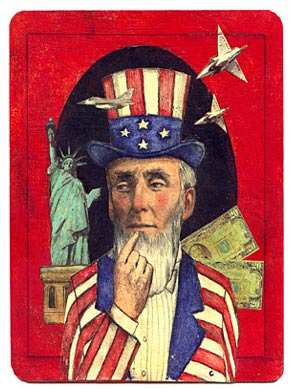

Gary Kamiya

What the world thinks of America

Yes, they hate our power and envy our wealth and respect our ideals. But it's deeper -- and more personal -- than that.

  • more
    • All Share Services

What the world thinks of America

Sept. 11 forced Americans to engage in that most un-American of activities: thinking about the country they live in. Mass death and the prospect of a future changed permanently for the worse has a way of raising questions. Some of them were purely political: Were the attacks perpetrated by evil men whose only motive was to do evil, or did specific U.S. policies lead to the attack? Should we rethink our entire approach to foreign policy, or bring renewed fervor to it? But others were more general. What kind of country is America? What does it stand for? How does the rest of the world see it? Why would people hate it enough to deal it such a blow?

Today, almost a year after the attacks, whatever illumination those ruminations provided seems faint indeed, buried beneath a ton of stale emotions and accumulated banalities, the dreary aftermath of a rending event that has no resolution. For a moment, the terrible collapse of the towers seemed to promise, if not a reborn America — those portentous claims that “nothing will ever be the same again” now seem vaguely embarrassing — at least one that its citizens would see in a new, sharply defined light, the way a person diagnosed with cancer suddenly sees his life strange, whole and infinitely precious. For a few weeks, a visceral sense of unity, a forged purpose born of a shared wound, allowed all Americans, the secular and the devout, liberals and conservatives, the ironists on the coasts and the straight shooters in the heartland, to come together under a flag that for once meant the same thing to everyone. But that sense of purpose, that clarifying vision, is gone. One of the most difficult of the many painful lessons of tragedy is that even its gifts do not always stay.

Many of those who wrote about America in the immediate aftermath of Sept. 11 fell into two predictable categories: the self-lacerating leftists and the breast-beating patriots. Those in the former camp displayed the virtues of sober reflection, but at times they seemed too worldly, too unsentimental, too quick to show off their cool awareness that much of the rest of the world has suffered far more than the United States ever has and that America has been directly or indirectly responsible for a great deal of that suffering. They were, of course, right, but their calculus lacked both empathy and a sense of historical proportion. Too much deference to history is vitiating: Not only does it leave one unable to strike out instinctively at danger, in the end it leaves one unable to feel anything at all. Patriotism has a tincture of sentimentality in it, but so do all feelings that have cooled into reflection, feelings that can support promises — and these are the feelings that allow work to be done and civilization to be built.

By contrast, the patriots were full of laudable vigor, but they were often myopic in their own way, unable or unwilling to grasp that even the worst tragedies do not relieve one of the responsibility of thinking. All too often, they reacted with outrage to even modest suggestions that it might be wise to consider whether any American actions might have led to the attacks, and that a little reflection on our place in the world might be in order. At their best, the patriots recalled the passionate but woolly-headed Mitya in “The Brothers Karamazov”; at their worst, they came across as nativists wrapped in the red, white and blue of permanent outrage, bludgeoning those who did not share their relentless Americanism.

Between or beyond these two essentially political poles, the rest of us wandered uneasily, sensing that both visions contained elements of truth but that neither did justice to who we are or the place we live. The fallout of Sept. 11 brought no closure. America’s retribution, the attack on the Taliban and al-Qaida, was both inevitable and necessary, the clearest manifestation of American power as self-defense since World War II, but it did not bring catharsis or clarify America’s identity to its citizens. In fact, this is encouraging: Wars should not do those things, and the temptation to make them into metaphors must be resisted.

President Bush did not resist. He framed the attack as an attack of evildoers against the chosen people, an act of sheer perverse malice, like Satan striking out at the angels in Heaven — an effusion of rhetoric as empty as a discontinued greeting card. It is true that Bush and his lieutenants have a responsibility to hunt down those responsible and prevent more such attacks, but they have gone much further. To a degree surprising only to those who thought Bush the younger might have a more nuanced view of the world and not be a cat’s paw for the old Cold Warriors he is surrounded by, the Bush administration has used the purposely vague and open-ended “war on terrorism” to advance its ideological and political agenda and intimidate dissenting voices. For those Americans opposed to the administration’s arrogant unilateralism and simplistic worldview, this failure to learn from a national tragedy is immensely disappointing, and the manipulation of that tragedy feels like a cynical defilement.

Perhaps irrationally, we wanted to come away from the tragedy of Sept. 11 with something beyond politics and righteousness, something closer to the sense of this vast reckless lovable coldblooded hard-working extravaganza of a country that can be found in the short obituaries for the World Trade Center victims in the New York Times or the poems of Whitman or the songs of Chuck Berry — meaningless sharp truths illuminating the American night. We wanted some kind of conclusion with long enough arms to fold all of us in. We wanted something that would get the bad taste of soapbox moralizing out of our mouths and leave the dead in peace.

One way to make a start, in thinking about America, is to examine what people who are not from here think about her. There are times, perhaps, when the only way to find out who you are is to look at yourself through other eyes.

The spring issue of the quarterly literary journal Granta gives readers a chance to do just that. Titled “What We Think of America,” it offers 24 short pieces by foreign writers (with the inexplicable inclusion of one writer from Hawaii), who deal with subjects ranging from a Lebanese woman’s painful realization that the U.S. can be even more heartless than her native land, to a British writer’s revelatory experience of the unique intensity of American literature, to the Hollywood censorship that led an Indian youth weary of truncated blouse-unbuttonings to prefer Russian films, to an Irishman’s confession that America no longer seemed strange because his own country had become America. By turns intimate and broadly analytical, these pieces are idiosyncratic, penetrating and refreshingly free of Big Thoughts about Sept. 11. Above all, they evince (almost all of them, anyway) a generosity of spirit, a clear-eyed affection for America — despite its flaws — and Americans. Those of us who can no longer even hear the braying self-praise of our compatriots will find this collection both touching and enlightening.

That intelligent foreigners have such deep and positive feelings about America, that they are willing to go past the received notion of America as a naive, blundering or perhaps malevolent giant, may come as a surprise. Being kicked when you’re down is a memorable experience, and certain pieces written after Sept. 11, as well as a steady flow of news stories along the lines of “Parisian intellectuals change mind after 24 hours, deny that vacuous Americans are worthy of empathy,” confirmed for many that the foreign intelligentsia took a jaundiced view of America — or actively despised her. The most notorious such piece, widely disseminated on the Internet, was by the Indian novelist Arundhati Roy. Titled “The Algebra of Infinite Justice,” it danced around the notion that America deserved the attack for its foreign-policy sins, and concluded that there was little difference between Osama bin Laden and George W. Bush. “Both are dangerously armed — one with the nuclear arsenal of the obscenely powerful, the other with the incandescent, destructive power of the utterly hopeless,” Roy wrote. “The fireball and the ice pick. The bludgeon and the axe. The important thing to keep in mind is that neither is an acceptable alternative to the other.”

This is not mature political thinking: It is name-calling, and it descends from a specious platform of perfect Third World rectitude. The limitations of Roy’s analysis are revealed not by her unassailable assertion that America has committed sins, but her monolithic insistence that all of America’s foreign-policy interventions are pernicious and all of them can be explained by the basest and most self-interested of motivations. This argument is so selective and tendentious that it betrays what one suspects is an underlying hostility that precedes political analysis, a hostility created by the mere fact of America’s global preeminence.

Of all the fears Americans have about what others think about us, probably the deepest — and the one we can do least about — is that they hate us simply because of how much power we have. But on this subject, as so many others, many of the authors in “What We Think About America” hold surprising views. One of the revelations of this collection is that although foreigners are aware of America’s power and influence, and of course of its shortcomings, they are far more aware of its complexity, its strengths, its paradoxes than we think. They are also closer to us, more attuned to the American sensibility than is generally believed. This awareness, and closeness, leads the writers not just to reject or slavishly imitate the “dominant power,” but to engage with it in much more interesting ways.

For the Australian writer David Malouf, it leads to a nuanced perspective. “We are ambivalent about ‘America’ — but isn’t that so with all of us, even a good many Americans? — according to what America most immediately suggests to us: The United Fruit Company, McCarthyism, Vietnam, the CIA subversion of Allende, the tanks at Waco; or the words of the Declaration and Lincoln’s address at Gettysburg, the Marshall plan, the Civil Rights Movement, our own delivery from European Fascism, Communism or the Japanese.”

For the Irish writer Fintan O’Toole, America is so omnipresent that it has ceased to be an Other altogether and has totally taken over his own country. What’s noteworthy is that O’Toole doesn’t write about this mournfully, but with a kind of nonjudgmental sense of wonder: “We had broken America’s spell by turning it into our own, living it out day by day … And if we sometimes feel the tectonic plates shifting beneath us and wonder where we are, it is simply because America is now the ground on which we stand.”

The German writer Hans Magnus Enzensberger, on the other hand, argues that America has not taken over Europe at all, that Europe has become more European and the U.S. more American, and this is a good thing. The strangeness of America, for Enzensberger, leaves it wonderfully unknowable: “Surely we cannot pretend to understand such a society entirely. It will always be something else, a world unto itself, a Western Heavenly Empire, a China of our imagination, a place to admire, to be grateful to, and to be baffled by forever.”

The British writer John Gray echoes the notion that the United States is fundamentally unknowable, but he puts a less Romantic gloss on this fact than the German. After citing such stereotype-busters as Dorothy Parker and H.L. Mencken, who flourished in a culture supposedly without irony, Gray writes, “America is too rich in contradictions for any definition of it to be possible … In truth, there is no such thing as an essentially American world view — any more than there is an essentially American landscape. Anyone who thinks otherwise shows that they have not grasped the most important fact about America, which is that it is unknowable.” After commenting — movingly, to an American — that Americans responded to the tragedy of Sept. 11 with dignity and conducted the war with restraint, he concludes that a new United States, broader and more enlightened and no longer certain that its values will conquer the world, is “being born — one as creative, contradictory and indefinable as any that has existed in the past.” Whether this optimistic prediction will come true, in the age of Bush, seems doubtful from this side of the pond; but perhaps the long, external view is the better one.

For the British/Dutch/German writer Ian Buruma, America’s omnipresence makes the actual country vie, in the imagination of the world, with “America,” a make-believe place as seductive, addictive and illusory as Gatsby’s green light: “The pull to cut loose, to reinvent ourselves, to shake off the past, and to want instant gratification, sexual, material, spiritual, is something most of us have felt. That is why ‘America,’ the ideal, expressed in Hollywood movies, rock music, advertising and other pop culture, is so attractive, so sexy and, to some, so deeply disturbing. All of us want a bit of ‘America,’ but few of us can have it, and even those who do still hunger for more, and more.”

Buruma notes that he treasures the idea of America as a “possible refuge,” even though he is well aware of its faults — “the sentimentality, the conformity, the insularity.” He concludes: “America, however, is a very different place to those who live in places where ‘America’ is only a mirage, a kind of guilty wet dream in dry desert lands, a promise which can never be fulfilled. If you live under a tyranny, with no personal freedom and no hope of advancement, in a country that feels abandoned and perhaps even betrayed by the modern world, the pull of family tribe and tradition may be all that is left. Then a very different utopia beckons the embittered pilgrim, one built on a mirage of purity, sacred community and self-sacrifice. In such a state of mind, it is not enough to avert your gaze from those seductive towers of Babylon. You might have to tear them down.”

As is clear from the above passages, the contributors are struck by the strange dualities of American life, dualities that seem to them sharper and odder than those in their own lands. (Since Americans tend to be struck by the same odd contradictions in foreign lands, this may be a universal reaction to the Other.) The Indian writer Amit Chaudhuri notes that Bombay carries echoes of American culture, the same “mixture of the childlike and the grown-up, of naivete and ruthlessness, a mixture that, as I now know, is also peculiarly American.” The way that American innocence and optimism coexists blandly with corruption or self-interest is a constant theme.

Again and again, the writers hammer away on the disparity between the sophistication of Americans and the crude conservatism of their leaders and their nation’s international policies. The British writer James Hamilton-Paterson, who also notes that Americans are singularly ignorant of the rest of the world (another familiar theme) writes, “Time and again I’m struck by the extraordinary disparity between the United States’ global face and the many individual Americans I know and love. Their sophistication, generosity of spirit, intellectual honesty and subversive humor seem wholly at odds with their country’s monolithic weight on the world. Why is it, I wonder, their government is never represented by people like themselves? … Are my friends in some way disenfranchised: part of a vital, intelligent, and quintessentially American constituency doomed to be forever unrepresented in their Congress and Senate? And if so, why?” For Americans who have essentially given up even dreaming that their politicians might reflect them, this question is painful.

Lest the reader think that the world’s intelligentsia is uniformly gracious toward the United States, there is Harold Pinter, who makes Noam Chomsky look like Rush Limbaugh. The British playwright and activist whispers these sweet nothings in America’s ear: “Arrogant, indifferent, contemptuous of International Law, both dismissive and manipulative of the United Nations: this is now the most dangerous power the world has ever known — the authentic ‘rogue state,’ but a ‘rogue state’ of colossal military and economic might … These remarks seem to me even more valid than when I made them on Sept. 10. The ‘rogue state’ has — without thought, without pause for reflection, without a moment of doubt, let alone shame — confirmed that it is a fully-fledged, award-winning, gold-plated monster. It has effectively declared war on the world. It knows only one language — bombs and death.” The most dangerous rogue state ever? Adolf, Caligula — eat your hearts out! Mr. Pinter seems to have written one too many strange, elliptical scenes in which banal fragments of dialogue hang menacingly at cross-purposes — and gone completely off the deep end.

The British author Doris Lessing, not as over the top as Pinter but more critical of the U.S. than many other contributors, notes in the Tocquevillean vein that “America … has as little resistance to an idea or a mass emotion as isolated communities have to measles and whooping cough. From outside, it is as if you are watching one violent storm after another sweep across a landscape of extremes.” After denouncing political correctness, which she finds run amok here, Lessing comments acerbically on the “patriotic fever” that has gripped the country after Sept. 11, leading Americans to see themselves “as unique, alone, misunderstood, beleaguered, and they see any criticism as treachery. The judgement ‘they had it coming,’ so angrily resented, is perhaps misunderstood. What people felt was that Americans had at last learned that they are like everyone else … They say themselves that they have been expelled from their Eden. How strange they should ever have had a right to one.”

The only global area where specific U.S. policies are explicitly discussed is the Middle East. The contributors take unsurprising positions. Haim Chertok, who was born in the U.S. and emigrated to Israel after becoming disillusioned with the Vietnam War, only to suddenly find himself serving in Lebanon, describes himself as an “unrepentant citizen of both the Zionist Entity and the global Gulliver-state,” who accordingly gets the “automatic double-whammy of reproach and contempt.” Although he acknowledges some Israeli responsibility for the region’s suffering, he offers the U.S. unstinting praise for its support of Israel: “only American administrations have seriously endeavored to nudge Palestinians from their skewed sense of the realities of our region.”

Raja Shehadeh, a Palestinian, takes a different view of the American role in the region. After pointing out that more people from Ramallah now live in America than in Ramallah, he offers an eloquent account of how the new American-financed roads to the settlements in the West Bank have “done a kind of spiritual damage. Gone is that attractive stretch of serpentine road that meandered downhill into the lower wadi that led into Nablus.” He concludes by describing how his cousin was attending a wedding when the building next door was destroyed by an Israeli-piloted, American-built F-16, shattering the event and encrusting the wedding cake with glass. His cousin had studied in the U.S. and did not hate it, but when Shehadeh asked him what he thought of the U.S. he dismissed it as “a lackey of Israel, giving it unlimited military assistance and never censoring its use of US weaponry against innocent civilians.” But Shehadeh ends on a poignantly hopeful note: “Most Americans may never know why my cousin turned his back on their country. But in America the parts are larger than the whole. It is still possible that the optimism, energy and opposition of Americans in their diversity may yet turn the tide and make America listen.”

The Egyptian writer Ahdaf Soueif advances the theory that the U.S. affinity with Israel has a deeper explanation than the power of the Zionist lobby or guilt over the Holocaust. “The U.S. too is a (relatively) young nation; a state that came into being at the hands of groups of white Europeans who ‘discovered’ a land and ‘settled’ it — never mind that there were people already there. Maybe America’s fondness for Israel is like that of a parent watching a child follow in its footsteps. And now it looks as though the parent will be taught by the child: airborne attacks on civilian populations, illegal detentions, use of torture in interrogation, targeted assassinations worldwide: these have been the stock-in-trade of the Israeli state for fifty years and now America looks to follow suit … I still love my American friends; like the music and stories that captivated me all those years ago they’re smart and funny and open and warm. Is it really the case that to be good for them America has to be bad for the rest of us?”

Such explicitly political statements are the exception, however, and offbeat and personal observations are the rule, like Ivan Klíma’s recollection of the generosity of American strangers when his car got stuck in a snowstorm (“I don’t think drivers in our country would behave with such concern and self-sacrifice”) or the Chinese writer Lu Gusun’s account of turning on a light switch in Berkeley and discovering a poster of Ronald Reagan naked adorned the wall and that his professor friend had put the switch over his private parts. These quirky tales can be not just amusing but illuminating: the Indian writer Ramachandra Guha describes how his anti-Americanism was shaken by the sight of the dean of his college at Yale carrying a box of papers up three flights of stairs into his office — something that would be inconceivable for his father or grandfather, who would use flunkies to carry even a tiny file. “Over the years, I have often been struck by the dignity of labor in America,” he notes. But he then goes on to denounce America’s woeful role in world politics, cataloging the long list of treaties — on global climate change, biodiversity, land mines — it has refused to honor. “The truth about America is that it is at once deeply democratic and instinctively imperialist. This curious coexistence of contrary values is certainly exceptional in the history of the world.”

No collection of foreign writings on the United States would be complete without including the French, known far and wide for their Cartesian contempt for sundry American vulgarities (not to mention the wall-eyed Sartrean sneer they direct at our buttoned-up sexual behavior). But Benoît Duteurtre is far too civilized to indulge in the crass America-baiting his countrymen are legendary for. He makes the deflating point that French criticism of the U.S. allows those who make it to pretend they’re not part of the same morally ambiguous world, one “mired in identical contradictions.” He takes a shot at the odd, anomalous fact that contemporary French nationalism comes from the left: “They’re not fighting for the French flag but for humanist values which apparently French society alone can defend (even when reality proves the opposite). Most hurtfully of all, he rates Parisians lower than New Yorkers on the self-criticism scale: He writes that when he travels to New York, “I more often come across New Yorkers able to criticize a certain kind of American horror than Parisians capable of defining a particular French horror: that mixture of a pristine conscience always ready to criticize and an unquestioning acceptance of the need to adapt and modernize. This abhorrence strikes me as particularly abhorrent since Sept. 11.”

Duteurtre concludes that he found the “collapse of the twin towers more moving than any of the other tragedies of the last decade. Because in my eyes Europe and America are intimately linked by history, by way of life and thought; and because we belong to the same society which we should learn to transform together.”

Of all the contributors, the one who offers the most heartfelt praise for America — what it could be, what it is, the dreams enshrined in its most soaring language — is the Canadian writer Michael Ignatieff. He marched against Nixon and the Vietnam war, he writes, but he believed in the U.S. in a way he never did in Canada. Citing Abraham Lincoln’s Second Inaugural (“with malice toward none …”), the words spoken by a rabbi in Iwo Jima burying his marines (“Too much blood has gone into this soil for it to lie barren …”) and Martin Luther King’s speech on the steps of the courthouse in Montgomery, Ala. (“How long? Not long, because no lie can live forever … Be jubilant my feet. Our God is marching on”), Ignatieff writes that the “power of American scripture lies in [the] constant process of democratic reinvention. First a wartime president, then a battlefield rabbi, then a black pastor — all reach into the same treasure house of language, at once sacred and profane, to renew the faith of the only country on earth that believes in itself in this way, the only country whose citizenship is an act of faith, the only country whose promises to itself continue to command the faith of people like me, who are not its citizens.”

For those of us who are privileged — and yes, sometimes cursed — to call America home, remembering those promises, and trying to keep them, is a worthy task.

Continue Reading Close

Obama’s Iran charade

The shrill, militaristic Manichean worldview that brought us the Iraq war is gone -- except when it comes to Iran

  • more
    • All Share Services

Topics: ,

Obama's Iran charadeThe main reactor at the Bushehr nuclear facility in Iran. (Credit: Reuters/Raheb Homavandi)

The nuclear summit that concluded last week between Iran and six world powers was a ridiculous charade. The Obama administration never intended it to succeed. Its sole purpose was to placate hawks in U.S. Congress, ensure that Democratic donors keep writing checks during election season, and buy another month of time during which Israeli Prime Minister Benjamin Netanyahu will not be able to bomb Iran. In the meantime, American drivers can sit back and enjoy more $4-per-gallon gas.

The talks failed because the U.S. and the rest of the P5+1 (Russia, China, Britain, France and Germany) refused to take yes for an answer. The key issue on the table was Iran’s accumulation of uranium enriched to 20 percent – not a high enough level to make a nuclear weapon, but close enough that it would be much easier for Tehran to do so. Iran made it clear that it was prepared to stop enriching to 20 percent and to even ship its stockpile of enriched uranium out of the country, if the U.S. and the other powers agreed to relax the draconian sanctions they have imposed on the country.

This deal would have been a major diplomatic breakthrough. It would have greatly reduced Iran’s capacity to develop a nuclear weapon, defused tensions in the region, calmed the oil markets, driven prices at the pump down and made it impossible for Netanyahu to attack Iran. In a presidential campaign as tight as this one, a significant drop in gas prices could be the difference between Obama being reelected and Romney defeating him. So why didn’t the Obama administration take the deal?

The ostensible reason, piously mouthed by Secretary of State Hillary Clinton, is that the U.S. believes that the upcoming, even harsher round of sanctions on Tehran will generate even further concessions. According to this line of reasoning, Iran only came to the bargaining table because of sanctions, and more sanctions will produce better results.

But this justification is transparently false. First, Iran has made it clear again and again that it will never allow itself to be seen as folding under U.S. pressure. It is prepared to negotiate, but successful diplomacy requires not just sticks but carrots. The carrot the P5+1 offered at Baghdad was ridiculous: If the Iranians agreed to suspend 20 percent enrichment, what they would receive in return was not a reduction in sanctions, but rather spare aircraft parts. For Tehran, accepting this deal would have been tantamount to surrendering. As Iranian analyst Hasan Abadini said, “Giving up 20 percent enrichment levels in return for plane spare parts is a joke.” These are not arcane diplomatic mysteries. As Iran expert Gary Sick pointed out in an interview on NPR, what it will take to reach a resolution of this issue is clearly understood by all the players involved. It is no more possible that the Iranians would have taken that deal than that the Palestinians would agree to establish their state in Jordan.

Second, Clinton’s argument that the Iranians will make more concessions begs the question: what concessions? The only remaining significant concession Iran could make would be to agree to give up enriching uranium altogether – and it has made it clear that it is never going to give up that right, which it is guaranteed as a signatory of the Non-Proliferation Agreement. In an interview with Washington Post columnist David Ignatius, former Iranian negotiator Seyed Hossein Mousavian made it clear that Iran would be prepared to give up 20 percent enrichment if its rights to enrich uranium were recognized.

All of this makes clear that the U.S. knew going into the negotiations that they were not going to succeed. The entire process was an elaborate ritual whose dual purpose was to inoculate President Obama against charges that he was “soft on Tehran” and to make it impossible for Netanyahu to go postal.

In fact, despite the conventional wisdom, it is extremely unlikely that the far-right Israeli leader will attack Iran. His constant threats to do so were the reason that Congress imposed the latest round of sanctions, against the Obama administration’s wishes. But despite Congress’s lockstep support for Netanyahu and anything he decides to do, up to and including an attack on Iran, it would be far too risky for Netanyahu to actually do it. The American people, unlike their bought-off, coerced and/or ideologically myopic political representatives, are sick of Middle East wars. Many, including increasing numbers of American Jews, are growing weary of Israeli intransigence and extremism. They’re also broke. An Israeli attack on Iran would draw in the U.S. and plunge the world into a depression – and the American people would hold Israel to account. Netanyahu may, as the former head of Israel’s spy service said, be “messianic,” but even he knows better than to jeopardize his country’s relationship with America. However, in order to manipulate America, it is essential that he constantly give the impression that he is about to attack Iran.

The Obama administration probably knows that Netanyahu is bluffing. But it has to play out this farce to placate Congress, keep pro-Israel Democrats writing checks, remove a Romney attack line and generally appear tough on Iran.

The irony is that the U.S. and Israel are always claiming that Iran uses negotiations over its nuclear program to play for time while it works feverishly to develop a bomb. But playing for time is precisely what the U.S. just did.

Obama is trying to run out the clock on Iran before the November election. He adroitly stalled the nuke-Iran hysteria that built up during the AIPAC conference in March, but he did so at a price, painting himself into a corner with tough rhetoric denying that containment of a nuclear Iran was an option and threatening to use military force. The negotiations in Baghdad had to fail in order for him to maintain that posture.

His strategy may work. He may stumble over the finish line in November, still dragging out negotiations. And he may overcome the serious headwind of high gas prices and beat Romney. But there is nothing good to be said about his weak and pandering approach. It will not stop the Iranian nuclear program, it is causing the Iranian people to suffer, and it hurts the average U.S. citizen. At bottom, it is an approach predicated not on achieving real progress in dealing with the Tehran regime but on overthrowing it. As such, it is antithetical to Obama’s proclaimed desire to reach out to Iran and to reset America’s relationship with the Middle East. In the long run, he will have to decide whether he really wants to continue a brinkmanship game that locks the U.S. into the self-defeating Middle East policies it pursued during the Bush years.

For the truth is that Obama’s Iran policy represents the last vestige of Bush-era neoconservative extremism. The moralistic, shrill, militaristic Manichean worldview that brought us the “Axis of Evil” and the Iraq war is gone – except when it comes to Iran.

Obama’s schizoid foreign policy – extreme and ideological on Iran, pragmatic and flexible everywhere else — was brought into sharp relief this week. Even as the Baghdad summit broke down, events elsewhere in the Middle East and South Asia demonstrated the utter failure of Bush’s approach – and provided a cautionary warning to Obama of the follies of continuing it with Iran.

Start with Iraq, where Bush’s nine-year-long military adventure is coming to an inglorious end. That unprovoked invasion was supposed to bring an end to an evil regime and transform the Middle East – the same reasons neocons now give for attacking Iran. It left an ethnically fractured, horribly wounded land in the grip of a strongman that is just now emerging from a nightmarish civil war and is still plagued by sectarian violence and terrorism. Our moral responsibility predates the war: America’s crippling pre-war sanctions devastated Iraq’s entire society, and they were one of the reasons why it was so difficult to rebuild it. Congressional proponents of sanctions against Iran should take note.

Then there’s Afghanistan, where after 11 agonizing years we have essentially given up. Afghanistan has proven beyond the shadow of a doubt that even a superpower cannot always succeed in imposing its will, that cultural and anthropological differences are critical, and that trying to combine nation building and counterinsurgency in one of the most backward and impoverished places on Earth is a recipe for disaster. The best we can hope for now is that not too many more U.S. troops are shot dead by the Afghans they are training – and that the Taliban does not roll into Kabul the moment we roll out.

Next there’s Syria, where an appalling regime is locked in a brutal struggle with a murky opposition and where all the options are so bad that we have no choice but to remain on the sidelines.

Finally, there’s Egypt, where a nascent democracy is fighting to be born. Everything about this inspiring, painful and threatened revolution, culminating in this week’s elections, was generated by the Egyptian people themselves. America had nothing to do with it. Contrary to claims made by Bush apologists, the appalling example of Iraq was actually a disincentive to throw off Mubarak’s tyranny. As for the rise of the Muslim Brotherhood, that dire event so feared by neoconservatives and Islamophobes, they may turn out to be the stable, conservative, don’t-rock-the-boat party.

The lessons these different situations hold for our dealings with Iran are very simple. First, we have far less ability to control what happens in the Middle East than we think. In Iraq and Afghanistan, we tried to impose our will directly and failed. In the other two, we either do not have the ability to intervene (Egypt) or the risks of doing so would be too high (Syria). Second, none of these situations are susceptible to the kind of good-and-evil moralizing that characterized Bush’s approach to the Middle East. Individually they are incredibly complex, and as a whole they are even more complex. There is no simple way to approach any of them. Basing our policy toward them on a Manichaean, good guys vs. bad guys worldview is self-defeating. Bashir Assad is a bad guy, but if we sided with the rebels, we could unleash a civil war even more catastrophic than the one going on now. Some of the Salafis in Egypt may be planning to ban beer and abrogate the Camp David treaty, but if we tried to prevent them from taking power, we would be thwarting the will of those Egyptian people who want those outcomes. Nouri al-Maliki may be a sectarian thug, but the alternative could be worse. Hamid Karzai may be a corrupt, drug-addled charlatan, but he’s the guy who’s there.

And so on, down the list, from Pakistan to Hamas to Netanyahu to Libya. The real world, as opposed to the black-and-white world of the neocons, is all about complexity, grey areas, compromises, diplomacy, flexibility. It’s about accepting that America will have to deal with regimes that do not toe our line. It’s about realizing that our soft power is more effective than our military power. It’s about putting down the Big Stick and trying to actually listen to what the people in the region are saying. It’s the opposite of the Bush Doctrine.

Obama knows this, but the dead hand of neoconservative ideology still drives his Iran policy. Until he shakes it off and accepts that Iran is a regional power and must be dealt with realistically, even though it does not always share our interests, his Middle East policy will continue to resemble that of his predecessor.

Continue Reading Close

Obama’s finest hour

For once, the president who ran on a platform of hope and change lived up to his ideals

  • more
    • All Share Services

Topics: ,

Obama's finest hourPresident Obama (Credit: Reuters/Yuri Gripas)

On Wednesday, the real Barack Obama stood up. He is a better man and a better president for having done so. And America is a better country.

Homophobia is the last refuge of open bigotry in American life. Racism, anti-Semitism and misogyny still exist, but they lurk in the shadows. It is no longer socially acceptable in any segment of society to openly say that blacks are violent or Latinos are lazy or Jews are grasping or women are genetically inferior. But it is still acceptable to say the crudest and most hate-filled things about gay people. In his 1999 book “One Nation, After All,” sociologist Alan Wolfe found that Americans were remarkably tolerant and open-minded about every controversial subject except one: homosexuality. Attitudes toward gays have become far more enlightened during the last 13 years, but Wolfe’s findings touch on a profound social reality: Many Americans still feel gays are somehow unacceptable, or scary, or immoral, or just different in some way that makes it acceptable to discriminate against them and/or openly disparage them.

That does not mean that all of the North Carolinians, for example, who voted Tuesday for an amendment outlawing same-sex marriages are homophobes. Many of them simply believe that marriage should be restricted to heterosexual couples because that’s the way marriage has traditionally been defined, and they believe that defending tradition as important. But their personal views have become irrelevant. The fact is that same-sex marriage has become a national civil rights issue, and as such, it has enormous symbolic importance. To simply stand on the sidelines and not take a position on it, as Obama tried to do until Wednesday, is to tacitly accept that gay people are second-class citizens. This narrow, legalistic approach to gay marriage only encourages bigotry and stands in the way of needed progress. It was necessary for Obama to take a risk – and take a stand.

I did not think he would do it. But he did.

Obama dislikes conflict, and he dislikes risk even more. Some of that is both understandable and justifiable. Politics is the art of the possible. You have to get elected to get anything done. And to get elected, or reelected, you have to make compromises. That is why Obama hid behind the transparently false excuse that his views on same-sex marriage were “evolving.” He wanted to avoid a hot-button issue that could potentially cost him the election.

To be sure, that was a questionable political tactic. Advocates argued that Obama faced little political risk in endorsing same-sex marriage because the social conservatives for whom this issue is crucial were not going to vote for him anyway. Moreover, they argued that the number of swing and independent voters the president would lose would be more than made up for increased turnout among his supporters.

Those arguments may be correct – but they may not be. We just don’t know. North Carolina is a swing state. It just voted to ban same-sex marriage. It is indeed possible that Obama will lose the election because he took the opposite position.

It is no secret that Obama has sorely disappointed his most ardent supporters. Throughout his first term, he has consistently refused to do anything truly politically risky. He spoke of fundamentally changing the rules and culture of Wall Street – then stood by as the same looters who destroyed the economy gamed the system. He talked up a progressive reform of healthcare – and ended up with a watered-down version of a Republican idea. He announced a bold stimulus package – then made it too small to be fully effective. He gave the best speech about the Israeli-Palestinian crisis ever given by an American president – then caved in to the Israel lobby. And so on.

But there are times when pragmatism must take a back seat to principle. And to his undying credit, Obama decided that this was one of them. He decided that it was more important for him, the leader of the United States, to stand up and defend the rights of an abused minority group, than to accept the unacceptable status quo.

We don’t know why he decided to take the risk. A cynic – or perhaps a realist – might simply say that he decided there was no risk, that most Americans would stand with him on this issue. But I prefer to think of his decision as being at least in part shaped by the two most crucial, and inseparable, parts of his identity: his blackness, and his profoundly inclusive ideals. As president, Obama has never played the race card, never asserted his racial identity in any significant way. This reticence is both politically astute and deeply grounded in Obama’s own sense of what race means – and does not mean. For Obama, race matters – but paradoxically, it matters precisely because it offers all of us, black or white or brown or yellow or red, an opportunity to transcend it. In that regard, Obama is a true child of the civil rights movement. The men and women who struggled and died at Selma and Birmingham and Little Rock and Neshoba County are his heroes, and he was not going to betray their memory. That’s bedrock for him.

What happened yesterday is that Barack Obama, as flawed and brave and human as the rest of us, just struck his own bedrock. And the sound of that pick hitting stone brought tears to my eyes.

He did not have to do it. History is filled with crucial decisions that did not have to be taken. Gandhi could have decided the Salt March was too divisive. John Fitzgerald Kennedy could have decided that extending the hand of friendship to the USSR at the height of the Cold War, in his famous American University speech, was too politically risky. Lyndon Baines Johnson could have decided the Civil Rights Act of 1964 was not worth spending so much political capital on. Martin Luther King could have decided that white America was not ready for a campaign of civil disobedience. The hundreds of thousands of Arab men and women who risked their lives to demand justice, opportunity and freedom could have turned back when the club-wielding thugs appeared. The Occupy protesters who came out in the rain to demand that America live up to its ideals could have stayed home.

But they did not. Those people – leaders and ordinary citizens alike — took the risk. They did the right thing. And history will remember them, and honor them, when the pragmatists and calculators have long been forgotten.

The night before he was shot, Martin Luther King Jr. seemed to prophesy his own death. “But it doesn’t really matter with me now,” he said. “Because I’ve been to the mountaintop … And I’ve seen the Promised Land. I may not get there with you. But I want you to know tonight, that we, as a people, will get to the Promised Land. So I’m happy, tonight. I’m not worried about anything. I’m not fearing any man. Mine eyes have seen the glory of the coming of the Lord.”

Obama could lose the presidency because he stood up for the rights of gay Americans. But if he does, for the rest of his life he can look back and know that when it counted most, he did the right thing. That is something no one can ever take away from him. Or from the American people.

Continue Reading Close

Reboot the Romney-bot

Since clinching the nomination, the candidate's behavior has become even less recognizably human

  • more
    • All Share Services

Topics: ,

Reboot the Romney-botMitt Romney (Credit: AP/Jim Cole)

Even before the Republican primaries began, rumors abounded that Mitt Romney was a robot. His zombie-like cheerfulness, his excessively regular features and his strangely perfect-looking family led to widespread suspicion that he had been assembled in Silicon Valley by a team of right-wing nanotechnologists and engineers and shipped secretly to GOP headquarters. The suspicions were far from universal, however. An influential group of skeptics rejoined that cybernetics had not advanced to the point where it could create lifelike humanoids, even ones as unconvincing as Romney, and that the GOP candidate should be considered a human being until it was definitively proven that he was a cyborg.

There the debate rested. Then Romney hit the campaign trail, and the pendulum swung decisively toward those who held that he was constructed out of high-impact plastic. Even the skeptics admitted that Romney’s “personality” did not appear to be of organic origin. He seemed uncomfortable in his own skin (which of course would make sense if he did not have actual skin), and did not know how to tell jokes (humor is notoriously difficult to program). Even the words he used to describe himself sounded like they were auto-imported from a slightly archaic database, as when he oddly described himself as “severely conservative.”

But the clearest sign that Romney had fiber optic cable coiled in his midriff was the bizarrely smug and clumsy way in which he constantly referred to his plutocratic lifestyle. When asked at the Daytona 500 whether he followed NASCAR closely, Romney completely failed to take advantage of this traditional GOP opportunity to demonstrate the common touch. He replied, “Not as closely as some of the most ardent fans, but I have some great friends who are NASCAR team owners.” Two weeks later, in an interview about the NFL, Romney again went out of his way to affirm his membership in a tiny fraternity of disliked multimillionaires, saying, “I’ve got a lot of good friends – the owner of the Miami Dolphins and the New York Jets – both owners are friends of mine.”

The subject of money, in particular, seemed to produce continual script errors, including inappropriate answers, dead-end loops and other rudimentary programming flaws. In Detroit, Romney boasted that his wife “drives a couple of Cadillacs” – the political equivalent of showing up for a photo op at a diner wearing an ascot and a monocle. He casually challenged Rick Perry to a $10,000 bet during a debate, an unforced error that evoked vote-losing images of Fortune 500 CEOs snapping towels at each other in the sauna. But that weird glitch was dwarfed by a statement Romney made a month later. His hard drive apparently malfunctioning after his tax returns were revealed, Romney referred to the $370,000 he had earned giving speeches one year — an amount it would take the average American worker 14 years to make — as “not very much.” In short, Romney came across not only as an obscenely rich person, but as an obscenely rich person from another planet.

At this point, some leading technology analysts had begun to openly accuse whoever programmed Romney of gross incompetence. But others defended the unknown scriptwriter, pointing out that the Republican Party’s worship of plutocrats as emblems of “aspirational” capitalism made it impossible to for even the best programmer to write a coherent GOP script about wealth.

Romney’s performance in the primary debates also provided strong empirical support for the Mitt-is-a-cyborg thesis. For the entity claiming to be “Mitt Romney” that appeared onstage bore no resemblance to the Romney-like entity Americans had come to know in previous years. The moderate, conciliatory governor of Massachusetts was gone, his place taken by a strange, harsh figure who appeared to have been programmed by a disciple of Torquemada. Romney Version One had strongly supported a healthcare plan identical to Obama’s; Romney Version Two denounced “Obamacare” as opening the door to socialism. Beta Romney, who had defended a woman’s right to choose, had been replaced by an updated model that, like a doll that speaks a few simple phrases when its bottom is squeezed, intoned “abortion is immoral” again and again.

Different observers had different explanations for this strange phenomenon. Some maintained that “Mitt Romney” had been originally programmed in the factory to flip-flop when politically necessary. Others held that the earlier version had been surreptitiously refurbished, or possibly completely replaced.

Since he clinched the GOP nomination, Romney’s behavior has become even less recognizably human. Following his mechanical move to the far right during the primary season, his even more mechanical attempt to move back to the center has made it appear increasingly likely that he was assembled by nano-machines. His victory speech in New Hampshire was a tape loop of Reagan-like platitudes about free enterprise and Reagan-like blasts at the apocalyptic evil posed by Big Government, topped off with a weird, casuistic attempt to claim that his laissez-faire, I’ve-got-mine-Jack ideology was “fairer” than Obama’s attempt to shrink the increasing gap between rich and poor. Instead of the Great Communicator, Romney came off like a Frankenstein monster, cobbled together out of various right-wing bits and pieces, trying simultaneously to appease Tea Party extremists and clank back to the middle, all while smiling a big, artificially-whitened smile.

His inability to impersonate a human being poses severe political problems for Romney. But the worst is yet to come. Republican strategists are now advising Romney to stop attacking Obama and offer a “positive vision.” Most experts believe this simply cannot be done. Romney’s CPU, set up to defend cutthroat capitalism, destroy his opponents, and present the innocuous centrist Barack Obama as the reincarnation of V.I. Lenin, cannot accommodate the impossible demand that he suddenly become “human.” No one knows whether he will literally melt down in public with smoke pouring out of his eye sockets, or will simply begin regurgitating meaningless phrases about an “opportunity society,” like the unplugged super-computer HAL in “2001: A Space Odyssey.” But sooner or later, Romney is doomed to a fatal system error.

Like Arnold Schwarzenegger in “The Terminator,” Romney is about to be turned into scrap metal. But there is still time for him to save his campaign. If Mitt Romney wants to be president, he must appear before the American people on prime-time TV and admit that he is a robot.

With this one bold stroke, Romney would dispel all questions about his authenticity. After all, unlike human beings, robots are not expected to demonstrate consistency in their beliefs and actions. They do not have “selves,” only circuits that react in programmed ways to new situations. The instant Romney shows the nation the power cable hidden in his posterior, his self-contradictory positions and blatant pandering will cease to be seen as a cynical grab for power. Instead, they will become the visible manifestations of an advanced Google-like algorithm, inspiring technological interest and respect.

A frank confession that Romney plugs himself into a socket in his garage every night would also end the criticism of his wooden demeanor. “Star Wars,” “Mystery Science 3000,” “The Terminator” and other pop-culture hits have popularized lovable, wisecracking, helpful robots. Romney would be far better served if he was seen as C3PO, rather than a stilted, fake-Tea-Party plutocrat boasting about his friendships with other plutocrats.

Moreover, by forthrightly admitting that his head swivels around on a titanium base, Romney would instantly wipe out Obama’s advantage among young voters. Tech-savvy young Americans prefer Facebook, Tumblr, Zynga, smartphones and iPods to reality anyway, and would jump at the chance to make their generational mark by electing a president who is one of them (and can be easily disassembled and shipped back to the factory for repair.)

Finally, if Romney were to stand before the American people, remove his head and forthrightly admit that he is a robot, he would get rid of the biggest albatross around his nonexistent neck: his leadership of the private equity firm Bain Capital. As a human being, Romney cannot justify the rapacious, job-destroying actions engaged in by Bain. When critics – including his GOP rivals – rightfully accused him of practicing “vulture capitalism,” all Romney could say was “In the free economy, in the private sector, sometimes investments don’t work and you’re not successful.” Coming from a human, this answer is heartless. Coming from a robot, it feels almost cuddly.

Which points to the real reason Romney should admit to being a robot – whether he is one or not. As a human being, Mitt Romney is a flop. But as a robot, he’s positively human.

Continue Reading Close

Don’t arm Syria’s rebels

Liberals arguing that the U.S. should give weapons to Syrian rebels underestimate Assad's power at home

  • more
    • All Share Services

Topics:

Don't arm Syria's rebelsSyrian rebels aim during a weapons training exercise outside Idlib, Syria. (Credit: AP)

In Syria, the horror has taken a brief break. The Kofi Annan-brokered cease-fire is holding so far, give or take a few government snipers, but no one expects it to last. Within hours, days or weeks, something will break the fragile calm. President Bashir al-Assad’s tanks will once again begin firing high-explosive shells into civilian neighborhoods, blowing up houses and everyone in them. Opposition fighters will kill government troops and set off bombs. Mysterious massacres, which each side will blame on the other, will take place. Soldiers will continue to rape women, children will be tortured, and the horrible human toll – 9,000 deaths, 42,000 refugees since fighting began 13 months ago – will continue to climb.

There is a very good chance that this slow-motion blood bath could go on for years. And at the end, Assad could still be in power.

As this dreadful situation festers, calls for America to arm the opposition are growing louder. And they are not only coming from neocons, neo-imperialists and warmongers, proxy warriors for whom defeating Assad is part of a Great Game whose real goal is defeating Iran. No one is surprised that neocons like Joe Lieberman, for whom America’s foreign policy comes down to “Is it good for Israel?” or his chest-beating partner in imperialist Islamophobia, John McCain, want the U.S. to arm the Syrian opposition. Nor is it surprising that Elliott Abrams, Fox News or the Washington Post editorial board have beat the war drums. But these predictable hawks have been joined by an increasing number of liberals and humanitarians who have no ideological ax to grind.

Saying “the basis for any settlement must be a rough equality of forces,” New York Times columnist Roger Cohen called for the U.S. to arm the Syrian opposition. Analyst James Traub similarly called for the U.S. to back what he called a “neo-mujahadeen strategy.” Guardian columnist Simon Tisdall blasted Obama’s refusal to get the U.S. more involved, saying that the world had a “moral imperative” to intervene. “A shoulder shrug will just not cut it any more,” Tisdall wrote. In a column titled “Syria is not Iraq. And it is not always wrong to intervene,” Tisdall’s Guardian colleague Jonathan Freedland denounced facile left-wing opposition to Western intervention in Syria, writing, “we must not make the people of Homs pay the price for the mistake we made in Baghdad.” Oxford economist Paul Collier argued in the Financial Times that Assad’s regime was doomed and arming the opposition would push it over the edge.

None of these commentators are neoconservatives or proxy warriors, fans of the “War on Terror,” the Bush Doctrine or the unbridled use of American force. In their different ways, they are driven by simple, and legitimate, moral outrage. That outrage was expressed in its purest form by the Iraqi exile Kanan Makiya, the Iraqi exile whose powerful indictment of Saddam Hussein’s tyranny played a large role in convincing liberals like George Packer and Paul Berman to support the Iraq War. In a largely pro-intervention symposium posted recently by the New Republic, Makiya wrote, “I don’t really think there is any kind of a reasonable argument against intervention in Syria. Quite the opposite: There is a moral and a human imperative to act that is larger than any nation’s interests and larger than any strategic calculation. That is so obvious it is an embarrassment to have to say it. This is how I thought about intervention in Iraq 20 years ago and it is how I think about what needs to be done in Syria today.”

To their credit, most of these observers recognize that their call for the West in general and America in particular to support the Syrian opposition holds considerable risks. For example, after acknowledging the murky and disorganized nature of the Syrian opposition, the looming possibility of sectarian massacres, and the unhappy outcome of America’s mujahedin experiment in Afghanistan, Traub writes,  “[T]here are no good solutions; only less bad ones … I’m open to a better suggestion.”

So these commentators deserve respect for their intellectual integrity, their good intentions and their moral outrage. All of them find the unfolding carnage in Syria unbearable to behold, and anyone with a conscience would agree.

And yet, we must bear it. For the worst thing that America and the rest of the world could do is to arm the opposition.

This is not a knee-jerk left-wing response. It has nothing to do with Iraq. Nor does it have anything to do with the proxy war between the U.S. and its allies and Iran and its allies. It is not driven by pacifism or opposition to all war. All U.S. wars are not axiomatically foolish, evil or driven by brutal self-interest (although most of them since World War II have been). The airstrikes on Kosovo and the Libya campaign were justified (although the jury is still out on the latter intervention). If arming the Syrian opposition would result in fewer deaths and a faster transition to a peaceful, open, democratic society, we should arm them.

Every situation is different: There is no one-size-fits-all template for foreign affairs. And in Syria, the truth is that further militarizing the conflict will likely cause it to spiral out of control. Moral outrage alone is not enough. It must be tethered to a coldly rational analysis.

That analysis has been provided by a number of in-depth reports, most notably a new study by the International Crisis Group, as well as the excellent on-the-ground reporting of Nir Rosen for Al-Jazeera. The bottom line is simple. The war has become a zero-sum game for Assad. If he loses, he dies. But the only way he can lose is if he is abandoned by his crucial external patron, Russia, which is extremely unlikely to happen absent some slaughter so egregious that Moscow feels it has to cut ties with him. Assad has sufficient domestic support to hold on for a long time, and a huge army that is not likely to defect en masse. Under these circumstances, giving arms to the rebels, however much it may make conscience-stricken Western observers feel better, will simply make the civil war much bloodier and its outcome even more chaotic and dangerous.

The key point concerns Assad’s domestic support. Contrary to the widely held belief that most Syrians support the opposition and are opposed to the Assad regime, Syrians are in fact deeply divided. The country’s minorities – the ruling Alawites, Christians and Druze – tend to support the regime, if only because they fear what will follow its downfall. (The grocery on my corner in San Francisco is owned by a Christian Syrian from a village outside Damascus. When I asked him what he thought about what was going on in his country, he said, “It’s not like what you see on TV. Assad is a nice guy. He’s trying to do the right thing.”) As Rosen makes clear, Syria’s ruling Alawite minority is the key to Assad’s survival: Absent an outside invasion, the regime will not fall unless the Alawites turn on it. But the Alawites fear reprisals if the Sunni-dominated opposition, some of whose members have threatened to “exterminate the Alawites,” defeats the Assad regime. The fear of a sectarian war, exacerbated by the murky and incoherent nature of the opposition, means that the minorities are unlikely to join the opposition in large numbers.

As for the opposition, it has suffered too many losses to stop fighting.

What this means is that neither side has any reason to stop pursuing its present course, and short of a U.S. or NATO invasion – which only barking-mad neocons are suggesting we embark on – the regime will be able to hold on for years. The longer the struggle goes on, Rosen notes, the more radicalized and Islamist the opposition will become. As Rosen gloomily writes, “Syria is crumbling before our eyes, and a thoroughly modern nation is likely to be set back many decades.”

The International Crisis Group report argues that America’s current posture of talking about arming the opposition while simultaneously pursuing a diplomatic track is a mistake.

“In the meantime this dual U.S. and Arab approach – on the one hand, proclaiming support for Annan and for a diplomatic resolution; on the other, toying with greater militarization of the opposition – arguably is a strategy at war with itself and one that could readily backfire. Some argue that only by dangling the prospect of a stronger rebel force might Assad be persuaded to give in. But a different scenario is more likely: The regime will point to any decision to arm the opposition as a breach of the Annan plan and use it as a reason not to comply and to reinvigorate its own offensive; meanwhile, the military half-measures on behalf of the opposition might satisfy the urge to ‘do something’ – but these will be woefully inadequate to beat back a regime offensive.”

The ICG report recommends “a more pragmatic, consensual approach, a controlled, negotiated transition that would spare the country additional bloodshed … a middle course between chaos without the regime and chaos with it – a controlled transition that preserves state institutions, thoroughly reforms the security services and puts squarely on the table the issue of unaccountable family rule.” To get there, it suggests strengthening some of mediator Kofi Annan’s general ideas, including a monitoring mechanism to ensure that cease-fires are not violated, freezing of weapons smuggling across the border, and a pragmatic compromise on demonstrations that would allow them but not in the center of Damascus, where they would become Tahrir Square-style mass movements that would topple the regime. In the long run, the radioactive issue of the Assad family’s rule and legitimacy and the sectarian makeup of the security forces would have to be addressed. But in the short term, Assad would remain in power.

An Op-Ed piece in the New York Times by two law professors, Asli Bali and Aziz F. Rana, made the same point: The most humane thing for the Syrian people, the authors argue, would be to engage with Assad – which means leaving him, at least for now, in power.

This means that the best-case scenario is that the fighting winds down, the opposition eventually gives up the armed struggle, contents itself with whatever crumbs Assad throws it, and waits for the political winds to shift enough so that real change can start taking place.

For this, thousands of men, women and children gave their lives?

Such an outcome seems morally outrageous. It’s unthinkable. But the alternative – an all-out sectarian civil war between evenly matched adversaries, both of them fighting to the death – is even more unthinkable.

What America and the world are faced with in Syria, in short, is nothing less than a tragedy. And we are not good at dealing with tragedy.

Americans are not a tragic people. We do not understand tragedy, and we instinctively resist it. Our history has insulated us from it. American exceptionalism, the belief that we are qualitatively different from all other nations and immune to the woes that afflict them, goes back to the Puritans. No American president can avoid paying lip service to it. The Republican Party’s foreign policy consists almost entirely of endless variations on it. It is in our national DNA.

The American belief that we live in a city on a hill, that we are immune from tragedy, has not only molded our national character, it has shaped our relations with the rest of the world. Some of its influence has been positive. Optimism and generosity, the benign face of American exceptionalism, drove epochal achievements like the Marshall Plan, which rebuilt a shattered Europe after World War II.  That altruistic, engaged approach to the world known as “Wilsonian idealism” or “liberal interventionism” has resulted in some notable achievements, including the ouster of Serbian tyrant Slobodan Milosevic and the toppling of Libyan dictator Moammar Gadhafi. A foreign policy that does not have a moral component, a purely Machiavellian approach to the world, is soulless. Realism is essential, but  realism without compassion is deadly.

But America’s belief that it is inherently a force for good, that American interventions always have positive results, and that we can shape the world at will, have led us to make a number of appalling foreign policy decisions – ones that not only failed to advance our own interests, but that harmed the very people and causes we were allegedly trying to help. Vietnam and Afghanistan, our two longest wars, were both driven partly by altruistic motives – and both proved to be disastrous quagmires. George W. Bush’s Iraq War was motivated by a bizarre mixture of factors – Zimmerman-style vigilante vengeance for 9/11, a half-baked “grand strategy” to remake the Middle East for U.S. and Israel, a feckless and puerile president’s desire to play the he-man – but lurking among them was a myopic, almost drugged belief that because we were the ones dropping the bombs, and God was on our side, everything was going to be OK in the end. Hundreds of thousands of dead Iraqis, thousands of dead American and coalition troops and a wrecked country later, everything did not turn out to be OK.

Our national instinct is to come riding to the rescue. It goes against our character to simply sit on our hands.  Our sincere, naive and self-centered belief that America can fix everything, and our equally sincere, naive and self-centered belief that moral outrage justifies intervention, is a powerful tide, pulling us toward getting directly involved in Syria’s civil war.

But in the real world, we cannot always come riding to the rescue. Sometimes, we have no choice but to watch tragedy unfold, because anything we do will create an even bigger tragedy.

America is going to have to come to terms with this painful truth, and a lot of similar ones, in the years ahead. We’re going to have to accept that Obama’s drone war is creating more enemies than it kills and shut it down, even if that means some potential terrorists get away. We’re going to have to accept that Afghanistan and Iraq may end up as basket cases, even failed states. We’re going to have to learn to live with an Egypt run by Islamists, and an Israeli-Palestinian conflict that can no longer be solved with a two-state solution. We’re going to have to give up on the dream of perfect safety from terrorism.

After too many childish illusions, and childish wars that killed too many people, it’s time for us to grow up.

Continue Reading Close

Big Romney is watching you

Romney’s private equity firm is helping China create an all-seeing surveillance system -- the free market at work

  • more
    • All Share Services

Topics: ,

Big Romney is watching youSecurity cameras on a pole in front of the giant portrait of former Chinese Chairman Mao Zedong at Beijing's Tiananmen Square Jan. 9, 2012. (Credit: David Gray / Reuters)

The New York Times reported today that Bain Capital, the private equity firm started by GOP presidential candidate Mitt Romney, owns a Chinese company, Uniview, that supplies highly advanced surveillance equipment to the Chinese government. China’s authoritarian rulers are using the equipment to create an “omniscient monitoring system” throughout the country, according to a Human Rights Watch researcher quoted by the Times. “When it comes to surveillance, China is pretty upfront about its totalitarian ambitions,” said Nicholas Bequelin.

To realize those totalitarian ambitions, China’s authorities, with Bain Capital’s help, are expanding the country’s already vast network of surveillance cameras. The city of Chongqing is spending $4.2 billion for a network of 500,000 cameras, Guangdong Province is installing a million cameras, and Beijing is planning to put cameras in all entertainment venues, the Times reported.

The authorities use these cameras, along with Internet monitoring and cellphone surveillance, to monitor as much of the entire population as possible. But they are particularly interested in keeping a permanent eye on democracy advocates, intellectuals, religious figures and other people they deem dangerous. For example, police used a surveillance camera to record a human rights lawyer named Li Tiantian entering a hotel with men other than her boyfriend, then taunted her about her sex life and threatened to show the tape to her boyfriend. “The scale of intrusion into people’s private lives is unprecedented,” Li told the Times. “Now when I walk on the street, I feel so vulnerable, like the police are watching me all the time.”

But the whining of Li and her troublemaking ilk are of no concern to the patriotic Uniview. In its promotional materials, the company chirps, “Social management and society building pose new demands for surveillance and control systems.”

Bain is also untroubled by the fact that it owns a company dedicated to re-creating the unique societal ambience of George Orwell’s “1984.” It stressed to the Times that Uniview’s products “were advertised” as tools to fight crime, not to monitor dissidents, and that only one-third of Uniview’s sales were to public security bureaus.

Ah, because Uniview advertised that its surveillance cameras were only used to fight crime, it’s OK for Bain to own them. Thanks for clearing that up, Bain! (I take the liberty of addressing you as Bain because, as the Supreme Court has ruled and the GOP believes, corporations are people.)

Speaking of which, Bain, I would be remiss to your investors if I did not draw your attention to an excellent opportunity to acquire a leading Rwandan firm, the Tutsi Machete Co. The Tutsi Machete Co. is a perfect target for you. It is underperforming, has a weak management structure and is ripe for a leveraged buyout. Some have claimed that TMC provides hundreds of thousands of machetes to frenzied genocidal mobs, but that is not a concern: The company ran an ad claiming that their machetes were only used to fight crime. Making the optics even stronger, only one-third of the machetes were given to frenzied genocidal mobs. With a significant downsizing of its workforce – which can be accomplished using the company’s own products, thus ensuring significant additional savings – TMC’s profits should increase by 300 percent. Recommendation: Buy.

Romney and his wife earned at least $5.6 million from their Bain holdings, the Times reported. But according to the person who manages their trusts, the Romneys had nothing to do with the decision to invest in Uniview. All they did was pocket the money.

Owning a piece of the Great Eye of Sauron Company is probably too much even for the free-market-worshiping Romney. He will probably get out of the trust, and it won’t be surprising if Bain suddenly decides to unload Uniview. But that won’t solve the real problem, which this grotesque episode highlights. The real problem is untrammeled capitalism, at whose coldblooded shrine he and the rest of the GOP worship. And that problem won’t go away if Romney washes his hands of Uniview, any more than Pontius Pilate was able to wash away his responsibility for crucifying Jesus.

For the almighty market has no conscience. Private equity firms like Bain are sharks. They were created to maximize profits for their investors – nothing more, nothing less. Buying Uniview was egregious, but firms like Bain buy slightly less nasty versions of Uniview every day. Until they stop making decisions solely based on the bottom line, the same issues will keep coming up.

The same thing applies to the free-market mantra constantly repeated by companies like Bain and their defenders — “improving corporate performance.” “Improving corporate performance” really means “maximizing profits for shareholders.” Sure, it sometimes works out well for everyone, workers and investors alike. But the point is, that isn’t its goal. The fate of human beings is not important. If tens of thousands of workers get dumped along the way, they’re just collateral damage, road kill along the great haj to honor Adam Smith.

Early in the primary campaign, in a desperate attempt to wound Romney, Rick Santorum and Newt Gingrich both channeled their inner Marx and made this exact charge against Romney and Bain. When Romney fired back that they were “putting free enterprise on trial,” and GOP ideologues tut-tutted, Twinkle Dumb and Twinkle Me realized that they had gone too far off the reservation and changed the subject. But they were right.

As a liberal, I’d like to be able to cite this story as an example of the perfidy of the American right and the internal contradictions of an ideology that exalts “freedom” but somehow leads to totalitarianism. Unfortunately, the Democrats are virtually indistinguishable from the Republicans on this issue. Bain Capital, in all its creepiness, is as American as apple pie.

Bain is doing two things with Uniview. It is helping an authoritarian regime keep an eternal eye on its citizens, and it is doing so for the same reason it does everything: to maximize its profits. The Democrats are marginally better than the Republicans when it comes to the latter issue: they at least pay lip service to the workers who are “downsized” by firms like Bain. But the differences are cosmetic: they, too, have essentially bought the gospel of greed. And both parties have signed off on the Surveillance Society.

It was President George W. Bush who created the Patriot Act. But in 2011, it was President Obama who asked Congress to extend its surveillance powers. It was Obama who signed the National Defense Authorization Act, which allows indefinite detention and essentially declares that the “war on terror” is permanent. And it was Obama who decided that it was OK to launch drones at will around the world, and assassinate American citizens without trial.

After all, those who are innocent have nothing to fear.

So there’s no reason to worry about the millions of surveillance cameras being deployed all over China. Big Brother is already watching us. Why shouldn’t he watch some other people too?

Continue Reading Close

Page 1 of 63 in Gary Kamiya