
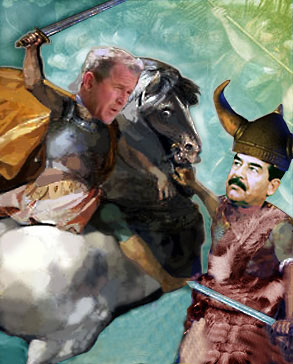

President George W. Bush is presiding over the most radical change in American policy since the end of World War II. Bush’s determination to invade Iraq represents a gigantic gamble. It is the riskiest military intervention America has undertaken since the end of World War II. Yet cavalierly disregarding those risks, the White House is pushing for regime change in Iraq as part of an aggressive new global strategy, one that represents a decisive — and extremely dangerous — break with the thinking that has guided American policy since the Cold War.
Prodded by hard-line ex-Cold Warriors and crusading neoconservatives, President Bush — who ran for office promising a “humble” America — has embraced an arrogant new doctrine of American supremacy that threatens not just to destabilize the Middle East and breed more terror, but to unravel the carefully constructed international order that has safely guided the world through the Cold War and into the new millennium. By word and deed — breaking treaties, disdaining allies, declaring America exempt from international law, announcing a new doctrine of preemptive force — the Bush administration has shown its desire to establish the United States as, in effect, an imperial power, the new Rome. After Sept. 11, an angry and triumphalist America is to be answerable to no one. Flaunting our 3,000 dead like a crusader’s banner, we will march against foes wherever we may find them, our unchallengeable military and invincible rectitude giving us the right and might to do whatever we want. Deus lo volt!
Bush’s new imperial doctrine is just the opposite of what the historical moment calls for. It gives other nations an imprimatur to take “preemptive” military action. It allows oppressive regimes to crack down on insurgents, claiming they are “fighting terrorism.” And it represents a viscerally attractive but ill-thought-out response to terrorism. Yes, military might is needed to fight terror — but it is only half of what is required. Jolted by Sept. 11 back into his most primal right-wing instincts, sacrificing farsighted foreign policy for short-term political advantage, Bush has completely failed to grasp that the Cold War paradigm is inadequate and inappropriate in an age when America has no rivals. Addressing global inequality, promoting democracy, consolidating relations with allies, sharing intelligence, respecting and working with international organizations, and generally doing the slow, painstaking work of winning hearts and minds — “draining the swamp” of terrorism — pay no immediate dividends, but in the long run they are a far better guarantor of American security than might alone.
In fact, Sept. 11 should have made clear that military force, unless used surgically, will make the United States a more dangerous place, not less. Before the terrorist attacks, the unintended consequences of war — destabilized regions, enraged populations — could be written off by strategists. No longer. As the twin towers collapsed, the lesson we should have learned is that there is a paradoxical correlation between domination and vulnerability. Terrorism is the weapon of the powerless, and in an age when the powerless can wreak havoc, an all-powerful nation must be extremely careful not to use its power recklessly.
As Robert Wright noted in a perceptive essay in Slate, in an age of instant communications, terrorism spreads almost literally like a virus. “We have to understand that terrorism is fundamentally a meme — a kind of virus of the mind, a set of beliefs and attitudes that spread from person to person,” Wright observed. “The ultimate target is memes; killing or arresting people is useful only to the extent that it leads to a net reduction in terrorism memes.” And it is not just speeded-up communications, but the individual’s absolute feeling of impotence in the face of omnipotent, abstract force that breeds the terrorism meme — which is why the unreflective use of American force can be a cure that is worse than the disease.
To put it bluntly: America needs to make friends more than it needs to make enemies. Of course, some enemies will inevitably choose us, in which case we may have no choice but to attack them: This is why the war on al-Qaida and their Taliban sponsors was necessary and justified. But an endless and undefined “war on terror” — one also fought in pursuit of strategic ends that are not quite so high-minded — risks making more enemies than it eliminates. Bush almost certainly does not intend Iraq to be the first battle in an endless war, but it is hard to imagine choosing a riskier place to launch a grand strategy for changing the world.
Apparently, the Bush administration no longer believes in risks. Intoxicated by America’s unprecedented position as the world’s first hyperpower, believing they can redraw the map in the Middle East without consequences and running roughshod over an opposition party too ideologically bankrupt and feeble to offer any resistance, Bush’s war hawks have seized the ring of power. It is difficult to have confidence that they will have the wisdom to use it properly — or to let it go.
Having said that, a caveat is in order. If the Bush administration’s loud saber-rattling, and its clumsier lobbying at the U.N., succeeds in convincing the Security Council to sign off on full, unrestricted inspections and Saddam to agree to them, if Bush accepts this outcome and Iraq is disarmed without war, Bush will deserve credit for an important achievement. At this point, however, all indications are that Bush intends to go to war no matter what Saddam does.
Saddam Hussein’s Iraq does indeed present a serious problem. And the problem is more complex than many on either the left or the right are willing to acknowledge.
Those on the left correctly point out that a major strategic motivation for invading Iraq is securing access to its vast oil reserves — which would also make us less beholden to the Saudis, with whom we have become disenchanted after 9/11. They also point to the gross hypocrisy of America suddenly demonizing a regional strongman whom we embraced just a few years ago as a secular bulwark against the supposedly greater threat posed by Islamist Iran. But the left often acts as if such Machiavellian strategic goals are our only motivation. This is too simplistic and fails to address the actual threat that Saddam poses.
Those on the right, for their part, disingenuously overemphasize the “Saddam is evil” justification for invasion. And they are unwilling to admit that military adventuring in the Middle East is about the most uncertain activity a state can engage in.
The administration has two motivations for invading Iraq. The stated motivation is that Saddam represents a clear and present danger to America and the world and must be removed. The strategic motivation, which is rarely articulated, is to fundamentally alter the balance of power in the Middle East — and beyond that, to establish a precedent for “preventive” military action, carried out unilaterally if necessary. The debate about invasion has focused almost exclusively on the danger posed by Saddam and his efforts to build a doomsday arsenal. But the strategic dimension is actually more significant. And without considering the risks it holds, trying to decide whether the threat posed by Saddam justifies an invasion is a pointless exercise.
First, let us examine the threat posed by Saddam. According to advocates of regime change, Saddam is the post-Hiroshima world’s worst nightmare: an erratic tyrant of singular brutality, filled with hatred and a desire for revenge against his enemies, who sooner or later will use weapons of mass destruction (WMD) against America and its allies, in particular Israel and/or Saudi Arabia. Saddam has not made trouble since the Gulf War (aside from a few genocidal rampages against his own people) because sanctions and an inspection regime have hemmed him in, but both have collapsed, and soon he will acquire a nuclear bomb. The world simply cannot afford to gamble on the rationality of a nuclear Saddam.
Contrary to the views of some on the left, this argument cannot simply be dismissed. It’s true that Bush’s campaign to whip up popular support for an invasion of Iraq by linking Baghdad to Sept. 11 was opportunism of so cheap a hue (the Arabs are coming! the Arabs are coming!) that it aroused suspicions that the administration’s case for regime change was completely specious. But it is not. Ousting Saddam carries undeniable risks — but so does leaving him in power.
The strongest argument that Saddam would not use WMD is that he is neither mad nor suicidal, and would never do anything that would bring about his own destruction. In the end, I believe that this argument still carries the day. But Kenneth M. Pollack’s “The Threatening Storm: The Case for Invading Iraq” mounts a powerful attack on it. Pollack, a former CIA analyst, makes a compelling if not finally convincing case that Saddam, although not a madman or suicidal, is so obsessive, arrogant, lacking in information about the outside world and unpredictable in his behavior that conventional notions of deterrence simply don’t apply to him and we can’t afford to leave him in power. Specifically, Pollack conjectures that if Saddam managed to get a nuclear bomb, he might invade Kuwait or Saudi Arabia, gambling that the United States would not be willing to sacrifice Tel Aviv or the Saudi oil fields to stop him. (The destruction of the Saudi oil fields, Pollack asserts, could send the world into a 1930s-type depression.) Pollack also raises the frightening specter of Saddam on his deathbed, taking a final revenge on his hated enemy and establishing his eternal bona fides as the new Saladin by firing a nuclear-armed missile at Israel.
Simply denouncing American hegemonism or heaping contempt on Bush as a swaggering cowboy (“the toxic Texan,” as one European editorial writer called him) cannot make these fears go away. According to Pollack, we have three options in dealing with Saddam: containment (the current policy), deterrence (cheaper than containment) and regime change. Pollack argues convincingly that the current policy of containment has failed. Just how many weapons of mass destruction Saddam now possesses is unclear, but he is known to be building up his arsenal as quickly as possible and seeking enriched uranium, the final ingredient it is thought he needs to build a hydrogen bomb. The draconian sanctions the U.S. imposed on Saddam — which have resulted in the deaths of thousands of Iraqis and enraged the Arab world — failed to achieve their purpose: Illegal smuggling brings in billions of dollars a year that he can use to build his nuclear, biological and chemical weapons. Therefore, if containment is to work, it can only be through inspections, which last took place in 1998.
But Pollack argues that even if we could get Saddam to agree to meaningful inspections, which he doubts, “we cannot hold the gun to Saddam’s head for as long as it would take to actually disarm Iraq.” The problem is that Saddam never yields until troops are actually on his doorstep, but for logistical reasons we cannot maintain an invasion force in the Persian Gulf longer than six months or at most a year — a period of time Pollack calls “laughably inadequate to disarm Iraq.”
If Pollack is right, or if the Bush administration accepts this argument, war seems inevitable regardless of the minuet currently being danced by the Security Council, Washington and Baghdad. But it is hard to fathom why, if unconditional inspections are imposed and fully backed up by the U.N., Saddam could not be disarmed within a year. Pollack, who has years of painful experience dealing with Saddam’s evasions and lies, is understandably skeptical — but the inspections regime proposed now goes far beyond earlier ones, which did keep Saddam in a box.
The problem with containment is that it is expensive, forces us to commit too many of our resources to Iraq and never ends. Deterrence is cheaper, but as noted, Pollack rejects it as a viable option. Deterrence is based on the calculation that Saddam is a Stalin-type survivor who would never use WMD because he knows that if he did he would immediately be vaporized. But in perhaps the most valuable part of his book, Pollack draws on a long history of bizarre and arrogant miscalculations by Saddam to assert that we cannot have sufficient faith that it would work with him.
Pollack does concede that Saddam is not crazy enough to have hooked up with Osama bin Laden. Contrary to the vague claims being made lately by the administration that Saddam has ties to al-Qaida, Pollack is highly skeptical that Saddam had anything to do with Sept. 11, has ever assisted al-Qaida or will ever do so. Saddam, a secularist, detests and has butchered hundreds of Islamists like bin Laden, and bin Laden regards godless leaders like Saddam as satanic figures against whom jihad is a holy duty. Moreover, Saddam is far too cautious ever to give WMD to a group not under his control.
Pollack rules out covert action and an Afghan-style alliance with Iraqi exiles as impractical. That leaves one choice: invasion.
A major objection to invasion is that it would cause the Arab masses — the so-called street — to topple their regimes. Pollack regards this as unlikely. (It should be noted, however, that he assumes that the only motivation the U.S. would have for invading Iraq is our stated one of preemptive self-defense; he never explores the consequences of other strategic or tactical moves we might make in the region. This makes his optimistic conclusions less convincing.) He rightly points out in his book that “every time commentators have warned that the Arab ‘street’ would rise up and overthrow their governments — specifically during the Gulf War and the recent Afghan campaign — the reaction has not lived up to the predictions.” He also points out that Arab leaders themselves seem to believe they can survive a U.S. invasion — he says that contrary to their public position, the Saudis support it — and there is no reason for us to be more pessimistic than they are. He acknowledges, however, that there could always be a first time for the appearance of the “street.” And he notes that even if the “moderate” Arab regimes survive the invasion, their populations may be increasingly alienated and their rule less secure.
Pollack strenuously argues that to avoid enraging the Arab and Muslim world unnecessarily and inciting regional chaos, the invasion must be as multilateral as possible, should be accompanied by a major American effort to broker an end to the Israeli-Palestinian conflict and must be followed by a long-term, expensive commitment to rebuilding Iraq. Under optimal circumstances, Pollack asserts that a relatively democratic and relatively prosperous Iraq that was not an American puppet could be a beacon of hope and progress in the Middle East. The price? Anywhere from a few hundred American combat deaths to 10,000, with Pollack estimating the most likely figure being 500 to 1,000 American deaths during a war that would last four to eight weeks. Iraqi casualties, of course, would be much greater.
It is a high price. But if it was the entire cost the United States would have to pay to be rid of Saddam, the American people would probably judge it worth paying. And if the invasion also changed the Middle East for the better — if it promoted a just peace between the Israelis and the Palestinians, opened the region to democracy, resulted in a more equitable distribution of wealth and diminished the number of future Mohammad Attas — they would probably be willing to pay an even higher price.
But will it? Or will it have the opposite effect? What if the shaky autocracies in Saudi Arabia and Egypt are faced with popular uprisings and are forced to suppress their people with a heavy hand? What if the Mubarak government falls and Egypt is taken over by the moderate Islamists who now dominate its educated classes? What if Saddam manages to hit Israel with a biological weapon and Israel decides it has to retaliate? What if an American outpost in Baghdad gives Ariel Sharon a free hand to grind the Palestinians down even further, exacerbating the semi-war? What if witnessing the most blatant Muslim defeat yet in the “clash of civilizations” — Baghdad apartment houses being blown up by American jets, broadcast live on al-Jazeera into every Arab household in the Middle East — increases the number of angry, disaffected, culturally humiliated young men who may someday seek revenge on America?
It is impossible to know what will happen. But deciding whether or not to invade Iraq requires making a judgment about the possibility that the Middle East may go up in flames as a result, or that the attack will breed future terrorists in the region and around the world, or that other nations will emulate us and launch invasions of their own, or that our allies will turn away from an out-of-control America — and balancing those possibilities against the chance that Saddam will use WMD at some point in the future. Confining ourselves only to one possible negative consequence, dangerous instability in the Middle East, the answer is clear: It is much more likely that an invasion of Iraq will inflame the Middle East than that Saddam will use WMD against the United States or its allies. Even if al-Qaida never existed and there had never been a Sept. 11, invading a major sovereign Arab nation would be an extremely risky undertaking, one likely to spin out of our control. And the Cold War/pro-Israeli fervor the Bush administration brings to the Middle East is not reassuring.
Pollack makes a strong case that Saddam is too great a threat to ignore, but in the end it isn’t strong enough. Since he is trying to show that Saddam will do something he has never done before, the burden of proof remains on him. Nor does Pollack fully address the impact that the catastrophic Gulf War defeat may have had on Saddam: He presents him as basically unchanged, as malevolent and prone to delusions of grandeur as he ever was. It seems unlikely that a man as cunning as Saddam would not have learned that any further serious aggression would result in his doom. This does not mean that he is harmless. In a different context, removing him might be justifiable — and this possibility poses moral ambiguities that many on the left have not come to grips with. But Iraq is in the middle of the Middle East.
The administration has said little about this crucial point, but clearly it has decided that it is not worried about the regional consequences of an invasion. To understand why, we must turn to its larger strategy.
It is impossible, of course, to know exactly what the Bush game plan is. What follows is speculation based on extrapolations from existing U.S. policy, its declared intentions and some vague hints by key policymakers. After Saddam is gone, the U.S. will help stabilize Iraq, promoting an autonomous Iraqi government — not a U.S. puppet, or at least not a regime that looks like a U.S. puppet — that will be more democratic and less autocratic than other Middle Eastern regimes. Kurds and Shiites will be given limited autonomy under a federal system to prevent Iraq breaking into three parts; Turkey’s restive Kurds remain a question mark, but perhaps Washington will lean on Turkey to grant them limited federal status also. As in Pollack’s optimistic scenario, the presence of this relatively enlightened nation in the heart of the Middle East, and the awareness that the U.S. is prepared to act decisively to protect both its interests and to promote positive regional change, will shake everything up.
The U.S. will prod Egypt and Saudi Arabia toward liberalizing their societies, hoping to improve the lot of the middle class and release the dangerous societal tensions that produced a Mohammad Atta and his Saudi hijacking team. If as a result the ruling parties are either toppled or voted out of office, Washington will not necessarily regard that as a bad thing. The status quo — with the exception of U.S. access to oil — is no longer sacrosanct, now that we know that Saudi Arabia has been funding extremist Wahabbi groups and we’ve come to realize that propping up incompetent and repressive regimes like Mubarak’s is a devil’s bargain. If new popular regimes in Cairo and Riyadh do arise, they will be more openly hostile to Israel than the old ones, but as in the past they will be kept in line by oil (in the case of Saudi Arabia) and massive U.S. cash (in the case of Egypt). Over time, in accordance with New York Times columnist Thomas Friedman’s dictum that joining the global economy trumps the rejectionism of radical Islam, they will work out an accommodation with the modern world, blending sharia (Islamic law) with democracy and capitalism in innovative ways.
Charter axis-of-evil member Iran and honorable mention Syria (which was left off the list for diplomatic reasons) will be put on notice. They will be informed by an envoy holding Saddam Hussein’s head on a spike that future sponsorship of anti-Israel terrorist groups and, in Iran’s case, pursuit of nuclear weapons will result in extremely unpleasant consequences. If they resist, a crucial policy debate will ensue: The U.S. may attack them (if the hawks win) or it may back down. In any case, Washington will regard time as being on its side. Iran, with its vibrant secular opposition, is already engaged in the democracy debate, and sooner or later the mullahs will fall. Syria, marginalized by the defeat of fellow rejectionist Iraq, will sooner or later join the modern world. Lebanon will be freed of Syrian control, and Jordan, with Iraq removed from its eastern border, will be stable.
That leaves the crucial issue: the conflict between Israel and the Palestinians. Free from the domestic political constraints of the November election, the White House will throw the long-suffering Colin Powell a bone and pay more attention to the conflict. It will gently turn up the heat on Sharon, insisting on at least a settlement freeze in an attempt to “park” the Palestinian problem, which as always threatens to inflame the region. Given political cover against Benjamin Netanyahu and the far right by Bush’s removal of Saddam, Sharon will be able to do this without his right-wing coalition partners bolting on him. If the Palestinian crisis worsens, Bush will face a fateful choice. Will he make the political calculation that he can get away with leaning harder on Sharon, enabling more moderate Palestinians to oust Arafat and eventually achieve a state? Or will he side with Sharon?
The hawks imagine a sun-dappled vision of a post-Saddam future. With one lightning thrust into the heart of Baghdad, the unrivaled U.S. military machine cuts through the Mideast’s Gordian knots and brings peace and stability to the region. The problem is that there are too many unknowns in this scenario. How will the U.S. manage the post-Saddam transition in Iraq (based on our post-Taliban track record in Afghanistan, the prospects are not encouraging)? What will Iran do, and what will we do with Iran? If the U.S. is drawn into a war there, the consequences are unforeseeable. Will Egypt and Saudi Arabia survive unscathed — or will they go the way of Iran in 1979, or Algeria, where secular leaders have brutally crushed popular Islamist parties? As leading scholars like John L. Esposito have argued, it may be developmentally necessary for the Arab world to elect Islamist governments: Will the U.S. accept these regimes, even if they cannot be bought off like Egypt or Saudi Arabia?
And, most critically of all: What if the Israeli-Palestinian conflict continues to fester, destabilizing the entire region? Will the hawks on the Bush team, most of whom hold views indistinguishable from those of Sharon’s Likud Party, be willing to turn up the heat on Sharon? The answer is crucial, for resolving the Israeli-Palestinian conflict holds the key, as it has since 1948, to ending tensions not just in the region but between Muslims around the world and the U.S.
It’s impossible to predict what Bush and his team will do. But there is reason to doubt that they will be able to make the tough decisions needed on Israel and Palestine — decisions they have completely failed to make until now, to the dismay of the world. Let us look at some of the key players.
Bush himself, like most U.S. presidents, seems never to have grasped the historical context of the Israeli-Palestinian conflict, and the blinding moral certainty that struck him on Sept. 11 did not help educate him. In a simple-minded way, he conflates Palestinian terrorism with al-Qaida terrorism. Bush has repeatedly deferred to Sharon, humiliatingly doing nothing after the Israeli leader rejected his demand that he withdraw his troops from the West Bank. Vice President Dick Cheney once said he thought Palestinian Authority leader Yasser Arafat should be hanged. Defense Secretary Donald Rumsfeld refers to the West Bank and Gaza as the “so-called occupied territories,” echoing the Likud line. Deputy Defense Secretary Paul Wolfowitz is a prominent neoconservative and stalwart supporter of the Likud line. According to a recent New York Times magazine profile, he regards the fact that Saddam pays subsidies to the families of Palestinian suicide bombers as convincing evidence that the Iraqi dictator would attack the U.S. — almost the definition of an Israel-centric argument. (If they could get away with it, practically every state in the Middle East would pay those subsidies.) Douglas Feith, the fourth-highest ranking member of the Pentagon, is a fervent Zionist who has opposed virtually every peace deal Israel has made, including the original Camp David accords with Egypt, and once wrote that the Palestinians had no claim to any part of biblical Eretz Israel. Then there is Richard Perle, a key Pentagon advisor who for decades has been one of the Likud’s most vociferous supporters. Several of the figures mentioned above helped write a hard-line position paper for the incoming Netanyahu administration.
It is remarkable that a group with such a manifest ideological tilt dominates policymaking on an issue of this gravity. It is too vulgar to suggest, as many in the Arab world and Europe do, that the Bush war hawks are planning to invade Iraq on Israel’s behalf: The threat to Israel is a (legitimate) factor in their decision, but not the only one. The Bush hard-liners might well have planned to replace Saddam even if Israel did not exist. It would be more accurate to say that Bush and many of his advisors, whether out of emotional identification, shared ideology or a mere coincidence of interests, act as if they regard Israel and the United States as virtually indistinguishable.
To be sure, it is possible that the administration will be willing and able to put pressure on Israel to resolve the Palestinian crisis, if that pressure is needed. (And with Sharon at the helm, it is almost certain to be.) But it is also possible — though unlikely — that lured on by the belief that Arabs ultimately respect only force (the famous “iron wall” of Ze’ev Jabotinsky, the spiritual father of the Israeli right), the Bush hawks will decide to resolve the Palestinian problem once and for all, with American force.
This would, of course, be a catastrophic development. But unforeseen things happen in war. The armchair generals and think-tank warriors who are Bush’s most gung-ho backers of invasion can map out as many scenarios as they please, but reality has a way of confounding expectations. And in the Middle East, a misstep can have nightmarish consequences. Ask Ariel Sharon, whose invasion of Lebanon to root out the PLO — which he claimed would be limited in scope — turned into Israel’s worst political debacle and gave birth to the Hezbollah.
As Pollack points out, what the U.S. does after Saddam falls is crucial in determining what happens in the region. But Bush’s disgraceful performance in postwar Afghanistan does not inspire confidence. Rebuilding Afghanistan to prevent it from falling into chaos was obviously not just a case of altruistic internationalism — terms of abuse for the machos on the Bush team — but was emphatically in America’s interest. But under pressure from ideological hard-liners — and still clinging to the isolationist, America-first, anti-globalizing beliefs that found famous expression in his derisive attack on Clinton’s “nation building” — Bush invested only a paltry $296 million toward rebuilding the shattered country and refused to commit American troops to peacekeeping. The result: Hamid Karzai, the country’s would-be leader, barely controls Kabul and rampaging warlords are running amok.
If invading Iraq is unacceptably risky, the larger doctrine of American supremacy that propels the Bush war team is potentially still more disturbing. The Bush administration recently released its chest-beating new national security doctrine, announcing that the United States is free to take preemptive action against terrorists, that no nation will ever be allowed to challenge our military dominance and that the U.S. will place its own interests above international relations. Iraq can be seen as the tactical implementation of that strategy. An invasion will establish, ex post facto, the legitimacy of American hegemonism. Once the United States successfully breaks with established norms of international behavior and carries off a unilateral act of preventive aggression without undue negative consequences, it will confer legitimacy on all subsequent acts. The first time is always the hardest: After the sword has been blooded with Iraq, it will be much easier for America to act unilaterally, and the hand-wringing and whining of our European allies and great-power rivals will fade away as they accept the reality of American dominance.
The doctrine is deeply paternalistic: Once the unruly children (the rest of the world) are disciplined, they will realize not only that resistance is futile but that Dad has their best interests at heart. As for those who continue to resist, they will have chosen sides against Good and will be dealt with accordingly.
It is a forthright and morally unambiguous doctrine, and for many enraged and fearful Americans — and especially for Bush’s far-right political base — an attractive one. Why should we defer to the spineless, envious Europeans, the pathetic Russians, the untrustworthy Chinese or the treacherous, Israel-hating Arabs? The Cold War is over; we have no military rivals, nor even any real competitors. The terror attacks of Sept. 11 have given us not just the necessity but the moral right to expand our definition of self-defense. Going hat in hand to the “international community” is beneath us and a waste of time. What our friends and enemies alike respect is force — whether that of our all-conquering military machine, which towers above all others the way the club-wielding ape dominated his bare-handed foes in “2001,” or that of our mighty economy, the greatest generator of wealth in world history.
Neo-imperialism, then, has a potent appeal. But it may be the rashest doctrine in American history. If the Bush administration continues down the path it is on, it will alienate our allies, turn wavering states against us and increase the hatred of our enemies. Above all, neo-imperialism will make America more vulnerable, not less. The great irony of Bush’s neo-imperialism is that its announced purpose is to prevent future terrorist attacks, by giving the United States a free hand to strike anywhere at any time against an insidious enemy that no longer respects borders and cannot be deterred. But in fact this policy, by breeding hatred and resentment, is certain to make future terrorist attacks more likely.
In the end, the issue goes beyond terrorism, which centuries from now we will hopefully look back on as a historical blip. As Michael Hirsh points out in an important critique of Bush’s neo-imperialism in the October Foreign Affairs, Bush has failed to communicate to the world what America stands for except its own security. He has not articulated an ideal because he doesn’t have one, except for “everyone should be like us.” Neo-imperialism simply turns self-defense into a justification for remaking the world to our liking. It may be that the American way is the best way, but the rest of the world should be allowed to make its own decisions about that. And without altruism or the spirit of cooperation — without charity, as a man from Nazareth said many years ago — even our might and our money will look hollow to the rest of the world.
Americans have always believed they are exceptional. But they have leavened this sense of being a chosen people with idealism, and a sturdy, unsentimental willingness to pitch in and help others. That spirit, already eroded by the almighty market, may be at its all-time low. As many foreign observers have noted, Bush’s America is a more selfish, more arrogant nation than they ever remembered it being. These are not attractive qualities, and in an increasingly interconnected world they are not even self-serving. Yes, every state must protect itself. But America stands tallest when it stoops to help those who need it — the poor, the oppressed, the victimized — not when it struts about the stage like Rambo. The anger and self-righteousness that America and the Bush White House felt after the terrible events of Sept. 11 is understandable. But it’s time for the Bush administration to get over its moral self-intoxication and rediscover that virtue Bush extolled before he assumed the presidency: humility. For the greatest power on earth, a nation that has the power to help change the world for the better, no less is expected.
