
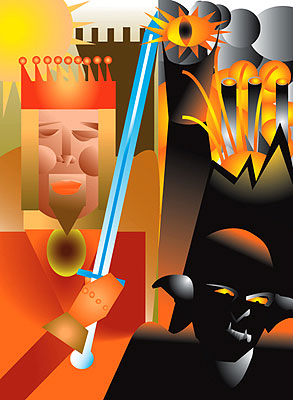

Want to forget about terrorism and all those distracting rumors of war? Need to ignore the economy for a while? Got the holiday blues? Our culture has a sure-fire cure — the traditional spate of post-Thanksgiving movies.
This year, despite a clamor over the latest Harry Potter film, much of the attention is going to another fantasy called “The Two Towers” — Part 2 in the “Lord of the Rings” trilogy. Will it succeed in distracting us for a while, conveying audiences to a world more beautiful and stirring than humdrum modern life?
Naturally, I enjoyed the “Lord of the Rings” (LOTR) trilogy as a kid, during its first big boom in the 1960s. I mean, what was there not to like? As William Goldman said about another great fantasy, “The Princess Bride,” it has “Fencing. Fighting. Torture. Poison. True Love. Hate. Revenge. Giants. Hunters. Bad Men. Good Men. Beautifulest Ladies. Spiders. Dragons. Eagles. Beasts of all natures and descriptions. Pain. Death. Magic. Chases. Escapes. Miracles.”
In 1997, voters in a BBC poll named “The Lord of the Rings” the greatest book of the 20th century. In 1999, Amazon.com customers chose it as the greatest book of the millennium.
Of course there is much more to this work than mere fantasy escapism. J.R.R. Tolkien wrote his epic — including its prequel, “The Hobbit” — during the dark middle decades of the 20th century, a time when modernity appeared to have failed in one spectacle of technologically amplified bloodshed after another.
LOTR clearly reflected this era. Only, in contrast to the real world, Tolkien’s portrayal of “good” resisting a darkly threatening “evil” offered something sadly lacking in the real struggles against Nazi or Communist tyrannies — a role for individual champions. His elves and hobbits and über-human warriors performed the same role that Lancelot and Merlin and Odysseus did in older fables, and that superheroes still do in comic books. Through doughty Frodo, noble Aragorn and the ethereal Galadriel, he proclaimed the paramount importance — above nations and civilizations — of the indomitable Romantic hero.
All right, I read Tolkien’s epic trilogy a bit unconventionally, starting with “The Two Towers” and backfilling as I went along. Likewise, I may be a bit off-kilter in liking, best of all, the unofficial companion volume to LOTR — perhaps the funniest work penned in English — the Harvard Lampoon’s 1968 parody, titled “Bored of the Rings.”
Nonetheless, I deem Tolkien’s trilogy to be one of the finest works of literary universe-building ever, with a lovingly textured internal consistency that’s excelled only by J.R.R.T.’s penchant for crafting “lost” dialects. Long before there was a Klingon Language Institute, expert aficionados — amateurs in the classic sense of the word — were busy translating Shakespeare and the Bible into High Elvish, Dwarvish and other Tolkien-generated tongues.
And yes, LOTR opened the door to a vast popular eruption of heroic fantasy. With exacting devotion to Tolkien’s masterly architecture, his followers scrupulously copied the rhythms, ambience and formulas that worked so well.
Indeed, the popularity of this formula is deeply thought-provoking. Millions of people who live in a time of genuine miracles — in which the great-grandchildren of illiterate peasants may routinely fly through the sky, roam the Internet, view far-off worlds and elect their own leaders — slip into delighted wonder at the notion of a wizard hitchhiking a ride from an eagle. Many even find themselves yearning for a society of towering lords and loyal, kowtowing vassals.
Wouldn’t life seem richer, finer if we still had kings? If the guardians of wisdom kept their wonders locked up in high wizard towers, instead of rushing onto PBS the way our unseemly “scientists” do today? Weren’t miracles more exciting when they were doled out by a precious few, instead of being commercialized, bottled and marketed to the masses for $1.95?
Didn’t we stop going to the moon because it had become boring?
Just look at how people felt about Princess Diana. No democratically elected public servant was ever so adored. Democracy doesn’t have the pomp, the majesty, the sense of being above accountability. One of the paramount promoters of the fantasy-mythic tradition, George Lucas, expressed it this way:
“There’s a reason why kings built large palaces, sat on thrones and wore rubies all over. There’s a whole social need for that, not to oppress the masses, but to impress the masses and make them proud and allow them to feel good about their culture, their government and their ruler so that they are left feeling that a ruler has the right to rule over them, so that they feel good rather than disgusted about being ruled.”
This yearning makes sense if you remember that arbitrary lords and chiefs did rule us for 99.44 percent of human existence. It’s only been 200 years or so — an eye blink — that “scientific enlightenment” began waging its rebellion against the nearly universal pattern called feudalism, a hierarchic system that ruled our ancestors in every culture that developed both metallurgy and agriculture. Wherever human beings acquired both plows and swords, gangs of large men picked up the latter and took other men’s women and wheat. (Sexist language is meaningfully accurate here; those cultures had no word for “sexism,” it was simply assumed.)
They then proceeded to announce rules and “traditions” ensuring that their sons would inherit everything.
Putting aside cultural superficialities, on every continent society quickly shaped itself into a pyramid with a few well-armed bullies at the top — accompanied by some fast-talking guys with painted faces or spangled cloaks, who curried favor by weaving stories to explain why the bullies should remain on top.
Only something exceptional started happening. Bit by bit, the elements began taking shape for a new social and intellectual movement, one finally capable of challenging the alliance of warrior lords, priests, bards and secretive magicians.
Timidly at first, guilds and townsfolk rallied together and lent their support to kings, thereby easing oppression by local lords. Long before Aristotle became a tool of the establishment, his rediscovery during the High Middle Ages offered some relief from dour anti-intellectualism. Then Renaissance humanism offered a philosophical basis for valuing the individual human being as worthy in its own right. The Reformation freed sanctity and morality from control by a narrow, self-chosen club; it also legitimized self-betterment through hard work in this world, not the next. Then Galileo and Newton showed that creation’s clockwork can be understood, even appreciated in its elegance, not just endured.
Still, the entire notion of progress remained nebulous and ill-formed. Society’s essential pyramidal shape remained intact till a full suite of elements and tools were finally in place for a true revolution — one so fundamental, coming with such heady, empowering suddenness, that participants gave it a name filled with hubristic portent: Enlightenment.
The word wasn’t ill-chosen, for it bespoke illuminating a path ahead — which, in turn, implied the unprecedented notion that “forward” is a direction worth taking, instead of lamenting over a preferred past. Progress — and boy, did we take to it. In two or three centuries our levels of education, health, liberation, tolerance and confident diversity have been momentously, utterly transformed.
The very shape of society changed from the once-universal pyramid toward a diamond configuration, wherein a comfortable and well-educated middle class actually outnumbers the poor. For the very first time. Anywhere.
We can argue endlessly about the accuracy and implications of this “diamond” analogy — and its vast remaining imperfections — but not over the fact that a profound shift has occurred, driven by a genuine scientific-technical-educational revolution.
And yet, almost from its birth, the Enlightenment Movement was confronted by an ironic counterrevolution, rejecting the very notion of progress. The Romantic Movement erupted as a rebellion against the rebellion.
In fairness, it didn’t start out that way. The first Romantics stood with their Enlightenment predecessors against feudalism and clericalism and welcomed the French Revolution as a step toward a kind of utopian universal brotherhood. Even today, men like Thomas Jefferson stand as icons of both Enlightenment and Romanticism.
But this changed when the industrial revolution hit full stride. Suddenly, where once gentry and clergy ruled, there were arrogant new powers striding about. An entrepreneurial bourgeoisie. A new intellectual elite of science. And a clanking, noisome ruction of impudent machinery.
Even democracy began to seem less classically pure when it was taken off a pedestal to be practiced for real by farmers, shopkeepers and a rising middle class, all of them arguing, wheedling and conniving amid an incredible din.
Temblors began splitting a chasm between Romantics and Enlightenment pragmatists. The alliance that had been so formidable against feudalism began turning against itself. Trenches soon aligned along the most obvious fault line, down the middle — between future and past.
In this conflict, J.R.R. Tolkien stood firmly for the past.
Calling the scientific worldview “soul-less,” he joined Keats and Shelley, Sir Walter Scott, Henry James and many European-trained philosophers in spurning the modern emphasis on pragmatic experimentation, production, universal literacy, progress, cooperative enterprise, democracy, city life and flattened social orders.
In contrast to these “sterile” pursuits, Romantics extolled the traditional, the personal, the particular, the subjective, the rural, the hierarchical and the metaphorical.
By the turn of the century, Romanticism was fast losing all vestige of its initial empathy for the concerns of common folk. One solitary artist — or entertainer or lost prince or angry poet — loomed larger in importance, by far, than a thousand craft workers, teachers or engineers (a value system shared today by the mythic engine of Hollywood). Just as in Homer’s time, 10,000 foot soldiers mattered less than Achilles’ heel.
This fits the very plot of “Lord of the Rings,” in which the good guys strive to preserve and restore as much as they can of an older, graceful and “natural” hierarchy, against the disturbing, quasi-industrial and vaguely technological ambience of Mordor, with its smokestack imagery and manufactured power rings that can be used by anybody, not just an elite few. (Recall the scene where Saruman turns away from the “good” side and immediately starts ripping up trees, replacing them with mining pits and smoky forges. The anti-industrial imagery could not be more explicit.)
Consider the rings. Those man-made wonders are deemed cursed, damning anyone who dares to use them, especially those nine normal humans who tried to rise up, using tools to equalize and then usurp the rightful powers of their betters — the High Elves.
The nine Ringwraiths aren’t just evil henchmen and cardboard monsters. In my opinion, they are among the most important figures of the epic. Tolkien himself calls them tragic figures and dwells on their background. These fallen mortals — men who were hauled into service to the “dark side” — can be looked upon as cautionary figures, conveying the universal lesson that “power corrupts.”
On that much we can all agree. But I think there’s more to the Ringwraiths. To me, they distill the classical Greek notion of hubris — a concept that Romantics often embrace — the idea that pain and damnation await any mortal whose ambition aims too high. Don’t try putting on the trappings or emblems or powers that rightfully belong to your betters. Above all, don’t try to decipher and redistribute mysteries.
In other words, exactly the same morality tale preached in “Star Wars.” Romanticism has come full circle, now unctuously praising the very same lords — the über-men — that it started out bravely opposing.
– – – – – – – – – – – –
I’m not suggesting that Romanticism is never right in its critique of the Enlightenment. Scientific advancement badly needs the constant light of public scrutiny, or else the “advances” can easily go sour. The most blatant example of this is what we’re doing to the environment today.
(An aside, in self-defense. Some readers may assign “left” or “right” political significance to what I say here. But both Romantics and pragmatists can be found in every modern political movement. For example, as a staunch environmentalist, I can still comment on the Romantic elitism of many who share the same cause. Enlightenment’s child — suspicion of authority — often comes paired with the quintessential romantic image: a smug loner who despises the masses. They get mixed together, even though they arise from different traditions. One way to tell them apart is to observe whether a character sneers only at power-abusers — or at everybody: Is his or her ire aimed solely upward, toward some cruel elite, or downward too, despising fellow citizens and neighbors as clueless sheep?)
Moreover, Enlightenment can never completely replace older modes of thinking. The need for stirring, illogical tales and images runs deep within us all. (Some of us earn a good living that way.) Without romance, we’d be sorry creatures, indeed.
Still, scientific/progressive society has been known to listen to its critics, and not just now and then. Name one feudal society whose leaders did that.
Were any orcs or “dark men” offered coalition positions in King Aragorn’s cabinet, at the end of the War of the Ring? Was Mordor given a benign Marshall Plan?
I think not.
– – – – – – – – – – – –
Which brings us to another of the really cool things about fantasy — identifying with a side that’s 100 percent good. You can revel as they utterly annihilate foes who deserve to be exterminated because they are 100 percent distilled evil. This may not be politically correct, but then, political correctness is really a bastard offspring of egalitarian-scientific enlightenment. Witness the sometimes saccharine p.c.-sweetness of “Star Trek.”
Romanticism never made any pretense at equality. It is hyperdiscriminatory, by nature. (Have you ever actually read Byron or Shelley?) Whole classes of people are less worthy, less deserving of life, than other classes. The Nazis were archetypal Romantics.
The urge to crush some demonized enemy resonates deeply within us, dating from ages far earlier than feudalism. Hence, the vicarious thrill we feel over the slaughter of orc foot soldiers at Helm’s Deep. Then again as Ents flatten even more goblin grunts at Saruman’s citadel, taking no prisoners, never sparing a thought for all the orphaned orclings and grieving widorcs. And again at Minas Tirith, and again at the Gondor Docks and again … Well, they’re only orcs, after all.
Lev Grossman made a similar point in a recent Time Magazine article, when he asked, “Where are the women? Peter Jackson filled out Liv Tyler’s role for the movies (it’s much less prominent in Tolkien’s version), but the Fellowship is still as much a boys’ club as Augusta National.”
Let’s not ignore but instead openly acknowledge the underlying racism and belief in aristocracy that J.R.R. Tolkien wove into the books, without even much attempt at subtlety. Nor do I much blame him. He couldn’t help it, coming from the imperialist and class-ridden culture that raised him.
Moreover, the characters whom the reader comes to know best — Frodo, Sam and even the king-in-waiting, Aragorn — are themselves not very snooty or racist. Aragorn has an easygoing, common touch — much like Luke Skywalker, the only unpatronizing Jedi. The snootiest and most relentlessly aristocratic characters in LOTR stand off in the wings — for example, the preachy, secretive and patronizing elf-lords Elrond and Galadriel, coaxing maximum effort from their allies while letting others do the fighting for them.
(I’d point out endless parallels with a fellow named Yoda, but that would stir up too many hornets at once!)
In fact, J.R.R. Tolkien was himself far more critical of the situation portrayed in his universe than any but a few of his myriad readers ever chose to notice. Certainly more self-critical than most of his contemporary readers or those watching the new film trilogy.
In several places, Tolkien openly stated his authorial judgment that the elves who made the Three Rings were ultimately to blame, having set the stage for tragedy in Middle Earth. They made their own rings (preceding Sauron’s One Ring) in order to control the world, stopping time and preventing change, forbidding anything to die and decay and thus blocking the potential for new growth. In an oft-quoted letter, Tolkien wrote:
“They wanted to have their cake and eat it: to live in the mortal historical Middle Earth because they had become fond of it … and so tried to stop its change and history, stop its growth, keep it as a pleasaunce.”
There are moments scattered throughout LOTR when Tolkien seems to be warning that Romanticism can lead one down the road to genocide. He was disturbed to see the Nazis, for example, embrace many of the same Nordic mythic stories and symbols that he used as source material.
In other books, like “The Silmarillion,” Tolkien went deeper into this self-exploration, even going so far as to cast an analytical eye upon the elvish hierarchs of Middle Earth, in much the same way that Isaac Asimov reevaluated his Second Foundation and the meddlesome-patronizing robots of his famed science fictional universe. (This is the kind of self-examination the “Star Wars” cosmos desperately needs, alas, while there’s still time.)
Indeed, many academics have cited the obvious parallel between the retreat of the High Elves in LOTR — who abandon Middle Earth to return “west across the sea” — and the dissolution of the British Empire that began with the emancipation of India about the same time that Tolkien was writing his epic. In fairness, J.R.R.T. did not rail against this change: He saw it as regrettable but inevitable — like the end of his mythical Third Age, an approaching time of iron, when aloofly noble figures like Elrond and Galadriel must go back whence they came.
But those self-critiques never had the widespread readership or influence of the original LOTR. And ultimately, Tolkien could never bring himself to cross the gap that another Oxbridge don was writing about at roughly the same time — the infamous “two cultures” gulf that C.P. Snow mapped between the world of science and the world of the arts.
Try as he might, and even confronted with the blatant Romantic excesses of Nazism, Tolkien could not escape his own deep conviction that democratic enlightenment and modernity made up the greater evil. That hated trend, he feared, would ruin all the beauty that he found in tradition. In aristocratic-mystical hierarchies. In the ways of the past.
It all seems rather a pity, in light of what happened later, during the final third of the 20th century. For Snow’s gap between two cultures began to be crossed, time and again, by unfettered spirits who simply refused to accept primly drawn categories. I wish Tolkien could have lived to see how easily this chasm is traversed now, in both directions, by technologically savvy artists and by scientists who love art.
Indeed, science fiction bridged the two-cultures gap with a superhighway. But that’s another story.
– – – – – – – – – – – –
Having trouble picturing this dichotomy I’m painting? Between Romantics and followers of Ben Franklin’s pragmatic Enlightenment?
Well here’s another way of looking at it, focusing on how people view the time orientation of wisdom.
All creatures live embedded in time, though only human beings lift their heads to comment on it, lamenting the past or worrying over the future. Unique portions of our brains handle this temporal skepsis. Prefrontal lobes, the “lamps on our brows,” ponder tomorrow, while swaths of older cortex can flood with vivid memories of yesterday, triggered by the merest sensory tickle — as when a single aromatic whiff sent Proust back to roam his mother’s kitchen for 80,000 words.
Obsession with either past or future can almost define a civilization. Worldwide, most cultures believed in some lost golden age when people knew more, mused loftier thoughts and were closer to the gods — but then fell from grace. Under this dour but recurrent worldview, men and women of a later, coarser era can only look back with envy, hearkening to remnants of ancient wisdom.
Recognize this motif? It drenches every page of “Lord of the Rings.” It is the old classic, the eternal verity — the worst of all human clichés.
Only a few societies ever dared to contradict this dogma of nostalgia. Our own scientific West, with its impudent notion of progress, brashly relocated any “golden age” to the future, something we might work toward, a human construct for our grandchildren to achieve with craft, sweat and good will — assuming that we manage to prepare them. Implicit is the postulate that our offspring can and should be better than us, a glimmering hope that is nurtured (a bit) by two generations of steadily rising IQ scores.
Of course, the very notion of progress is anathema to nostalgic Romantics. These Romantics needn’t be anti-technological, though they almost always reject science. I’ve already mentioned a renowned sci-fi pop-epic that, despite techie furnishings, relentlessly preaches the nostalgist party line — an ideal society ought to be ruled by secretive-mystical elites, unaccountable and self-chosen based on inherent qualities of blood. The only good knowledge is old knowledge. (No wonder it all happened “long ago, in a galaxy far away.”)
Let me avow upfront that I share the more recent, upstart belief in universities, democratic accountability, science and human improvability — one that questions the fated persistence of “eternal” stupidities. Above all, any “golden age” lies in our future. It has to. Or what are we striving for?
Anyway, people with my view had better be right. Because if humanity is as obstinate as the cynics and Romantics believe, we shall surely go extinct quite soon.
– – – – – – – – – – – –
This may seem a dour picture I am painting, especially in light of the surge in popularity of feudal-magical fantasy.
Was Enlightenment a transient thing, already starting to flicker out as we return to our older fascinations? Back to Joseph Campbell-style heroes and traditional epics, with their paeans to kings and traditional, pyramid-shaped hierarchies? There are those who see this cloud rolling over us, a returning fog of Romanticism.
“Change and technology are so pervasive a part of daily life that for the most part there’s no magic to it anymore,” says Vivian Sobchack, a professor of film and television studies at UCLA. “The promise of science and technology has been normalized. The utopian vision we had didn’t come to pass. The magic would have to come from somewhere else, and we found it in fantasy.”
She has a point. Witness the most amazing accomplishment of NASA — managing to turn the exploration of space into a huge snore.
Or, as Lev Grossman put it in his Time essay:
“Popular culture is the most sensitive barometer we have for gauging shifts in the national mood, and it’s registering a big one right now. Our fascination with science fiction reflected a deep collective faith that technology would lead us to a cyberutopia of robot butlers serving virtual mai tais. With ‘The Two Towers,’ the new installment of the ‘Lord of the Rings’ trilogy, about to storm the box office, we are seeing what might be called the enchanting of America. A darker, more pessimistic attitude toward technology and the future has taken hold, and the evidence is our new preoccupation with fantasy, a nostalgic, sentimental, magical vision of a medieval age. The future just isn’t what it used to be — and the past seems to be gaining on us.”
Grossman’s view is intelligent and thought-provoking — though at the surface also quite easy to disprove.
For example, which cyberutopias might he be talking about?
“Soylent Green”? “Blade Runner”? “Rollerball”? “Silent Running”? “1984”? “Fail-Safe”? “The China Syndrome”? “Terminator”? “The Hot Zone”? “Logan’s Run”? “The Postman”? “Fahrenheit 451”?
These don’t strike me as exactly utopias.
For the life of me, I cannot picture more than one truly optimistic portrayal of future society in all of TV or film sci-fi. With the sole exception of “Star Trek,” most of the SF we’ve viewed in the last 40 years has been relentlessly critical of perceived technological or social trends. Far from utopian, these films have served us well by dramatizing potential failures. To coin a term, they have been self-preventing prophecies, helping us work out our fears and exploring dark possibilities.
Yes, one result has been a lessened sense of confidence, a sadly stylish fatalism in an era of unprecedented goodness and competence. Paradoxical, yes. But by any metric, these dark warning tales have been far more useful than all those sword and sorcery flicks that try to teach us about good and evil by portraying the former as always pretty and the latter, always, with red, glowing eyes.
May I offer a final little mind-stretching exercise? Let’s start by remembering that history is written by the victors.
How do we know that Hitler was as bad as we are told?
We know because we live in a democracy that has given Holocaust deniers plenty of opportunities to make their case, and all they ever come up with is blatant drivel, ridiculous scenarios that are laughably easy to disprove. We see and hear countless witnesses to the Nazi horrors, conveyed via a press that, for all its faults, is relatively free. As implausible as the story of deliberate mass genocide might have seemed, in fiction, the reality was undeniably true, and worse than anything previously imagined.
Allied propagandists did not have to make up any of it.
But things were different in kingdoms of old, where one official party line was promulgated and alternative sources of information got routinely squelched. And that’s in every kingdom, mind you. Go ahead, name one where it didn’t happen. (Note how the Norman propagandists went to work on poor old King Harold, even as his body was cooling after the Battle of Hastings.)
My point? Well, LOTR is obviously an account written after the Ring War ended, long ago. Right? An account created by the victors.
So how do we know that Sauron really did have red glowing eyes?
Isn’t some of that over-the-top description just the sort of thing that royal families used to promote, casting exaggerated aspersions on their vanquished foes and despoiling their monuments, reinforcing their own divine right to rule?
– – – – – – – – – – – –
Yes, I’m having fun with words like “really” — relating to a made-up story. But come along with me for a minute: Next time you reread LOTR, count the number of powerful beings who are vastly uglier than anybody with that kind of power would allow themselves to be. Why? How does being grotesquely ugly help you govern an empire?
Then unleash your imagination a bit further.
Ask yourself: “How would Sauron have described the situation?”
And then: “What might ‘really’ have happened?”
Now ponder something that comes through even the party-line demonization of a crushed enemy — this clear-cut and undeniable fact: Sauron’s army was the one that included every species and race on Middle Earth, including all the despised colors of humanity, and all the lower classes.
Hmm. Did they all leave their homes and march to war thinking, “Oh, goody, let’s go serve an evil Dark Lord”?
Or might they instead have thought they were the “good guys,” with a justifiable grievance worth fighting for, rebelling against an ancient, rigid, pyramid-shaped, feudal hierarchy topped by invader-alien elfs and their Numenorean-colonialist human lackeys?
Picture, for a moment, Sauron the Eternal Rebel, relentlessly maligned by the victors of the War of the Ring — the royalists who control the bards and scribes (and moviemakers). Sauron, champion of the common Middle Earthling! Vanquished but still revered by the innumerable poor and oppressed who sit in their squalid huts, wary of the royal secret police with their magical spy-eyes, yet continuing to whisper stories, secretly dreaming and hoping that someday he will return … bringing more rings.
– – – – – – – – – – – –
If that’s going too far, here’s a milder version. Those orcs and low elves and dwarves and dark-skinned or proletarian men who fought for the Ringlord were fooled by Sauron’s propaganda.
Fair enough. Even that slight variation adds flavor to an already-great tale, making you pity Sauron’s dupes a little, even though you still cheer as they’re slaughtered down to the last private and orcoral.
Come on, folks, a little empathy!
Instead of railing against “evil,” try to understand it. That’s always been the best way to defeat it.
– – – – – – – – – – – –
Am I pulling your leg? You bet! I don’t take speculations about fictional villains quite that seriously.
My real point is more general.
Don’t just receive your adventures. Toy with them. Re-mold them in your mind. Keep asking “What if …?”
It’s how you get practice not just being a passive consumer, or critic, but a creative storyteller in your own right.
And remember this too: Enlightenment, science, democracy and equal opportunity are still the true rebels, reigning for just a few generations (and still imperfectly) in one or two corners of the Earth, after elite chiefs, romantic bards and magicians dominated our ancestors for maybe half a million years.
Don’t you think a little pride in that rebellion — a radical revolution-in-progress, still fresh and incomplete — might be called for?
A rebellion that, among many other things, taught serfs like you to read so you can enjoy epic books and picture things differently than they are.
One that makes vivid movies that cater to your taste for adventure.
One that, for all its imperfections, gave you a better chance than in some peasant village of old.
One that has a long way to go, but has at least turned our eyes around to face the future.
Self-critical almost to a fault, this culture may not be as romantic as those old kingdoms. But isn’t it better?
You are heirs of the world’s first true civilization, arising out of the first true revolution. Take some pride in it.
Let’s keep enjoying kings and wizards. But also remember to keep them where they belong.
Where they can do little harm.
Where they entertain us.
In fantasies.
