
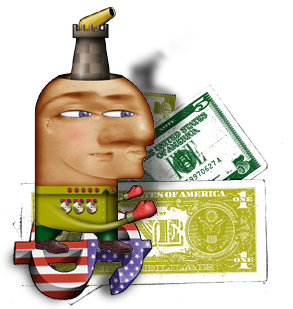

The international airport at Conakry, Guinea, is busier than usual this week, as diplomats from France, the U.S. and Britain continue to descend upon the West African capital for more discreet horse-trading in preparation for the expected United Nations vote on the Iraq resolution. Although Guinea has close financial ties to France and polls show that its Muslim population strongly opposes an Iraq invasion, the developing nation could gain $21.4 million in U.S. foreign aid this year in exchange for a vote in favor of the pending resolution.
Wooed by such a wealthy suitor, Guinea may not be able to afford ideology.
Such are the naked politics of checkbook diplomacy, currently on gaudy display as the Bush administration tries to pull from among the 15 members of the U.N. Security Council the nine votes required to authorize an invasion. In the tug-of-war over the six undecided countries that will determine the final outcome, the U.S. is brandishing its wallet as a weapon. Guinea, Mexico, Chile, Angola, Cameroon and Pakistan all face the same dilemma this week: Ignore mounting opposition to war at home, or face the wrath of Washington?
Turkey has been offered $6 billion in direct aid, plus billions more in loans, if it will allow the U.S. to base soldiers there in advance of an invasion. But promises are flowing to nations far from the war front. A no vote by Chile could jeopardize a bill now pending in Congress for increased trade access — a measure worth billions of dollars over time. For Cameroon, a proposed 670-mile oil pipeline from Chad to be built by Exxon Mobil and ChevronTexaco is at stake. Poland stands to win $3.8 billion in loans for military aircraft. Bulgaria has no doubt heard hints that it could win a chance to host a new U.S. military base, which would inject millions into its economy. Guinea’s army rangers continue to need U.S. training to prevent attacks from neighboring Liberia.
Such mercenary diplomacy is a long-accepted fact of international relations, and it is so widely practiced that few are shocked by it. As employed by the Bush administration, such largesse has helped build a coalition of approximately 40 nations to back the Iraq war effort. But some analysts find one fact especially striking: Despite the aid, and despite the underlying threat that comes with every offer, the administration has still not locked up the Security Council vote. Given the amount of cash being dangled, “it raises questions that the administration has not made a persuasive case,” says Nick Ziegler, an associate professor of political science at the University of California at Berkeley. “You’ve got to pay a lot of money to convince people to go along with you when you haven’t given them a more convincing reason to do so.”
According to a recently released report by the left-leaning Institute for Policy Studies in Washington, the nebulous coalition represents barely a tenth of the world’s population — and many of the countries didn’t join out of an idealistic commitment to the liberation of Iraq. “Almost all, by our count, join only through coercion, bullying, bribery, or the implied threat of U.S. action that would directly damage the interests of the country,” the report states. “Far more impressive is the list of nations that have stood up to U.S. bully tactics and stand opposed.”
Turkey is only the most prominent example of how strong-arming hasn’t worked. Turkish public opinion has been staunchly against the war. The day Turkey’s parliament voted against allowing the deployment of 62,000 U.S. troops for the development of a northern front against Iraq, the country lost a potential $26 billion in future aid. One week later, the U.S. House of Representatives passed a trade bill that assists Pakistani rugmakers but omitted provisions aiding Turkey.
If the U.S. remains true to form, the punishment is likely to get worse if Turkey doesn’t reverse its vote. Past U.N. negotiations have proven that the U.S. deals harshly with those who oppose its considerable will. In 1990, Yemen made the mistake of opposing the U.S. in a Security Council vote authorizing the Gulf War. Three days later, the U.S. cut off nearly all aid to that country. More recently, a vote on an early version of the U.N. resolution on Iraq contained a similar threat for Mauritius, which held a temporary seat on the council last year. When Washington complained about less-than-enthusiastic support, Mauritius recalled its U.N. ambassador for “continuing to convey the mistaken impression that his country had reservations about the U.S. resolution against Iraq.”
“We support the United States,” Mauritian Foreign Minister Anil Gayan said at the time. “Our position is not neutral.”
Although the current Bush administration vehemently denies it, bribery is not abnormal U.S. foreign policy. In “The Politics of Diplomacy: Revolution, War and Peace, 1989-1992,” former Secretary of State James Baker writes frankly of his coercive role in the U.N. Security Council vote authorizing the Gulf War in 1990. “I met personally with all my Security Council counterparts in an intricate process of cajoling, extracting, threatening, and occasionally buying votes,” he recalled. “Such are the politics of diplomacy.”
White House press spokesman Ari Fleischer tried to argue at a Feb. 25 news briefing that the current administration is above such venal forms of persuasion. “You’re saying that the leaders of other nations are buyable,” he sniffed. “And that is not an acceptable proposition.” The Washington press corps literally laughed him out of the room.
The fine art of quid pro quo is not just about foreign aid. Cameroon and Guinea are both eligible for preferential access to U.S. markets through the Africa Growth and Opportunity Act enacted in 2000 — provided they do ”not engage in activities that undermine U.S. national security of foreign policy interests.” Voting against the U.N. resolution could result in loss of U.S. preferential status, but voting for it would almost certainly sour relations with France, a top trading partner and primary lender for many West African nations.
For Angola, which did not qualify for the growth and opportunity act because of an anti-corruption clause, future eligibility is one of several issues at stake. Angola exports more oil to the United States than Kuwait, and future International Monetary Fund loans for developing that critical industry may pivot on its vote. Angola’s U.N. Ambassador, Ismael Gasper Martins, has remarked coyly about his country’s position. ”For a long time now, we have been asking for help to rebuild our country after years of war,” he said recently. “No one is tying the request to support on Iraq, but it is all happening at the same time.” On Feb. 20, the U.S. Agency for International Development approved $15.4 million in annual aid for the war-ravaged country, which France is unlikely to match.
Even Mexico, normally a firm ally, has been pressured over its unwillingness to line up in the yes column. On a recent trip to Mexico, former Secretary of State Henry Kissinger warned that Washington would be “very unhappy” if Mexico voted no at the U.N., and unnamed U.S. diplomats have been widely quoted as saying that a “No” vote could “stir up feelings” against Mexicans in the United States. For Mexico, which sends 80 percent of its exports to the U.S. market, the economic and social consequences of a no vote seem dire.
Oman, Jordan and Bahrain are militarily dependent on the U.S. through arms purchases and training. “New Europe” countries in line for NATO membership — such as Albania, Estonia and Romania — face the possibility that the U.S. could block them from joining.
If the muck of diplomacy more frequently displays Machiavellian than Wilsonian ethics, that’s nothing new. According to the U.S. Agency for International Development website, “U. S. foreign assistance has always had the twofold purpose of furthering America’s foreign policy interests in expanding democracy and free markets while improving the lives of the citizens of the developing world.” Pragmatically, USAID’s first emphases were on countering the spread of communism, particularly the influence of the People’s Republic of China.
The idea that anyone would consider such naked haggling unethical is “ridiculous,” according to Danielle Pletka, a scholar at the Washington-based American Enterprise Institute and former Republican staffer on the Senate Foreign Relations Committee during the 1990s.”Foreign aid is not charity,” she said in an interview. “There are costs of going to war, and there are costs of siding against the U.S. At the end of the day, they’ll do what’s in their best interest.”
But the scope of available options for checkbook diplomacy has just increased dramatically. In the first major change to the distribution of foreign assistance since the Kennedy administration four decades ago, President Bush last month submitted to Congress his plan for the Millennium Challenge Account, which links foreign aid to “performance markers” to be determined by U.S. administrators. “To be eligible for this new assistance, countries must demonstrate commitment to three standards — ruling justly, investing in their people, and encouraging economic freedom,” Bush said in his message to Congress.
The accompanying budget request of $20 billion — beginning with $1.3 billion in fiscal year 2004 and stabilizing at $5 billion per year by 2006 — translates to a lot more diplomatic horsepower. “It is clear that this administration has taken development off the back burner and placed it squarely at the forefront of our foreign policy,” said Andrew S. Natsios, USAID administrator, before the House International Relations Committee on last week.
And even if the U.S. persuasions are insufficient to win a war authorization in the Security Council, Bush has made clear that it will have the backing of a “large coalition of the willing.” Although the White House refuses to release a list of these allies, administration officials approximate that about 40 countries are involved. “There are many ways to form international coalitions,” Fleischer explained Monday. “The United Nations Security Council is but one of them.”
The following list, culled from reports by the U.S. State and Commerce Departments, along with other studies, includes some of those ways to form a coalition:
Albania is in line for NATO membership, which would bring not only international legitimacy but also more aid. But because NATO requires a unanimous vote to add a new member, Bush could easily block their membership.
Angola is the ninth-largest exporter of oil to the U.S., and future International Monetary Fund loans for developing its oil industry are at stake. Additionally, U.S. officials have threatened to cut back humanitarian aid to Angola — $20 million in the current fiscal year — because of its stained human rights record.
Bahrain, a small Persian Gulf state, is militarily dependent on the United States through arms purchases, training and the presence of U.S. bases on its soil.
Bulgaria, a member of the U.N. Security Council, is owed about $1.7 billion by Iraq, dating back to the Cold War. The Bush administration has promised that postwar Iraq will repay the debt. The U.S. has also promised to favor Bulgarian engineering and construction firms for contracts to rebuild the country after a war, in addition to helping Bulgaria become a member of NATO.
Cameroon, another U.N. Security Council member, is eligible for preferential access to U.S. markets through the Africa Growth and Opportunity Act enacted in 2000 — provided it ”not engage in activities that undermine U.S. national security of foreign policy interests,” one criterion of eligibility. Additionally, a proposed 670-mile oil pipeline from Chad to be built by Exxon Mobil and ChevronTexaco is at stake.
Chile, a Security Council member, is hoping a new free-trade agreement with Washington is approved by Congress. Such an agreement would give Chile the same trade status as Canada and Mexico — a deal worth billions over time.
Costa Rica is negotiating a free-trade agreement between Central America and the United States. Negotiations began in January.
Estonia is in line for NATO membership.
Guinea, a Security Council member, received $3 million in U.S. military grants last year and is expected to get $20.7 million in development assistance this year. It is also eligible for preferential access to U.S. markets through the Africa Growth and Opportunity Act enacted in 2000 — provided it ”not engage in activities that undermine U.S. national security of foreign policy interests.”
Hungary looks forward to potential arms deals in exchange for hosting a U.S. training mission for Iraqi exiles.
Israel is seeking $4 billion in new grants and up to $10 billion in U.S. government guaranteed loans in exchange for shared intelligence and the guaranteed restraint by the government of Prime Minister Ariel Sharon in the event of an Iraqi attack.
Jordan stands to win $460 million in aid and loans in Bush’s 2004 budget proposal, up $150 million from last year.
Kuwait is militarily dependent on the U.S. through arms purchases, training and the presence of U.S. bases.
Latvia, in line for NATO membership, has granted requests for U.S. military use of its airspace.
Lithuania, in line for NATO membership, has granted requests for U.S. military use of its airspace.
Macedonia, in line for NATO membership, has granted requests for U.S. military use of its airspace.
Mexico sends 80 percent of its exports to the U.S. market. Trade, increased aid for anti-drug-trafficking initiatives, and immigration negotiations are all at stake for the U.N. Security Council member.
Pakistan, another key vote on the U.N. Security Council, saw a 15 percent increase in clothing and textile exports to the U.S. in late 2001, worth $500 million to Pakistani manufacturers. Bush has also promised $1 billion in debt forgiveness this year.
The Philippines received $71 million in USAID money in 2002. On Feb. 21, the U.S. announced it would send an additional 1,700 troops to help fight terrorism.
Poland is being courted to host a new U.S. base. It recently received a $3.8 billion U.S. government subsidized loan to finance the purchase of Lockheed Martin F-16 combat aircraft.
Qatar is militarily dependent on the U.S. through arms purchases, training and the presence of U.S. bases.
Romania is in line for NATO membership.
Saudi Arabia is militarily dependent on the U.S. through arms purchases, training and the presence of U.S. bases. It is also under pressure to improve relations with the U.S. that have been strained since the Sept. 11 terrorist attacks.
Slovakia is in line for NATO membership.
Slovenia is in line for NATO membership.
Turkey failed to pass a first vote to allow U.S. troops access to the Turkey-Iraq border, but it is likely to approve a second one — if the U.S. can sweeten the proffered $26 billion in aid and loans with a promise to protect Turkey from an insurgency by Iraqi Kurds.
United Arab Emirates is militarily dependent on the U.S. through arms purchases, training and the presence of U.S. bases.
