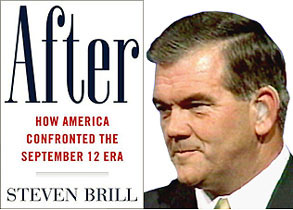
Tom Ridge

Protecting America

In the second selection from "After," Tom Ridge is drafted for homeland security and Anthony Romero maneuvers the ACLU into the post 9/11-era.

Editor’s note: This week, Salon is publishing selected scenes from “After,” Steven Brill’s definitive, deeply revealing book about how America has changed since the national trauma of September 11. Brill, who started his career as an investigative reporter before becoming a media entrepreneur (the American Lawyer, Court TV, Brill’s Content), draws from interviews with more than 300 people, as well as court filings, internal summaries of high-level government meetings and other documents to create his portrait of a nation struggling to redefine itself while holding on to its fundamental values. “After” is told through the eyes of a wide range of powerful and unsung people, from Attorney General John Ashcroft to ACLU executive director Anthony Romero, from a World Trade Center widow to the attorney for John Walker Lindh, from lobbyists in Washington to a Silicon Valley entrepreneur whose company makes machines that detect bombs in luggage. Chronicling their stories on a nearly day-by-day basis, “After,” which will be published in April, is the most sweeping, yet detailed, account of what Brill calls “the September 12 era.” It’s a “towering achievement,” in the words of New York magazine’s Michael Wolff, in which “the granular becomes epic.” Read Excerpt 1.

- – - – - – - – - – - -
By Steven Brill

April 1, 2003  |  Wednesday, September 19, 2001

Pennsylvania Governor Tom Ridge was in the governor’s mansion at about 1:30 on Wednesday when his secretary said that Andrew Card, the White House chief of staff, was calling. Ridge immediately took the call.

Card wanted to know if maybe Ridge could come down to Washington from Harrisburg to talk about a new job they were thinking about involving homeland security. It turned out that Ridge was already supposed to be in Washington the next day to testify at the International Trade Commission in support of his state’s steel industry. Stopping by for a chat would be no problem, he told Card.

Ridge aides recall that he seemed preoccupied after the call, but that he kept mum. About an hour later, the staff became more curious when the secretary put through a second call from Card. After they chatted for a few minutes, Card said, “someone else wants to talk to you,” and Vice President Cheney got on the phone.

Cheney told Ridge he was delighted that he was coming to talk about the job, that it was a job that Cheney and his staff had been focusing on in the last few days, and that he was hoping Ridge was prepared to give it serious consideration. Ridge was surprised that things had gotten far enough that the vice president was already involved.

At about 4:15 Ridge left in the state plane for a funeral in Meadville, Pennsylvania. When the plane returned to Harrisburg at about 8:30, Ridge was greeted by an aide as the door opened. The president had been trying to reach him.

Ridge went quickly to the governor’s mansion where he could take the call from the privacy of his bedroom. The president was also glad Ridge was coming to town so quickly, he said, because this was a really important job.

As he finished the call, Ridge’s wife, Michele, came in, surprised to see him at home. “I took one look at his face,” Michele Ridge recalls, “and stopped. I knew something was going on.”

“We have to talk,” Ridge said. “Right now.”

“Is it your mother?” Michele asked. Ridge’s 78-year-old mother had recently been in the hospital for surgery.

“No,” he replied. “Let’s talk.”

“I’m an army brat,” says Michele Ridge, “and was used to getting told we were moving. And Tom was drafted, too. So for some reason, without him saying it, this seemed to me like the time he’d been drafted — which it kind of was.”

As Ridge’s aides speculated about all the calls, Michele told him she knew he had to take the job. But they also discussed another problem: With Ridge needing to rent an apartment in Washington and the family needing to find a home in Harrisburg at least until the end of the school year, Michele was going to have to go back to work. There was no way they could suddenly assume all those new housing costs, plus keep the kids in private school, on his White House salary (which he later found out was $140,000). Plus, she’d have to buy a car (they had not needed one of their own in the seven years he had been governor), and figure out how to pack up their files and furniture with none of the usual transition costs budgeted by the state for this kind of sudden move.

The Ridges decided that they could not tell anyone, including their children — son, Tommy, 14, and daughter, Lesley, 15 — until the next evening, because, as Michele remembers, “the kids are so networked on the computer that they were bound to let the word out.”

At 6:45 the next morning, Thursday, September 20, Ridge flew to Washington for his testimony. By 9:30 he was in Card’s office at the White House. Soon Cheney joined them, then the president. The meeting had all the urgency of a wartime conference. They outlined the coordinator’s role. Bush promised his friend that he’d have his full backing to shake things up. But they needed an answer now because the president wanted to make the announcement of a new homeland security chief in his address to Congress scheduled for that evening. Ridge shook the president’s hand and said yes.

Tom and Michele Ridge talked to Tommy and Lesley on Thursday afternoon, just before Ridge left for Washington to be there for the president’s announcement. It helped that the kids knew and liked the Bushes. They’d spent weekends with them in Kennebunkport, Maine (at the Bush family compound), when their father and Bush had been fellow governors. And this past summer they’d stayed at the White House during a July 4th celebration. Bush had also stayed with them a few times at the Pennsylvania governor’s mansion. But this was quite a shock. Would he really leave Harrisburg and the governorship? What would this job be? What about the kids’ schools?

Ridge said that Washington was only about a two-hour drive and that he’d commute on weekends, at least until the school year ended. Then they’d see how things were going.

Ridge would later say that the decision was not that hard, and was made easier by his longtime friendship with Bush. “The president wasn’t asking me to run into a burning 110-story building like those firemen did,” is the way he put it. “This sacrifice, if it was one, was the least I could do.”

Nonetheless, it was an extraordinary decision, and one that was emblematic of the time — that brief, probably too brief, period of weeks following Sept. 11 when for most Americans the unprecedented urgency of the moment was such that no sacrifice, no disruption of normal life, seemed too much. In the space of about 21 hours, the seven-year governor of Pennsylvania had quit his job. He had forced his family to find a new home. (Ridge’s successor, Lieutenant Governor Mark Schweiker, soon decided to let the Ridges stay in the mansion until December 31.) He had left his family. His wife would have to go from being a first lady with a staff of five involved in a variety of community service projects to a working mom. And he had gone from being a chief executive to a staff position that was, at best, ill defined, and would soon be challenged and belittled.

October 12, 2001

On the same morning that the USA Patriot Act was being pushed through the House by a lopsided vote after having been supported 96-1 in the Senate, and on the day after the Senate passed the aviation security bill 100-0, the executive committee of the national board of the ACLU convened in Washington — where one of the first issues up for debate was whether the ACLU should continue to oppose metal detectors at airports. Since 1973, the official ACLU policy had been that the organization was against the screening of airline passengers for guns and other weapons because it violated Fourth Amendment protections against unreasonable searches.

Amazingly, the ACLU position had never changed, despite attempts over the years by some members of the board to get it amended. Now, the organization’s executive director, Anthony Romero, was determined to get the policy expunged before he started reading about it in the press.

After about an hour of discussion, the executive committee voted unanimously to repeal it. But when the full 84-person national board, which includes representatives from the 50 states, would meet two days later, things didn’t move that quickly. After a debate that lasted much of the morning, the repeal resolution passed by a voice vote, but not at all unanimously.

Among those who wanted to keep the ACLU on record against screening all passengers for guns and knives was Arthur Heyderman, the delegate from Iowa. “We should not cave in to the pressure of the moment,” he argued. “The government should do a better job of figuring out who has to go through a metal detector. They should have probable cause before making someone go through it.”

How are they supposed to check every passenger for probable cause, one of the other board members asked. “That’s their job, not ours,” Heyderman replied. “We have to stop worrying about how they do their jobs. Why can’t they just put an air marshal on every plane,” he added. “Then they wouldn’t have to worry about searching people or finding probable cause. If that’s the price we have to pay not to violate our right not to be searched, we should pay it.”

Heyderman, who also argued that we should not be bombing Afghanistan “any more than we should have bombed Chicago because Al Capone lived there,” is part of what Romero calls “an old-guard faction at the ACLU, which has a lot of respect in the organization but which does not always prevail.” Yes, they make his job more difficult in the September 12 era, he says, but they also “help us keep to our principles.”

Beyond the metal detector issue (which Romero did succeed in disposing of without any publicity), the ACLU’s three-day policy meeting featured what Heyderman would later call “debates over efforts we have to make to reach out to people to get them to slow down. Ashcroft wanted to scare people to death, and we had to figure out how to stop that.”

Steven Brill is currently a Newsweek columnist and a consultant to NBC on issues related to the aftermath of the Sept. 11 attacks

Ridge walks back terror alert politicization claim

The former Homeland Security chief now says he wasn't pressured to raise the alert level for political reasons

In his new book, former Homeland Security chief Tom Ridge seemed to indicate that he felt others in the Bush administration wanted him to raise the terror alert level to help President Bush’s 2004 re-election campaign. Since that news confirmed many critics’ suspicions, the revelation — even late as it was — was big news. But now Ridge is disavowing it, at least to a point.

“I was never pressured,” Ridge said in an interview with USA Today. And in an appearance on “Good Morning America,” the former Pennsylvania governor says people “are hyperventilating” about the assertion in his book, saying, “A consensus was reached. We didn’t go up. The process worked.”

As the Associated Press notes, though, Ridge “did not take back the statement in his new book … that he wrorried at the time that politics was a consideration in discussions among high-level officials about whether to raise the color-coded terror alert.”

Update: At Time’s Swampland blog, my former colleague Michael Scherer has a smart take on all of this; he writes that Ridge didn’t truly say what the media says he did, and so he’s not really backpedaling.

Continue Reading Close

Alex Koppelman is a staff writer for Salon.

The media can’t handle the truth

Media sheep facing truth-hungry Internet wolves

In this March 12, 2002 file photo, Homeland Security Director Tom Ridge unveils a color-coded terrorism warning system in Washington. The Homeland Security Department says it will review the multicolored terror alert system that was created after the Sept. 11, 2001 attacks.

So yet another Bush administration Cabinet-level official has petitioned to get his conscience and reputation back. This time, it’s Tom Ridge, former secretary of Homeland Security. The one-time Pennsylvania governor admits in a new book that he felt political pressure from the White House to issue bogus terror alerts before the 2004 presidential election.

Big surprise, right? By 2004, anybody who didn’t grasp that crying wolf was the Bush/Cheney administration’s basic game plan was probably also astonished last January when the “Texas cowboy” who’s never been seen on a horse chose a Dallas mansion over his beloved ranch. Golly, who’s doing all that brush-cutting?

Indeed, the most fascinating aspect of the Ridge revelations has been a flame war that’s broken out between establishment Washington pundits and less-reverent bloggers. The Atlantic’s Marc Ambinder started it by observing in smug inside-the-Beltway fashion that he and like-minded colleagues were actually right to be wrong about fake terror warnings.

People who smelled a rat, see, “based their assumption on gut hatred for President Bush, and not on any evaluation of the raw intelligence.” Whereas, sober-sided thinkers like him credited the Bush administration’s good intentions.

Confronted with ample contemporaneous evidence of Bush administration flimflams by Salon’s Glenn Greenwald and the scholarly Marcy Wheeler of Firedoglake.com, Ambinder apologized for the “gut hatred” part. But he alibied: “Information asymmetry is always going to exist, and, living as we do in a democratic system, most journalists are going to give the government the benefit of some doubt, even having learned lessons about giving the government that benefit.”

Yeah, sure. Purely with regard to terrorism and national security, by 2004, Bush/Cheney had already gotten caught deceiving the public about having “no warning” before the 9/11 attacks, not to mention about Saddam Hussein’s nonexistent weapons of mass destruction. If skepticism was still inappropriate, would it ever be warranted?

Yet people who found the timing of terror alerts suspect, such as then-Democratic presidential candidate Howard Dean, were dismissed as crackpots.

It was much the same after former Secretary of State Colin Powell confessed misgivings about his 2003 U.N. speech that stampeded the United States into an ill-advised war in Iraq. How could any serious American journalist possibly have seen that coming? Or, as your humble, obedient servant here wrote at the time, “War fever, catch it.”

This column summarized “mainstream” opinion on Feb. 12, 2003: “The allegedly ‘liberal’ Washington Post responded editorially with a one-word headline, ‘Irrefutable.’ Columnist Mary McGrory announced that despite being almost a pacifist … ‘I’m Persuaded,’ mostly by what she described as Powell’s unimpeachable integrity. Joining the stampede was New York Times columnist Bill Keller, who noted that ‘The I-Can’t-Believe-I’m-a-Hawk Club includes op-ed regulars at this newspaper and the Washington Post, the editors of the New Yorker, the New Republic and Slate, columnists in Time and Newsweek.”

And yet it was all rubbish, exactly as some of us raised on intelligence hoaxes suspected. Evidence of what I called “chicanery and fraud” in the U.S. case against Iraq was obvious to anybody unafraid to see it.

But here’s the big thing about “mainstream” journalism and what Ambinder calls “information asymmetry.” Upton Sinclair said it best: “It is difficult to get a man to understand something when his salary depends upon his not understanding it.”

Furthermore, the safest place during a stampede is the middle of the herd. Establishment journalists with mortgages, car payments and children in private schools saw what happened to the Dixie Chicks. Why couldn’t it happen to them? (The job I got fired from that month wasn’t paying my bills.) The United States had been attacked. Feelings ran high, especially in New York and Washington.

What did it matter if we killed the wrong Arabs, so long as Arabs were being killed? In Thomas Friedman’s immortal words, “We hit Iraq because we could. That’s the real truth.”

Under oath to a Senate committee, Condi Rice told a barefaced whopper about the Aug. 6, 2001, CIA terrorism briefing that Bush blew off. Media insiders pretended not to notice. Bush made a slapstick skit of searching under his Oval Office desk for Iraqi WMDs. The press laughed on cue. He claimed that Saddam Hussein forced him to invade Iraq by expelling U.N. arms inspectors. (In reality, Bush made them leave.) Pundits praised his charm.

Long under siege for “liberal bias,” media careerists now find themselves confronted with people they see as passionate amateurs. True, fearless scrappers like my friend Joe Conason have always been around, and somebody like Paul Krugman — a world-class economist who doesn’t care what, say, MSNBC’s Chris Matthews thinks of him — can be very annoying.

But what’s really driving these jokers up the wall is economic and intellectual competition from the Internet: people with first-class minds and a passion for truth that some of them can barely remember.

© 2009 Gene Lyons. Distributed by Newspaper Enterprise Association

Continue Reading Close

Arkansas Times columnist Gene Lyons is a National Magazine Award winner and co-author of "The Hunting of the President" (St. Martin's Press, 2000). You can e-mail Lyons at eugenelyons2@yahoo.com.

Ridge: Bush administration wanted terror politicized

The former Homeland Security head says he got pressure to raise the alert level before the 2004 election

Former Homeland Security head Tom Ridge appears to have confirmed what many already believed: The Bush administration wanted to use the terror alert level system for political gain.

Ridge, who was also the governor of Pennsylvania, has a new book coming out at the beginning of next month. U.S. News & World Report’s Paul Bedard reports on some details from the book:

Ridge was never invited to sit in on National Security Council meetings; was “blindsided” by the FBI in morning Oval Office meetings because the agency withheld critical information from him; found his urgings to block Michael Brown from being named head of the emergency agency blamed for the Hurricane Katrina disaster ignored; and was pushed to raise the security alert on the eve of President Bush’s re-election, something he saw as politically motivated and worth resigning over.

Update: Via Marc Ambinder, the Pittsburgh Post-Gazette has more information on what concerned Ridge:

Mr. Ridge is adamant in rejecting the contentions of Bush administration critics that the often-derided color-coded warning system he helped devise was manipulated for political ends. He depicts an atmosphere, however, in which the motives of some senior officials and Cabinet colleagues sometimes left lingering questions on that score.

The most dramatic example — and one that Mr. Ridge said would help him confirm his previous plans to leave his post — came on the eve of the 2004 election between Mr. Bush and Sen. John Kerry.

Osama bin Laden had released a videotape with one more ominous sounding but unspecific threat against the United States. Neither Mr. Ridge nor any of the department’s security experts thought the message warranted any change in the nation’s alert status … But that view met resistance in a tense conference call with members of the intelligence community and several other Cabinet officers including Attorney General John Ashcroft and Defense Secretary Donald Rumsfeld.

“A vigorous, some might say dramatic, discussion ensured. Ashcroft strongly urged an increase in the threat level and was supported by Rumsfeld.”

Noting the correlation found between increases in the threat level and the president’s approval rating, Mr. Ridge writes, “I wondered, ‘Is this about security or politics?’ “

The dispute remained open at the end of the call. Mr. Ridge’s aides carried the word to the White House staff that the threat escalation would court accusations of politicizing national security. Mr. Ridge’s view finally prevailed.

“I believe our strong interventions had pulled the ‘go-up’ advocates back from the brink,” Mr. Ridge writes. “But I consider the episode to be not only a dramatic moment in Washington’s recent history, but another illustration of the intersection of politics, fear, credibility and security.”

Continue Reading Close

Alex Koppelman is a staff writer for Salon.

Fringe leftist losers: wrong even when they’re right

Evidence was abundant that Bush was manipulating terror alerts for political gain. Why didn't journalists see it?

(Updated belowUpdate IIUpdate III - Update IVUpdate VUpdate VI)

“There is danger from all men. The only maxim of a free government ought to be to trust no man living with power to endanger the public liberty” – John Adams, Journal, 1772.

“All men having power ought to be distrusted to a certain degree” – James Madison, speech at the Constitutional Convention, July 11, 1787.

“All governments lie” – journalist I.F. Stone, addressing journalism students on the one truth they’d be well-advised always to recall.

“Information asymmetry is always going to exist, and, living as we do in a Democratic [sic] system, most journalists are going to give the government the benefit of some doubt, even having learned lessons about giving the government that benefit” — The Atlantic‘s Marc Ambinder, today, reacting to Tom Ridge’s confession that the Bush administration heightened terror alerts for political gain, and justifying why journalists such as himself “were very skeptical when anti-Bush liberals insisted that what Ridge now says is true, was true.”

________________________________

That little progression of thought explains much about our political and media culture.  Marcy Wheeler dissects and eviscerates Ambinder’s remarkable reaction to the Ridge revelation (Ambinder has now retracted some (though not all) of his more irresponsible assertions).  But Ambinder’s comments reveal a couple of other points worth highlighting.

Just as is still commonly said about opponents of the Iraq War (even though they were right, they were still wrong and unSerious because their motives were bad), Ambinder acknowledges that Bush critics were right that the terror alerts were being manipulated for political ends (he has no choice but to acknowledge that now that Ridge admits it), but still says journalists like himself were right to scorn such critics “because these folks based their assumption on gut hatred for President Bush, and not on any evaluation of the raw intelligence.”  As always:  even when the dirty leftist hippies are proven right, they’re still Shrill, unSerious Losers who every decent person and “journalist” scorns.

Ambinder’s belief that there is nothing other than blind “Bush hatred” that could have justified such a belief — and his accompanying self-defense that journalists like him had no way of knowing any of this — is patently false.  Here is a 2006 Time column by Josh Marshall that details the ample empirical evidence suggesting that “that the Bush Administration orchestrates its terror alerts and arrests to goose the GOP’s poll numbers.”  And here is an exhaustive and lengthy (17 minutes) segment from Keith Olbermann early last year that “weaves from each revelation of an intelligence failure or a Democratic political victory to an almost immediate orange alert or ‘new threat’ from al Qaeda.”  Olbermann’s conclusion after examining all the evidence:  ”what we were told about terror, and not told, for security reasons, has overlapped considerably with what we were told about terror, and not told, for political reasons” (Olbermann had been raising the same suspicion for many years).

The reason journalists such as Ambinder saw no such evidence wasn’t because it didn’t exist.  It existed in abundance; you had to suffer from some form of moral, intellectual or emotional blindness not to see it.  It’s because they didn’t want to see it, because — as Ambinder said — they trusted the Bush administration as good and decent people who might err but would never do anything truly dishonest.  It’s because only loser Leftist ideologues distrusted Bush officials and the overriding goal of establishment journalists is to prove that they are not like them, that they’re much more Serious and responsible and thus would never attribute bad motives to government leaders such as those who ran the Bush administration. 

That’s the same reason most establishment journalists instinctively oppose investigations of Bush officials:  the people who rule over their Washington court may make mistakes, but they never do anything dishonest or criminal.  They certainly don’t blatantly lie.  These journalists are the anti-I.F. Stones.  And that’s why political leaders know they can get away with blatant lying and lawbreaking.  Why is that, Marc Ambinder?  Because “most journalists are going to give the government the benefit of some doubt, even having learned lessons about giving the government that benefit.”

About Ridge’s revelations, Atrios today observes:

Sometimes it’s a bit hard to remember just how nutty the world was in those post-9/11 days. Suggesting that Bush was using the terror alert for political purposes would have made you a crazy person, the mere suggestion of it would’ve put you outside the bounds of acceptable discourse.

Indeed, so strong was the stigma against those who said such things that Josh Marhsall felt compelled to insert this qualifier into the first paragraph of his column:  ”Now, I’m a respectable columnist. I don’t want to draw rolled eyes. But think about it.”  And in 2004, after Howard Dean argued that the Bush administration was raising the terrorist alerts for political purposes, John Kerry proved his Seriousness by attacking Dean for making such an irresponsible claim:

Kerry was campaigning Monday in Grand Rapids, Mich., where he dismissed suggestions that a decision to raise the terror alert level was politically motivated. . . .

Kerry dismissed former Vermont Gov. Howard Dean’s comment that raising the terror level might be politically motivated.

“I don’t care what he said. I haven’t suggested that and I won’t suggest that,” Kerry said. “I do not hold that opinion. I don’t believe that.”

That was because, as Atrios suggested, anyone like Dean who uttered such a suggestion was demonized as being among “the less stable among us,” as right-wing war reporter Michael Totten put it in 2004, who proudly noted that “Kerry dismissed Dean’s ravings the way a picnicker treats a fly buzzing around his barbecued chicken.”  An incredulous Chris Matthews interviewed Dean in 2004 about his accusations and could barely refrain from mocking Dean in every question:

MATTHEWS: But what you’re saying here, Governor, is that there’s a political brain somewhere in the administration which directs people like Tom Ridge and people like Ashcroft to exploit whatever info they have got to try to make it easier on the president for reelection, that someone is directing this timing? . . .

MATTHEWS:  Are you saying that there’s a political mind behind that, that is stirring these things up in a time the Democrats are trying to get some lift?

DEAN: We don’t know that, Chris, but what we do know is there’s a very disturbing pattern of…

MATTHEWS: Right, well, you sound like you’re… You do sound, Governor, like you do know. You’re not — you’re acting like you are just speculating here out loud, when in fact you’re — it’s almost like push-polling. You’re saying, “Could it be?” rather than just, “I’m thinking about these things” . . .

MATTHEWS: But is there any evidence that the administration is timing these releases of information to benefit themselves politically? Is there any evidence of that?

And an August, 2004 USA Today Editorial decried those, such as Dean, who were irresponsible enough to suggest such a thing:

Former presidential candidate Howard Dean said Sunday, without offering evidence, that terror warnings crop up whenever President Bush needs a boost. That statement follows the premise of Michael Moore’s incendiary film Fahrenheit 9/11: that the alerts are used to keep the public in fear for political benefit.

It is the most serious of allegations — that the nation’s leaders would selfishly manipulate the gravest threat we face.

While no one should be naive enough to think that the White House — or John Kerry’s campaign — doesn’t discuss the politics of terrorism, any evidence of terror alerts called for political advantage is lacking.

And just to demonstrate how deceitful were the people who were running our government, here’s what The New York Times reported in the wake of Dean’s accusation:

Speaking to factory workers and invited supporters at a lawn and garden equipment manufacturer in Lee’s Summit, Mo., Mr. Cheney lashed out at those who have implied that the terror alerts were at all politically motivated, specifically citing former Gov. Howard Dean of Vermont, an unsuccessful candidate this year for the Democratic presidential nomination.

“There has been some commentary from some of our critics – Howard Dean comes to mind – saying somehow this is being hyped for political reasons, that the data we collected here, the casing reports that provided the information on the prospective attacks is old data, i.e., four, five years old,” he said. “That just tells me Howard Dean doesn’t know anything about how things operate.”

Even the very same Tom Ridge, in 2004, lambasted those who made such a suggestion

The AP also reports that Homeland Security Secretary Tom Ridge “spent a second day Wednesday defending the warnings, which came on the heels of the Democratic National Convention and drew attention from the presidential campaign of nominee John Kerry. ‘I categorically state that the none of the terror threats are politically motivated,’ Mr. Ridge said.” Ridge also granted an extensive interview to CNN’s Newsnight With Aaron Brown, in which he addressed the charges that the Administration was playing politics, saying, “I regret that there’s an inference that this kind of public revelation of information is. . .political. It clearly was not and it never will be.”

But that is how our political culture works.  Throughout the Bush years, those who said demonstrably true things were continuously dismissed as fringe, conspiracy-driven leftist-losers:   those who questioned whether Saddam really had WMDs; those who argued that the invasion of Iraq would lead to long-term military bases in that country; those who worried that warrantless eavesdropping and Patriot Act powers would lead to abuses; those who opposed the war in Afghanistan on the ground that it would be drag on for years with no resolution, etc. etc. 

Having been proven right about all of those things hasn’t changed perceptions any at all.  As Ambinder’s comments today reflect, the paramount unchangeable Beltway Truth is that those who distrust government claims are unSerious Fringe Leftist Losers.  Even when they turn out to be right, they’re still that.   And no matter how many times journalists like Ambinder are proven wrong in “giv[ing] the government the benefit of some doubt, even having learned lessons about giving the government that benefit,” they still continue to do it and believe it is the right and responsible thing to do.  

Powerful political leaders are, as Jay Rosen often puts it, the ruling priests in the journalists’ church of Savviness.  Trusting the politically powerful is the establishment religion and carrying forth their message is the prime function of establishment journalists (note how Newsweek‘s Jonathan Alter, just two months ago, argued that the ”public option” was crucial but then, like so many liberal pundits eager to maintain and build close relations with the White House, got dutifully on board with the White House message, by completely and shamelessly changing course the minute the White House did).  Distrusting the statements and actions of government leaders was once the central value of our political system and of basic journalism.  But now, especially in the eyes of establishment journalists, it is the hallmark of the unSerious, fringe, leftist loser, no matter how many times it is proven right.


UPDATE: In comments, Gator90 sums it all up:

The Maturation Cycle of Bush Administration Scandals

1. Crazy, hysterical, paranoid accusation by wild-eyed, partisan, left-wing loonies.

2. Old news

What’s most amazing is that even when we reach Step 2, Step 1 still applies in full force.


UPDATE II: As he so often does, Tom Tomorrow, all the way back in 2005, perfectly captured the syndrome illustrated here (and which Gator90 described) — click on image to enlarge:


UPDATE III: As Hume’s Ghost noted on his blog back when it happened, Tom Ridge — in early, 2005, shortly after he resigned — strongly suggested that the terror alerts were raised for political reasons having nothing to do with legitimate security needs:

The Bush administration periodically put the USA on high alert for terrorist attacks even though then-Homeland Security chief Tom Ridge argued there was only flimsy evidence to justify raising the threat level, Ridge now says. . . .

Ridge, who resigned Feb. 1, said Tuesday that he often disagreed with administration officials who wanted to elevate the threat level to orange, or “high” risk of terrorist attack, but was overruled. . . .

“More often than not we were the least inclined to raise it,” Ridge told reporters. “Sometimes we disagreed with the intelligence assessment. Sometimes we thought even if the intelligence was good, you don’t necessarily put the country on (alert). … There were times when some people were really aggressive about raising it, and we said, ‘For that?’ “

That apparently wasn’t enough to make Ambinder and other journalists wonder why the official responsible for the alerts would have been “aggressively pressured” to raise it even in the face of “flimsy evidence” that there was a threat to justify that (we had no idea until today that this happened!).  Real Journalists knew that the officials exerting that pressure had Good Reasons for wanting the alerts raised even if those journalists — or, for that matter, even Homeland Security Secretary Ridge — didn’t know what those reasons were.  Real Journalists just assume those officials had good reasons because they’re trustworthy and entitled to the benefit of the doubt.  Only irresponsible Far Leftists hysteric conspiracy-theorists with gut hatred for George Bush would entertain suspicions that something nefarious might motivate those decisions.


UPDATE IV: Ambinder now has a separate post apologizing for his use of the phrase “gut hatred.”  Whenever someone clearly apologizes for something that way, they deserve credit, but that offending phrase was only a small part of what I (and, I believe, Marcy Wheeler) were criticizing.  Far more significant is Ambinder’s belief that journalists can and should vest the pronouncements of political leaders with faith and trust rather than the skepticism that should be at the heart of all political journalism (notably, Ambinder lauded the “skepticism” which journalists harbored for “activists’ conclusions” critical of the Bush administration while defending the trust journalists place in the claims of Bush officials themselves — a truly bizarre way for a journalist to look at things, if you think about it).  That mentality is far more consequential than Ambinder’s careless public unleashing of standard Beltway journalist slurs against Bush critics.


UPDATE V:  There’s one other point made by Atrios about the Ridge confession (he was a veritable font of wisdom today) that I want to highlight:

And just so it’s clear: using the threat of terrorism to try to achieve political goals is, you know, what terrorists do.

No observation will cause one to be ejected from acceptable mainstream company more immediately than pointing out that what the U.S. Government is doing is “terrorism” by definition.  Ask Noam Chomsky about that, if you can find him.  That’s because using Terrorist threats (or civilian-destroying violence) for political gain, or to keep a population in fear, is something that only other people do — but never the United States — even when it’s as plain as day (as it is here) that the U.S. Government is doing exactly that.


UPDATE VI:  Tucker Carlson — at the height of the August, 2004, controversy triggered by Howard Dean’s accusation that the Bush administration manipulated terror alerts for political gain — labeled those who believed the alerts were being exploited for political purposes as “insane conspiracy nuts” and said: “what they really need is psychological help, obviously.”  Separately, Carlson said that Dean had gone “berserk” and demanded that the Kerry campaign repudiate Howard Dean for suggesting that this was the case.  I’ve emailed Carlson and asked him:

In light of Tom Ridge’s belief that this is exactly what happened — that, as the official responsible for assessing terrorist threats, he was pressured to raise the terrorist threat alert in order to benefit Bush’s re-election campaign (something he also strongly suggested in 2005 after he resigned) — do you still believe that?  Or do you merely now believe Ridge to be one of the berserk, insane conspiracy nuts in need of psychological help?

I’ll post any reply I receive.

Continue Reading Close
Glenn Greenwald

Follow Glenn Greenwald on Twitter: @ggreenwald.

Ridge won’t run against Specter

The former Pennsylvania governor has decided not to jump in the race, leaving the Republican field open for a conservative favorite.

Pennsylvania Sen. Arlen Specter’s life just got a little easier.

After the senator’s decision to switch parties and become a Democrat, Republicans were pushing former Gov. Tom Ridge to run against him in 2010, and according to early polling, Ridge would have proven a formidable opponent. But on Thursday, Ridge announced that he’s decided against throwing his hat in the ring.

Ridge’s decision means that former Rep Pat Toomey, R-Pa., a conservative favorite whose entry in to the Republican primary was the key in driving Specter to the Democratic Party, might not face a seriouis opponent in his quest for his party’s nomination. That’s good news for conservatives, but probably bad news for the GOP generally.

Though Toomey would almost certainly have beaten Specter in a primary, polls show him trailing badly in the general. There’s still plenty of time for him to make up that difference, of course, but Pennsylvania has gotten bluer and bluer in recent years, and it will be very hard for a virtually unknown conservative to beat a moderate who also has the advantage of incumbency.

Continue Reading Close

Alex Koppelman is a staff writer for Salon.

Page 1 of 5 in Tom Ridge