
Dick Morris

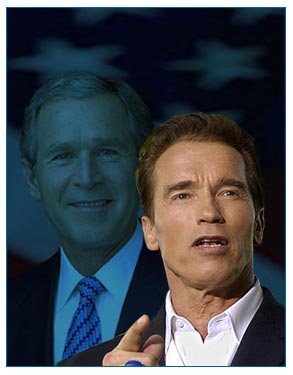
George Bush’s Terminator problem

Arnold Schwarzenegger may be the GOP's best shot yet at a California comeback. But his playboy ways and pro-choice politics make him anathema to the president's allies on the Christian right.

  • more
    • All Share Services

George Bush's Terminator problem

A few months after the U.S. Supreme Court called off the counting and awarded the presidency to George W. Bush, a New York Times reporter asked Republican strategist Karl Rove about the future for Republicans in California. The overall outlook was bleak. Al Gore had trounced Bush in the state without even trying; Democrats held virtually every statewide elective office and a huge lead in voter registration; and the California Republican Party was dysfunctional and in disarray. For the chief White House political strategist, there was just one bright spot in the Golden State: the hope that Arnold Schwarzenegger might someday run for governor. “That would be nice,” Rove told the Times. “That would be really nice. That would be really, really nice.”

Well, maybe.

Together with more than 190 other candidates who filed papers in time to meet last Saturday’s deadline, Arnold Schwarzenegger is running for governor of California now. And while Bush told reporters Friday that he thought Schwarzenegger would make a “good governor,” the White House may soon discover that a Terminator candidacy is not so nice after all. Although Schwarzenegger’s run to replace Gov. Gray Davis is playing like the second coming for mainstream Republicans, it threatens to open a nasty rift between the Bush administration and the right-wing Christians to whom it usually kowtows.

The problem: While the White House is eager to back a winner in California — and a Time/CNN poll released over the weekend has Schwarzenegger looking like one — born-again Christian conservatives are mortified by the actor’s liberal views on abortion and homosexuality and wary about allegations of drug use, infidelity and juvenile sexual antics. The Rev. Louis Sheldon, head of the ultra-right Traditional Values Coalition, warned in a statement last week of a “moral vacuum” in Sacramento. “It is hard to imagine a worse governor than Gray Davis,” Sheldon said, “but Mr. Schwarzenegger would be it.”

Sheldon’s group has launched an anti-Arnie project called Californians for Moral Government. James Lafferty, a consultant for the group, said its work is just the first rumbling of an earthquake to come. “There’s a gathering storm on the right,” Lafferty told Salon Sunday. “Rush Limbaugh, Michael Reagan and, we have been told, a number of other prominent conservatives are going to come out against Schwarzenegger and say he’s not a real conservative.”

There is plenty of evidence to support the charge. Schwarzenegger has expressed support for abortion rights, gay adoption and gun control. During Special Prosecutor Kenneth Starr’s investigation of President Bill Clinton, Schwarzenegger said he was “embarrassed” to be a Republican. And in an interview with Salon in 2001, he said he supported George W. Bush but that “it would have been better if he had really won, instead of through the courts.”

Limbaugh and Reagan have both expressed their concerns about Schwarzenegger on their radio shows and in columns, and Lafferty predicted that other conservative Republicans, including Col. Oliver North, will soon join the chorus.

Leaders of other conservative Republican groups were holding their fire Monday. Roberta Combs, president of the Christian Coalition, said her group would wait to hear more about Schwarzenegger’s views and his background before deciding what do about the recall. But if conservatives like North and groups like the Christian Coalition get into the fight, the White House will face a choice: back away from Schwarzenegger or risk losing some of its love from conservatives, and particularly the religious right. “I don’t think the White House wants to get caught between a fairly large religious community in California and Arnold Schwarzenegger,” Lafferty told Salon. “The White House has built a pretty good relationship with religious conservatives. Getting involved with Schwarzenegger would be a waste of the goodwill they’ve accumulated.”

After weeks of predictions and prognostications, false starts and broken vows, the dust cleared in the California recall over the weekend. Would-be candidates had until Saturday at 5 p.m. to file the papers necessary to put their names on the Oct. 7 ballot. When time ran out Saturday, three serious Republican contenders were in the race: Schwarzenegger, conservative state Sen. Tom McClintock, and businessman Bill Simon, who lost to Davis in November. Republican Rep. Darrell Issa, who pumped $1.6 million into the recall drive, was in the race early but dropped out after Schwarzenegger got in. Former baseball commissioner Peter Ueberroth is running as an independent from the right; columnist Arianna Huffington is running as one from the left. California Lt. Gov. Cruz Bustamante is the only prominent Democrat in the race; like Issa, California Insurance Commissioner John Garamendi was in but backed out before the filing deadline.

With the field set — at least until somebody else drops out — the candidates and the parties have begun plotting their paths to the plurality needed to win on Oct. 7. For Democrats, the two competing strategies advanced before Saturday are both now history. Party leaders failed in their attempt to keep any prominent Democrat out of the race — Bustamante decided to run after seeing polls suggesting that the governor’s “political viability” was disappearing — while members of the state’s congressional delegation failed in their bid to draft Sen. Dianne Feinstein. As a result, Democrats are now left mouthing a less-than-convincing two-part mantra: “No on the recall, but yes on Bustamante.”

The Republicans have different, but no less vexing, problems. With three plausible candidates — and half of a fourth in Ueberroth — they risk splitting the vote and leaving a Democrat in control of the state. Picking a winner now, in what amounts to a primary conducted through public opinion polls, appears to be essential for a Republican victory.

But for Republicans generally, and for the Bush White House in particular, the Golden State has been a black hole, where the right choice has frequently been impossible to see and even harder to make. Although the state gave rise to Ronald Reagan, no Republican presidential candidate has carried California since 1988. Democrats now hold every single statewide elective office, and the president’s approval ratings are lower in California than they are anywhere else in the country. The California Republican Party has been its own worst enemy, routinely nominating extreme right-wing candidates who cannot possibly beat their Democratic opponents in general elections. The White House threw its support behind a moderate, former Los Angeles Mayor Richard Riordan, in the last gubernatorial primary. He lost to the more conservative Simon, who in turn ran a bumbling campaign that left the White House flatfooted and embarrassed.

Davis barely beat Simon in November, and right-wing Republicans launched their recall drive shortly thereafter. Although the White House watched the drive closely, the Bush team was careful to keep its fingerprints off of it. Rove met with Schwarzenegger in the spring; Laura Bush aide Noelia Rodriguez advised Riordan as he contemplated entering the race; and Bush’s California liaison, Gerald Parsky, met in July with representatives of possible Republican candidates in the hope of developing a unified strategy for beating Davis. Publicly, however, Bush said that the recall was a matter for the people of California, and that he was staying out of it.

But then came the Terminator.

Schwarzenegger announced his intentions on “The Tonight Show” Wednesday, apparently surprising both host Jay Leno and his own closest advisors, who had been told that Schwarzenegger had decided not to run. With his announcement — and Feinstein’s earlier in the day — Schwarzenegger immediately became the frontrunner. Radio talk-show callers have declared themselves “amped” about Arnie’s candidacy, apparently hoping that his on-screen tough-guy persona means he can kick some serious Sacramento butt.

By Friday, the national press was so focused on the suddenly star-studded recall that Bush couldn’t stay out of it any longer. When reporters asked him about Schwarzenegger at his ranch in Crawford, Texas, the president said he wouldn’t want to arm-wrestle Arnie but thought he’d make a “good governor.” At about the same time, Matt Drudge was posting a new photograph on his Web site: a black and white shot of a beaming, youthful Arnie, his head straddled by the legs of a topless hottie.

Conservative Christians see a photo like that and feel “a sense of separation,” says Lafferty. “There are good, solid prominent Republicans who are well-suited to run for governor,” he said. “This guy clearly is not that serious.”

That’s not the way many Republicans see it, of course. While a Democrat with a record like Schwarzenegger’s would be deemed all but un-American by Karl Rove and his friends at Fox, many of the Republicans who see hope in Schwarzenegger are willing to accept the sacrilege that comes with his stardom. “The Republican Party is not monolithic,” said Jonathan Wilcox, who was the spokesman for Issa’s campaign. Pointing to pro-choice Republicans who have served as governors and antiabortion Democrats who have served in the House, Wilcox says parties do what they have to do in order to win elections.

And for Republicans in California right now, the most important thing is winning the race to replace Davis. Anyone — or, at least, any Republican — would be better than the incumbent governor, they say, even if that anyone isn’t the Republican they’d choose if they thought they had a choice. “Republicans want to win more than anything now,” said Jo Ellen Allen, spokeswoman for the Republican Party of Orange County. “It’s not just winning to win, but you can’t do anything if you don’t win.”

Arguments like that don’t fly with some Christian conservatives. Lori Waters, executive director of Phyllis Schlafly’s Eagle Forum, rejected any “relativistic” view based on Schwarzenegger’s electability. “He may be a better fiscal conservative than Gray Davis but that doesn’t mean that the Eagle Forum has to put its name on [his campaign],” Waters told Salon Monday. “We are pretty firm in supporting social conservatives and fiscal conservatives, but you’ve got to be both.”

It’s what comes after that matters, counters Allen. If Schwarzenegger wins, she says, he will surround himself with more traditional Republican aides and appointees — perhaps like the team of aides and advisors to former Gov. Pete Wilson that Schwarzenegger has hired for his campaign — who will understand the interests of the party’s more conservative members. And then, when the next legislative election comes, Schwarzenegger can push voters to send him Republican legislators with whom he can work.

But that only happens if Arnie wins. And to win, he is going to have to prove to voters that he’s serious — a credible leader, not just a comic book action hero — and he is going to have to survive the intense scrutiny that comes with a political campaign. That’s where even forgiving Republicans like Allen begin to express doubts. They have heard rumors about Schwarzenegger, and the whispers make them nervous.

In March 2001, Premiere magazine ran a feature titled “Arnold the Barbarian” which chronicled allegations of what the magazine called his “boorish” sexual behavior. According to the magazine, the actor has a penchant for groping at the breasts of women who are not his wife — including a fellow star and crew member during the filming of “Terminator 2″ in 1991 and three different female talk-show hosts he encountered during a single day of hyping a film in late 2000.

The Premiere story also quoted an unnamed source who claimed to have walked in on Schwarzenegger performing oral sex on a woman in his trailer during the filming of the 1996 film “Eraser.” “When we opened the door to his trailer, Arnold was giving oral sex to a woman,” Premiere quoted the source as saying. “He looked up and, with that accent, said very slowly, ‘Eating is not cheating.’”

Schwarzenegger has denied the allegations, but not always in ways most becoming to a would-be politician. He told the Weekly Standard last year, for instance, that he was not so “stupid” as to be caught “eating a chick in the living room” of his trailer.

While Republicans may be able to suck it up when it comes to Schwarzenegger’s political views, they may have a harder time with the allegations, and the actor’s attitude about them, particularly if it becomes clear that any hi-jinks occurred in the recent past. “In the last few years, has he been doing anything like that?” asked Chuck Devore, a conservative Republican currently running for the California Assembly. “If he has, he will run into some trouble.”

Allen agreed. “I don’t know whether he has done these things,” she said. “I believe about half of what I read. I would hope that if it’s true, it’s behavior that’s a long time ago and that it has stopped.” Allen began to compare the allegations against Schwarzenegger to the ones that led House Republicans to impeach Bill Clinton. She caught herself before going too far. “One can make a distinction of location, of the White House and an aide under your jurisdiction and control. But it’s still inappropriate behavior.”

Davis’ political team circulated the Premiere article to reporters in 2002 when it appeared that Schwarzenegger was thinking about running for governor. While Schwarzenegger told Jay Leno last week that he expects his opponents will use such stories against him now that he’s in the recall race, at least one prominent Democrat has publicly warned Davis against running a “puke” campaign to save himself. Thus, California Democratic Party spokesman Bob Mulholland is downplaying the dirt for now — sort of.

“We’re not getting into it,” Mulholland told Salon last week. “In any campaign, you have to decide where your resources are going to go. We’ll let the tabloids do the work. We’ll leave it to them, but we’ll add some gasoline to the fire.”

In the meantime, the White House will have to tread carefully into the recall race. While Schwarzenegger is the frontrunner now, the field has been set for only a few days, and things could change quickly as the Republican contenders begin to cannibalize support from one another. Already, the knives are out: In a Web site put up so fast that most of it is unfinished, the operative who directed the Rescue California recall drive is warning Californians against the “sexist playboy.” Bush may want to wait until the picture sorts itself out, before tying himself too tightly to any one candidate. The Bush team got burned the last time it involved itself in California politics, and many believe Rove and company will be wary about jumping in too soon this time. After Bush said that Schwarzenegger would be a good governor Friday, a White House aide reportedly took pains to make it clear that the statement wasn’t an official endorsement.

“It sounds to me like he’s testing the waters,” Devore said of Bush’s seemingly off-the-cuff comments about Schwarzenegger. “The next thing you’re going to see is an incremental gauging of the opinions of the party faithful, a cautious observation of the campaign trail — is this guy capable of rising to the top?”

No doubt, the White House will also be watching to see how the rumors and allegations about Schwarzenegger resolve themselves — and how they play with constituencies important to the president’s reelection in 2004. Says Mulholland: “They don’t want to be standing next to him if another Premiere article is coming out.”

A related question, of course, is whether Schwarzenegger wants to be standing too closely to Bush in California. Schwarzenegger aides did not return calls for comment on this story. But at least some political observers wonder whether Schwarzenegger will be better off if Bush stays out of the recall race entirely; Bush’s presence could remind Democrats of the recall’s partisan birth and drive them to vote it down. “I think a Bush endorsement could be a kiss of death in California because it’s a Democratic state,” former Clinton strategist Dick Morris told Salon Monday. “The more the partisan theme underscores the race, the worse it will be for Schwarzenegger.”

Tim Grieve is a senior writer and the author of Salon's War Room blog.

Tuesday link dump: I can hear Chuck Grassley’s “no”

GOP splits over gay group, Dick Morris lies, and the shocking truth about bipartisan compromise and healthcare

  • more
    • All Share Services

Alex Pareene

Alex Pareene writes about politics for Salon and is the author of "The Rude Guide to Mitt." Email him at apareene@salon.com and follow him on Twitter @pareene

Fred Barnes not on a team? Why did GOP pay him?

The Weekly Standard editor claimed political purity in bashing Journolist, but he's on the Republican payroll

  • more
    • All Share Services

Fred Barnes not on a team? Why did GOP pay him?

In the pages of the Wall Street Journal, Fred Barnes has lately lamented the betrayal of “traditional journalism” by the liberal denizens of Journolist — the defunct listserv that conservatives have used to revive the debate over “liberal media bias.” His widely quoted Journal Op-Ed noted that before Journolist, neither liberal nor conservative journalists were likely to be “part of a team,” and went on to add:

“If there’s a team, no one has asked me to join. As a conservative, I normally write more favorably about Republicans than Democrats and I routinely treat conservative ideas as superior to liberal ones. But I’ve never been part of a discussion with conservative writers about how we could most help the Republican or the conservative team.”

This assertion of political purity struck me as false, coming from a journalist who has appeared repeatedly as a speaker at Republican Party events across the country — a breach of the political boundaries of “traditional journalism” that few, if any, of the writers on Journolist, for example, would ever contemplate.

Nevertheless, it is true that Barnes has enjoyed greater credibility than other journalists on the partisan right throughout his career. After all, he is a former reporter for such publications as the Washington Star, the Baltimore Sun and the New Republic. He was once a Nieman Fellow at Harvard and served as one of three panelists for the first nationally televised debate between Ronald Reagan and Walter Mondale in 1984.

Now, however, there is further evidence that Barnes not only routinely helped Republicans raise money as a banquet speaker, but accepted tens of thousands of dollars from party organizations as well:

• In February 2006, Barnes was paid $10,000 plus travel expenses by Oregon’s Lane County Republican Central Committee to deliver the keynote address at the annual Lincoln Day Dinner. (Thanks to Carla Axtman for research assistance.) These payments, recorded in filings with the Oregon secretary of state, were evidently made through the Premier Speakers Bureau of Franklin, Tenn., which represents other Fox personalities including Sean Hannity, Dick Morris and Mike Huckabee. Barnes is no longer listed on the Premier website, but the company did not respond to phone or e-mail inquiries about its relationship with him.

• In February 2007, Barnes spoke at the annual  Lincoln-Reagan Dinner held by the Republican Party of Fort Bend County, Texas — home of former House Majority Leader Tom DeLay, who purchased a ticket to the event. The party organization’s filing with the Texas Ethics Commission shows two payments of $5,000 each on April 26, 2007, to Premiere Speakers Bureau (with the notation “LRD 2007 Speaker – Fred Barnes”) and travel expenses of $1,823. Photos of a smiling Barnes with various local dignitaries at the event, which netted a reported $70,000 for the party, can be viewed  here.

• In early March 2008, Barnes served as the keynote speaker for the Republican Party of Palm Beach County at its annual Lincoln Day Dinner. Whether he received the customary $10,000 is not clear because the party’s  filing with the Palm Beach County Supervisor of Elections show only a single payment of $5,500 to Premiere Speakers Bureau on Feb. 18. The committee reported net $120,000 in net proceeds from the event.

Barnes didn’t return a call seeking comment. Neither did a Fox News spokeswoman. The question they avoided answering is whether accepting money from party organizations is appropriate for any political journalist, and whether such payments fall within the ethical guidelines of Fox News. Whatever Fox might say, the Murdoch network’s  long history of excessive coziness with Republican politicians and organizations offers little reassurance.

I hoped to ask Barnes whether he agrees that being on the team payroll means he is indeed “on the team” — the Republican Party team. Understandably, he may prefer not to respond. But he ought to reflect on his standing to criticize the behavior of other journalists, left or right, before he mounts his high horse again.

Continue Reading Close

Joe Conason blogs in Salon several times a week and writes a weekly column for the New York Observer. His latest book is "It Can Happen Here: Authoritarian Peril in the Age of Bush."

Why do Republicans (pretend to) hate the Upper West Side?

Growing up on Manhattan's West Side is un-American -- unless you happen to be named Kristol or Podhoretz

  • more
    • All Share Services

Why do Republicans (pretend to) hate the Upper West Side?Supreme Court nominee Elena Kagan testifies on Capitol Hill in Washington, Tuesday,June 29, 2010, before the Senate Judiciary Committee hearing on her nomination. (AP Photo/Susan Walsh)(Credit: Susan Walsh)

As they attempt to disparage Elena Kagan, the most aggressive Republicans on the Senate Judiciary Committee are proving that Supreme Court nomination hearings can produce something worse than vapidity: in this instance, gross hypocrisy and barely veiled appeals to bigotry. Whatever the merits or deficits of Kagan may be (and Salon readers know that there are skeptics on the left as well), the quality of the partisan assault so far seems very low, even by the usual standards of this process.

Consider the discussion of her personal background on the first day of the hearings, when Arizona Sen. Jon Kyl directed our attention to the New York City neighborhood where bright young Elena grew up. Quoting a profile from Politico that described her life experience as “distant from most Americans,” Kyl noted portentously that she was raised on “Manhattan’s Upper West Side” before attending Princeton and Harvard Law School, where she eventually served as dean.

Exactly what is so disturbing about the Upper West Side? As Joan Walsh notes, it is a place renowned as liberal in politics, Jewish in ethnicity, and therefore, according to Kyl’s implication, foreign to the nation’s heartland. Never mind that some of the greatest American authors, musicians, actors and artists — including very many who happened not to be Jews — lived and worked in that special slice of urban landscape over the past century or so, including Scott Fitzgerald, Theodore Dreiser, J.D. Salinger, Saul Bellow, Humphrey Bogart, Harry Belafonte and George M. Cohan, an Irish Catholic who won the Congressional Gold Medal in 1936 for composing “You’re a Grand Old Flag,” among other achievements. (Rush Limbaugh used to live there, too. And Joe Scarborough says he “loves” living there with his family today.)

Beyond the narrow and ignorant parochialism of such remarks by Kyl and others, what is most galling is their absolute phoniness. Scarcely anyone on the Republican right ever suggests that Weekly Standard editor William Kristol ought to shut up because he was raised on the un-American Upper West Side, a few blocks from Ms. Kagan. Anyone who does so is rightly rebuked for appealing to prejudice. Are Kristol and all the other neoconservatives who have inhabited that neighborhood, beginning with those named Podhoretz, to be tarred as “un-American” too? In May, Commentary editor John Podhoretz published a timely, quasi-nostalgic essay about his family’s half-century in the neighborhood, candidly dismissing the right-wing stereotypes:

Conservatives sometimes invoke the Upper West Side in their lists of petri-dish-like leftist enclaves along with Cambridge and Berkeley, but despite its homogeneous radicalism, it didn’t then and doesn’t now offer much in the way of interesting, unexpected, or comical ideological excess.

Podhoretz goes on to mention that it was anything but sociologically monolithic or elite:

It might have been the most integrated area in the United States. According to a 1966 study, out of 150,000 residents, 105,000 were white (of whom 40,000 were Jews); 26,000 came from Spanish-speaking homes; and 18,000 were black. “Only in Honolulu,” wrote the journalist Joseph P. Lyford, “is there a greater confusion of blood, ancestry, language, and culture in as small a space.” But though there were racial and ethnic tensions aplenty, and these would grow exponentially as the years passed, the division in the neighborhood was primarily one of class — a division between the middle class and the lower class. (There weren’t many rich people on the Upper West Side then, a situation much altered today.)

Let’s not forget Dick Morris, cousin of Roy Cohn and Upper West Side native, who earned his political spurs in the neighborhood’s Democratic clubhouses. Will Fox News dump the voice of Fox Nation as an Upper West Sider and potential crypto-socialist? Of course not. He’s a Republican now, and those nasty ethnogeographical snarks are reserved for Democrats only.

The spurious resentments encouraged by Republicans only begin with Kagan’s home turf. Moving on to her legal education, they sought to demean the memory of Justice Thurgood Marshall, for whom she clerked — and for whom she expresses unreserved admiration, despite the fact that he called her “Shorty.” The late justice was best known for his life’s work ending legal discrimination in America, culminating in the 1954 Brown v. Board of Education decision, which struck down “separate but equal” education in public schools. This is a topic that Republicans might wish to avoid, considering their recent embarrassment when Kentucky Senate nominee Rand Paul started a debate over the 1964 Civil Rights Act and its violation of his “freedom” to discriminate in public accommodations. But Sen. Jeff Sessions of Alabama, along with several of his colleagues, could not resist a gratuitous assault on Marshall as a “judicial activist.”

Coming from Sessions, this sounded like a dog-whistle appeal to segregationist nostalgia. But even if that isn’t what he meant, the “activism” complaint is bogus. Republicans endorse activist decisions whenever they like the result. The most notorious example is still Bush v. Gore, but the current Supreme Court majority is just as eager to overturn precedent and engineer society from the bench, as they proved this year in the Citizens United decision. Reversing more than a century of the jurisprudence that upheld congressional authority to regulate corporate political speech, the conservative justices overturned basic precedent to make a sweeping and ominous change in law. Indeed they seized an opportunity to venture far beyond the issues at hand in that case to free corporations from any restriction and corrupt our politics even further.

How did Chief Justice John Roberts justify that outrage, after repeatedly and falsely promising during his nomination hearings to respect precedent? He cited Brown v. Board of Ed, writing that had the court observed precedent in 1954, “segregation would be legal.” Many legal scholars would quarrel with that claim, but the point is plain enough: Activism is fine, as long as we like the outcome.

It is probably a forlorn hope, but before these hearings conclude the Republicans should stop pandering to their dimmest constituencies and instead try to elicit the actual views of this accomplished American woman, who is almost certain to join the high court next fall.

Continue Reading Close

Joe Conason blogs in Salon several times a week and writes a weekly column for the New York Observer. His latest book is "It Can Happen Here: Authoritarian Peril in the Age of Bush."

Dick Morris: When he predicts doom, expect sunshine

The Fox News political guru warns that healthcare reform will "eradicate" Democrats -- which may mean there's hope

  • more
    • All Share Services

Dick Morris: When he predicts doom, expect sunshineDick Morris

Of all the many media prophets of gloom and Democratic doom, nobody can quite match the fury of Dick Morris, Fox News star, Newsmax guru and chief political strategist for a shady outfit called the League of American Voters. Just today I received an “urgent message” from him, touting the dire consequences to ensue from passage of healthcare reform — including an electoral massacre of the Democrats come November.

According to him, voter revulsion “will be enough to eradicate an entire generation of House and Senate Democrats … This is the prospect the House and Senate Democrats who vote for Obamacare will face in the fall of 2010. This is the record they will have to defend. Or, they could save their political lives and vote no!”

Such hysterics must be expected from every carnival barker in Fox Nation, especially a featured player like Morris – and the shrill rhetoric surely helps to separate the rubes from their money, in this case through donations to the League of American Voters, sponsor of this morning’s e-mail and many more from him.

Scamming aside, however, a prediction is a prediction, and Democratic legislators preparing to vote yea on reform should be comforted whenever Morris prognosticates their demise, because he is dead wrong with almost perfect consistency.

Only two months ago, following the election of Scott Brown in the Massachusetts Senate special election, the excitable Morris looked into his crystal ball and  told Fox listeners that he had seen the effective end of Obama’s presidency. “Let’s just stop for a second and understand the magnitude of the earthquake that hit Massachusetts … ultimately, this is the end of the Obama ascendancy, he will never get another major piece of legislation passed,” he pronounced. (Which must mean that the healthcare bill is almost certain to pass next weekend.)

During the 2008 election cycle, Morris offered many forecasts, none of which were right. Early on he picked Hillary Clinton and Rudolph Giuliani as almost certain nominees of their respective parties and trashed John McCain as a sure loser. In January 2007, he told an audience of conservative journalists: “I think what’s going to happen in the world is that Hillary’s going to be the next president.” Not too long after that, he and wife Eileen McGann wrote a column for the New York Post headlined “It’s Now a Rudy Romp.” A year later, he was predicting that Clinton would crash and burn in the New Hampshire primary, right up to the evening before that election. Her tears had proved to voters that she was unfit to serve as president, he explained. When she won the following night, he overreacted again by predicting that she would surely go on to secure the nomination. (Back when Clinton was running for the U.S. Senate from New York in the 2000 cycle, Morris similarly made one delusional prediction after another, claiming that she would never run, withdraw, falter, lose, and so on. She ran and won, of course.)

Among Dick’s wackiest blunders in recent years was his confident assertion — on the eve of the 2006 midterm election — that North Korea would become the overriding issue in that campaign, eclipsing taxes, the war in Iraq, and Republican corruption. As Glenn Greenwald observed back then in a mordant post: “It’s just not possible to be more wrong than this.”

By Election Day, Dick had forgotten about North Korea and could no longer ignore the unanimity of polls showing that the Republicans were on the verge of a historic defeat. (He occasionally gets it right, if he waits until moments before the polls close to place his bet.)

Part of Dick’s problem, in the years since he sold out completely to the Republicans, is his irrepressible urge to spin rather than analyze. This has led him to some fantastically stupid conjectures, captured on video. One of my favorites came in the aftermath of Hurricane Katrina, when President Dubya made a desultory speech in New Orleans.

On Fox News, Morris rated the weak speech as “fantastic!” Building up a head of steam, he cruelly raised Republican hopes. “The people who said this storm is going to hurt Bush’s presidency,” he declared, “are just wrong.” Defying polls that showed the president’s public approval scraping bottom, he went on to assure listeners that the Katrina fiasco would be nothing more than “a distant memory,” while the city’s recovery would prove to be “a huge positive for Bush. That will be a second term legacy … [Bush] can get all the money he wants out of Congress ’cause of this disaster, the people will be solidly behind him, the media will cover it like crazy and he’s gonna look like Santa Claus.”

Obviously he pulls a lot of these prognostications straight out of his butt, with no polling or expertise required. Certainly there are plenty of polls showing that the Democrats will face serious trouble come fall (although there are also surveys showing a hint of daylight now, too). But when someone like Morris warns of catastrophe, there just may be reason for optimism. 

Continue Reading Close

Joe Conason blogs in Salon several times a week and writes a weekly column for the New York Observer. His latest book is "It Can Happen Here: Authoritarian Peril in the Age of Bush."

Congratulations, President Romney!

A good sign for the Republican hopeful: Dick Morris is writing him off

  • more
    • All Share Services

We’ve got good news and bad news for former Massachusetts Gov. Mitt Romney. Bad news first: Dick Morris says Romney’s got no shot to capture the Republican presidential nomination in 2012.

“Romney, I think, is virtually out of this race because he proposed healthcare reform in Massachusetts very similar to Obama’s. It passed, and it’s a disaster in Massachusetts now,” Morris said in a recent interview. (Hat-tip to GOP 12.)

Fortunately for Romney, the good news is very good: Given Morris’ recent history of prognostication, it’s probably best to now consider Romney the front-runner for the nomination, if not a lock to win in the general.

Most people have probably forgotten by now — or, at least, that’s probably what Morris is hoping — but the former strategist for Bill Clinton turned professional Clinton-hater was the author of a book, published in 2005, titled “Condi vs. Hillary: The Next Great Presidential Race.” In it, he and his wife, Eileen McGann, wrote:

[A]s of this moment, there is no doubt that Hillary Clinton is on a virtually uncontested trajectory to win the Democratic nomination and, very likely, the 2008 presidential election ….

But her victory is not inevitable. There is one, and only one, figure in America who can stop Hillary Clinton: Secretary of State Condoleezza “Condi” Rice.

Continue Reading Close

Alex Koppelman is a staff writer for Salon.

Page 1 of 5 in Dick Morris