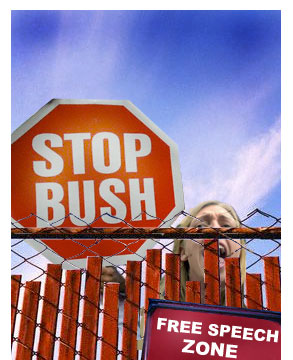

When Bill Neel learned that President George W. Bush was making a Labor Day campaign visit to Pittsburgh last year to support local congressional candidates, the retired Pittsburgh steelworker decided that he would be on hand to protest the president’s economic policies. Neel and his sister made a hand-lettered sign reading “The Bushes must love the poor — they’ve made so many of us,” and headed for a road where the motorcade would pass on the way from the airport to a Carpenters’ Union training center.
He never got to display his sign for President Bush to see, though. As he stood among milling groups of Bush supporters, he was approached by a local police detective, who told him and his sister that because they were protesting, they had to move to a “free speech area,” on orders of the U.S. Secret Service.
“He pointed out a relatively remote baseball diamond that was enclosed in a chain-link fence,” Neel recalled in an interview with Salon. “I could see these people behind the fence, with their faces up against it, and their hands on the wire.” (The ACLU posted photos of the demonstrators and supporters at that event on its Web site.) “It looked more like a concentration camp than a free speech area to me, so I said, ‘I’m not going in there. I thought the whole country was a free speech area.’” The detective asked Neel, 66, to go to the area six or eight times, and when he politely refused, he handcuffed and arrested the retired steelworker on a charge of disorderly conduct. When Neel’s sister argued against his arrest, she was cuffed and hauled off as well. The two spent the president’s visit in a firehouse that was serving as Secret Service and police headquarters for the event.
It appears that the Neels’ experience is not unique. Late last month, on Sept. 23, the American Civil Liberties Union filed a lawsuit in a federal court in Philadelphia against the Secret Service, alleging that the agency, a unit of the new Homeland Security Department charged with protecting the president, vice president and other key government officials, instituted a policy in the months even before the Sept. 11 terrorist attacks of instructing local police to cordon off protesters from the president and Vice President Dick Cheney. Plaintiffs include the National Organization for Women, ACORN, USA Action and United for Justice, and groups and individuals who have been penned up during presidential visits, or arrested for refusing to go into a “free speech area,” in places ranging from California to New Mexico, Missouri, Connecticut, New Jersey, South Carolina and elsewhere in Pennsylvania.
The ACLU, which began investigating Secret Service practices following Neel’s arrest, has identified 17 separate incidents where protesters were segregated or removed during presidential or vice-presidential events, and Pittsburgh ACLU legal director Witold Walczak says, “I wouldn’t be surprised if this is just the tip of the iceberg. We don’t have the resources to follow Bush and Cheney everywhere they go.” The suit also comes at a time of mounting charges by many civil libertarians on both the left and the right that the Bush Administration and Attorney General John Ashcroft’s Justice Department are trampling on civil liberties.
“There is some history supporting the notion that all presidents dislike people who don’t like them,” says Stefan Presser, head of the ACLU of Philadelphia ACLU chapter and another lead attorney in the suit the Secret Service. “But this approach of fencing protesters in and removing them from view is unprecedented, and it’s gotten worse over the past two years.”
Well, maybe not exactly unprecedented. Pittsburgh’s Walczak notes that during Nixon administration, especially during his second term, police “made quite a practice” of tearing up protest signs and confining protesters, and at least in one case that went to court, the Secret Service admitted being behind the actions. He says there were some isolated instances of interference with protesters during the Reagan administration, and even at President Clinton’s inauguration, an attempt was made (unsuccessfully, thanks to ACLU intervention) to bar anti-abortion protesters from the inaugural march.
In its complaint, the ACLU cites nine cases since March 2001 in which protesters were quarantined. And it alleges that the Secret Service, with the assistance of state and local police, is systematically violating protesters’ First Amendment rights via two methods. “Under the first form,” the suit says, ” the protesters are moved further away from the location of the official and/or the event, allowing people who express views that support the government to remain closer. Under the second form, everyone expressing a view — either critical or supportive of the government — is moved further away, leaving people who merely observe, but publicly express no view, to remain closer.”
In either case, the complaint adds, “protesters are typically segregated into what are commonly referred to as ‘protest zones.’”
In the ACLU’s view, the strategy, besides violating a fundamental right of free speech and assembly, is damaging in two ways. “It insulates the government officials from seeing or hearing the protesters and vice-versa, and it gives to the media and the American public the appearance that there exists less dissent than there really is.”
Certainly, as television cameras follow a presidential motorcade lined with cheering supporters, the image on the tube will be distorted if protesters have all been spirited away around a corner somewhere fenced in for the duration.
Contacted by Salon, the Secret Service denied that it discriminates against protesters. “The Secret Service is message-neutral,” said spokesman John Gill. “We make no distinction on the basis of the purposes or intent of any group or the content of signs.”
Further, Gill insisted that the establishment and oversight of local viewing areas during a presidential or vice presidential visit “is the responsibility of state and local law enforcement.” In practice, it’s apparently not that simple, though. Nor is the Secret Service’s carefully worded denial of responsibility as definitive as it might appear. The “establishment of viewing areas” is indeed a local law enforcement responsibility, but local law enforcement officials say that the Secret Service has in some cases all but ordered them to pen in protesters. And it appears that the Secret Service is making recommendations about how that should be done.
Paul Wolf is an assistant supervisor in charge of operations at the Allegheny County Police Department and was involved in planning for the presidential visit to Pittsburgh last fall. He told Salon that the decision to pen in Bush critics like Neel originated with the Secret Service. “Generally, we don’t put protesters inside enclosures,” he said. “The only time I remember us doing that was a Ku Klux Klan rally, where there was an opposing rally, and we had to put up a fence to separate them.
“What the Secret Service does,” he explained, “is they come in and do a site survey, and say, ‘Here’s a place where the people can be, and we’d like to have any protesters be put in a place that is able to be secured.’ Someone, say our police chief, may have suggested the place, but the request to fence them in comes from the Secret Service. They run the show.”
The statement by Wolf, who ranks just below the Allegheny County police chief, is backed up by the sworn testimony of the detective who arrested Neel. At a hearing in county court, Det. John Ianachione, testifying under oath, said that the Secret Service had instructed local police to herd into the enclosed so-called free-speech area “people that were there making a statement pretty much against the president and his views.” Explaining further, he added: “If they were exhibiting themselves as a protester, they were to go in that area.”
Asked to respond to the accounts of Wolf and Ianachione about the Secret Service’s role in handling of protesters, spokesman Gill said only, “No comment.” Asked pointedly whether Wolf’s account was incorrect, Gill again said, “No comment.”
Wolf also raises the possibility that White House operatives may be behind the moves to isolate and remove protesters from presidential events. He says that while he cannot recall specifically whether they were present with the Secret Service advance team before last year’s presidential Labor Day visit, “I think they are sometimes part of” the planning process. The Secret Service declined to comment on this assertion, saying it would not discuss “security arrangements.” The White House declined to comment on what role the White House staff plays in deciding how protesters at presidential events should be handled, referring all calls to the Secret Service.
Asked specifically whether White House officials have been behind requests to have protesters segregated and removed from the vicinity of presidential events, White House spokesman Allen Abney said, “No comment.” But he added, “The White House staff and the Secret Service work together on a lot of things.” While the Secret Service won’t confirm that it is behind the pattern of tight constraints placed on protesters at public appearances by Bush and Cheney, the ACLU claims that mounting evidence suggests that this is exactly what is going on.
But the ACLU’s lawsuit claims that the Secret Service is responsible for the tight constraints. A number of individual plaintiffs in the suit say that when they were directed into remote “free-speech areas,” or arrested for refusing to go to such sites, they were informed that the local police were acting “on orders from the Secret Service.”
That’s the story Bill Ramsey got when he was arrested last Nov. 4 by police in St. Charles, Mo., while attempting to unfurl an antiwar banner amid a group of pro-Bush people during a presidential visit to a local airport. “The police told us if we wanted to show the banner, we’d have to go to a parking lot four-tenths of a mile away and out of sight of the president’s motorcade,” says Ramsey. When we attempted to put it up anyway, they arrested us, and said they’d been ordered to by the Secret Service.”
But Ramsey says that when his organization, the Instead of War Coalition, has sought to obtain permission to hold its demonstrations during presidential visits, they are told by the Secret Service that such matters are the responsibility of local police. “When we go to the local police, though, they say it’s up to the Secret Service.”
Efforts to obtain a comment from the St. Charles Police Department were unsuccessful.
Andrew Wimmer, another member of the Instead of War Coalition, says he was offered a similar explanation last January in St. Louis when he attempted to unfurl a sign reading “Instead of War, Invest in People” on a street full of Bush supporters. According to Wimmer, St. Louis police officers told him he’d have to leave a street full of Bush supporters and go to a protest area two blocks from the presidential motorcade route because of his protest sign. He recalls that as crowds of people walked down a thoroughfare toward the trading company that President Bush was slated to visit, “local police were pulling out people carrying protest signs and directing them to the protest area.” The 48-year-old IT worker says, “When they got to me, I said no, I’d just as soon stand with the people here. But they said the Secret Service wanted protesters in the protest area.”
In the end, Wimmer, like Ramsey and others who have refused to be caged during protests, was arrested. “They charged me with obstructing passage with my sign, which was a 2.5-foot-by-2-foot lawn sign,” he says, noting that a woman standing nearby with a similar-size sign saying “We love you Mr. President,” was left alone.
“The Secret Service keeps saying that the decision to separate protesters and remove them from view is a local police matter,” says Denise Lieberman, legal director of the ACLU of Eastern Missouri, who is representing both Ramsey and Wimmer in their arrest cases. “But these kinds of things only happen when the Secret Service is involved. We’ve had many visits to St. Louis — by the pope, by candidates, by dignitaries — and it’s only when the president or the vice president come to town that this kind of thing happens.”
“We expect to see a lot more of this heading into a campaign season,” says Chris Hansen, senior staff attorney at the ACLU and one of the lead attorneys handling the suit against the Secret Service.
Presser, the Philadelphia ACLU attorney, traces the tactic to the last Republican National Convention, which nominated Bush for the presidency in August 2000. “The GOP tried to reserve every possible space where a protest group might rally,” Presser recalls. “Part of the party’s contract with the city of Philadelphia for the convention was that they were given an omnibus permit to use ‘all available space’ for the two weeks of the convention. They basically privatized the city to block all legal protest.”
During that convention, the city attempted to require all groups seeking to protest during the convention to apply for permits to get a 15-minute protest time slot, during which they would be allowed to assemble and make their statement in a sunken “protest pit,” remote from the Convention Center. Many groups refused, and the result was a series of conflicts with local police and many arrests, most of which were later tossed out by the courts.
Since then, Presser charges, the Bush administration has continued the strategy of using the Secret Service and cooperative local police departments to keep protesters at bay, and not incidentally, out of easy range of the media. “People used to say that Ronald Reagan’s was the most scripted administration we ever had,” the attorney says, “but this Bush administration has gone way beyond that.” Presser adds that he was told by William Fisher, a senior Philadelphia police captain and head of the department’s Civil Affairs Unit, that the tight restrictions and decision to cordon off protesters during presidential visits have come “at the Secret Service’s direction.” Fisher declined to be interviewed for this article, but when asked, did not deny Presser’s account of their conversation.
Presser and the ACLU don’t question the Secret Service’s responsibility to protect the president and other key government officials. Even plaintiffs in the case agree that the president must be protected. But “putting protesters behind a fence isn’t going to help,” says Neel, the former Pittsburgh steelworker. “I mean, somebody who was going to attempt an assassination wouldn’t be carrying a protest sign. He’d be carrying a sign saying ‘I love George!’”
The ACLU’s Presser agrees. “Just as the terrorists who attacked the World Trade Center were careful to blend in and stayed away from mosques,” he says, “anyone who had ill will towards the president could just put on a pro-Bush T-shirt and, under this policy, he’d be allowed to move closer to the president by the Secret Service.”
He adds, “It seems that these ‘security zones’ for protesters have very little to do with the president’s physical security, and a whole lot to do with his political security.” Asked how many times in history an attack had been made on a president or other official under Secret Service protection by someone clearly identifiable as a protester, agency spokesman Gill said, “I’m not going to comment on that.” Interestingly, Gill at no point claimed that protesters posed a special threat to the president or vice president.
Whatever the real motives behind it, the Secret Service policy of fencing off protests and protesters during presidential events may be in for a tough challenge. The judge assigned to the case, John Fullam, is an appointee of former President Lyndon B. Johnson, and back in the late 1980s issued a permanent injunction in Philadelphia — still in effect — that bars both the city of Philadelphia and the National Parks Department (the agency in charge of the city’s many federal monuments), from treating protesters or people wearing protest paraphernalia any differently from other citizens.
The ACLU, which is seeking an injunction barring the Secret Service and local police from treating protesters differently from other spectators at administration events, is hopeful that the court will act “before the presidential campaign gets into full swing next summer,” says Walczak. Meanwhile, Presser says he is optimistic that the lawsuit, simply by being filed, could make things easier for protesters during the coming campaign season.”I suspect that this suit may give the Secret Service and local police some pause in how they treat protests,” he says.
New documents obtained by the ACLU show that the FBI has for years been using Census data to “map” ethnic and religious groups suspected of being likely to commit certain types of crimes.
Much is still not known about the apparent large-scale effort in racial profiling, partly because the documents the ACLU obtained through public records requests are heavily redacted.
The FBI maintains that the mapping program is designed to “better understand the communities that are potential victims of the threats,” but the ACLU says it is plainly unconstitutional.
To learn more about the FBI program, its implications for civil liberties and the questions that remain unanswered, I spoke to Michael German, policy counsel at the ACLU’s Washington office and a former FBI agent.
What is the new information that has come to light here?
In 2008, the FBI’s guidelines were changed to create a new category of investigations called assessments, which required no factual predicate. The FBI’s policy in implementing those changes were released around 2010 and showed the FBI was engaged in a program called “domain management,” which included mapping and gathering intelligence on racial and ethnic communities. We were concerned about the program, so we filed a series of Freedom of Information Act requests across the country and we now have documents that indicate what the FBI has been doing with this new authority. Clearly they have been engaging in crass racial stereotyping of minority groups are linked to certain types of crime, and then using Census information to map entire communities based on their race or ethnicity.
When you say “map,” what does that actually look like in practice?
It’s hard for us to know because all the maps were heavily redacted. It’s clear they are maps. They are using Census data in order to identify anybody who identifies with a certain race or ethnicity. In the Detroit memo, it’s based on adherence to Muslim faith or Middle Eastern origin. The purpose of the program is to identify these communities where the FBI can then conduct intelligence or law enforcement investigations.
So what sort of crimes have they linked to various racial groups?
There was a San Francisco memo that suggested because there was Chinese organized crime, there should be a domain management collection program to identify the entire Chinese community in the San Francisco area. That memo also included an effort to target the Russian-American community. There was an Atlanta FBI memo that purported to analyze the black separatist threat. It documented the population growth of blacks in Georgia as part of the assessment. It also identified a couple of actual organizations, but in the information, what is reported is their First Amendment activities: their appearances at different protests and at a congressional campaign event.
Is the ACLU arguing here that this program is unconstitutional?
Yes, we feel it is unconstitutional — and in many cases actually violates the Department of Justice guidance regarding the use of race in federal law enforcement. That guidance purports to ban racial profiling in ordinary law enforcement investigations. The problem is, it has a huge loophole for national security and border integrity investigations. What’s clear from these new documents is that the loophole has swallowed the rule because they are using this program to target communities based on their race in the context of normal criminal activity.
What part of the Constitution does this violate in the ACLU’s view?
It violates the First, Fourth and 14th amendments. This program is entirely targeting communities of people for investigation based on their race, ethnicity, national origin, or religion, denying them equal protection under the law — and also targeting people because of their First Amendment-protected activities. They are then conducting broad suspicionless investigations called assessments, and collecting information in which there are Fourth Amendment concerns that it is unreasonable to conduct such invasive investigations.
One of the documents we released this week is an FBI memo to the field where they discuss what type of information they want collected during assessments. That document shows this isn’t a minimally invasive investigation. It collects a tremendous amount of material so the FBI can build dossiers against people with no reason to believe that they as individuals were involved in any kind of wrongdoing. It also authorizes what it calls a “disruption strategy,” in which, after all the information is collected and the threat is otherwise resolved, the FBI can continue doing other things like performing interviews, arrests and source-directed operations. Back in the Hoover era, the FBI’s COINTELPRO included a disruption strategy that was later found to be aimed at obstructing First Amendment-protected activity. So we have serious concerns about what this new disruption strategy might be doing and who is overseeing it.
When it comes to that Detroit memo about Muslims and terrorism, how do you respond to people who look at this and think, “This is what the FBI should be doing”?
This is racial and religious profiling on an industrial scale. Rather than just stopping an individual based on race, the FBI is identifying an entire community based on race and subjecting them to more intense scrutiny. There are many problems that exist with racial profiling: first that it’s unlawful, but also that it’s ineffective as a methodology because every dollar and every hour of an agent’s time that is spent investigating innocent people is completely wasted. It is also really a dangerous practice because all law enforcement depends on public support to be successful. If they’re alienating entire communities based on race or religion, that is going to be an entirely counter-productive methodology.
Continue Reading
Close
The last decade has spawned a massive expansion of the domestic Surveillance State. Worse, the U.S. Government has vested itself with the virtually unchallenged ability to operate this surveillance regime in full secrecy and even beyond the reach of judicial review, which is another way of saying: above and beyond the rule of law.
Each time U.S. citizens in the post-9/11 era have accused government officials in federal court of violating the Constitution or otherwise acting illegally with how they spy on Americans, the Justice Department employs one of two secrecy weapons to convince courts they must not even rule on the legality of the domestic spying: (1) they insist the spying program is too secret to allow courts even to examine it (the Bush/Obama rendition of the “state secrets” privilege); and/or (2) because the spying is conducted in complete secrecy, nobody can say for certain that they have been subjected to it, and the DOJ thus argues that the particular individuals suing the Government — and, for that matter, everyone else in the country — lacks “standing” to challenge the legality of the spying (because nobody knows on whom we’re spying, nobody has the right to sue us for breaking the law).
A government that can spy on its own citizens without judicial review is a government which, by definition, operates outside of the rule of law; as Alexander Hamilton put it in Federalist 15:
It is essential to the idea of a law, that it be attended with a sanction; or, in other words, a penalty or punishment for disobedience. If there be no penalty annexed to disobedience, the resolutions or commands which pretend to be laws will, in fact, amount to nothing more than advice or recommendation.
These are the two secrecy doctrines which the Bush and Obama DOJ have repeatedly invoked to shield even the Bush NSA warrentless eavesdropping program from all forms of legal accountability, notwithstanding the fact that three separate federal judges ruled (ultimately without consequence due to reversals on secrecy grounds) that the program violated the Constitution and/or criminal laws such as FISA. Most amazingly, the Obama DOJ has aggressively used these same secrecy doctrines to ensure that no courts ever review or adjudicate any government surveillance programs, including Bush’s NSA warrantless program, even though then-Sen. Obama — when opposing the 2005 nomination of NSA Chief Michael Hayden to become CIA Director — accused Bush of breaking the law in spying on Americans without warrants and then said this on the Senate floor:
We don’t expect the President to give the American people every detail about a classified surveillance program. But we do expect him to place such a program within the rule of law, and to allow members of the other two coequal branches of government – Congress and the Judiciary – to have the ability to monitor and oversee such a program. Our Constitution and our right to privacy as Americans require as much.
In 2008, the Democratic Congress enacted the FISA Amendments Act, which not only retroactively immunized telecoms from all liability for their role in Bush’s illegal eavesdropping programs (thus terminating all pending lawsuits and ensuring no judicial adjudication of that program), but also, going forward, legalized much of Bush’s previously illegal warrantless spying activities. The FAA was the most drastic expansion of government eavesdropping powers in decades. Numerous scholars documented how blatantly the new surveillance powers it vested violated the Fourth Amendment (the FAA was the bill which candidate Obama, when seeking the Democratic nomination, had unambiguously promised to filibuster, only to turn around, once he secured his Party’s nomination, and vote against a filibuster and then in favor of the underlying bill).
* * * * *
When Congress enacts a law vesting new domestic spying powers in the NSA that very likely violate the Fourth Amendment, the only solution — at least in theory, as the American system is designed — is for citizens to sue the Government in federal court and argue that the new law is unconstitutional. The Supreme Court unanimously explained back in 1803 in Marbury v. Madison (emphasis added):
It is emphatically the duty of the Judicial Department to say what the law is. . . .If courts are to regard the Constitution, and the Constitution is superior to any ordinary act of the legislature, the Constitution, and not such ordinary act, must govern the case to which they both apply. . . .
[W]here a specific duty is assigned by law, and individual rights depend upon the performance of that duty, it seems equally clear that the individual who considers himself injured has a right to resort to the laws of his country for a remedy.
That’s as basic as it gets to the ostensible American design. If citizens are not able to do that — if they have no mechanism to deny the Government the power to transgress the limits imposed by the Constitution — what is the point of even having a Constitution?
Immediately after Bush signed the FAA into law, numerous journalists, human rights activists, and groups such as Amnesty International — represented by the ACLU — adhered to this design by suing the U.S. government, claiming that the FAA was unconstitutional under the Fourth Amendment. They argued that although the secrecy behind which the program was conducted prevented them from proving that they were subjected to it, their well-founded fear that they would be (and the steps they were forced to take in response) was enough harm to confer “standing” on them and allow them to challenge the law’s constitutionality.
In response, the Bush DOJ raised its standard secrecy claims and convinced a lower court judge to dismiss the suit based on “standing.” When the ACLU appealed this ruling to the Second Circuit Court of Appeals in New York, the Obama DOJ raised the same arguments to demand dismissal. But in March, a unanimous three-judge appellate panel rejected the Bush/Obama argument and reinstated the ACLU’s lawsuit, holding that the plaintiffs’ credible fear of being subjected to the FAA’s eavesdropping power entitled them to proceed with their claims that the new law was unconstitutional. The Obama DOJ then sought a review of that decision by the entire Circuit, insisting that plaintiffs should be barred from contesting the constitutionality of the FAA.
Yesterday, the full Second Circuit panel issued its ruling on the Obama DOJ’s request. Six of the judges voted against a full review of the decision by the three-judge panel, while six voted in favor of reviewing it. Because a majority is needed for a full-circuit review, the 6-6 tie means that there will no further review, and the March decision of the three-judge panel — allowing the lawsuit challenging the FAA’s constitutionality to proceed — will stand. This significant victory for the rule of law may well be temporary, as the unusual 6-6 vote (and the numerous contentious opinions accompanying the vote) makes it likely (though by no means guaranteed) that the Supreme Court will accept this standing dispute for resolution. But at least for now, this is a good and important development.
* * * * *
The bulk of the opinions issued by the Second Circuit judges were devoted to fairly standard arguments over the requirements of ”standing.” Here, for instance, was the crux of the argument for recognizing plaintiffs’ standing, as expressed by Judge Gerard Lynch after he reviewed the Goverment’s substantive arguments for why the FAA was constitutional:

The dissenting judges argued that mere fear of being subjected to this spying was insufficient to allow plaintiffs to sue; instead, they must prove they have been or will be spied upon (that nobody can prove this, due to the secrecy in which the program is shrouded, is a Kafkaesque Catch-22 of no apparent concern to these jurists).
But by far the most remarkable aspect of this ruling was the dissenting opinion issued by Dennis G. Jacobs, the Chief Judge of the Second Circuit. Notably, no other judges joined the Chief Judge’s opinion, and it’s not difficult to see why. Jacobs’ opinion is one of the most intemperate, childish, nakedly ideological, and just plain obnoxious judicial outbursts you will ever encounter in writing. But it highlights some important facts about the federal judiciary that make it worth examining.
After accusing the plaintiffs of harboring anti-Americanism for daring to enforce the mandates of the United States Constitution against precisely the activities most feared by the American Founders: unchecked domestic government spying (Jacobs announced his discovery that the plaintiffs’ argument rests on a “buried assumption that the United States is the only threat to liberty that anyone anywhere needs to worry about”), he turned his scornful ire to the ACLU for the crime of representing these plaintiffs — for free — in a lawsuit to enforce the privacy rights of all American citizens. Unprovoked, Jacobs posed the question of what could possibly motivate the ACLU and its clients to bring this lawsuit — apparently, an actual belief that the law is unconstitutional and dangerous could not possibly be the real motive — and this is the answer he supplied:
At the risk of being obvious, the purpose of this lawsuit is litigation for its own sake — for these lawyers to claim a role in policy-making for which they were not appointed or elected, for which they are not fitted by experience, and for which they are not accountable. As best I can see, the only purpose of this litigation is for counsel and plaintiffs to act out their fantasy of persecution, to validate their pretensions to policy expertise, to make themselves consequential rather than marginal, and to raise funds for self-sustaining litigation.
Apparently, only “fantasies of persecution” — as opposed to the most basic knowledge of history — can lead someone to believe that spying powers conducted in secret will be abused. He then added that this Constitutional challenge to the Government’s secret spying powers “bears similarity to a pro se plaintiff’s allegation that the CIA is controlling him through a radio embedded in his molar.” Not content with maligning their motives and patriotism, he then all but accused the ACLU and its clients of lying in order to sustain the lawsuit (“these affidavits employ all the lawyer’s arts to convey a devious impression . . . affidavits that are craftily worded to skirt actual falsehood”).
* * * * *
Let’s spend a moment comparing Dennis G. Jacobs to the ACLU lawyers whose alleged motives he just smeared based on his armchair assessments of their psychology (all while ironically criticizing them for “pretenses” to “expertise” for “which they are not fitted by experience”). This comparison not only demonstrates how deceitful and malicious is his attack, but it also speaks volumes about the corrupted role the federal judiciary is playing in our system of government.
Virtually every ACLU lawyer is very smart and well-educated; for instance, the lead ACLU lawyer in this case, Jameel Jaffer, is a graduate of Cambridge University and Harvard Law School, where he served as an editor of its law review. Every one of these lawyers could therefore easily have joined (and could still join) the nation’s most lucrative Wall Street law firms, or enter government and serve in various functionary capacities — presumably what they would do if actually motivated by a need for self-importance, policy influence or financial gain, as Jacobs accuses.
Instead, they labor very long hours in exchange for a salary that is a small fraction of what they could earn at any moment they choose. They work for a non-profit organization that is systematically excluded from the halls of Washington power, often representing the most marginalized, powerless, and scorned segments of society (which, by definition, are most vulnerable to rights abridgments). They do so knowing that they will be continuously smeared and maligned in the most vicious, McCarthyite and public ways by the Dennis Jacobses — or the Lee Atwaters and Weekly Standards — of the world. Nobody with their background and opportunities would do that for any reason other than genuine convictions about basic Constitutional liberties and a passionate commitment to defending them, thus fulfilling what Thomas Paine, in his 1790 Dissertations on First Principles in Government, described as the prime duty for preserving freedom for everyone (a passage Dennis Jacobs, if he would ever read it, would likely castigate as “fantasies of persecution”):
An avidity to punish is always dangerous to liberty. It leads men to stretch, to misinterpret, and to misapply even the best of laws. He that would make his own liberty secure must guard even his enemy from oppression; for if he violates this duty he establishes a precedent that will reach to himself.
All of that stands in very stark contrast to Dennis G. Jacobs. Immediately after graduating law school, he went to work for a large Wall Street law firm — Simpson, Thacher & Bartlett — and stayed there for the next 19 years, until George Bush 41 appointed him to a life-tenured federal judgeship. How noble. So the entirety of Jacobs’ law career before becoming a judge was devoted to snorting up as much cash as he could as he represented large corporations and banks. That’s the person who just anointed himself the arbiter and smearer of the integrity, psychology and motives of ACLU lawyers and their human-rights-activists clients for daring to challenge a government spying law on Fourth Amendment grounds.
But far more notable is that Jacobs has remained every bit as loyal — indeed, more so — to these large corporate institutions as a federal judge. He has developed a bizarre contempt for pro bono legal work: i.e., lawyers who work for free on behalf of poor and otherwise marginalized clients against the types of clients Jacobs enriched himself representing, in order to provide some minimal degree of fairness and balance in the justice system. In 2008, Jacobs delivered a speech to the right-wing Federalist Society mocking and scorning pro bono work — he entitled the speech ”Pro Bono for Fun and Profit” — and began by depicting himself as some sort of courageous, politically incorrect martyr for bravely attacking pro bono lawyers in front of this right-wing audience:
When lawyers gather and judges speak, you can count on hearing something on the subject of pro bono service. It is always praise of all that is done, with encouragement to do more. This evening I am going to articulate a view that you may not have heard: I will touch on some of the anti-social effects of some pro bono activity.
He then devoted his entire speech to attacking lawyers who challenge government acts as unconstitutional and those who bring civil rights cases on behalf of large numbers of discriminated-against citizens. Most of the rhetoric he spat yesterday at the ACLU, Amnesty and others in his “judicial opinion” was just pre-packaged politicized tripe that he delivered years ago to the Federalist Society. He’s on a one-man ideological crusade to convince the nation of the evils of pro bono work and, especially, effective challenges to government and corporate power.
In 2010, Jacobs again appeared before the Federalist Society’s annual conference and delivered the “Barbara K. Olsen Memorial Lecture,” named after the Fox News legal scholar who spent the 1990s churning out every tawdry allegation against Bill and Hillary Clinton before she died in the 9/11 attack. Ironically, Jacobs delivered a 2006 speech — entitled “The Secret Life of Judges” — in which he purported to reveal a pervasive “bias” among the judiciary: reliance on law and legal procedure in lieu of policy judgments.
Of course, Jacobs is the living, breathing embodiment of judicial bias: a devoted servant to corporate and government power, a right-wing hack who barely attempts to hide his political loyalties, and — most of all — a declared enemy of the very few mechanisms that exist to enable the poor and marginalized to receive competent legal representation and for political power to be subject to some minimal checks (what we call “the Constitution”). It should be anything but surprising that a corporate-serving, political-power-revering, highly politicized figure like this produces judicial opinions that are slightly more restrained versions of a Rush Limbaugh or Bill O’Reilly rant. He churns out right-wing agitprop masquerading as legal reasoning.
But the reason he’s worth examining is because he’s anything but aberrational. He’s the Chief Judge of the second- or third-most important court in the country. He works in a judicial system that more and more does the opposite of what it was ostensibly designed to do: it is now devoted to shielding political officials from legal accountability and transparency rather than exposing them to it, enabling rather than halting transgressions of the Constitutional limits imposed on them, and most of all, further empowering the most powerful factions against the least powerful rather than equalizing the playing field. In that regard, the life of Dennis G. Jacobs — and his slanderous, contemptuous outburst of yesterday — should be studied as a perfect embodiment of how the American judicial branch has become so corrupted as a tool for the nation’s most powerful factions.
Continue Reading
Close
(updated below – Update II)
The ACLU decided to use the 10th anniversary of the 9/11 attack to comprehensively survey the severe erosion of civil liberties justified in the name of that event, an erosion that — as it documents — continues unabated, indeed often in accelerated form, under the Obama administration. The group today is issuing a report entitled A Call to Courage: Reclaiming Our Liberties Ten Years After 9/11; that title is intended to underscore the irony that political leaders who prance around as courageous warriors against Terrorism in fact rely on one primary weapon — fear-mongering: the absence of courage — to vest the government with ever-more power and the citizenry with ever-fewer rights. Domestically, the “War on Terror” has been, and continues to be, a war on basic political liberties more than it is anything else. The particulars identified in this new ACLU report will not be even remotely new to any readers here, but given the organization’s status among progressives as the preeminent rights-defending group in the country, and given the bird’s-eye-view the report takes of these issues, it is well worth highlighting some of its key findings.
Let’s begin with the ACLU’s summary assessment of what President Obama has done with regard to these matters:

Last week, the top lawyer and 34-year-veteran of the CIA, John Rizzo, explained to PBS’ Frontline that Obama has “changed virtually nothing” from Bush policies in these areas, and this week, the ACLU explains that “most [Bush] policies remain core elements of our national security strategy today.“ At some point very soon, this basic truth will be impossible to deny with a straight face even for the most hardened loyalists of both parties, each of whom have been eager, for their own reasons, to deny it (and even the two differences cited there, though positive, are wildly exaggerated by Obama defenders: the torture techniques authorized by Bush were no longer in use and the CIA black sites were empty by the time Obama was inaugurated; by contrast, there is ample evidence that the Obama administration continues to use torture by proxy and rendition/CIA-black-sites by proxy as well).
The ACLU then highlights one of the most perverse though revealing ironies of Democratic Party opinion on civil liberties in the Obama age: the way in which Bush’s attempt merely to imprison a U.S. citizen without due process (or merely to eavesdrop on citizens) prompted such outrage, while Obama’s claimed right to assassinate U.S. citizens without due process provokes virtually no protest:
Critically, the ACLU emphasizes that this Obama fixation — wildly expanded programs of targeted killings even of U.S. citizens far from any battlefield — is as threatening to the rule of law, and at least as dangerous, as any policy implemented by Bush/Cheney:
For all the talk about how Bush and Cheney turned the U.S. into a rogue state, here is the escalating result of this Obama policy:
The ACLU then devotes an entire chapter to the way in which immunity for America’s torturers — bestowed jointly by President Obama and a judicial branch meekly deferential to his and Bush’s claims of state secrecy — has contaminated and degraded the entire justice system and made the future reintroduction of torture a virtual inevitability:
Then there’s the ongoing targeting of American Muslims for some of the most invasive and unconstitutional rights-abridging actions in decades. Explains the ACLU: ”No area of American Muslim civil society was left untouched by discriminatory and illegitimate government action during the Bush years . . . In short, the Bush administration used religious, racial, and national-origin profiling as one of this nation’s primary domestic counter-terrorism tools.” And now?

A separate chapter is devoted to what the ACLU calls “A Massive and Unchecked Surveillance Society.” It explains: ”Using Patriot Act authority, the Bush Administration started — and the Obama Administration has continued — to conduct wholesale ‘preventive’ surveillance of innocent Americans without judicial review.” And “the result is a national surveillance society in which Americans’ right to privacy is under unprecedented siege.” But little is known about exactly what is being done by this purely unaccountable hidden government — what The Washington Post calls “Top Secret America” – because of this:
This Surveillance State, like most other Bush/Obama Terrorism policies, is justified by a never-ending orgy of fear-mongering. But other than the enrichment of the private Security State industry (see here and here), its real purpose — as I documented last week — is this:
But the primary cause of this Bush-Obama continuity is the vigorous embrace by both Presidents of the same theory of war and Terrorism — the unlimited global battlefield and the President’s resulting unconstrained power to act anywhere in the world without limits — which was once so controversial during the Bush presidency but has now become mainstream, bipartisan consensus:
Pointing to that core theory of both presidencies, the ACLU dispatches one of the most misleading claims of Obama defenders: that the President’s failure to close Guantanamo is due exclusively to Congressional obstructionism; in fact, long before Congress acted at all with regard to that camp, the President announced his intention to continue its core injustice — indefinite detention — albeit in a different locale:

During the Bush era, the actions and condemnations of the ACLU received ample positive attention from progressives. That, of course, is no longer true, and this damning report will likely be ignored in most of those circles, just as this truly remarkable comment from the ACLU’s Executive Director has been. And, as usual, anyone urging that attention be paid to these facts will be met with demands that eyes be diverted instead to how scary Sarah Palin Christine O’Donnell Michele Bachmann Rick Perry is, and then this will all blissfully fade away in a cloud of partisan electioneering even with the election more than a year away.
Either way, this creeping unchecked authoritarianism marches forward unabated, and is now — rather than the province of the right-wing GOP – fully bipartisan consensus. I really don’t understand how progressives think they’ll be taken seriously the next time there is a GOP President and they try to resurrect their feigned concern for these matters; they’ll be every bit as credible as conservatives who pretend to be deficit-warriors and defenders of restrained government only when the other party is in power.
But even that ultimately matters little: so entrenched is this institutional militarism, secrecy, surveillance and authoritarianism that even if there were greater public debate over it like there was during the Bush presidency, this system would hardly be affected, let alone threatened. Governments and other power factions — especially ones threatened by the prospect of social unrest and upheaval — do not relinquish this sort of authority unless compelled to do so.
UPDATE: Tomorrow morning beginning at roughly 11:20 am EST, I’ll be on NPR’s On Point, discussing 9/11 and civil liberties, along with The Washington Post‘s Dana Priest, who will be on from the start of the show at 11:00 am discussing Top Secret America.
UPDATE II: Donald Rumsfeld becomes the latest right-wing figure — of many — to heap praise on President Obama’s Terrorism and civil liberties policies (h/t flellis):
Former Defense Secretary Donald Rumsfeld says President Barack Obama has come to accept much of the Bush Doctrine out of necessity, despite what he campaigned on in 2008. . . .
“They ended up keeping Guantanamo open not because they like it — we didn’t like it either — but they couldn’t think of a better solution,” Rumsfeld told Fox News’ Greta Van Susteren on Tuesday. . . .
“The same is true with the Patriot Act, and military commissions, and indefinite detention. All of those things were criticized but today are still in place two-and-a-half years later because they are the best alternative to the other choices — and they are in fact successful in keeping America safer,” he says.
Just as nobody could have strengthened the Bush/Cheney Terrorism template the way Obama has, so, too could nobody have provided vindication for those policies the way he has.
Continue Reading
Close
What’s good for the police apparently isn’t good for the people — or so the law enforcement community would have us believe when it comes to surveillance.
That’s a concise summary of a new trend first reported by National Public Radio last week — the trend whereby law enforcement officials have been trying to prevent civilians from using cellphone cameras in public places as a means of deterring police brutality.
Oddly, the effort — which employs both forcible arrests of videographers and legal proceedings against them — comes at a time when the American Civil Liberties Union reports that “an increasing number of American cities and towns are investing millions of taxpayer dollars in surveillance camera systems.”
Then again, maybe it’s not odd that the two trends are happening simultaneously. Maybe they go hand in hand. Perhaps as more police officers use cameras to monitor every move we make, they are discovering the true power of video to independently document events. And as they see that power, they don’t want it turned against them.
But wait — why not?
Though you’d expect that uncomfortable question to evoke dissembling, Fraternal Order of Police spokesman Jim Pasco was quite straightforward about it.
Police officers, he told NPR, “need to move quickly, in split seconds, without giving a lot of thought to what the adverse consequences for them might be.” He added that law enforcement authorities believe “that anything that’s going to have a chilling effect on an officer moving — an apprehension that he’s being videotaped and may be made to look bad — could cost him or some citizen their life.”
Obviously, nobody wants to stop officers from doing their much-needed job (well, nobody other than budget-cutting politicians who are slashing police forces). In fact, organizations such as the NAACP have urged citizens to videotape police precisely to make sure police are doing ALL of their job — including protecting individuals’ civil liberties.
This is not some academic or theoretical concern, and video recording is not a needless exercise in Bill of Rights zealotry. The assault on civil liberties in America is a very real problem and monitoring police is absolutely required in light of recent data.
As USA Today reported under the headline “Police brutality cases on rise since 9/11,” situations “in which police, prison guards and other law enforcement authorities have used excessive force or other tactics to violate victims’ civil rights increased 25 percent” between 2001 and 2007. Last year alone, more than 1,500 officers were involved in excessive force complaints, according to the National Police Misconduct Statistics and Reporting Project.
Considering this, Pasco has it exactly wrong. We should want more officers feeling “apprehension” about breaking civil liberties laws, we should hope more of them “give a lot of thought to what the adverse consequences” will be if they trample someone’s rights and we should crave an immediate “chilling effect” on such violations.
That’s what the practice of cellphone recording is supposed to do — not mimic the national security state’s Big Brother culture, but prevent that security state from trampling our freedoms.
Law enforcement officials, of course, don’t like the cellphone cameras because they don’t want any check on police power. So they’ve resorted to fear-mongering allegations about lost lives. But the only police officers who are threatened by cellphone cameras are those who want to break civil liberties laws with impunity. The rest have nothing to worry about and everything to gain from a practice that simply asks them to remember the all-too-forgotten part of their “protect and serve” motto — the part about protecting the public’s civil rights.
Continue Reading
Close