
John Feffer

The military industrial porn complex

Popular science magazines used to be aimed at the geeky wannabe inventor. Today, it's all about the glamour of war.

  • more
    • All Share Services

The military industrial porn complex

Photo spreads of supersized weapons, sidebars of eye-popping stats, and prose of pumped-up power: What is happening to popular science magazines? It’s not quite hardcore, like the descriptions of raw, sweaty military ops in Soldier of Fortune or the Marines’ in-house organ, Leatherneck. The science magazines have more of a soft-core vibe. Over the last several years, several have turned themselves into military versions of a Victoria’s Secrets catalog.

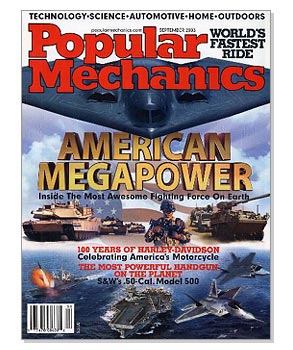
Take the September 2003 issue of Popular Mechanics. The cover proclaims “American Megapower: Inside the Most Awesome Fighting Force on Earth.” A bat-winged stealth bomber presides over a group shot of tanks, an aircraft carrier and a visored soldier. The text inside amounts to an unabashed love letter to the Pentagon. No mention is made of how this megapower appears to be bogged down in Iraq or that there are any limits to military force, scientific or otherwise.

The megapower issue was only one of five cover stories that Popular Mechanics ran on the U.S. military in 2003, each one announced with all the subtlety of a tabloid (“Floating Self-Propelled Military Base Projects American Power Anywhere!”). Nearly every month last year featured a new celebration of the military’s know-how or sheer force.

Since 2001, the military has become hip: the ultimate extreme sport with all the coolest gear. The military budget is up, the United States launched the war on terrorism and invaded Iraq, and the Pentagon has launched a “hearts and minds” campaign in American popular culture. As a result, military coverage in science magazines has proliferated faster than weapons of mass destruction, particularly in Popular Mechanics and Popular Science.

While Popular Mechanics caters to an almost exclusively male audience — which explains all the scantily clad babes reclining on speedboats and straddling motorcycles — Popular Science has traditionally gone after a more diverse demographic. But PopSci, too, has recently been sexed up. In 2003, it featured four cover stories and 10 substantial articles on military affairs, with carefully posed photos of voluptuous stealth bombers, knockout Scud-busters, and alluring autonomous underwater vehicles. In November and December it upped the ante with a pair of full-color military pullouts, concealed behind two-page recruiting ads for the U.S. military. In December, there was a loving comparison between the HMS Victory (of “Master and Commander” vintage) and the USS Ronald Reagan aircraft carrier. November’s pullout was something halfway between satire and paranoia: an air-war scenario pitting U.S. federal forces and those of breakaway California 40 years in the future.

Other science magazines cover the military. But they’re more sober, less repetitive and considerably less titillating. Popular Science and Popular Mechanics “have a long tradition of covering science and technology as it comes out of the military because they are essentially gee-whiz magazines and all the gee-whiz stuff came out of the military,” says Steve Petranek, editor in chief of Discover.

While PopSci and P.M. have long focused on making a direct appeal to the Y chromosome, they weren’t always dripping with quite so much testosterone as today. Through the 1970s, such magazines patrolled the borderline between geek and cool, with obligatory issues devoted to cars, house repairs, the emerging computer and robotics fields, and every so often a report on the latest bomber design out of the Pentagon. Even during the Defense Department’s last boom-boom era in the 1980s, these magazines remained relatively restrained.

By the early 1990s, Popular Science was running articles on disarmament, cleaning up chemical weapons, and decommissioning the reactors that produced material for America’s nuclear weapons. With the Cold War over, the editors began greening the magazine with articles on saving this or that piece of the earth. Even 1991, with the lead-up to the first Gulf War and its aftermath, generated only two covers and three military-related articles. Military articles in the 1990s, instead of gushing, were just as likely to wax nostalgic about old Cold War satellites or serve forth a critique such as a March 1993 investigative piece on the Pentagon’s Black Budget. (Popular Mechanics, by contrast, devoted seven cover stories to the military in 1991; although coverage subsided again until the next peak after 2001, the magazine never seemed to return comfortably to its former civilian life.)

In 2000, the Bush team campaigned against the perceived Democratic weakness on military issues. It was only after Sept. 11, however, that the wet dream of the far right — a $400 billion defense budget — became a reality. Money was now available for a full range of cutting-edge military hardware, from the terrestrial (self-guiding vehicles) to the empyrean (a new generation of space weapons) to the downright taboo (tactical nukes like the “bunker buster”). Even as it shed manufacturing jobs and lost its competitive edge in key civilian technologies, the United States still boasted a military sector without parallel. Says Joel Johnson, vice president of Aerospace Industries Association, “Given what we spend on Department of Defense R&D and procurement, if we didn’t have a comparative advantage on weapons systems, the people in my industry should be taken out and shot.”

This comparative advantage translated into more stuff to write about. “It’s one of these ‘follow the money’ things,” relates Susan Hassler, editor in chief of Spectrum, the flagship publication of the Institute of Electrical and Electronics Engineers. “When the military budget goes up, there’s more coverage.”

But it wasn’t simply a question of money. After the terrorist attacks on New York and Washington, the Pentagon changed its attitude toward the media. “We get press releases that I never would have gotten before Sept. 11,” says Discover’s Petranek. “There’s clearly an attempt to get out the word from the Pentagon that they’re serious about what they do. In some sense, it’s kind of refreshing. Historically it’s been difficult to report on what the military is doing. There’s been a sea change in their attitude.”

The Pentagon’s new P.R. spin can be found in the unprecedented cooperation extended to Jerry Bruckheimer to produce the TV show “Profiles From the Frontline,” about a special-ops unit in Central Asia. Cooperation has its price. In describing its relationship with the TV show “JAG,” a Pentagon official told the New York Times, “We offer our assistance when we think it is in the best interest of the Department of Defense and our people, and it’s up to the production company to accept it. If they go on and say, ‘Thanks but no thanks, we won’t make our character be what you stand for,’ we are less inclined to support them.”

William Hartung, author of the recent book “How Much Are You Making on the War, Daddy?” maintains that the Pentagon is much more conscious in its outreach to popular culture venues. “It wants to give the impression that it’s a new, improved Pentagon,” he argues. “They have all this futuristic weaponry in the works — like this cyber-soldier of the future who’s basically a networked army of one — and they want to hide the fact that they’re still building all these Cold War weapons that they never took out of the budget. Rifles that see around corners, new space weapons — it’s what Buck Rogers was to a previous generation. It appeals to readers of science magazines, people who are addicted to gadgetry.”

In the wake of Sept. 11 and a decision by its owner, Time4, to reorient the magazine toward young men, Popular Science created a new position for an aviation and military editor. In this position, Eric Adams has presided over an expansion of military coverage that takes its cue from the overwhelming popularity of military cover stories among its readership. “The fact that we’ve had the war and the post-9/11 increased visibility of the military warrants the additional coverage,” he explains. “We try not to be gung ho about it. We try not to be particularly negative about it. This is technology that can ostensibly help minimize the impact of war — the civilian casualties and the losses on our side.”

While certainly more on the gung-ho side, Popular Mechanics is nevertheless very detailed in its coverage. Jim Wilson, science editor at P.M. and author of “Combat: The Great American War Planes,” relies on expert writers from specialized magazines who often report from a first-person perspective. Other magazines have borrowed P.M.’s style (and, in the case of PopSci, some of P.M.’s editors). In many ways, P.M. set the standard of embeddedness that the Pentagon applied to other media over the last two years.

Being down in the trenches with the military lends a great deal of authenticity and immediacy to P.M.’s coverage. Lacking, however, is critical distance or a willingness to explore the negative consequences of military technology. This is what Susan Hassler of Spectrum describes as a “curious disconnect in popular culture” between, for instance, marveling at the Baghdad sky lit up from the bombing raids of 2003 and ignoring the effects of the bombing on the ground. This disconnect, more than the airbrushed photos or the unveiling of previously secret weapons programs, makes the treatment of military issues by popular science magazines pornographic. Stripped of its moral and political context, the technology is merely mechanical.

Public enthusiasm for war has already seemed to peak. In 2004, U.S. casualties continue to mount, Congress has threatened to trim the president’s military budget request, and the Pentagon is just not as sexy as it was back in the blitzkrieg days last spring. And, indeed, the April 2004 issues of PopSci and P.M. have no articles on the military. Nor are there any Army recruitment ads. Instead, attractive couples pitch Viagra, Cialis, Testostazine, and Sildenaflex — to remind us, perhaps, that popular science is always at the ready to bolster the power and aid the conquests of men.

The GOP’s new Islamophobic narrative

Mainstream Republicans aren't suggesting Obama is a Muslim -- just that he's "acting" like one

  • more
    • All Share Services

The GOP's new Islamophobic narrativeRepublican presidential candidate, former Pennsylvania Sen. Rick Santorum, accompanied by his daughter Elizabeth Santorum and son Daniel Santorum, speaks in front of the Supreme Court in Washington, Monday, March 26, 2012, as the court began three days of arguments on the health care law signed by President Barack Obama. (AP Photo/Charles Dharapak) (Credit: AP)
This piece originally appeared on TomDispatch.

Those who fervently believe that Barack Obama is a Muslim generally practice their furtive religion in obscure recesses of the Internet. Once in a while, they’ll surface in public to remind the news media that no amount of evidence can undermine their convictions.

In October 2008, at a town hall meeting in Minnesota for Republican presidential candidate John McCain, a woman called Obama “an Arab.” McCain responded, incongruously enough, that Obama was, in fact, “a decent family man” and not an Arab at all. In an echo of this, a woman recently stood up at a town hall in Florida and began a question for Republican presidential hopeful Rick Santorum by asserting that the president “is an avowed Muslim.” The audience cheered, and Santorum didn’t bother to correct her.

Though they belong to a largely underground cult, the members of the Obama-is-Muslim congregation number as many as one-third of all Republicans. A recent poll found that only 14 percent of Republicans in Alabama and Mississippi believe that the president is Christian.

These true believers treat their scraps of evidence like holy relics: the president’s middle name, his grandfather’s religion, a widely circulated photo of Obama in a turban. They occasionally traffic in outright fabrications: that he attended a radical madrasa in Indonesia as a child or that he put his hand on the Qur’an to be sworn in as president. An even more apocalyptic subset believes Obama to be nothing short of the anti-Christ.

By and large, however, this cult doesn’t attract mainstream support from the larger church of Obama haters. Indeed, these more orthodox faithful have carefully shifted the debate from Obama being Muslim to Obama acting Muslim. Evangelical pundits, presidential candidates and the right-wing media have all ramped up their attacks on the president for, as Baptist preacher Franklin Graham put it recently on MSNBC, “giving Islam a pass.”

The conservative mainstream still calls the president’s religious beliefs into question, but they stop just short of accusing him of apostasy and concealment. What they consider safe is the assertion that Obama is acting as if he were Muslim. In this way, Republican mandarins are cleverly channeling a conspiracy theory into a policy position.

There is a whiff of desperation in all this.  After all, it’s not an easy time for the GOP. The economy shows modest signs of improvement. The Republican presidential candidates are still engaged in a fratricidal primary. By expanding counterterrorism operations and killing Osama bin Laden, the president has effectively removed national security from the list of Republican talking points.

One story, however, still ties together so many narrative threads for conservatives. Charges that the president is a socialist or a Nazi or an elitist supporter of college education certainly push some buttons. But the single surefire way of grabbing the attention of the media and the public — as well as appealing to the instincts of the Republican base — is to assert, however indirectly, that Barack Obama is a Manchurian candidate sent from the Islamic world.

Obama and the Muslim World

A succession of Republican candidates have attempted to run to the right of party favorite Mitt Romney by asserting that only a true conservative can defeat Obama in November. Most of them boasted of the same powerful backer. Michele Bachmann, Herman Cain, Rick Perry and Rick Santorum all declared that God asked them to run for higher office. Together with Newt Gingrich, they have deployed various methods of appealing to their constituencies, but none is more potent than religion.

Rick Santorum, a Catholic and the favorite of the evangelical community, has been particularly adept at using his soapbox as a pulpit. The president subscribes to a “phony theology,” Santorum has claimed, “not a theology based on the Bible, a different theology.” Although he occasionally asserts that “Obama’s personal faith is none of my concern,” he nonetheless speaks of the president’s attempt to “impose values on people of faith”– implying that the president is certainly no member of that community.

In his attacks on the president’s spirituality, Santorum is cleverly attacking Mitt Romney’s Mormonism as well (a theology also based on text other than the Bible). At the same time, the suggestion that Obama is somehow “other” operates as a code word for “black” in a race in which race goes largely unmentioned.

It’s an odd set of charges. Obama, after all, did everything possible during his first presidential campaign to foreground his Christianity. He was repeatedly seen praying in churches and assiduously avoided mosques. He never made a campaign appearance with a prominent Muslim. He talked about his “personal relationship” with Jesus Christ.

The day after he clinched the Democratic Party nomination in 2008, he gave a speech to the American Israel Public Affairs Committee (AIPAC) in which he reaffirmed that he was “a true friend of Israel.” Although he would occasionally mention his Muslim relatives and the time he spent in Indonesia as a child, he generally did whatever he could to emphasize only two out of the three major monotheisms.

As president, Obama has certainly “reached out” to the Muslim world. In Cairo, in June 2009, he spoke of seeking “a new beginning between the United States and Muslims around the world, one based on mutual interest and mutual respect, and one based upon the truth that America and Islam are not exclusive and need not be in competition.”

That new beginning, however, has yet to come. At home, for example, the Obama administration provided federal funds that the New York City Police Department then used to expand its surveillance of Muslim American neighborhoods. (Even the CIA was involved in this “human mapping” project.) The FBI has spent the Obama years rounding up suspected Muslim terrorists in operations that flirt dangerously with entrapment. The administration has expanded the no-fly list, though because the list is secret it’s difficult to know whether Muslim-Americans are specifically profiled. Anecdotal evidence, however, suggests that they are.

The administration’s record internationally is even more disappointing. The conduct of U.S. troops in Afghanistan — the night raids, massacres (including the recent murders of 16 Afghan villagers), and the Qur’an burnings — have enraged local Muslims. Obama has expanded the CIA’s drone air campaign by a considerable margin in the Pakistani borderlands. Civilian casualties, overwhelmingly Muslim, continue to occur there and in other “overseas contingency operations” as U.S. Special Operations Forces have dramatically expanded their activities in the Muslim world.

Despite right-wing charges, Obama has maintained a tight relationship with Israel and the Israeli leadership. As former New Republic editor Peter Beinart concludes, “The story of Obama’s relationship to [Prime Minister] Netanyahu and his American Jewish allies is, fundamentally, a story of acquiescence.”

It’s no surprise, then, that surveys in six Middle East countries taken just before and two months after the Cairo speech in 2009, the Brookings Institution and Zogby International discovered that the number of respondents optimistic about the president’s approach to the region had suffered a dramatic drop: from 51 percent to 16 percent. A 2011 Pew poll found that U.S. favorability ratings had continued their slide in Jordan (to 13 percent), Pakistan (12 percent) and Turkey (10 percent).

And yet, perversely, the hard right in the U.S. maintains that the Obama administration has behaved in quite the opposite manner. “There’s something sick about an administration which is so pro-Islamic that it can’t even tell the truth about the people who are trying to kill us,” Republican presidential candidate Newt Gingrich typically said while campaigning in Georgia.

Pro-Islamic? That’s news to the Islamic world.

But it’s nothing new to the world of the U.S. right wing, which portrays Obama as anti-Israel and weak in the face of Islamic terrorism. At best, the president emerges from these attacks as a booster of Islam; at worst, he is the leader of a genuine fifth column.

Although the administration’s policy on Iran is virtually indistinguishable from those of his Republican challengers, they have presented him as an appeaser. The president who “surged” in Afghanistan somehow becomes, through the magic of election-year sloganeering, a pacifist patsy. Although Obama never endorsed the location of the “Ground Zero mosque,” his opponents have suggested that he did. Although he was slow to withdraw support from U.S. allies in the Middle East like Hosni Mubarak in Egypt and Ben Ali in Tunisia, Republican candidates have accused the president of practically campaigning on behalf of the Islamist parties that have grown in influence as a result of the Arab Spring.

Barack Obama, the right wing has discovered, does not have to be Muslim to convince American voters that he has a suspect, even foreign, agenda. They have instead established a much lower evidentiary standard: he only has to act Muslim.

For this, they don’t need a birth certificate. All they need are allegations, however spurious, that the president is in league with Iran’s Ahmadinejad, Arab Spring jihadists and anti-Israel forces at home. This more subtle but no less ugly Islamophobia has already insinuated itself into the 2012 elections in a potentially more damaging way than did the overt disparagement of Obama’s religious bona fides back in 2008.

The Upcoming Elections

The 2010 midterm elections witnessed a sharp uptick in anti-Islamic sentiment. In addition to the concocted “Ground Zero mosque” controversy, Florida preacher Terry Jones threatened to burn the Qur’an in front of the world’s cameras; a group called Stop Islamization of America bought anti-Islamic ads on buses in major cities; and a movement to pass anti-Sharia legislation at a state level began in Oklahoma. In response to this brushfire of hatred, Time magazine devoted a cover story to Islamophobia that year. On the right at least, Islam seemed on the way to becoming a litmus test in the way communism was during the Cold War.

Two years later, the hysteria seems to have subsided. The Islamophobes haven’t gone into hiding. They tried to organize an advertising boycott of the TV show “All-American Muslim”; they campaigned against halal meats. But these efforts didn’t get much traction.

Meanwhile, Park51 — the real name of the cultural center inaccurately dubbed the “Ground Zero mosque” — opened in its original Park Street location with an exhibition by a Jewish photographer. Terry Jones is pursuing a quixotic bid for the presidency far from the media spotlight. Time has returned several times to the topic of Islamophobia, particularly after Anders Breivik’s bombing and shooting rampage in Norway in July 2011, but with none of the intensity of the summer of 2010. The anti-Sharia campaign has passed legislation in several states, and laws are pending in more than a dozen more. But the 10th Circuit Court of Appeals ruled the Oklahoma anti-Sharia statute unconstitutional, and the anti-Sharia crowd has been unable to provide a single piece of evidence that Islamic law poses any challenge to the U.S. legal system.

Don’t be fooled, though, by the relative quiet. It’s still early in the election cycle. The Republicans, arrayed in a circular firing squad, have been largely focusing their attacks on each other. The last man standing will marshal his resources to challenge Obama. In the unlikely event that Rick Santorum emerges as the Republican candidate, religion will be central to his attack on Obama and the Democrats.

Mitt Romney has a more ambivalent relationship to religion as a wedge issue, given the level of discomfort that many American have toward Mormonism. But there are no Mormon countries to which Romney can be accused of owing primary allegiance. It will be safe, in other words, to challenge Obama for acting rather than being Muslim, for deferring to the Muslim world much as anti-Catholic voters in 1960 imagined John F. Kennedy to be taking his orders directly from the Pope.

Romney is already lining up his ducks, welcoming onto his team Islam critic Walid Phares and attack ad specialist Larry McCarthy (who did an distortion-laden spot on the “Ground Zero mosque” back in 2010). After securing the nomination, Romney will simultaneously appeal to the center and shore up support among evangelicals. The message that Obama is weak, anti-Israel, and appeases Islamic movements and countries could catch the attention of both constituencies.

A disconnect between accusation and reality hardly matters in American politics these days. Obama the “socialist” somehow manages to work hand in hand with Wall Street financiers. Obama the “Nazi” courts AIPAC. Obama the “peacenik” has been very much a war president. And Obama the “Muslim” gets a big thumbs-down from the Muslim world.

The president makes a lousy Muslim Manchurian candidate, for he has disappointed his imagined Muslim handlers at virtually every turn. In an election in which racist slogans are off the table, however, the Islamophobic accusation of “acting Muslim” remains a politically acceptable chauvinism. Given the deep anti-Islamic currents in American culture, such accusations might unfortunately prove effective as well.

To stay on top of important articles like these, sign up to receive the latest updates from TomDispatch.com here.

Continue Reading Close

America’s new role in the Pacific

Can the U.S. adjust to the military and economic rise of Northeast Asia?

  • more
    • All Share Services

America's new role in the Pacific (Credit: flankerd via Shutterstock/Salon)
This originally appeared on TomDispatch.

The United States has long styled itself a Pacific power. It established the model of counterinsurgency in the Philippines in 1899 and defeated the Japanese in World War II. It faced down the Chinese and the North Koreans to keep the Korean peninsula divided in 1950, and it armed the Taiwanese to the teeth. Today, America maintains the most powerful military in the Pacific region, supported by a constellation of military bases, bilateral alliances, and about 100,000 service personnel.

It has, however, reached the high-water mark of its Pacific presence and influence. The geopolitical map is about to be redrawn. Northeast Asia, the area of the world with the greatest concentration of economic and military power, is on the verge of a regional transformation. And the United States, still preoccupied with the Middle East and hobbled by a stalled and stagnating economy, will be the odd man out.

Elections will be part of the change. Next year, South Koreans, Russians, and Taiwanese will all go to the polls. In 2012, the Chinese Communist Party will also ratify its choice of a new leader to take over from President Hu Jintao. He will be the man expected to preside over the country’s rise from the number two spot to the pinnacle of the global economy.

But here’s the real surprise in store for Washington. The catalyst of change may turn out to be the country in the region that has so far changed the least: North Korea. In 2012, the North Korean government has trumpeted to its people a promise to create kangsong taeguk, or an economically prosperous and militarily strong country. Pyongyang now has to deliver somehow on that promise — at a time of food shortages, overall economic stagnation, and political uncertainty. This dream of 2012 is propelling the regime in Pyongyang to shift into diplomatic high gear, and that, in turn, is already creating enormous opportunities for key Pacific powers.

Washington, which has focused for years on North Korea’s small but developing nuclear arsenal, has barely been paying attention to the larger developments in Asia. Nor will Asia’s looming transformation be a hot topic in our own presidential election next year. We’ll be arguing about jobs, health care, and whether the president is a socialist or his Republican challenger a nutcase. Aside from some ritual China-bashing, Asia will merit little mention.

President Obama, anxious about giving ammunition to his opponent, will be loath to fiddle with Asia policy, which is already on autopilot. So while others scramble to remake East Asia, the United States will be suffering from its own peculiar form of continental drift.

Pyongyang Turns on the Charm

On April 15, 1912, in an obscure spot in the Japanese empire, a baby was born to a Christian family proud of its Korean heritage. The 100th anniversary of the birth of Kim Il Sung, North Korea’s founder and dynastic leader, is coming up next year. Ordinarily, such an event would be of little importance to anyone other than 24 million North Koreans and a scattering of Koreans elsewhere. But this centennial also marks the date by which the North Korean regime has promised to finally turn things around.

Despite its pretensions to self-reliance, Pyongyang has amply proven that it can only get by with a lot of help from its friends. Until recently, however, North Korea was not exactly playing well with others.

It responded in a particularly hardline fashion, for instance, to the more hawkish policies adopted by new South Korean President Lee Myung Bak, when he took office in February 2008. The shooting of a South Korean tourist at the Mount Kumgang resort that July, the sinking of the South Korean naval ship the Cheonan in March 2010 (Pyongyang still claims it was not the culprit), and the shelling of South Korea’s Yeonpyeong Island later that year all accelerated a tailspin in north-south relations. During this period, the North tested a second nuclear device, prompting even its closest ally, China, to react in disgust and support a U.N. declaration of condemnation. Pyongyang also managed to further alienate Washington by revealing in 2010 that it was indeed pursuing a program to produce highly enriched, weapons-grade uranium, something it had long denied.

These actions had painful economic consequences. South Korea cancelled almost all forms of cooperation. The North’s second nuclear test scotched any incipient economic rapprochement with the United States. (The Bush administration had removed North Korea from its terrorism list, and there had been hints that other longstanding sanctions might sooner or later be dropped as part of a warming in relations.)

Only the North’s relationship with China was unaffected, largely because Beijing is gobbling up significant quantities of valuable minerals and securing access to ports in exchange for just enough food and energy to keep the country on life support and the regime afloat. Between 2006 and 2009, an already anemic North Korean economy contracted, and chronic food shortages again became acute.

To these economic travails must be added political ones. The country’s leadership is long past retirement, with 70-year-old leader Kim Jong Il younger than most of the rest of the ruling elite. He has designated his youngest son, Kim Jeong Eun, as his successor, but the only thing that this mystery boy seems to have going for him is his resemblance to his grandfather, Kim Il Sung.

Still, North Korea seems no closer to full-scale collapse today than during previous crises — like the devastating famine of the mid-1990s. A thoroughly repressive state and zero civil society seem to insure that no color revolution or “Pyongyang Spring” is in the offing. Waiting for the North Korean regime to go gently into the night is like waiting for Godot.

But that doesn’t mean change isn’t in the air. To jumpstart its bedraggled economy and provide a political boost for the next leader in the year of kangsong taeguk, North Korea is suddenly in a let’s-make-a-deal mode.

Kim Jong Il’s recent visit to Siberia to meet Russian President Dmitri Medvedev, for instance, raised a few knowledgeable eyebrows. Conferring at a Russian military base near Lake Baikal, for the first time in a long while the North Korean leader even raised the possibility of a moratorium on nuclear weapons production and testing. More substantially, he concluded a preliminary agreement on a natural gas pipeline that could in itself begin to transform the politics of the region. It would transfer gas from the energy-rich Russian Far East through North Korea to economically booming but energy-hungry South Korea. The deal could net Pyongyang as much as $100 million a year.

The North’s new charm offensive wouldn’t have a hope in hell of succeeding if a similar change of heart weren’t also underway in the South.

The Bulldozer’s Miscalculation

On taking office, the conservative South Korean president Lee Myung Bak, known as “the Bulldozer” when he headed up Hyundai’s engineering division, promised to put Korean relations on a new footing. Ten years of “engagement policy” with the North had, according to Lee, produced an asymmetrical relationship. The South, he insisted, was providing all the cash, and the North was doing very little in exchange. Lee promised a relationship based only on quid pro quasi.

What he got instead was tit for tat: harsher rhetoric and military action. Ultimately, although the North made no friends below the 38th parallel that way, the new era of hostility didn’t help the Lee administration either. South Koreans generally watched in horror as a relatively peaceful relationship veered dangerously close to military conflict.

Lee’s ruling party suffered a loss in last April’s by-elections, and in August, he replaced his hardline “unification” minister with a more conciliatory fellow. Still insisting on an apology for the Cheonan sinking and the Yeonpyeong shelling, the ruling party is nevertheless looking for ways to restore commercial ties and again provide humanitarian assistance to the North. Since the summer, representatives from North and South have met twice to discuss Pyongyang’s nuclear program. Although the two sides haven’t made substantial progress, the stage is set for the resumption of the Six Party Talks between the two Koreas, Russia, Japan, China, and the United States that broke off in 2007.

Even if the opposition party doesn’t sweep the conservatives out of power in the 2012 elections, South Korea will likely abandon Lee’s tough-guy approach. In September, his likely successor as the ruling party candidate in 2012, Park Geun-Hye, openly criticized Lee’s approach in an article in Foreign Affairs that called instead for “trustpolitik.”

One project Park singled out for mention is an inter-Korean railroad line that would “perhaps transform the Korean Peninsula into a conduit for regional trade.” That’s an understatement. Restoring the line and hooking it up to Russia’s Trans-Siberian Railroad would connect the Korean peninsula to Europe, reduce the shipment time of goods from one end of Eurasia to the other by about two weeks, and save South Korea up to $34 to $50 per ton in shipping costs. Meanwhile, the natural gas pipeline, which South Korea approved at the end of September, could reduce its gas costs by as much as 30%. For the world’s second largest natural gas importer, this would be a major savings.

Serious economic steps toward Korean reunification are not just a dream, in other words, but good business, too. Even in the worst moments of the recent period of disengagement, it’s notable that the two countries managed to preserve the Kaesong industrial complex located just north of the Demilitarized Zone. Run by South Korean managers and employing more than 45,000 North Koreans, the business zone is a boon to both sides. It helps South Korean enterprises facing competition from China, even as it provides hard currency and well-paying jobs to the North. The railroad and the pipeline would offer similar mutual benefits.

According to conventional wisdom, North Korea has a single bargaining chip, its small nuclear arsenal, which it will never give up. But a real estate agent would look at the situation differently. What North Korea really has is “location, location, location,” and it finally seems ready to cash in on its critical position at the heart of the world’s most vital economic region.

The train line would bind the world’s two biggest economic regions into a huge Eurasian market. And the pipeline, coupled with green energy projects in China, South Korea, and Japan, might begin to wean East Asia from its dependency on Middle Eastern oil and thus on the U.S. military to secure access and protect shipping routes.

Thought of another way, these projects and others like them lurking in the Eurasian future are significant not just for what they connect, but what they leave out: the United States.

Out in the Cold

The Bush administration anticipated Lee Myung Bak’s approach to North Korea by chucking the carrot and waving the stick. By 2006, however, Washington had made a U-turn and was beginning to engage Pyongyang seriously. The Obama administration took another tack, eventually adopting a policy of “strategic patience,” a euphemism for ignoring North Korea and hoping it wouldn’t throw a tantrum.

It hasn’t worked. North Korea has plunged full speed ahead with its nuclear program. The U.S./NATO air campaign against Libya’s Muammar Gaddafi, who had given up his nuclear program to secure better relations with the West, only reinforced Pyongyang’s belief that nukes are the ultimate guarantor of its security. The Obama administration continues to insist that the regime show its seriousness about denuclearization as a precondition for resuming talks. Even though Washington recently sent a small amount of flood relief, it refuses to offer any serious food assistance. Indeed, in June, the House of Representatives passed an amendment to the agriculture bill that prohibited all food aid to the country, regardless of need.

Though the administration will likely send envoy Stephen Bosworth to North Korea later this year, no one expects major changes in policy or relations to result. With a presidential election year already looming, the Obama administration isn’t likely to spend political capital on North Korea — not when Republicans would undoubtedly label any new moves as “appeasement” of a “terrorist state.”

Obama came into office with a desire to shift U.S. policy away from its Middle Eastern focus and reassert America’s importance as a Pacific power, particularly in light of China’s growing regional influence. But the president has invested more in drones than in diplomacy, sustaining the war on terror at the expense of the sort of bolder engagement of adversaries that Obama hinted at as a candidate. In the meantime, the administration is prepared to just wait it out until the next elections are history — and by then, it might already be too late to catch up with regional developments.

After all, Washington has watched China become the top trading partner of nearly every Asian country. Similarly, the economic links between China and Taiwan have deepened considerably, a reality to which even that island’s opposition party must bow. The Obama administration’s recent decision not to upset Beijing too much by selling advanced F-16 fighter jets to Taiwan, opting instead for a mere upgrade of the F-16s it bought in the 1990s, is a clear sign of relative U.S. decline in the region, suggests big-picture analyst Robert Kaplan.

Then there’s the sheer cost of the U.S. military presence in the Pacific, which looks like a juicy target to budget cutters in Washington. Key members of Congress like Senators John McCain and Carl Levin have already signaled their anxiety about the high price tag of a planned “strategic realignment” in Asia that involves, among other things, an expansion of the U.S. military base in Guam and an upgrading of facilities in Okinawa. In response to a question about potential military cuts, new Deputy Secretary of Defense Ashton Carter has confirmed that reducing U.S. troops and bases overseas is “on the table.”

The future of East Asia is hardly a given, nor is an economic boom and regional integration the only possible scenario. Virtually every country in the region has hiked its military spending. Tension points abound, particularly in potentially energy-rich waters that various countries claim as their own. China’s staggering economic growth is not likely to be sustainable in the long term. And North Korea could ultimately decide to make do as an economically destitute but adequately strong military power.

Still, the trend lines for 2012 and after point to greater engagement on the Korean peninsula, across the Taiwan Strait, and between Asia and Europe. Right now, the United States, for all of its military clout, is not really part of this emerging picture. Isn’t it time for America to gracefully acknowledge that its years as the Pacific superpower are over and think creatively about how to be a pacific partner instead?

To stay on top of important articles like these, sign up to receive the latest updates from TomDispatch.com here

Continue Reading Close

Forget China; Turkey is the next superpower

The nation has a booming economy, a powerful military, and increasing clout in the Middle East

  • more
    • All Share Services

The future is no longer in plastics, as the businessman in the 1967 film ”The Graduate” insisted. Rather, the future is in China.

If a multinational corporation doesn’t shoehorn China into its business plan, it courts the ridicule of its peers and the outrage of its shareholders. The language of choice for ambitious undergraduates is Mandarin. Apocalyptic futurologists are fixated on an eventual global war between China and the United States. China even occupies valuable real estate in the imaginations of our fabulists. Much of the action of Neal Stephenson’s novel “The Diamond Age”, for example, takes place in a future neo-Confucian China, while the crew members of the space ship on the cult TV show “Firefly” mix Chinese curse words into their dialogue.

Why doesn’t Turkey have a comparable grip on American visions of the future? Characters in science fiction novels don’t speak Turkish. Turkish-language programs are as scarce as hen’s teeth on college campuses. Turkey doesn’t even qualify as part of everyone’s favorite group of up-and-comers, that swinging BRIC quartet of Brazil, Russia, India, and China. Turkey remains stubbornly fixed in Western culture as a backward-looking land of doner kebabs, bazaars, and guest workers.

But take population out of the equation — an admittedly big variable — and Turkey promptly becomes a likely candidate for future superpower. It possesses the 17th top economy in the world and, according to Goldman Sachs, has a good shot at breaking into the top 10 by 2050. Its economic muscle is also well defended: after decades of NATO assistance, the Turkish military is now a regional powerhouse.

Perhaps most importantly, Turkey occupies a vital crossroads between Europe, the Middle East, and Central Asia. A predominantly Muslim democracy atop the ruins of Byzantium, it bridges the Islamic and Judeo-Christian traditions, even as it sits perched at the nexus of energy politics. All roads once led to Rome; today all pipelines seem to lead to Turkey. If superpower status followed the rules of real estate — location, location, location — then Turkey would already be near the top of the heap.

As a quintessential rising middle power, Turkey no longer hesitates to put itself in the middle of major controversies. In the last month alone, Turkish mediation efforts nearly heralded a breakthrough in the Iran nuclear crisis, and Ankara supported the flotilla that recently tried to break Israel’s blockade of Gaza. With these and other less high-profile interventions, Turkey has stepped out of the shadows and now threatens to settle into the prominent place on the world stage once held by its predecessor. In the seventeenth century, the Ottoman Empire was a force to be reckoned with, spreading through the Balkans to the gates of Vienna before devolving over the next 200 years into “the sick man of Europe.”

Today, a dynamic neo-Ottoman spirit animates Turkey. Once rigidly secular, it has begun to fashion a moderate Islamic democracy. Once dominated by the military, it is in the process of containing the army within the rule of law. Once intolerant of ethnic diversity, it has begun to reexamine what it means to be Turkish. Once a sleepy economy, it is becoming a nation of Islamic Calvinists. Most critically of all, it is fashioning a new foreign policy. Having broken with its more than half-century-long subservience to the United States, it is now carving out a geopolitical role all its own.

The rise of Turkey has by no means been smooth. Secular Turks have been uncomfortable with recent more assertive expressions of Muslim identity, particularly when backed by state power. The country’s Kurds are still second-class citizens, and although the military has lost some of its teeth, it still has a bite to go along with its bark.

Nonetheless, Turkey is remaking the politics of the Middle East and challenging Washington’s traditional notion of itself as the mediator of last resort in the region. In the twenty-first century, the Turkish model of transitioning out of authoritarian rule while focusing on economic growth and conservative social values has considerable appeal to countries in the developing world. This “Ankara consensus” could someday compete favorably with Beijing’s and Washington’s versions of political and economic development. The Turkish model has, however, also spurred right-wing charges that a new Islamic fundamentalist threat is emerging on the edges of Europe. Neocon pundit Liz Cheney has even created a new version of George W. Bush’s “axis of evil” in which Turkey, Iran, and Syria have become the dark trinity.

These are all signs that Turkey has indeed begun to wake from its centuries-long slumber. And when Turkey wakes, as Napoleon said of China, the world will shake.

Out of Ottomanism

Constantinople was once an Orientalist’s dream. In his otherwise perceptive 1877 guide to the city, the Italian author Edmondo de Amicis typically wrote that old Istanbul “is not a city; she neither labors, nor thinks, nor creates; civilization beats at her gates and assaults her in her streets, but she dreams and slumbers on in the shadow of her mosques, and takes no heed.”

Turkey’s first wake-up call came from Kemal Ataturk, the modernizing military officer from Salonika who created a new country out of the unpromising materials left behind by the collapsed Ottoman Empire. Decisively ending the caliphate in 1924, Ataturk patterned his new secular state on the French model: strong central power, a modern army, and a strict division between public and private spheres. This was no easy process: Ataturk brought Turkey kicking and screaming into the twentieth century.

In many ways, that kicking and screaming continued throughout the rest of that century. The Turkish military never quite got used to civilian rule. It’s seized power four times since 1960. In the 1980s and 1990s, Turkish security forces killed thousands of its own citizens in a dirty war against the Kurds and the Turkish left, and subjected many more to beatings, torture, and imprisonment. The country’s leadership maintained a garrison mentality based on a fear that outsiders, aided by a fifth column, were bent on dismembering the country (as outside powers had indeed attempted to do in 1920 with the Treaty of Sèvres).

In the 1980s, however, economic globalization began to eat away at this garrison mentality as then-President Turgut Ozal attempted to reconnect Turkey to the world through export-oriented reforms and a policy of building economic bridges rather than erecting suspicious walls. During the eight-year Iran-Iraq War, for instance, Turkey refused to choose sides, remaining a friend to both countries.

In the process, Istanbul was transformed. It became the center of a laboring, thinking, and creating class that faced both westward toward Europe and the United States and eastward toward the Middle East and Central Asia. Even Central Anatolia and its key city, Kayseri, once considered a Turkish backwater, was emerging as a vital center of manufacturing. “While Anatolia remains a socially conservative and religious society, it is also undergoing what some have called a ‘Silent Islamic Reformation,’” went the European Stability Initiative’s influential 2005 report on Turkey’s new Islamic Calvinists. “Many of Kayseri’s business leaders even attribute their economic success to their ‘protestant work ethic.’”

By the 1990s, the “star of Islam” — as The Economist dubbed Turkey — had gone about as far as it could within the confines of the existing Ataturk model. In 1997, the military once again swatted aside the civilian leadership in a “stealth coup,” and the country seemed to be slipping back into aggressive paranoia. The Kurdish war flared; tensions with Russia over Chechnya rose; a war of words broke out with Greece over maritime territorial disputes. And Turkey nearly went to war with Syria for harboring the Kurdish separatist leader Abdullah Ocalan.

But that stealth coup proved a last gasp attempt to place the uncontainable new political and economic developments in Turkish society under tighter controls. Soon enough, the military gave way again and the Islam-influenced Justice and Development Party (AKP) came to power in 2002, only enlarging its political base after the 2007 elections.

Zero Problems?

Throughout the twentieth century, geography had proved a liability for Turkey. It found itself beset on all sides by former Ottoman lands which held grudges against the successor state. The magic trick the AKP performed was to transform this liability into an asset. Turkey in the twenty-first century turned on the charm. Like China, it discovered the advantages of soft power and the inescapable virtues of a “soft rise” during an era of American military and economic dominance.

Led by Foreign Minister Ahmet Davutoglu, a former academic who provided a blueprint for the country’s new good-neighbor policy in his 2001 book Strategic Depth, Turkey pledged “zero problems with neighbors.” In foreign policy terminology, Davutoglu proposed the carving out of a Turkish sphere of influence via canny balance-of-power politics. Like China, it promised not to interfere in the domestic affairs of its partners. It also made a major effort to repair relations with those near at hand and struck new friendships with those far away. Indeed, like Beijing, Ankara has global aspirations.

Perhaps the most dramatic reversal in Turkish policy involves the Kurdish region of Iraq. The détente orchestrated by the AKP could be compared to President Richard Nixon’s startling policy of rapprochement with China in the 1970s, which rapidly turned an enemy into something like an ally. In March, Turkey sent its first diplomat to Arbil, the capital of Iraqi Kurdistan, to staff a new consulate there. Today, as journalist Jonathan Head has written, “70% of investment and 80% of the products sold in the Kurdish region [of Iraq] are Turkish.” Realizing that when U.S. troops leave Iraq, its Kurdish regions are bound to feel vulnerable and thus open to economic and political influence, Ankara established a “strategic cooperation council” to sort things out with the Iraqis in 2009, and this has served as a model for similar arrangements with Syria, Bulgaria, Greece, and Russia.

Détente with Iraqi Kurdistan has gone hand in hand with a relaxation of tensions between Ankara and its own Kurdish population with which it had been warring for decades. Until the early 1990s, the Turkish government pretended that the Kurdish language didn’t exist. Now, there is a new 24-hour Kurdish-language national TV station, and new faculty at Mardin Artuklu University will teach Kurdish. The government began to accept returning Kurdish refugees from northern Iraq, as well as a handful of Kurdish guerrillas from the Kurdistan Workers’ Party (PKK).

This hasn’t been an easy sell for Turkish nationalists. In December, a Turkish court banned the main Kurdish political party, and this spring the military launched repeated attacks against PKK targets inside Iraq. But the AKP is continuing to push reforms, including proposed changes in the country’s constitution that would allow military commanders for the first time to be tried in civilian court for any crimes they commit.

The elimination of this demonizing of “internal enemies” is crucial to the AKP’s project, helping as it does to reduce the military’s power in internal affairs. Reining in the military is a top objective for party leaders who believe it will strengthen political stability, improve prospects for future integration into the European Union (EU), and remove a powerful opponent to domestic reforms — and to the party itself.

Only a little less startling than the government’s gestures toward the Kurds has been its program to transform Turkish-Greek relations. The two countries have long been at each other’s throats, their conflict over the divided island of Cyprus being only the most visible of their disagreements. The current Greek economic crisis, however, may prove a blessing in disguise when it comes to bilateral relations.

The Greek government — its finances disastrous and economic pressure from the European Union mounting — needs a way to make military budget reductions defensible. In May, Turkish president Erdogan visited Greece and, while signing 21 agreements on migration, environment, culture, and the like, began to explore the previously inconceivable possibility of mutual military reductions. “Both countries have huge defense expenses,” Erdogan told Greek television, “and they will achieve a lot of savings this way.”

If Turkey manages a rapprochement with Armenia, it will achieve a diplomatic trifecta. The two countries disagree over the fate of the Nagorno-Karabakh enclave, which is also at the center of a dispute between Armenia and Turkish ally Azerbaijan. Complicating this territorial issue is a long-standing historical controversy. Armenia wants acknowledgement of the Ottoman Empire’s 1915 extermination campaign that killed more than a million Armenians. The Turkish government today disputes the numbers and refuses to recognize the killings as “genocide.” Nevertheless, Turkey and Armenia began direct negotiations last year to reopen their border and establish diplomatic relations. Although officially stalled, secret talks between the two are continuing.

Other diplomatic efforts are no less dramatic. When Bashar Assad arrived in Ankara in 2004, it was the first visit by a Syrian leader in 57 years. Meanwhile, Turkey has cemented its relations with Russia, remains close to Iran, and has reconnected to the Balkans. This charm offensive makes Chinese efforts in Asia look bumbling.

Mediation Central

A friend to all sides, Turkey is offering its services as a diplomatic middleman, even in places where it was persona non grata not long ago. “Not many people would imagine that the Serbians would ask for the mediation of Turkey between different Bosniak groups in the Sandjak region of Serbia,” observes Sule Kut, a Balkans expert at Bilge University in Istanbul. “Turks were the bad guys in Serbian history. So what is happening? Turkey has established itself as a credible and powerful player in the region.”

It’s not just the Balkans. The new Turkey is establishing itself as Mediation Central. Teaming up with Brazil, Turkey fashioned a surprise compromise meant to head off confrontation with Iran over its nuclear program (which the Obama administration managed to shoot down). Along with Spain, it initiated the Alliance of Civilizations, a U.N. effort to bridge the divide between Islam and the West. It also tried to work its magic in negotiating an end to the blockade of Gaza, removing obstacles to the withdrawal of U.S. forces from Iraq, bringing Syria and Israel together, resolving the brouhaha around the cartoon depiction of Mohammed, and hosting U.N. meetings on Somalia.

“Zero problems with neighbors” is a great slogan. But it’s also a logical impossibility. Turkey can’t embrace Hamas without angering Egypt and Israel. It can move closer to Russia only at the potential expense of good relations with Georgia. Rapprochement with Armenia angers Azerbaijan.

Nor was Ankara’s attempt to transcend zero-sum thinking an easy task during the “with us or against us” years of the Bush administration. In addition, there are the periodic tensions that arise around U.S. congressional resolutions on the Armenian genocide, still a touchy issue in Turkey. Washington has indicated its growing unhappiness with Turkey’s increasingly active role in the Middle East, particularly its overtures to Syria. As a result, Turkey has had to finesse its relationship with the U.S. in order to remain a key NATO ally and a challenger to American power in the region.

As with China, the United States is willing to work with Turkey on some diplomatic issues even as it finds the country’s growing influence in the region a problem. In turn, Ankara, like Beijing, is trying to figure out how it can best take advantage of the relative decline in U.S. global influence even as it works closely with Washington on an issue-by-issue basis.

The greatest challenge to Turkey’s zero-problems paradigm, however, is its ever more troubled relationship with Israel. The U.S.-Turkey-Israel troika was once a solid verity of Middle Eastern politics. A considerable amount of bilateral trade, including military deals, has linked Turkey and Israel, and that trade increased dramatically during the AKP era.

But Israel’s 2008 invasion of Gaza — and Turkish Prime Minister Recep Tayyip Erdogan’s subsequent excoriation of then-Israeli president Shimon Peres at the World Economic Forum in Davos — began a process that is tearing these former allies apart, while boosting support for Turkey in the Arab world. In October, Turkey cancelled Israel’s participation in a military exercise, throwing lucrative military contracts between the two countries in jeopardy. In the wake of the recent Gaza-aid debacle in international waters, the rift threatens to become irreparable. When Israeli commandos seized a flotilla of ships attempting to break the Gaza embargo, killing nine Turkish citizens, Turkey spoke of severing diplomatic relations.

With Israel increasingly isolated and American mediation efforts seriously compromised, only Turkey is emerging stronger from what can now only be seen as the beginning of a regional realignment of power. Once viewed with suspicion throughout the area where the Ottomans ruled, Turkey may now be the only power that has even a remote chance of one day brokering peace in the Middle East.

Return to Ottomanism?

Neo-Ottomanism is not exactly a popular phrase in Turkey today. The leadership in Ankara wants to be clear: they have no intention of projecting imperial power or reestablishing the modern equivalent of the Ottoman caliphate. However, if you look at the friendships that Turkey has cultivated and the trade relations it has emphasized — Syria, Armenia, Greece, Palestine, Iraq, Libya, the Balkans — you can see a map of the old Ottoman empire reassembling itself.

In other words, just as the AKP has turned geography to its advantage, so it is transforming an imperial albatross into the goose that lays golden eggs (in the form of lucrative trade deals). In a similar way, China has tried to revive its old Sinocentric imperial system without stirring up fears of the Chinese army marching into India or the Chinese navy taking over the South China Sea, even as it — like Turkey — also establishes friendly relations with old adversaries (including Russia).

Still, even this amiable version of neo-Ottomanism can raise hackles. “We want a new Balkan region based on political values, economic interdependence, and cooperation and cultural harmony,” Foreign Minister Davutoglu said nostalgically at a conference in Sarajevo in October. “That is what the Ottoman Balkans was like. We shall revive such a Balkan region… The Ottoman centuries were a success story, and this should be revived.” A furor followed among some Serb commentators, who viewed this romanticized version of history as evidence of a Turkish desire to Islamicize the Balkans.

What Turkey means by its vision of Balkan harmony may prove critical in the context of European integration. The Ottomans and Western Europe fought a succession of wars over control of the Balkans. Today, the E.U. and Turkey compete for influence in the region, and much hangs on Turkey’s prospects for joining the 27-member European organization. Although Turkey began the process of meeting requirements for joining the Union, the talks stalled long ago. In the meantime, some European leaders like French Prime Minister Nicholas Sarkozy have spoken out against Turkish membership, while the spread of Islamophobia throughout Europe has dimmed what enthusiasm may still exist for bringing Turkey on board.

In Turkey as well, public support for membership has declined from 70% in 2002 to just over 50% today. In fact, Turkey’s turn toward the Middle East, Central Asia, and North Africa has in part been a reaction to the fading of the E.U. option. Fine, the Turks are saying, if you don’t want us, we can play with others.

And play they have, particularly when it comes to the energy game. If oil had been discovered in its territory just a little sooner, some form of the Ottoman Empire might have survived as the wealthiest energy player in history. The riches of Iraq, Kuwait, and Libya all once fell within the territorial limits of its empire.

Today, Turkey lacks energy wealth, but has worked assiduously to ensure that a maximum number of oil and natural gas pipelines flow through the country. Europe and the United States have funded a series of pipelines (like the Nabucco pipeline from the Caspian Sea) that use Turkish territory to bypass Russia and lessen Moscow’s ability to blackmail Western Europe by threatening to withhold energy supplies. Turkey hasn’t stopped there, however. It negotiated directly with Russia for another set of pipelines — the South Stream, which goes from Russia to Bulgaria through Turkish territorial waters, and the Samsun-Ceyhan pipeline that would transport Russian and Kazakh oil from the Black Sea to the Mediterranean through Turkey.

Turkey now relies on Russia for 60% of its energy imports and Iran for another 30%. In this sense, “zero problems with neighbors” could just as easily be understood as “zero problems with energy suppliers.”

Turkey is also a builder. Of the top 225 international contractors, 35 are Turkish, second only to China. Like China, Turkey asks no difficult questions about the political environment in other countries, and so Turkish construction companies are building airports in Kurdistan and shopping malls in Libya. Despite political tensions, in 2009 they were even involved in nine projects worth more than $60 million in Israel.

Finally, there is culture. Like the Confucian institutes China is establishing all over the world to spread its language, culture, and values, Turkey established the Yunus Emre Foundation in May 2009 to administer cultural centers in Germany, Bosnia and Herzegovina, Macedonia, Egypt, Turkmenistan, Kazakhstan, and Israel. Turkish schools have sprung up in more than 80 countries. Turkish culture has also infiltrated Middle Eastern life through television, as Turkish soap operas spread the liberal cultural values of moderate Islam. “The Turkish soaps have been daring and candid when it comes to gender equality, premarital sex, infidelity, passionate love, and even children born out of wedlock,” writes journalist Nadia Bilbassy-Charters.

Beyond Ottomanism

Turkey’s leaders may not themselves be comfortable with the neo-Ottoman label — in part because their ambitions are actually much larger. Their developing version of a peaceful, trade-oriented Pax Ottomanica takes in Turkey’s improved relations with sub-Saharan Africa, Latin America, and the Asia-Pacific. Turkey declared 2005 the “year of Africa” and accepted observer status in the African Union. In 2010, it has already opened eight embassies in African countries and plans to open another 11 next year.

At the pan-Islamic level — and a Turk, Ekmeleddin Ihsanoglu, now heads up the 57-member Organization of the Islamic Conference, the leading international voice of Islamic states — Turkish leaders think in terms of the ummah, the global Muslim community. For some critics, Turkey’s Islamic character and its ruling Islam-influenced party — as well as its recent attacks on Israel — suggest that the country is on a mission to reestablish, if only informally, the Islamic caliphate. In the most extreme version of this argument, historian of the Middle East Bernard Lewis has argued that Turkey’s fundamentalism will strengthen to such an extent that, in a decade’s time, it will resemble Iran, even as the Islamic Republic moves in the opposite direction.

This is, however, a fundamental misunderstanding of the AKP and its intentions. Islamism has about as much influence in modern-day Turkey as communism does in China. In both cases, what matters most is not ideology, but the political power of the ruling parties. Economic growth, political stability, and soft-power diplomacy regularly trump ideological consistency. Turkey is becoming more nationalist and more assertive, and flexibility, not fundamentalism, has been the hallmark of its new foreign policy.

In 1999, Bill Clinton suggested that if Ankara launched a reformist movement, the twenty-first century could be “Turkey’s century.” Turkey has indeed heeded Clinton’s advice. Now, Europe and the United States face a choice. If Washington works with Turkey as a partner, it has a far greater chance of resolving outstanding conflicts with Iran, inside Iraq, and between the Palestinians and Israelis, not to mention simmering disputes elsewhere in the Islamic world. If the European Union accepts Turkey as a member, its economic dynamism and new credibility in the Muslim world could help jolt Europe out of its current sclerosis. Spurned by one or both, Turkey’s global influence will still grow.

By all means, get that Lenovo computer, buy stock in Haier, and encourage your child to study Mandarin. China can’t help but be a twenty-first-century superpower. But if you want to really be ahead of the curve, pay close attention to that vital crossroads between the Black Sea and the Mediterranean. It won’t be long before we’ll all be talking Turkey.

John Feffer is the co-director of Foreign Policy in Focus at the Institute for Policy Studies, writes its regular World Beat column, and co-directs its Balkans Project. His past essays can be read at his website. He would like to thank Alexander Atanasov, Rebecca Azhdam, and Noor Iqbal for research assistance.

Copyright 2010 John Feffer

Continue Reading Close

Our misguided fight against Somali pirates

Those teenage high-seas renegades are not about to team up with terrorists, so why is the U.S. military devoting so much attention to them?

  • more
    • All Share Services

Our misguided fight against Somali pirates

In comic books, bad guys often team up to fight the forces of good. The Masters of Evil battle the Avengers superhero team. The Joker and Scarecrow ally against Batman. Lex Luthor and Brainiac take on Superman.

And the Somali pirates, who have dominated recent headlines with their hijacking and hostage-taking, join hands with al-Qaida to form a dynamic evil duo against the United States and our allies. We’re the friendly monsters — a big, hulking superpower with a heart of gold — and they’re the aliens from Planet Amok.

In the comic-book imagination of some of our leading pundits, the two headline threats against U.S. power are indeed on the verge of teaming up. The intelligence world is abuzz with news that radical Islamists in Somalia are financing the pirates and taking a cut of their booty. Given this “bigger picture,” Fred Iklé urges us simply to “kill the pirates.” Robert Kaplan waxes more hypothetical. “The big danger in our day is that piracy can potentially serve as a platform for terrorists,” he writes. “Using pirate techniques, vessels can be hijacked and blown up in the middle of a crowded strait, or a cruise ship seized and the passengers of certain nationalities thrown overboard.”

Chaotic conditions in Somalia and other countries, anti-state fervor, the mediating influence of Islam, the lure of big bucks: These factors are allegedly pushing the two groups of evildoers into each other’s arms. “Both crimes involve bands of brigands that divorce themselves from their nation-states and form extraterritorial enclaves; both aim at civilians; both involve acts of homicide and destruction, as the United Nations Convention on the High Seas stipulates, ‘for private ends,’” writes Douglas Burgess in a New York Times Op-Ed urging a prosecutorial coupling of terrorism and piracy.

We’ve been here before. Since 2001, in an effort to provide a distinguished pedigree for the Global War on Terror and prove the superiority of war over diplomacy, conservative pundits and historians have regularly tried to compare al-Qaida to the Barbary pirates of the 1800s. They were wrong then. And with the current conflating of terrorism and piracy, it’s déjà vu all over again.

Misreading piracy

Unlike al-Qaida, the Somali pirates have no grand desire to bring down the United States and the entire Western world. They have no intention of establishing some kind of piratical caliphate. Despite Burgess’ claims, they are not bent on homicide and destruction. They simply want money.

Most of the pirates are former fishermen dislodged from their traditional source of income by much larger pirates, namely transnational fishing conglomerates. When a crippled Somali government proved incapable of securing its own coastline, those fishing companies moved in to suck up the rich catch in local waters. “To make matters worse,” Katie Stuhldreher writes in the Christian Science Monitor, “there were reports that some foreign ships even dumped waste in Somali waters. That prompted local fishermen to attack foreign fishing vessels and demand compensation. The success of these early raids in the mid-1990s persuaded many young men to hang up their nets in favor of AK-47s.”

Despite their different ideologies — al-Qaida has one, the pirates don’t — it has become increasingly popular to assert a link between radical Islam and the Somali freebooters. The militant Somali faction al-Shabab, for instance, is allegedly in cahoots with the pirates, taking a cut of their money and helping with arms smuggling in order to prepare them for their raids. The pirates “are also reportedly helping al-Shabab develop an independent maritime force so that it can smuggle foreign jihadist fighters and ‘special weapons’ into Somalia,” former U.S. ambassador to Ethiopia David Shinn has recently argued.

In fact, the Islamists in Somalia are no fans of piracy. The Islamic Courts Union (ICU), which had some rough control over Somalia before Ethiopia invaded the country in 2006, took on piracy, and the number of incidents dropped. The more militant al-Shabab, which grew out of the ICU and became an insurgent force after the Ethiopian invasion, has denounced piracy as an offense to Islam.

The lumping together of Islamists and pirates obscures the only real solution to Somalia’s manifold problems. Piracy is not going to end through the greater exercise of outside force, no matter what New York Times columnist Thomas Friedman may think. (In a recent column lamenting the death of diplomacy in an “age of pirates,” he recommended a surge in U.S. money and power to achieve success against all adversaries.) Indeed, the sniper killing of three pirates by three U.S. Navy Seals has, to date, merely spurred more ship seizures and hostage-taking.

Simply escalating militarily and “going to war” against the Somali pirates is likely to have about as much success as our last major venture against Somalia in the 1990s, which is now remembered only for the infamous Black Hawk Down incident. Rather, the United States and other countries must find a modus vivendi with the Islamists in Somali to bring the hope of political order and economic development to that benighted country.

Diplomacy and development, however lackluster they might seem up against a trio of dead-eyed sharpshooters, are the only real hope for Somalia and the commercial shipping that passes near its coastline.

From the shores of Tripoli

It would have been the height of irony if the sharpshooters who took out the three Somali youths in that lifeboat with their American hostage had been aboard the USS John Paul Jones, a Navy guided-missile destroyer. Considered the father of the American Navy, Jones was quite the pirate in his day. Or so thought the British, whose ships he seized and looted.

We are left instead with the lesser irony of the sharpshooters taking aim from the USS Bainbridge. This ship was named for Commodore William Bainbridge, who fought against the Barbary pirates in the battles of Algiers and Tunis during the Barbary Wars and was himself taken prisoner in 1803.

The parallels between the pirates of yesterday and today are striking. Then, as now, American observers miscast the pirates as Muslim radicals. In fact, as Frank Lambert explains in his book “The Barbary Wars,” those pirates actually served secular governments that were part of the Ottoman Empire (much as Sir Francis Drake plundered Spanish ships on behalf of Queen Elizabeth in the 16th century or Jones served the United States in the 18th). Then, as now, the pirates resorted to preying on commercial shipping because they’d been boxed out of legitimate trade.

The Barbary pirates took to looting European vessels because European governments had barred the states of Algiers, Tripoli and Morocco from trading in their markets. Back then, the fledgling United States accused the Barbary pirates of being slavers without acknowledging that the U.S. was then the center of the global slave trade. Today, the U.S. government decries piracy, but doesn’t do anything to prevent the maritime poaching of fishing reserves that helped push pirates from their jobs into risky but lucrative careers in freebooting.

The most improbable link, however, involves the conflation of terrorism and piracy. In the aftermath of Sept. 11, pundits and historians identified the U.S. military response to the Barbary pirates as a useful precedent for striking out against al-Qaida. Shortly after the attacks, law professor Jonathan Turley invoked the war against the Barbary pirates in congressional testimony to justify U.S. retaliation against the terrorists. Historian Thomas Jewett, conservative journalist Joshua London, and executive director of the Christian Coalition of Washington State Rick Forcier all pointed to those pirates as Islamic radicals avant la lettre to underscore the impossibility of negotiations and the necessity of war, both then and now.

The battle against the Barbary pirates led to the creation of the U.S. Marine Corps (“… to the shores of Tripoli“) and the first major U.S. government expenditure of funds on a military that could fight distant wars. For historians like Robert Kagan (in his book “Dangerous Nation”), that war kicked off what would be a distinguished history of empire, which he contrasts with the conventional wisdom of a United States that only reluctantly assumed its hegemonic mantle.

Will the current conflict with the Somali pirates, if successfully linked in the public mind to global terrorism, serve as one significant part of a new justification for the continuation of empire and a whole new set of military expenditures needed to sustain such a venture?

The new GWOT?

The United States has the most powerful navy in the world. But what it can do against the Somali pirates is limited. Big guns and destroyers are incapable of covering the necessary vast ocean expanses in which the relatively low-tech pirates operate, can’t respond quickly enough to pinprick attacks, and ultimately aren’t likely to intimidate what Secretary of Defense Robert Gates has quite correctly termed “a bunch of teenage pirates” with little to lose.

“The area we patrol is more than one million square miles and the simple fact of the matter is we just can’t be everywhere at once to prevent every attack of piracy,” says Lt. Nathan Christensen, of the U.S. Fifth Fleet in Bahrain. Last year, approximately 23,000 ships passed through the Gulf of Aden. Pirates snagged 93 of them (some large, some tiny). Yet, in part because these trade routes are so crucial to global economic well-being, this minuscule percentage struck fear into the hearts of the most powerful countries on the planet.

The failure of the U.S. Navy to stamp out piracy has led to predictable calls for more resources. For instance, to deal with nimble, low-intensity threats like the speedy pirates, the Pentagon is looking at Littoral Combat Ships instead of another several-billion-dollar destroyer. The Navy is planning to purchase 55 of these ships, which, at $450 million to $600 million each, will come in at around $30 billion, a huge sum for a project plagued with costs overruns and design problems. With the ground (and air) war heating up in Afghanistan and the CIA in charge of operations in Pakistan, the Navy is understandably trying to keep up with the other services. The Navy’s goal of a 313-ship force, which boosters champion regardless of cost, can only be reached by appealing to a threat comparable to terrorists on land. Why not the functional equivalent of terrorists at sea?

Pirates are the perfect threat. They’ve been around forever. They directly interfere with the bottom line, so the business community is on board. Unlike China, they don’t hold any U.S. Treasury Bonds. Indeed, since they’re non-state actors, we can bring virtually every country onto our side against them.

And, finally, the Pentagon is already restructuring itself to meet just such a threat. Through its “revolution in military affairs,” the adoption of a doctrine of “strategic flexibility,” and the cultivation of rapid-response forces, the Pentagon has been gearing up to handle the asymmetrical threats that have largely replaced the more fixed and predictable threats of the Cold War era, and even of the “rogue state” era that briefly followed. The most recent Gates military budget, with its move away from outdated Cold War weapons systems toward more limber forces, fits right in with this evolution. Canceling the F-22 stealth fighter aircraft and cutting money from the Missile Defense Agency in favor of more practical systems is certainly to be applauded. But the Pentagon isn’t about to hold a going-out-of-business sale. The new Obama defense budget will actually rise about 4 percent.

George W. Bush’s Global War on Terror, or GWOT, turned out to be a useful way for the Pentagon to get everything it wanted: an extraordinary increase in spending and capabilities after 2001. With GWOT officially retired and an unprecedented federal deficit looming, the Pentagon and the defense industries will need to trumpet new threats or else face the possibility of a massive belt-tightening that goes beyond the mere shell-gaming of resources.

The War on Terror lives on, of course, in the Obama administration’s surge in Afghanistan, the CIA’s campaign of drone attacks in the Pakistani borderlands, and the operations of the new Africa Command. However, the replacement phrase for GWOT, “overseas contingency operations,” doesn’t quite fire the imagination. It’s obviously not meant to. But that’s a genuine problem for the military in budgetary terms.

Enter the pirates, who from Errol Flynn to Johnny Depp have always been a big box-office draw. As the recent media hysteria over the crew of the Maersk Alabama indicates, that formula can carry over to real life. Take Johnny Depp out of the equation and pirates can simply be repositioned as bizarre, narcotics-chewing aliens.

Then it’s simply a matter of the United States calling together the coalition of the willing monsters to crush those aliens before they take over our planet. And you thought “us versus them” went out with the Bush administration.

Continue Reading Close

The challenge facing local food

Food service giants like Sodexho, Aramark and BAMCO are jumping on the "eat local" bandwagon. Will the corporate attention give a boost to sustainable agriculture, or defuse the grassroots revolution?

  • more
    • All Share Services

The challenge facing local food

On Oct. 3, with the fall semester in full swing, the dining hall at Georgetown Law School was packed with students slumped over bookbags and laptops. Squeezed among their plates and papers were tabletop displays announcing that the day’s meal was part of an “Eat Local Challenge” that required the school’s chef to create a meal of ingredients entirely grown or raised within 150 miles of his kitchen. Between bites, the future lawyers peered at the signs with a mix of curiosity and indignation. Reducing food-shipping miles and supporting small farms were all good and fine — but what ever happened to Taco Tuesday?

Though it’s been 20 years since graduation, I can still recall my alma mater’s grim fare: the tetrazzinis, the iceberg lettuce, the gluey stews. I remember how my fellow students clamored for more vegetarian dishes — or more anything that just plain tasted better. The garlic roasted chicken and sautéed greens served up at Georgetown Law would have blown our minds and our taste buds. But the students I met there spoke longingly of packaged sandwiches and tacos filled with greasy, industrial-strength hamburger meat — while the food service staff sounded like gourmet revolutionaries. I wondered: What kind of culinary looking-glass universe had I fallen into?

Georgetown’s Eat Local Challenge — and the temporary disappearance of Taco Tuesday — was the brainchild of the Palo Alto, Calif.-based Bon Appétit Management Co. With a national staff of 10,000 and annual revenues of $400 million, BAMCO runs 300 cafes in colleges like Georgetown Law, at the corporate campuses of Oracle and Yahoo, and at other posh locations including the Guthrie Theater in Minneapolis and the Getty Villa in Malibu, Calif. Yes, that’s cafes, not cafeterias, as BAMCO’s director of communications, Maisie Ganzler, is quick to stress. “Cafeteria” conjures up images of can openers, frozen veggies and great quantities of mystery meat. But BAMCO believes even lowly college mess halls can be brought into the culinary vanguard.

BAMCO is not alone. In the past year, the “local” ethos has overtaken even organics as the gourmet cause célèbre — And eat-local challenges have begun sprouting up all over the place. Large food service providers like Sodexho and Aramark, having already introduced organic products, are now experimenting with local sourcing. At Yale, Stanford, Berkeley and other universities, students can eat meals prepared with fresh local produce grown on or just off campus.

The eat-local movement owes no small measure of its success to recent exposés of the organic industry. As huge corporate farms have moved into the sector, the media has been abuzz with the transformation of organics into business as usual — with Whole Foods catering to the upscale consumer and Wal-Mart aiming for the fat middle demographic. The question is: will big business’s discovery of “local” food eventually undercut the positive effects the movement may have on the environment, small farmers and taste? Advocates of eating local say no. Their singular hope is to foment a revolution that starts on the farm and ends on our plates.

- – - – - – - – - – - -

BAMCO’s annual Eat Local Challenge debuted only two years ago, but the company has long made local food a priority. Since its founding in 1987, the food service company has attempted to marry sustainability with profitability. “We weren’t founded as a health food company,” Ganzler explains. “And as we’ve made more decisions about sustainability, we’ve always considered the bottom line.” BAMCO’s Farm to Fork program, which connects small local producers to the cafe chefs, guarantees that an average 20 percent of sourcing for all meals must be local. “But that’s not the upper limit,” Ganzler says. “Some accounts go up to 70 or 80 percent during harvest season.”

On the wall of the Georgetown Law School cafe is a placard devoted to BAMCO’s Circle of Responsibility. It stresses the use of organic products, cage-free eggs, humanely raised meat and low-fat ingredients. The list even gets down to the nitty-gritty of stocks from scratch, fresh-squeezed lemon juice and mashed potatoes from real potatoes. The trifold brochures available beneath the placard read like the demands of a student protest movement rather than a multimillion-dollar company. The community brochure speaks of “boycotting purveyors that do not support farmworkers’ rights in regards to working and living conditions.” The environment brochure emphasizes fair trade coffee and decries net-pen fish farming, and the nutrition brochure challenges the claims of high-protein diets.

At the Georgetown challenge, however, few students had bothered to read any of the materials. “Those of us who are foodies don’t eat here,” admitted third-year law student Morgan Lynn. She dropped in that day for a juice and decided to stay for the Eat Local lunch, which she and a friend declared tasty but a little on the greasy and salty side. Lynn shops at a food co-op and prepares meals at home. The students who do frequent the cafe, still harboring a grudge over Taco Tuesday, are a tough crowd that is quick to criticize. Most days, chef Horne and his kitchen crew are like stand-up comics stuck with an audience of drunken hecklers.

But for the 800 students at Albertson College, just 25 miles outside Boise, Idaho, BAMCO is the best thing going. This year, the Eat Local Challenge surrounded students with local food. Beth Delmar, the general manager of the Albertson cafe, estimates that its food was 95 percent local that day — with local beef short ribs in plum sauce, sustainably farmed trout with cherry tomato and cilantro salsa, and even some unusual ground cherries for the salad bar. Delmar’s baker also runs an orchard, so comes to work every morning with fresh apples, plums, pears and pluots for pies and breads. But here, too, except for the environmental studies students — and the discerning faculty — her clientele has been slow to embrace the core concept of eating local, many still hung up on the ugliness of heirloom tomatoes.

Google and YouTube might have struck their recent deal at a Denny’s, but it’s a different scene at BAMCO’s five cafes at the Yahoo corporate headquarters in Sunnyvale, Calif. The folks at Yahoo take their food very seriously. Executive chef Bob Hart designs menus for the five employee cafes at Yahoo, plus the executive meals and the occasional business meeting. Northern California has local products year-round, and the Yahoo cafes serve an older crowd whose interest in the origins of their food is already primed. Breakfast for the Eat Local Challenge day was two eggs, duck confit and fingerling potatoes roasted in thyme, duck fat and kosher salt from the San Francisco Bay.

Whatever the sophistication level of their audience, the BAMCO chefs clearly enjoy the Eat Local Challenge. Far from rebelling against the sourcing requirements, they relish the way the restrictions spur their creativity. At Georgetown Law, for instance, chef Horne solved the black pepper problem — there are no tropical microclimates conducive to growing Piper nigrum in the D.C. area — by adding baby arugula to his sautéed greens to give them a kick. At the Yahoo cafe, for a thickener, Hart used boiled Italian butter beans in place of cornstarch and substituted blackberry compote for cranberries with his roast turkey. Michael Anderson, the chef at the Eckerd College cafe in St. Petersburg, Fla., solved his protein challenge by devising a citrus-marinated alligator salad (though less adventurous carnivores could take refuge in smoked chicken, organic beef burgers or Florida shrimp).

“I think it’s pretty hard to co-opt local, though doubtless people will try,” says environmentalist author Bill McKibben. In 2005, McKibben wrote an article for Gourmet magazine detailing how he subsisted entirely on local food through a Vermont winter, thanks to a lot of canning, the help of a local wheat grower, the consolations of locally brewed beer, and more root vegetables than you could shake a parsnip at. He says he came away from the project with a greater appreciation for the community connections that sustain local food production. “You just keep narrowing the distance you want your food to come from — 100 miles this year, 75 next. The industrial food machine depends on economies of scale, and these simply aren’t available locally — which is good.”

Though their approaches are different, behind both BAMCO’s and McKibben’s quests lay the same economic, environmental and aesthetic rationales. Economically, local sourcing can help small farmers establish relationships with the chefs and consumers who appreciate the quality of their produce. In Northern California, “farmers could easily build condos and get rich selling land at $100,000 an acre,” Yahoo’s Hart reports, so local purchasing provides the higher profit margins that can keep farms in business and the Bay Area a diverse ecosystem.

In Idaho farm country, where land prices are nowhere as dear, small farmers still face steep competition from the state’s powerful agribusiness sector. Boise lacks the concentration of high-end restaurants of Silicon Valley, so the small farmer is often searching for buyers. “We get calls from farmers who want to sell us their excess peaches and peppers at a low price instead of letting them rot in the fields,” Delmar says. Such unexpected bounties translate into char-grilled peaches for the Albertson students and lots of cobbler.

Tim Fischer, of Fischer Farms Natural Pork, raises 1,800 head of hogs a year in rural Minnesota, which is nothing compared to the corporate hog operations that supply tens of thousands of pigs for bacon, sausage and Spam. “I raise hogs the way my grandpa raised them in the 1940s: in big open buildings where they have room to run around,” Fischer says. “It’s hard to sell those kinds of pigs to Hormel because they have more fat on them. The meat is a crimson color.” The meat of the Hormel pigs, he says, turns gray because of the stress of their confinement.

Dozens of restaurants in Minneapolis, including the BAMCO cafes at the Guthrie Theater, want this tasty and tender pork. Fischer makes a better profit margin on his meat now than he did during his days supplying Hormel. But he also works harder. “The way I raise hogs is a lot of hard work, a lot more manual labor,” he explains.

On the environmental front, eating local reduces the amount of energy consumed in transporting food across vast distances. In his book “Coming Home to Eat,” ethnobotanist Gary Nabhan reports that food in America travels an average of 1,300 miles between farm and fork, changing hands six times — a figure that, according to Worldwatch, has increased by 25 percent since 1980. The Leopold Center for Sustainable Agriculture estimates that the food system accounts for 16 percent of U.S. energy consumption. And we’re importing more fresh fruits and vegetables than ever before: According to the USDA, 9 percent of our fresh fruit came from abroad in 1985; the figure had risen to 23 percent 16 years later.

But those numbers don’t even take into account the amount of energy that goes into the industrial production of food, from the petroleum-based fertilizers to the heavy machinery. Every mouthful of food fairly oozes with oil, and it’s not canola.

- – - – - – - – - – - -

Conserving energy and preserving America’s small farms may be important, but eat-local initiatives like BAMCO’s will likely live or die by taste. Many of those who opted for the local meat and potatoes at Georgetown Law chose to do so because the food looked better and, as they discovered, tasted better too. As he tucked into his roast chicken, law student Francesco Totaro spoke glowingly of the food traditions in Italy, his home country. “When we eat local, we know what it is,” he explains. “Here everything is artificial, plastified, genetically modified.”

For Americans, the desire to recapture a lost taste may prove the most powerful agent of change in our food culture — even if, for the younger generation, the taste is not remembered from their childhood but, rather, appropriated from the recollections of their parents and grandparents. Amy Trubek, an anthropologist of food at the University of Vermont whose book on the geography of taste will be published this year, believes that force is what will determine whether eating local will endure or “be just another blip, the latest version of food activism from the 1970s — what Warren Belasco calls a ‘counter-cuisine.’”

For local eating to catch on, Trubek argues, taste must drive large-scale infrastructural change. “If it’s going to be more than the month of August or a special week of menus at restaurants, like in Chicago or San Francisco, we have to create the infrastructure for slaughterhouses, processing plants, along with food safety regulations that are not based on huge factories but on small-scale operations,” she says. “All of the policy and regulatory apparatus around the food system since World War II has just assumed the industrial model. Everything has conspired against the small and the localized.” BAMCO has no plans to reduce its 150-mile target for either its Farm to Fork program or its Eat Local Challenge. But Ganzler, the company’s director of communications, agrees with the notion of scalability. “Because we value local over organic, our system is set up so that each individual chef and manager is responsible for sourcing products locally in their own community,” she says. “Our approach is scalable because it’s managed at a micro level. Our model puts power in the hands of people closest to the food.”

If Ganzler is right, local eating can indeed go national without suffering from the industrialization and homogenization that has afflicted the organics sector. Under current organic standards, you can eat organic lettuce that was grown with sodium nitrate fertilizer on a huge corporate farm, picked by poorly paid labor, and shipped thousands of miles. As the organic sector has grown, so has the pressure on growers to cut costs. Sure, if you happen to live right next to a corporate farm, eating local might not be any better for the environment or for your taste buds. But in most other situations, local sourcing eats away at the very foundations of corporate agriculture.

Whether appreciating the bison-and-wild-rice soup at Macalester College in Minnesota or the heirloom-tomato gazpacho at the Yahoo cafe in Sunnyvale, consumers might never go beyond the sybaritic pleasures to meet the local farmer or fully understand the fuel savings behind their food choices. Yet behind the scenes, consumer tastes, the rising cost of energy and the falling prices of agricultural commodities will conspire together to replace the agro-industrial complex with a new, sustainable system.

The effects of eating local don’t stop at the water’s edge. Eating local is not the culinary equivalent of Pat Buchanan’s isolationism. We live in an increasingly global age, and our food depends on global environmental conditions, the working conditions for migrant labor, the overall stocks of fish in the sea. It’s no contradiction, then, that the local meal at the Georgetown Law School cafe was dished up at the “global station.” “This is the station where I want to do the sustainable stuff,” chef Horne explains. “It’s because this is where we can have the most effect.”

Continue Reading Close

Page 1 of 2 in John Feffer