

Two springs ago, the streets and Web sites of Europe erupted in a paroxysm of anti-Israeli rage summed up by one word: “Jenin.” Across the continent, leftists organized to protest the deadly Israeli raid on the Palestinian refugee camp. One leaflet showed Uncle Sam with a hooked Jewish nose dangling the globe on a string. Another urged a trade boycott on Israeli settlements in the occupied territories. There were dark mutterings of an “East Coast” Jewish lobby and tracts describing suicide bombings as the “independence movements of oppressed minorities” on the Net. Demonstrations contained banners equating the Star of David with a swastika.
By the following spring, when America invaded Iraq, the European left had mobilized the largest antiwar protests in memory. In Paris, Berlin, London and elsewhere, millions marched in a massive rejection of the Bush administration’s policy. There were unionists and socialists, communists and peaceniks and greens — and in their ranks, like little unexploded mines, neo-Nazis in Palestinian kaffiyehs and radical Muslims who chanted “Death to Jews” and decked their kids out as suicide bombers. Some marches ended in fisticuffs: In Strasbourg, France, extremists trying to attack a synagogue were forcibly restrained. But at others, demonstrators reacted to the blatantly anti-Semitic rhetoric belatedly, if at all.
It is spring once again, and the European left is being called to account. When ministers from the 55 members of the Organization for Co-operation and Security in Europe met in Berlin this week to craft a response to an ugly outbreak of anti-Semitic violence, they did not just ask for a better monitoring of, and harsher sanctions against, expressions of neo-Nazi and radical Islamic hate. They also demanded that the loose and ungainly coalition of anti-globalization, pro-Palestinian and antiwar activists, chief among them the international group ATTAC, look long and hard in the mirror.
Since last fall, the critiques have multiplied — and not just from the right. Some of the loudest denunciations have come from within the left’s own ranks, primarily mainstream greens and trade unionists. The accusation is clear and harsh: A rising tide of anti-Jewish bigotry is sweeping Europe, for which the extreme left — with its drumbeat of vilification of the Jewish state — is at least partly to blame. ATTAC particularly, and its affiliated groups, which denounce Israeli policy in Palestine and reject the American occupation of Iraq, are accused of inciting a “new” anti-Semitism that updates and exploits classic anti-Semitic clichés. In one noteworthy outpouring of vitriol from the Hoover Institute, an author went so far as to depict violent Muslim youth torching French synagogues as the “‘shock troops’ for their more privileged comrades au centre ville.”
Werner Bergmann of Berlin’s Technical University, a leading researcher on anti-Semitism, summarized the issue more soberly in a widely circulated but unpublished report for the European Union Monitoring Centre on Racism and Xenophobia. He discussed “anti-Semitic tendencies in certain left-wing groups, particularly in anti-globalization milieus, which cross the line between legitimate critique of Israeli politics to instrumentalization of anti-Semitic stereotypes in the fight against an ‘imperialistic, capitalistic occupier.'”
At a conference this January that examined the question whether anti-Zionism is necessarily anti-Semitism, Germany’s Green foreign minister, Joschka Fischer, publicly took his erstwhile comrades to task. “I can smell it,” said Fischer, a one-time pro-Palestinian radical turned establishment politician. “It’s a very particular way of referring to America, and to Israel.”
The issue has driven a deep wedge between those on the European — and American — lefts who see anti-Zionism as veiled anti-Semitism and those who most emphatically do not. In Germany, the issue has divided not just the mainstream and far left but the far left itself. Here, it is a small but vocal, ardently pro-Israel splinter group known as the “anti-Germans” that leads the charge against the pro-Palestinians in ATTAC.
ATTACs leaders acknowledge that the militant base has at times crossed the line of acceptable discourse. But they vehemently deny inciting racial violence and defend their right to sharply criticize an Israeli government seen increasingly in Europe as trampling democratic principles in putting down the Palestinian resistance. In Germany, especially, ATTAC has mounted a spirited defense against these critics, whom they see as using the potent cudgel of the Holocaust in an effort to silence their movement.
Peter Wahl, a veteran lefty on the ATTAC board in Germany, has led a thorough reexamination of the organization’s principles and activities in response to the accusations. In an interview at the east Berlin offices of WEED (World Economy, Ecology and Development), a nongovernmental organization he founded in the early 1990s that formed the early backbone of ATTAC Deutschland, he is unequivocal that “anti-Semitism has no place in ATTAC.” Says Wahl, a 50-something former member of the Communist and Green parties whose father was interned in a concentration camp: “If criticism of Israeli foreign policy is anti-Semitic, we have 200 million anti-Semites in Europe” — a tongue-in-cheek reference to a controversial poll in which 59 percent of Europeans identified Israel as the greatest threat to world peace.
Some American Jewish leaders may indeed see things this way. The New York-based Anti-Defamation League released a new poll in Berlin on Monday, ahead of the OSCE conference, which showed that a third of Europeans harbor “some traditional anti-Jewish views.” What’s more, said Abraham Foxman, the ADL national director, who is a leading proponent of the idea of anti-Zionism as a “new anti-Semitism,” 44 percent think European Jews are more loyal to Israel than to the countries in which they reside. Americans, by contrast, are thought to be far less susceptible to the anti-Semitic “virus.” Yet the differences are not so marked: ADL’s own surveys consistently show one in three Americans doubts the loyalty of Jews, while in a poll conducted in 2002, more Americans than Europeans agreed that “Jews are more willing to use shady practices to get what they want.”
The finger-pointing gets even more dicey when it comes to distinguishing legitimate criticism of Israel from classic anti-Semitism. Foxman described the polls “bad news” as the fact that European attitudes toward Israel “have gotten progressively worse,” citing poll results which showed that Europeans believe, by a two-to-one margin, that Israel is primarily at fault in the Middle East conflict. Yet the April 2004 figures also show a marked decline in anti-Semitic attitudes in Europe, compared with the traumatic spring of 2002. When asked whether this did not in fact suggest a delinkage of anti-Israeli opinion and anti-Semitism, Foxmans answer was far from convincing. “When you treat Israel as being undemocratic, contrary to civility — and it is the only Jewish state in the world — it does impact the level of anti-Semitism,” he asserted. “I think there is a clear link.”
What is undisputed is that, in a dramatic fashion, the Middle East conflict has taken bitter root in European soil. Nowhere are feelings running higher than in France and Germany, home to the continent’s largest concentrations of Muslims (4.5 and 3.2 million, respectively) and Jews (600,000 and 100,000). If it is hard for Americans to appreciate how traumatic the Israeli-Palestinian conflict has become for Judeo-Christian Europe and the poorly integrated Muslim immigrants in its midst, consider that in both the French and German languages it is referred to not as the “Middle” but the “Near” East. For all that, and the continuing anti-Jewish violence in a number of European states, Europeans still view the conflict with a certain balance.
Although the European media are more willing than the U.S. media to criticize Israel (a phenomenon described as “pro-Palestinian bias” by the American Jewish Committee, which commissioned a scientific analysis of German reporting on the Mideast in 2002), nearly half of Europeans have not chosen sides. The ADL poll also shows that while Europeans feel more sympathy for the Palestinians than for the Israelis, even greater numbers feel sympathy for neither. The sharp spike in anti-Semitic acts and speech in 2002 and 2003 has by now been fairly conclusively laid to two causes: First, a minority of angry, poorly integrated Muslim immigrants, especially in France, are lashing out at the nearest Jewish targets they can find; and second, classic extremist right-wingers, are capitalizing on a gradual loosening of post-Holocaust taboos on anti-Jewish hate speech, nearly 60 years after World War II.
This is not to minimize the severity of the outbreak: Even today, the Conseil Répresentatif des Institutions Juives de France, the Jewish umbrella organization, tracks attacks on synagogues, Jewish schools and individuals daily on its Web site, as the NAACP once hung black flags outside its office each time an African-American was lynched. There has been “a real explosion of anti-Semitic hate” in France, which continues to be strong to this day, French parliamentarian Pierre Lellouche told OSCE ministers. Simone Weil, a Bergen-Belsen survivor and revered former French minister, said, “It is becoming more and more difficult to be Jewish in France, to have a Jewish name, or even wear a pendant with a Jewish symbol.”
Sharp increases in anti-Semitic acts have also been recorded in Belgium, the Netherlands and Britain in the past two years, according to the EU Monitoring Centre’s revised report published in late March. Political cartoons in both Europe and the United States have frequently compared Israeli occupation to Nazi genocide, using what researchers call “classic” anti-Semitic imagery similar to that used by the Third Reich. In Germany, where neo-Nazis have a history of criminal acts against Jewish sites, resurgent anti-Semitism has appeared mainly as a tide of threatening letters, not attacks on property (although the number of extremely violent personal attacks has also risen). This relative calm is due to many factors, including a secular tradition among Turks — Germany’s largest immigrant group — anti-fascist youth leagues, and a political “immune system” that continues to reject even the slightest public anti-Semitic utterance. Even so, an upsurge in German anti-Semitic attitudes is “detectable,” for the first time in 50 years, says Bergmann, the anti-Semitism researcher. Still, he insists, the problem is, for the moment “not significant.”
It is striking that many Europeans are quick to caution against easy parallels between Nazi Germany and what is happening today. Many, including Weil, say that to do so is to grievously insult the memory of Jews who perished in the Holocaust. European leaders, anxious not to stigmatize the entire Muslim community, have urged the American Jewish community not to panic, but this cautious approach has led the ADL and American Jewish Committee, among others, to accuse Europe of “denial” or “official indifference.” As recently as January, a host of seasoned researchers in the field convened by the Heinrich-Böll Foundation, a German Green Party think tank, took the view that such anti-Semitic outbreaks are cyclical and thus, while deplorable, no cause for undue alarm. Most researchers concur that anti-Semitism is a constant phenomenon over time, manifesting in 15 to 20 percent of most populations.
What is new about the current outbreak is Israel. It is clear, says Brian Klug, a senior fellow at Oxford and a founding member of Britain’s Jewish Forum for Justice and Human Rights, that “the perpetrators of the anti-Jewish attacks in France were animated by political outrage, not bigotry.” What is also new is that in the violent and deadlocked situation in the Middle East, and in their fury against Israeli government policy in the occupied territories, parts of the European left and the wider pro-Palestinian movement — from moderates to radical Islamists to the German neo-Nazi Nationaldemokratische Partei Deutschlands (NPD), which has pledged fealty to Palestine — have momentarily found common cause.
But is it therefore fair to say that the left’s strident criticism of Israel necessarily leads to anti-Jewish violence? Or even, as France’s Jewish leader Roger Cukierman maintains, that the anti-globalization movement — in particular its revolutionary, Trotskyist elements — has entered an unholy alliance with radical Islam and ultra-nationalism, espousing anti-Jewish hate in a new coalition of the “red, green and brown”?
A close look at ATTAC largely refutes such guilt by association. It is a large, loose, extremely heterogeneous group, numbering at last count more than 100 constituent organizations. It’s a kind of meta-NGO, uniting under one lumpy roof environmentalists, antiwar activists, trade unionists, human rights workers, Trotskyists, communists and those in social justice movements. There is no prevailing ideology or creed; its members are also active in big NGOs like Greenpeace, Amnesty International and Physicians for Social Responsibility; member organizations include everything from the youth wings of Socialist and Green parties to church groups, the revolutionary Socialists, and Free Palestine movements. The group was founded in 1998 as a French protest movement against currency speculation, with the aim of instituting a tax on international capital flows (hence the acronym, from Action pour une Taxe Tobin d’Aide aux Citoyens). It found its organizational élan with the first World Trade Organization protests and became established as a major actor on the anti-globalization scene. ATTAC now has branches in 38 countries, unified behind a sweeping rejection of U.S.-led global capitalism.
There is a loud anti-imperialist component in ATTAC, too, made up of young Trotskyists and die-hard revolutionaries who cut their teeth on resistance to NATO militarization in the 1970s (think Pershing missiles in Germany and the Larzac antinuclear protests in France). Today’s resurgent anti-Zionism dovetails with a long tradition of Third World-ism in France (where ATTAC members are known as “altermondialists”) and with communist German backing, both east and west, for groups resisting U.S. hegemony from Cuba to Nicaragua to Guatemala. Over the past two years, the violence in the Middle East and Iraq has only crystallized the theme of weak against strong, reactivating old resentments against America and a deeply held attachment to the Palestinian cause. The more radical have evolved a new theoretical justification for anti-Zionism that sees the Jewish state as an inherently racist construct, a postcolonial historical aberration. The result, says Aurélie Filippetti, a Green municipal council member in Paris who has been one of the strongest internal critics of her party’s increasingly anti-Zionist stance: “Suddenly, for the European left, the Palestinian cause became the new Vietnam.”
For all the demonization, ATTAC members look remarkably like lefties anywhere else. Last month’s Berlin march to mark the anniversary of the Iraq invasion featured aging peaceniks, babies in strollers, African communists, solemn Palestinian elders, even a banner reading “Free Mumia.” Apart from a bloody Statue of Liberty brandished by ATTAC Berlin, and scattered chants of “George Bush, terrorist,” the scene could have been in Berkeley or New York. The same fissures, in fact, have troubled and in some cases split American progressives, with groups like the far-left ANSWER tarring peace marches with equally virulent anti-Israel rhetoric.
The vast mass of ATTAC members abhor racist speech of any kind, and swift action has been taken to curb excesses within the ranks. Since the charges became public, Wahl says, the group has scrutinized its codes and practices, and clamped down on hate speech or association with those who espouse it. ATTAC does not permit questioning of the right of the state of Israel to exist, supports a two-state solution to the Middle East conflict, and “absolutely rejects” suicide bombings. It is evident the group has engaged in a serious process of self-examination and scrupulously confronted those instances in which criticism of Israel has slipped across the line. Its offending poster of Uncle Sam is dead, the proposed Israeli boycott rejected to avoid any suggestion that it reprised Hitler’s “Kauf nicht beim Juden” (Do not buy from Jews) slogan. Instances in 2002 at which neo-Nazis infiltrated marches have been analyzed to avoid repeats.
Wahl says the problem is that within ATTAC, the Middle East issue has been taken up by a militant Trotskyite faction whose radically pro-Palestinian views “tend to take a fast-and-loose approach” with terms such as “fascist,” “Nazi” and the like. “They talk about massacres in refugee camps which resemble the [Nazi liquidation of the] Warsaw ghetto,” Wahl says. “It’s wrong, it’s false, I don’t like it — but its not anti-Semitism.” Similarly, Wahl argues that ATTAC’s condemnation of speculative, stateless capital is not a subliminal attack on world Jewry, even though the Nazis instrumentalized those same themes to distinguish between the “good capital” of the worker and the “evil capital” of the supposedly parasitic Jew.
In a position paper developed to rebut the attacks, Wahl notes that there is no more potent weapon than the charge of anti-Semitism, especially in Germany. Being labeled anti-Semitic is offensive to many ATTAC members, from Wahl to Barbara Fuchs, an east German art historian who worked with survivors of the Ravensbruck camp to preserve their memories. The attempts by nationalists and racists to hijack a movement that resists global economic restructuring do not make the movement itself anti-Semitic, Wahl argues. Any form of communication can be misappropriated, he says, quoting the philosopher Theodor Adorno. On the other hand, “it cannot be that as a group we are barred from acting because of these reproaches,” Fuchs said. “We must always keep in mind that this fear is there, for Jews, and we respect it, but it can’t be an excuse for doing nothing, for not engaging in social justice for the Palestinians as we would for anyone else.”
Thus it is ultimately up to the board — largely older, more seasoned activists — to attempt to ensure that criticism of Israel does not overstep the bounds. It is not easy to identify that line, nor to maintain oversight over a welter of speech floating over the Web and the streets from hundreds of disparate groups. In recent weeks, ATTAC’s German “War and Globalization” e-mail list has begun censoring postings that question Israel’s right to exist, prompting angry exchanges over how much critique is permissible, and how willing the base is to be dictated to from above.
“I will be the one to decide what is Zionism and what is anti-Semitism,” one militant wrote. Responded another: “I have to say that this [individual’s previous] posting is a tiresome hedge that can be read as easily as endorsing Hamas’ call to ‘Drive the Jews into the sea’ as demanding withdrawal from the occupied territories.” At a meeting of the Berlin chapter of the War and Globalization committee in early April, a report on the Palestinian situation and the Israeli “defensive” wall by a member of Linksruck (“Shift to the Left,” the German branch of the Trotskyist, revolutionary left) clearly revealed deep disgust at Israeli extrajudicial killings along with a tendency to toss about Nazi allusions while blaming Israel for the mess. Most voices urged common action with Israeli and Palestinian peace groups, the official ATTAC position, but others were less temperate. “It is not anti-Semitic to note the character of the Israeli state as a racist colonial state, like South Africa under Piet Botha,” one Linksruck member said. “Our problem is to assert that, in this form, this state can no longer stand — so long as it has this racist, colonial character, it must be destroyed.”
Such views are what alarm Foreign Minister Fischer and other prominent Greens and Socialists. The Holocaust left Germany with a special responsibility for and to Israel, and this can never be forgotten, Fischer has repeatedly said. Ralf Fücks, a former Green parliamentarian who now runs the Heinrich-Böll Foundation, knows whereof he speaks. Like Fischer, he said, “I was a young left radical militant and had a blind solidarity with the oppressed Palestinians. We also saw the Palestinians as the victims of the original victims [the Jews].” What worries Fücks, he said, is “not just Israel being accused of oppressive acts, but the de-legitimization of Israel as a Jewish state.”
A furor erupted at the European Social Forum in Paris last fall when ATTAC France allowed Tariq Ramadan, an Islamic theologian, to participate after Ramadan had denounced a string of French intellectuals (not all of whom were Jewish) of purportedly abandoning “universalist ideals” in supporting the first Gulf War, allegedly out of solidarity for Israel. Ramadan was in turn denounced for putting this “Jewish blacklist” on the Internet. Filippetti, the Green city council member, was vilified by some in her own party when she proposed wearing both the Israeli and the Palestinian flags at a Paris demonstration, saying she was shocked by the rabid anti-Israeli slant of previous marches.
The heart of the problem lies in identifying all Jews with the policies of the current Israeli government, a phenomenon some leftists claim Israel and its supporters foster by denouncing harsh criticism as anti-Semitic. Says Klug, “Many Jewish community leaders, religious and secular, publicly reinforce this identification with the state.” Yet European Jewry finds itself in a delicate position. As Salomon Korn, vice president of the Central Council of Jews in Germany, noted in a recent interview in the weekly Der Spiegel, to many German Jews, Israel is still the last refuge, the one safe place they could flee to if they had to again. It is therefore hardly surprising, says Julius Schoeps, a noted German Jewish historian who sits on the board of the Berlin Jewish Community, that criticism of Israel by European Jews is muted. It should also be noted, however, that the “new anti-Semitism” is predominantly a theory espoused by American, not European, Jewish leaders.
“The mantra of the new anti-Semitism is a way for us to insulate ourselves from the pain caused by that hostility to Israel which has increased so dramatically in the media and worldwide,” observed prominent British Jewish leader Antony Lerman at the January forum in Berlin. “The motive of ‘Better safe than sorry’ is understandable, but does it help? I think not — it simply alienates our allies and fails to confront a very serious issue.”
Johannes Rau, Germany’s outgoing president, opened the OSCE conference by calling upon all Europeans to “exercise special care” in criticizing Israel, which since its founding has lived “in a state of existential siege.” But at the same time, he said, “this does not give us the right to discredit any criticism of an Israeli government. I know many friends of Israel who are deeply concerned about the situation, many Israelis who are sharply critical of their government, and not just in the opposition.”
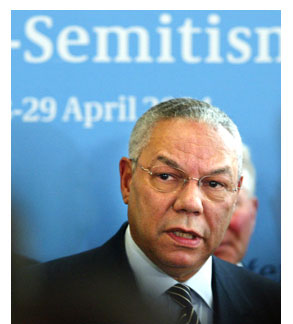
U.S. Secretary of State Colin Powell called upon member nations to “send the clear message to extremists of the political right and the political left alike that all those who use hate as a rallying cry dishonor themselves and dishonor their cause in the process.” The conference’s closing “Berlin Declaration” tried to tread a middle path, condemning all forms of anti-Semitism and declaring “unambiguously that international developments or political issues, including those in Israel or elsewhere in the Middle East, never justify” it.
Certainly, the left must do more, and forcefully, to condemn anti-Jewish speech and violence within its ranks when it occurs. “We cannot just say, we have a new anti-Semitism and it’s Muslims and it excludes us — we have to accept that we too are involved,” says Marie-Luise Beck, the Green German minister for social integration. But she and many others point out that radical Islamic bigotry, combined with resilient ultra-nationalism, poses the greatest direct threat to Jews in Europe today. “Anti-Semitism is prevalent not just in the extreme right wing,” says German journalist Eberhard Seidel, who runs tolerance programs for immigrant youth in Berlin schools. “Among Muslim young people it is also a part of everyday life.”
Whether it lies in an Egyptian production of the “Protocols of the Elders of Zion” beamed by satellite into European living rooms, the suffering of ordinary Palestinians, incendiary prayers by radical Muslim clerics, the 20 percent of French voters who support xenophobic politicians like Jean-Marie Le Pen, or the unlikely prospect of those two disaffected groups joining, “There is danger ahead,” says Schoeps.
Until very recently, these problems had not been named or addressed. But the rash of high-level conferences, and even the alarm bells pulled by American Jews, have made fighting anti-Semitism in Europe a priority and have been an enormous relief, said Weil, to French and Continental Jews. Still, in the end, the Israeli-Palestinian quagmire is the source of much hatred of Jews, and most Europeans believe it will not fade so long as that conflict goes unresolved.
