Most Olympic events have some tenuous connection with a useful human activity. Running fast and jumping far need no explanation, but even the more apparently gratuitous sports could come in handy. Being good at water polo, for example, would be a plus if a gang of thugs in bathing suits suddenly jumped into your swimming pool and tried to make off with your pool toys. Curling, with its mysterious frenetic ice- sweeping, could be valuable preparation for those planning to become Eskimo housewives. And knowing how to fence would be invaluable should you be a loudmouthed, adulterous scoundrel who somehow found himself in early 19th century Heidelberg.
But the pole vault? Who first dreamed that up? Some addled medieval military strategist, hoping to send a phalanx of unfortunate warriors flying over the enemy’s castle walls? A manufacturer of 15-foot-long wooden sticks, trying to grow his business? No explanation seems to make sense: The pole vault, like the ski jump, is apparently just one of those sports that exists for its own sake. And that makes it all the more marvelous.
I’d seen pole vaulting in Sydney, when American woman vaulter Stacy Dragila won the gold, but I was on the wrong side of the stadium and it was a little hard to stay involved. One thing that people who have only seen the big Olympic track and field events on television may not realize is how chaotic and hard to follow things can be when you’re actually there. This is partly because of the size of the stadiums (huge), but also because many events happen at the same time. This leads to strange juxtapositions, and double dramas unfolding simultaneously. For example, last night’s glamour event was the men’s 1,500 meters, in which Morocco’s Hicham el-Guerrouj, a four-time world champion and perhaps the greatest middle-distance runner of all time, was trying to end his Olympic nightmare: El-Guerrouj has lost only four times in eight years, but two of those were at the last two Olympics. Going in, if you had told me that I would take my eyes off that race for one of the 214.18 seconds it took to run it, I would have laughed. But I was so deeply engrossed in the drama unfolding in front of me that I had to turn away from the el-Guerrouj saga for a few seconds.
The drama was the women’s pole vault final, and it came down to a three-way duel between Russia’s Yelena Isinbayeva, Russia’s Svetlana Feofanova and Poland’s Anna Rogowska. In a shocking development, defending Olympic champion Dragila, who later blamed too-tight shoes for giving her problems with her Achilles tendon, did not even qualify, failing to get over a rudimentary 4.40 meters. Her debacle took place on the far side of the stadium Friday night, unnoticed by the crowd. I realized she had gone out, but I was watching something else and didn’t see her final miss, or her reaction. The huge, buzzing stadium resounds with blazoned deeds, with joy and heroism, but at the same time it is filled with invisible heartbreak, enormous personal losses that go unseen, like the tiny figure of Icarus plunging into the distant sea in Breughel’s happy pastoral painting. This is one of the many ways in which neither the Olympics, nor human beings, have changed.
The pole vault competition takes hours. Every competitor is given three chances at a given height; they’re gone if they miss the third. The competition was wide-open until 4.65 meters, when the challengers — notably Poland’s Monika Pyrek and Iceland’s Thorey Edda Elisdottir — crashed and burned. (The departure of the latter, who combined impossible height, granitic abdominals, broad shoulders and a blond Viking face that Beowulf would have given away all his rings for, sent deep gloom through those men petty-minded enough to root, in part or in whole, on the basis of such superficial phenomena. I do not myself know who these men are, but unless they can demonstrate that they can use them responsibly, their binoculars should be taken away.)
That left the big three, who would divvy up the medals between them. First up was Poland’s Rogowska, with the bar set at 4.70. She soared over and jumped for joy: If the Russians faltered, she could take home a gold that no one expected. But Feofanova was not going to falter. The red-haired, freckled, fair-skinned former gymnast has toughness written all over her, and her form is as consistent as a machine. You’d pass her on the street and not even notice her, but she has ice water in her veins and will beat you at anything she wants to beat you at. She went over 4.70 easily.
Now it was Isinbayeva’s turn at 4.70. Dark-haired, flashing-eyed and Slavic-featured, with a superbly elegant, muscular physique, she was the current world record holder, although that didn’t mean much. She and Feofanova had been trading world records like baseball cards all summer long: She set the last one, 4.90, only a month ago. She set out on her run down the track, powerful, light-footed, holding the absurdly long pole upright, made the crucial stick plant (the right hand grip at the moment of the plant seems all-important), exploded into that ridiculous breathtaking elevator-going-up swing feet-first into the air, soared up while twisting, easily cleared the bar — and somehow hit it coming down. As the bar landed in the pit behind her she jumped up and was seriously pissed. Her eyes shot out flames like a T-34 tank. I’ve watched a lot of dear old Svetlana Khorkina, the most famous of temperamental Russian athletic divas, but trust me, even Khorkina doesn’t shoot off sparks the way Isinbayeva did right then.
Now Rogowska put the bar up to 4.75. She missed. Feofanova then missed fairly badly. (One of the intriguing things about pole vaulting is how many ways there are to miss, from mis-hitting your plant to not getting enough vertical lift off the plant to misjudging the horizontal distance to the bar to not clearing your arms as you go over. Many times, vaulters never even get the pole down after their run.) Isinbayeva opted to pass a second jump at 4.70, so she now was making her second at 4.75. If she missed this, she would have only one more chance. She missed. Anger now began to turn to despair, almost tears. She looked imploringly over at her coach, sitting across the track.
Rogowska missed at 4.75 but Feofanova sailed over. Rogowska missed again. She was out but sitting on a silver medal unless Isinbayeva could come back. She looked ecstatic: Silver would be beyond her dreams. She could barely contain herself, she was so excited.
And then Isinbayeva made one of those gambles that make sports so much fun to watch. She had missed at 4.70 and 4.75 but elected to pass her final jump at 4.75 and put the bar at 4.80. If she missed, she would only take a bronze. If she made it, she would vault into the lead. In Vegas, they call it doubling down.
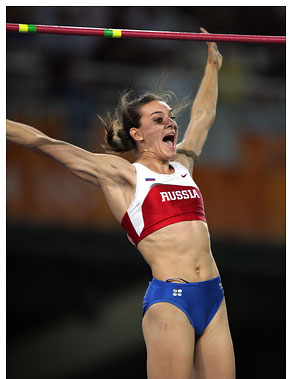
She stood at the end of the runway, her lips moving, saying something to herself. She was ready. She rocked on her feet and began the run, the crowd roaring for her. The stick, the ascent, hydraulic — perfect — twist, over! As she cleared the bar, maybe before she cleared it, even before her arms were clear of it, at that very moment she opened her mouth and screamed with joy. It was a vision I’ll never forget because it happened when she was still in her jump. As she flew over and down, the bar motionless, a giant jolt of electricity ran through the crowd. She leaped up, and if you want a visual embodiment of the word “passion,” it was on her face.
But she still had Feofanova to contend with. The two passed inches away but did not look at each other. They have acknowledged that they’re not exactly bosom pals, with Isinbayeva saying they have a “hi and goodbye” relationship. Feofanova was now vaulting at 4.85. Isinbayeva sat against the athlete’s bench, her back to the bar apparatus, with a huge towel over her head. Feofanova prepared, weighed, ran, planted, jumped — and missed. Now Isinbayeva was not just back from the dead, she was in full and devastating form. She nailed 4.85, with the crowd in full voice.
It was Feofanova’s last chance. She chose to take her last vault at 4.90, the world-record height. She missed and it wasn’t particularly close. She lay on her back for a moment, then jumped up and waved to the crowd, which gave her a warm ovation.
But Isinbayeva had one more vault. She set the bar at 4.91, higher than any woman has ever vaulted. As she lay on her back, preparing, the camera found her and for the first time she smiled. The gold was in the bank. This was strictly for glory.
The crowd wanted both and she did too. Down the track she ran, toward the bar that rose more than 16 feet up — three times her height. She planted the stick and uncoiled and the chrysalis thing happened again, the metamorphosis, an ungainly spear-carrier somehow turning first into a wrestler, then a gymnast, and finally into a bird. She went over, and when she came down, she collapsed for a moment and bounced back up, her face ablaze with half-disbelieving joy, and then the tears came.
Later, after the crowd had mostly disappeared, a kind-faced, middle-aged man came over and hugged, congratulated and spoke to her; it seemed like family, his calm demeanor expressing that I’m-proud-of-you-but-everything’s-still-the-same feeling that the greatest celebrities must come to crave like water. Feofanova then came over and the two exchanged a hug, and I got a good long look at Foefanova’s face with binoculars (being used for legitimate journalistic purposes), and that was a real, warm smile. So there were two champions there.
A lot else happened last night. Roman Sebrle of the Czech Republic won the men’s decathlon, earning the title of world’s greatest athlete by beating out an inspired effort by the U.S.’s Brian Clay. (The procession of the male decathletes around the track is something everybody should see, male, female, straight or gay — these are the most beautiful male physiques, quite simply, in the world. And that’s saying something after watching the procession of bodies here, which is pretty awe-inspiring. They look like they average out at about 6’1″, 190, with superbly balanced musculature. They’re bodies designed and honed to do everything. Stunning. But not worth becoming a decathlete to achieve.) American sprinter Joanna Hayes roared to victory in the 100 hurdles, as the Canadian favorite, Perdita Felicien, crashed on the first hurdle and immediately collapsed, grimacing in despair and bitter disappointment, knowing one misstep had blown her chance. Tonique Williams-Darling of the Bahamas won a stirring women’s 400 meters, beating the great Mexican quarter-miler Ana Guevara and deflating the hopes of the numerous Mexican fans who turned up in huge sombreros and Mexican flags. Williams-Darling, who has an extraordinarily beautiful and sensitive face, won the prize for most heartfelt comportment on the medal podium.
And finally, there was el-Guerrouj. Everyone was pulling for him, an atmosphere that can seem ominous. He ran a smooth race, holding a perfect outside position until he made his move to take the lead midway through the race. He was leading coming out of the last turn, but on the home straight his great rival, Kenya’s Bernard Lagat, kicked hard and overtook him. There was no way of knowing what would happen, no form to read, the challenge was too formidable. As they burned neck-and-neck toward the finish, with the crowd standing and imploring, the Moroccan reached down and summoned what was in him. It had not been enough at the Olympics before.
This time it was. He retook the lead and held off Lagat for the agonizing last 30 meters. When he crossed the line, 12 one-hundredths of a second ahead of the Kenyan, and realized he had won, he fell to the ground and kissed it, in prayer, in thanks. Lagat ran over and embraced him, a sportsman in every sense of the word, seeming to take almost as much joy in the victory, in the lifting of the curse, as his rival.
Guerrouj, too, cried as he ran his victory lap around the stadium. “It is finally complete,” he said later. “Four years ago in Sydney, I cried with sadness. Today I cry tears of joy. I’m living a moment of glory.”
And as el-Guerrouj ran around the great arena, his face radiant with joy, we cheered, we laughed, and we too gave thanks to the god, the force, the spirit that rewards a champion.
On Wednesday, the real Barack Obama stood up. He is a better man and a better president for having done so. And America is a better country.
Homophobia is the last refuge of open bigotry in American life. Racism, anti-Semitism and misogyny still exist, but they lurk in the shadows. It is no longer socially acceptable in any segment of society to openly say that blacks are violent or Latinos are lazy or Jews are grasping or women are genetically inferior. But it is still acceptable to say the crudest and most hate-filled things about gay people. In his 1999 book “One Nation, After All,” sociologist Alan Wolfe found that Americans were remarkably tolerant and open-minded about every controversial subject except one: homosexuality. Attitudes toward gays have become far more enlightened during the last 13 years, but Wolfe’s findings touch on a profound social reality: Many Americans still feel gays are somehow unacceptable, or scary, or immoral, or just different in some way that makes it acceptable to discriminate against them and/or openly disparage them.
That does not mean that all of the North Carolinians, for example, who voted Tuesday for an amendment outlawing same-sex marriages are homophobes. Many of them simply believe that marriage should be restricted to heterosexual couples because that’s the way marriage has traditionally been defined, and they believe that defending tradition as important. But their personal views have become irrelevant. The fact is that same-sex marriage has become a national civil rights issue, and as such, it has enormous symbolic importance. To simply stand on the sidelines and not take a position on it, as Obama tried to do until Wednesday, is to tacitly accept that gay people are second-class citizens. This narrow, legalistic approach to gay marriage only encourages bigotry and stands in the way of needed progress. It was necessary for Obama to take a risk – and take a stand.
I did not think he would do it. But he did.
Obama dislikes conflict, and he dislikes risk even more. Some of that is both understandable and justifiable. Politics is the art of the possible. You have to get elected to get anything done. And to get elected, or reelected, you have to make compromises. That is why Obama hid behind the transparently false excuse that his views on same-sex marriage were “evolving.” He wanted to avoid a hot-button issue that could potentially cost him the election.
To be sure, that was a questionable political tactic. Advocates argued that Obama faced little political risk in endorsing same-sex marriage because the social conservatives for whom this issue is crucial were not going to vote for him anyway. Moreover, they argued that the number of swing and independent voters the president would lose would be more than made up for increased turnout among his supporters.
Those arguments may be correct – but they may not be. We just don’t know. North Carolina is a swing state. It just voted to ban same-sex marriage. It is indeed possible that Obama will lose the election because he took the opposite position.
It is no secret that Obama has sorely disappointed his most ardent supporters. Throughout his first term, he has consistently refused to do anything truly politically risky. He spoke of fundamentally changing the rules and culture of Wall Street – then stood by as the same looters who destroyed the economy gamed the system. He talked up a progressive reform of healthcare – and ended up with a watered-down version of a Republican idea. He announced a bold stimulus package – then made it too small to be fully effective. He gave the best speech about the Israeli-Palestinian crisis ever given by an American president – then caved in to the Israel lobby. And so on.
But there are times when pragmatism must take a back seat to principle. And to his undying credit, Obama decided that this was one of them. He decided that it was more important for him, the leader of the United States, to stand up and defend the rights of an abused minority group, than to accept the unacceptable status quo.
We don’t know why he decided to take the risk. A cynic – or perhaps a realist – might simply say that he decided there was no risk, that most Americans would stand with him on this issue. But I prefer to think of his decision as being at least in part shaped by the two most crucial, and inseparable, parts of his identity: his blackness, and his profoundly inclusive ideals. As president, Obama has never played the race card, never asserted his racial identity in any significant way. This reticence is both politically astute and deeply grounded in Obama’s own sense of what race means – and does not mean. For Obama, race matters – but paradoxically, it matters precisely because it offers all of us, black or white or brown or yellow or red, an opportunity to transcend it. In that regard, Obama is a true child of the civil rights movement. The men and women who struggled and died at Selma and Birmingham and Little Rock and Neshoba County are his heroes, and he was not going to betray their memory. That’s bedrock for him.
What happened yesterday is that Barack Obama, as flawed and brave and human as the rest of us, just struck his own bedrock. And the sound of that pick hitting stone brought tears to my eyes.
He did not have to do it. History is filled with crucial decisions that did not have to be taken. Gandhi could have decided the Salt March was too divisive. John Fitzgerald Kennedy could have decided that extending the hand of friendship to the USSR at the height of the Cold War, in his famous American University speech, was too politically risky. Lyndon Baines Johnson could have decided the Civil Rights Act of 1964 was not worth spending so much political capital on. Martin Luther King could have decided that white America was not ready for a campaign of civil disobedience. The hundreds of thousands of Arab men and women who risked their lives to demand justice, opportunity and freedom could have turned back when the club-wielding thugs appeared. The Occupy protesters who came out in the rain to demand that America live up to its ideals could have stayed home.
But they did not. Those people – leaders and ordinary citizens alike — took the risk. They did the right thing. And history will remember them, and honor them, when the pragmatists and calculators have long been forgotten.
The night before he was shot, Martin Luther King Jr. seemed to prophesy his own death. “But it doesn’t really matter with me now,” he said. “Because I’ve been to the mountaintop … And I’ve seen the Promised Land. I may not get there with you. But I want you to know tonight, that we, as a people, will get to the Promised Land. So I’m happy, tonight. I’m not worried about anything. I’m not fearing any man. Mine eyes have seen the glory of the coming of the Lord.”
Obama could lose the presidency because he stood up for the rights of gay Americans. But if he does, for the rest of his life he can look back and know that when it counted most, he did the right thing. That is something no one can ever take away from him. Or from the American people.
Continue Reading
Close
Even before the Republican primaries began, rumors abounded that Mitt Romney was a robot. His zombie-like cheerfulness, his excessively regular features and his strangely perfect-looking family led to widespread suspicion that he had been assembled in Silicon Valley by a team of right-wing nanotechnologists and engineers and shipped secretly to GOP headquarters. The suspicions were far from universal, however. An influential group of skeptics rejoined that cybernetics had not advanced to the point where it could create lifelike humanoids, even ones as unconvincing as Romney, and that the GOP candidate should be considered a human being until it was definitively proven that he was a cyborg.
There the debate rested. Then Romney hit the campaign trail, and the pendulum swung decisively toward those who held that he was constructed out of high-impact plastic. Even the skeptics admitted that Romney’s “personality” did not appear to be of organic origin. He seemed uncomfortable in his own skin (which of course would make sense if he did not have actual skin), and did not know how to tell jokes (humor is notoriously difficult to program). Even the words he used to describe himself sounded like they were auto-imported from a slightly archaic database, as when he oddly described himself as “severely conservative.”
But the clearest sign that Romney had fiber optic cable coiled in his midriff was the bizarrely smug and clumsy way in which he constantly referred to his plutocratic lifestyle. When asked at the Daytona 500 whether he followed NASCAR closely, Romney completely failed to take advantage of this traditional GOP opportunity to demonstrate the common touch. He replied, “Not as closely as some of the most ardent fans, but I have some great friends who are NASCAR team owners.” Two weeks later, in an interview about the NFL, Romney again went out of his way to affirm his membership in a tiny fraternity of disliked multimillionaires, saying, “I’ve got a lot of good friends – the owner of the Miami Dolphins and the New York Jets – both owners are friends of mine.”
The subject of money, in particular, seemed to produce continual script errors, including inappropriate answers, dead-end loops and other rudimentary programming flaws. In Detroit, Romney boasted that his wife “drives a couple of Cadillacs” – the political equivalent of showing up for a photo op at a diner wearing an ascot and a monocle. He casually challenged Rick Perry to a $10,000 bet during a debate, an unforced error that evoked vote-losing images of Fortune 500 CEOs snapping towels at each other in the sauna. But that weird glitch was dwarfed by a statement Romney made a month later. His hard drive apparently malfunctioning after his tax returns were revealed, Romney referred to the $370,000 he had earned giving speeches one year — an amount it would take the average American worker 14 years to make — as “not very much.” In short, Romney came across not only as an obscenely rich person, but as an obscenely rich person from another planet.
At this point, some leading technology analysts had begun to openly accuse whoever programmed Romney of gross incompetence. But others defended the unknown scriptwriter, pointing out that the Republican Party’s worship of plutocrats as emblems of “aspirational” capitalism made it impossible to for even the best programmer to write a coherent GOP script about wealth.
Romney’s performance in the primary debates also provided strong empirical support for the Mitt-is-a-cyborg thesis. For the entity claiming to be “Mitt Romney” that appeared onstage bore no resemblance to the Romney-like entity Americans had come to know in previous years. The moderate, conciliatory governor of Massachusetts was gone, his place taken by a strange, harsh figure who appeared to have been programmed by a disciple of Torquemada. Romney Version One had strongly supported a healthcare plan identical to Obama’s; Romney Version Two denounced “Obamacare” as opening the door to socialism. Beta Romney, who had defended a woman’s right to choose, had been replaced by an updated model that, like a doll that speaks a few simple phrases when its bottom is squeezed, intoned “abortion is immoral” again and again.
Different observers had different explanations for this strange phenomenon. Some maintained that “Mitt Romney” had been originally programmed in the factory to flip-flop when politically necessary. Others held that the earlier version had been surreptitiously refurbished, or possibly completely replaced.
Since he clinched the GOP nomination, Romney’s behavior has become even less recognizably human. Following his mechanical move to the far right during the primary season, his even more mechanical attempt to move back to the center has made it appear increasingly likely that he was assembled by nano-machines. His victory speech in New Hampshire was a tape loop of Reagan-like platitudes about free enterprise and Reagan-like blasts at the apocalyptic evil posed by Big Government, topped off with a weird, casuistic attempt to claim that his laissez-faire, I’ve-got-mine-Jack ideology was “fairer” than Obama’s attempt to shrink the increasing gap between rich and poor. Instead of the Great Communicator, Romney came off like a Frankenstein monster, cobbled together out of various right-wing bits and pieces, trying simultaneously to appease Tea Party extremists and clank back to the middle, all while smiling a big, artificially-whitened smile.
His inability to impersonate a human being poses severe political problems for Romney. But the worst is yet to come. Republican strategists are now advising Romney to stop attacking Obama and offer a “positive vision.” Most experts believe this simply cannot be done. Romney’s CPU, set up to defend cutthroat capitalism, destroy his opponents, and present the innocuous centrist Barack Obama as the reincarnation of V.I. Lenin, cannot accommodate the impossible demand that he suddenly become “human.” No one knows whether he will literally melt down in public with smoke pouring out of his eye sockets, or will simply begin regurgitating meaningless phrases about an “opportunity society,” like the unplugged super-computer HAL in “2001: A Space Odyssey.” But sooner or later, Romney is doomed to a fatal system error.
Like Arnold Schwarzenegger in “The Terminator,” Romney is about to be turned into scrap metal. But there is still time for him to save his campaign. If Mitt Romney wants to be president, he must appear before the American people on prime-time TV and admit that he is a robot.
With this one bold stroke, Romney would dispel all questions about his authenticity. After all, unlike human beings, robots are not expected to demonstrate consistency in their beliefs and actions. They do not have “selves,” only circuits that react in programmed ways to new situations. The instant Romney shows the nation the power cable hidden in his posterior, his self-contradictory positions and blatant pandering will cease to be seen as a cynical grab for power. Instead, they will become the visible manifestations of an advanced Google-like algorithm, inspiring technological interest and respect.
A frank confession that Romney plugs himself into a socket in his garage every night would also end the criticism of his wooden demeanor. “Star Wars,” “Mystery Science 3000,” “The Terminator” and other pop-culture hits have popularized lovable, wisecracking, helpful robots. Romney would be far better served if he was seen as C3PO, rather than a stilted, fake-Tea-Party plutocrat boasting about his friendships with other plutocrats.
Moreover, by forthrightly admitting that his head swivels around on a titanium base, Romney would instantly wipe out Obama’s advantage among young voters. Tech-savvy young Americans prefer Facebook, Tumblr, Zynga, smartphones and iPods to reality anyway, and would jump at the chance to make their generational mark by electing a president who is one of them (and can be easily disassembled and shipped back to the factory for repair.)
Finally, if Romney were to stand before the American people, remove his head and forthrightly admit that he is a robot, he would get rid of the biggest albatross around his nonexistent neck: his leadership of the private equity firm Bain Capital. As a human being, Romney cannot justify the rapacious, job-destroying actions engaged in by Bain. When critics – including his GOP rivals – rightfully accused him of practicing “vulture capitalism,” all Romney could say was “In the free economy, in the private sector, sometimes investments don’t work and you’re not successful.” Coming from a human, this answer is heartless. Coming from a robot, it feels almost cuddly.
Which points to the real reason Romney should admit to being a robot – whether he is one or not. As a human being, Mitt Romney is a flop. But as a robot, he’s positively human.
Continue Reading
Close
In Syria, the horror has taken a brief break. The Kofi Annan-brokered cease-fire is holding so far, give or take a few government snipers, but no one expects it to last. Within hours, days or weeks, something will break the fragile calm. President Bashir al-Assad’s tanks will once again begin firing high-explosive shells into civilian neighborhoods, blowing up houses and everyone in them. Opposition fighters will kill government troops and set off bombs. Mysterious massacres, which each side will blame on the other, will take place. Soldiers will continue to rape women, children will be tortured, and the horrible human toll – 9,000 deaths, 42,000 refugees since fighting began 13 months ago – will continue to climb.
There is a very good chance that this slow-motion blood bath could go on for years. And at the end, Assad could still be in power.
As this dreadful situation festers, calls for America to arm the opposition are growing louder. And they are not only coming from neocons, neo-imperialists and warmongers, proxy warriors for whom defeating Assad is part of a Great Game whose real goal is defeating Iran. No one is surprised that neocons like Joe Lieberman, for whom America’s foreign policy comes down to “Is it good for Israel?” or his chest-beating partner in imperialist Islamophobia, John McCain, want the U.S. to arm the Syrian opposition. Nor is it surprising that Elliott Abrams, Fox News or the Washington Post editorial board have beat the war drums. But these predictable hawks have been joined by an increasing number of liberals and humanitarians who have no ideological ax to grind.
Saying “the basis for any settlement must be a rough equality of forces,” New York Times columnist Roger Cohen called for the U.S. to arm the Syrian opposition. Analyst James Traub similarly called for the U.S. to back what he called a “neo-mujahadeen strategy.” Guardian columnist Simon Tisdall blasted Obama’s refusal to get the U.S. more involved, saying that the world had a “moral imperative” to intervene. “A shoulder shrug will just not cut it any more,” Tisdall wrote. In a column titled “Syria is not Iraq. And it is not always wrong to intervene,” Tisdall’s Guardian colleague Jonathan Freedland denounced facile left-wing opposition to Western intervention in Syria, writing, “we must not make the people of Homs pay the price for the mistake we made in Baghdad.” Oxford economist Paul Collier argued in the Financial Times that Assad’s regime was doomed and arming the opposition would push it over the edge.
None of these commentators are neoconservatives or proxy warriors, fans of the “War on Terror,” the Bush Doctrine or the unbridled use of American force. In their different ways, they are driven by simple, and legitimate, moral outrage. That outrage was expressed in its purest form by the Iraqi exile Kanan Makiya, the Iraqi exile whose powerful indictment of Saddam Hussein’s tyranny played a large role in convincing liberals like George Packer and Paul Berman to support the Iraq War. In a largely pro-intervention symposium posted recently by the New Republic, Makiya wrote, “I don’t really think there is any kind of a reasonable argument against intervention in Syria. Quite the opposite: There is a moral and a human imperative to act that is larger than any nation’s interests and larger than any strategic calculation. That is so obvious it is an embarrassment to have to say it. This is how I thought about intervention in Iraq 20 years ago and it is how I think about what needs to be done in Syria today.”
To their credit, most of these observers recognize that their call for the West in general and America in particular to support the Syrian opposition holds considerable risks. For example, after acknowledging the murky and disorganized nature of the Syrian opposition, the looming possibility of sectarian massacres, and the unhappy outcome of America’s mujahedin experiment in Afghanistan, Traub writes, “[T]here are no good solutions; only less bad ones … I’m open to a better suggestion.”
So these commentators deserve respect for their intellectual integrity, their good intentions and their moral outrage. All of them find the unfolding carnage in Syria unbearable to behold, and anyone with a conscience would agree.
And yet, we must bear it. For the worst thing that America and the rest of the world could do is to arm the opposition.
This is not a knee-jerk left-wing response. It has nothing to do with Iraq. Nor does it have anything to do with the proxy war between the U.S. and its allies and Iran and its allies. It is not driven by pacifism or opposition to all war. All U.S. wars are not axiomatically foolish, evil or driven by brutal self-interest (although most of them since World War II have been). The airstrikes on Kosovo and the Libya campaign were justified (although the jury is still out on the latter intervention). If arming the Syrian opposition would result in fewer deaths and a faster transition to a peaceful, open, democratic society, we should arm them.
Every situation is different: There is no one-size-fits-all template for foreign affairs. And in Syria, the truth is that further militarizing the conflict will likely cause it to spiral out of control. Moral outrage alone is not enough. It must be tethered to a coldly rational analysis.
That analysis has been provided by a number of in-depth reports, most notably a new study by the International Crisis Group, as well as the excellent on-the-ground reporting of Nir Rosen for Al-Jazeera. The bottom line is simple. The war has become a zero-sum game for Assad. If he loses, he dies. But the only way he can lose is if he is abandoned by his crucial external patron, Russia, which is extremely unlikely to happen absent some slaughter so egregious that Moscow feels it has to cut ties with him. Assad has sufficient domestic support to hold on for a long time, and a huge army that is not likely to defect en masse. Under these circumstances, giving arms to the rebels, however much it may make conscience-stricken Western observers feel better, will simply make the civil war much bloodier and its outcome even more chaotic and dangerous.
The key point concerns Assad’s domestic support. Contrary to the widely held belief that most Syrians support the opposition and are opposed to the Assad regime, Syrians are in fact deeply divided. The country’s minorities – the ruling Alawites, Christians and Druze – tend to support the regime, if only because they fear what will follow its downfall. (The grocery on my corner in San Francisco is owned by a Christian Syrian from a village outside Damascus. When I asked him what he thought about what was going on in his country, he said, “It’s not like what you see on TV. Assad is a nice guy. He’s trying to do the right thing.”) As Rosen makes clear, Syria’s ruling Alawite minority is the key to Assad’s survival: Absent an outside invasion, the regime will not fall unless the Alawites turn on it. But the Alawites fear reprisals if the Sunni-dominated opposition, some of whose members have threatened to “exterminate the Alawites,” defeats the Assad regime. The fear of a sectarian war, exacerbated by the murky and incoherent nature of the opposition, means that the minorities are unlikely to join the opposition in large numbers.
As for the opposition, it has suffered too many losses to stop fighting.
What this means is that neither side has any reason to stop pursuing its present course, and short of a U.S. or NATO invasion – which only barking-mad neocons are suggesting we embark on – the regime will be able to hold on for years. The longer the struggle goes on, Rosen notes, the more radicalized and Islamist the opposition will become. As Rosen gloomily writes, “Syria is crumbling before our eyes, and a thoroughly modern nation is likely to be set back many decades.”
The International Crisis Group report argues that America’s current posture of talking about arming the opposition while simultaneously pursuing a diplomatic track is a mistake.
“In the meantime this dual U.S. and Arab approach – on the one hand, proclaiming support for Annan and for a diplomatic resolution; on the other, toying with greater militarization of the opposition – arguably is a strategy at war with itself and one that could readily backfire. Some argue that only by dangling the prospect of a stronger rebel force might Assad be persuaded to give in. But a different scenario is more likely: The regime will point to any decision to arm the opposition as a breach of the Annan plan and use it as a reason not to comply and to reinvigorate its own offensive; meanwhile, the military half-measures on behalf of the opposition might satisfy the urge to ‘do something’ – but these will be woefully inadequate to beat back a regime offensive.”
The ICG report recommends “a more pragmatic, consensual approach, a controlled, negotiated transition that would spare the country additional bloodshed … a middle course between chaos without the regime and chaos with it – a controlled transition that preserves state institutions, thoroughly reforms the security services and puts squarely on the table the issue of unaccountable family rule.” To get there, it suggests strengthening some of mediator Kofi Annan’s general ideas, including a monitoring mechanism to ensure that cease-fires are not violated, freezing of weapons smuggling across the border, and a pragmatic compromise on demonstrations that would allow them but not in the center of Damascus, where they would become Tahrir Square-style mass movements that would topple the regime. In the long run, the radioactive issue of the Assad family’s rule and legitimacy and the sectarian makeup of the security forces would have to be addressed. But in the short term, Assad would remain in power.
An Op-Ed piece in the New York Times by two law professors, Asli Bali and Aziz F. Rana, made the same point: The most humane thing for the Syrian people, the authors argue, would be to engage with Assad – which means leaving him, at least for now, in power.
This means that the best-case scenario is that the fighting winds down, the opposition eventually gives up the armed struggle, contents itself with whatever crumbs Assad throws it, and waits for the political winds to shift enough so that real change can start taking place.
For this, thousands of men, women and children gave their lives?
Such an outcome seems morally outrageous. It’s unthinkable. But the alternative – an all-out sectarian civil war between evenly matched adversaries, both of them fighting to the death – is even more unthinkable.
What America and the world are faced with in Syria, in short, is nothing less than a tragedy. And we are not good at dealing with tragedy.
Americans are not a tragic people. We do not understand tragedy, and we instinctively resist it. Our history has insulated us from it. American exceptionalism, the belief that we are qualitatively different from all other nations and immune to the woes that afflict them, goes back to the Puritans. No American president can avoid paying lip service to it. The Republican Party’s foreign policy consists almost entirely of endless variations on it. It is in our national DNA.
The American belief that we live in a city on a hill, that we are immune from tragedy, has not only molded our national character, it has shaped our relations with the rest of the world. Some of its influence has been positive. Optimism and generosity, the benign face of American exceptionalism, drove epochal achievements like the Marshall Plan, which rebuilt a shattered Europe after World War II. That altruistic, engaged approach to the world known as “Wilsonian idealism” or “liberal interventionism” has resulted in some notable achievements, including the ouster of Serbian tyrant Slobodan Milosevic and the toppling of Libyan dictator Moammar Gadhafi. A foreign policy that does not have a moral component, a purely Machiavellian approach to the world, is soulless. Realism is essential, but realism without compassion is deadly.
But America’s belief that it is inherently a force for good, that American interventions always have positive results, and that we can shape the world at will, have led us to make a number of appalling foreign policy decisions – ones that not only failed to advance our own interests, but that harmed the very people and causes we were allegedly trying to help. Vietnam and Afghanistan, our two longest wars, were both driven partly by altruistic motives – and both proved to be disastrous quagmires. George W. Bush’s Iraq War was motivated by a bizarre mixture of factors – Zimmerman-style vigilante vengeance for 9/11, a half-baked “grand strategy” to remake the Middle East for U.S. and Israel, a feckless and puerile president’s desire to play the he-man – but lurking among them was a myopic, almost drugged belief that because we were the ones dropping the bombs, and God was on our side, everything was going to be OK in the end. Hundreds of thousands of dead Iraqis, thousands of dead American and coalition troops and a wrecked country later, everything did not turn out to be OK.
Our national instinct is to come riding to the rescue. It goes against our character to simply sit on our hands. Our sincere, naive and self-centered belief that America can fix everything, and our equally sincere, naive and self-centered belief that moral outrage justifies intervention, is a powerful tide, pulling us toward getting directly involved in Syria’s civil war.
But in the real world, we cannot always come riding to the rescue. Sometimes, we have no choice but to watch tragedy unfold, because anything we do will create an even bigger tragedy.
America is going to have to come to terms with this painful truth, and a lot of similar ones, in the years ahead. We’re going to have to accept that Obama’s drone war is creating more enemies than it kills and shut it down, even if that means some potential terrorists get away. We’re going to have to accept that Afghanistan and Iraq may end up as basket cases, even failed states. We’re going to have to learn to live with an Egypt run by Islamists, and an Israeli-Palestinian conflict that can no longer be solved with a two-state solution. We’re going to have to give up on the dream of perfect safety from terrorism.
After too many childish illusions, and childish wars that killed too many people, it’s time for us to grow up.
Continue Reading
Close
The New York Times reported today that Bain Capital, the private equity firm started by GOP presidential candidate Mitt Romney, owns a Chinese company, Uniview, that supplies highly advanced surveillance equipment to the Chinese government. China’s authoritarian rulers are using the equipment to create an “omniscient monitoring system” throughout the country, according to a Human Rights Watch researcher quoted by the Times. “When it comes to surveillance, China is pretty upfront about its totalitarian ambitions,” said Nicholas Bequelin.
To realize those totalitarian ambitions, China’s authorities, with Bain Capital’s help, are expanding the country’s already vast network of surveillance cameras. The city of Chongqing is spending $4.2 billion for a network of 500,000 cameras, Guangdong Province is installing a million cameras, and Beijing is planning to put cameras in all entertainment venues, the Times reported.
The authorities use these cameras, along with Internet monitoring and cellphone surveillance, to monitor as much of the entire population as possible. But they are particularly interested in keeping a permanent eye on democracy advocates, intellectuals, religious figures and other people they deem dangerous. For example, police used a surveillance camera to record a human rights lawyer named Li Tiantian entering a hotel with men other than her boyfriend, then taunted her about her sex life and threatened to show the tape to her boyfriend. “The scale of intrusion into people’s private lives is unprecedented,” Li told the Times. “Now when I walk on the street, I feel so vulnerable, like the police are watching me all the time.”
But the whining of Li and her troublemaking ilk are of no concern to the patriotic Uniview. In its promotional materials, the company chirps, “Social management and society building pose new demands for surveillance and control systems.”
Bain is also untroubled by the fact that it owns a company dedicated to re-creating the unique societal ambience of George Orwell’s “1984.” It stressed to the Times that Uniview’s products “were advertised” as tools to fight crime, not to monitor dissidents, and that only one-third of Uniview’s sales were to public security bureaus.
Ah, because Uniview advertised that its surveillance cameras were only used to fight crime, it’s OK for Bain to own them. Thanks for clearing that up, Bain! (I take the liberty of addressing you as Bain because, as the Supreme Court has ruled and the GOP believes, corporations are people.)
Speaking of which, Bain, I would be remiss to your investors if I did not draw your attention to an excellent opportunity to acquire a leading Rwandan firm, the Tutsi Machete Co. The Tutsi Machete Co. is a perfect target for you. It is underperforming, has a weak management structure and is ripe for a leveraged buyout. Some have claimed that TMC provides hundreds of thousands of machetes to frenzied genocidal mobs, but that is not a concern: The company ran an ad claiming that their machetes were only used to fight crime. Making the optics even stronger, only one-third of the machetes were given to frenzied genocidal mobs. With a significant downsizing of its workforce – which can be accomplished using the company’s own products, thus ensuring significant additional savings – TMC’s profits should increase by 300 percent. Recommendation: Buy.
Romney and his wife earned at least $5.6 million from their Bain holdings, the Times reported. But according to the person who manages their trusts, the Romneys had nothing to do with the decision to invest in Uniview. All they did was pocket the money.
Owning a piece of the Great Eye of Sauron Company is probably too much even for the free-market-worshiping Romney. He will probably get out of the trust, and it won’t be surprising if Bain suddenly decides to unload Uniview. But that won’t solve the real problem, which this grotesque episode highlights. The real problem is untrammeled capitalism, at whose coldblooded shrine he and the rest of the GOP worship. And that problem won’t go away if Romney washes his hands of Uniview, any more than Pontius Pilate was able to wash away his responsibility for crucifying Jesus.
For the almighty market has no conscience. Private equity firms like Bain are sharks. They were created to maximize profits for their investors – nothing more, nothing less. Buying Uniview was egregious, but firms like Bain buy slightly less nasty versions of Uniview every day. Until they stop making decisions solely based on the bottom line, the same issues will keep coming up.
The same thing applies to the free-market mantra constantly repeated by companies like Bain and their defenders — “improving corporate performance.” “Improving corporate performance” really means “maximizing profits for shareholders.” Sure, it sometimes works out well for everyone, workers and investors alike. But the point is, that isn’t its goal. The fate of human beings is not important. If tens of thousands of workers get dumped along the way, they’re just collateral damage, road kill along the great haj to honor Adam Smith.
Early in the primary campaign, in a desperate attempt to wound Romney, Rick Santorum and Newt Gingrich both channeled their inner Marx and made this exact charge against Romney and Bain. When Romney fired back that they were “putting free enterprise on trial,” and GOP ideologues tut-tutted, Twinkle Dumb and Twinkle Me realized that they had gone too far off the reservation and changed the subject. But they were right.
As a liberal, I’d like to be able to cite this story as an example of the perfidy of the American right and the internal contradictions of an ideology that exalts “freedom” but somehow leads to totalitarianism. Unfortunately, the Democrats are virtually indistinguishable from the Republicans on this issue. Bain Capital, in all its creepiness, is as American as apple pie.
Bain is doing two things with Uniview. It is helping an authoritarian regime keep an eternal eye on its citizens, and it is doing so for the same reason it does everything: to maximize its profits. The Democrats are marginally better than the Republicans when it comes to the latter issue: they at least pay lip service to the workers who are “downsized” by firms like Bain. But the differences are cosmetic: they, too, have essentially bought the gospel of greed. And both parties have signed off on the Surveillance Society.
It was President George W. Bush who created the Patriot Act. But in 2011, it was President Obama who asked Congress to extend its surveillance powers. It was Obama who signed the National Defense Authorization Act, which allows indefinite detention and essentially declares that the “war on terror” is permanent. And it was Obama who decided that it was OK to launch drones at will around the world, and assassinate American citizens without trial.
After all, those who are innocent have nothing to fear.
So there’s no reason to worry about the millions of surveillance cameras being deployed all over China. Big Brother is already watching us. Why shouldn’t he watch some other people too?
Continue Reading
Close
Just before he died on March 1, the right-wing attack dog and disinformation specialist Andrew Breitbart promised to reveal explosive videos of a racially charged speech made by the young Barack Obama that would “change this election.”
Breitbart’s death at age 43 led wingnuts on the right to mutter darkly that he was taken out by nameless forces, presumably working for a Satanic Commie Muslim with the initials B.O. Now the video has been released, and it is safe to say that if the Obama administration did dispatch a hit team to silence Breitbart, it was a serious miscalculation. If Breitbart really believed that this feeble artifact would change the election, it would have been much better for the White House if he remained a key member of the right-wing brain trust charged with reclaiming the White House.
The brief video, shot in 1990, shows a young, skinny Barack Obama, at the time a second-year student at Harvard Law School, delivering a speech at a rally on behalf of a tenured law professor at the school named Derrick Bell.
As the video opens, Obama says, “And I remember that the black law students had organized an orientation for the first-year black law students. And one of the persons who spoke at that orientation was Professor Bell. And I remember him sauntering up to the front and not giving us a lecture, but engaging us in conversation. And speaking the truth.”
Here Obama says something indecipherable; there may be a gap or edit in the video. Then, after apparently praising Bell’s achievements, Obama goes on to rhetorically ask, “How did this one man do all this? How has he accomplished all this? He hasn’t done it simply by his good looks and easy charm, although he has both in ample measure. He hasn’t done it simply because of the excellence of his scholarship, although his scholarship has opened up new vistas and new horizons and changed the standards of what legal writing is about.” After loud applause, there is another apparent gap or edit in the video. Obama’s final words are “Open up your hearts and your minds to the words of Professor Derrick Bell.”
Before he died, Breitbart claimed that this video would show “why racial division and class warfare are central to what hope and change was sold in 2008.” Sure enough, right-wingers have seized upon it to portray Obama as a race-card player and friend of white-hating academic extremists. It’s this year’s version of the Bill Ayers, Rashid Khalidi and the Rev. Jeremiah Wright “scandals,” in which Obama was accused of playing footsie with, respectively, a radical Weatherman, a Palestinian academic and an incendiary black clergyman.
Obama’s association with Derrick Bell will turn out to be even more of a non-event than those fizzled bombshells. But the story does shed some light – for better and for worse — on Obama’s temperament, his intellectual style and his racial politics.
To understand the video, one must understand the context. Academia in the late 1980s and early 1990s was roiled by an enormous controversy over “multiculturalism.” The debate took many forms. In the humanities, multiculturalists argued that works by minorities, women and gays had been systematically excluded and devalued by institutions of higher learning, and that it was time to change the canon to end the hegemony of “dead white males.” Students at Stanford marched through campus chanting “Hey ho, Western Civ has got to go.” Activists demanded that campuses create Black Studies, Women’s Studies, Gay and Lesbian Studies departments, and hire more minority faculty members. The conflict was bitter, long-lasting and spawned an enormous literature.
Perhaps the most extreme variant of multiculturalism was found in law schools. Called “Critical Legal Studies,” this movement asserted that law was essentially political and served the hegemony of the white racist power structure. As one of its leading figures, Derrick Bell argued that racism was intractable and permanent and that minority professors were systematically excluded simply because of that racism. He further argued that minority professors, by virtue of the oppression and discrimination they allegedly experienced, possessed unique talents and perspectives not available to white professors, and should be hired on that basis alone.
Bell was given to writing in “non-traditional” forms, like science fiction, and argued that narratives and the like should have the same academic standing as footnoted, peer-reviewed papers. In one such story, “Space Traders,” Bell imagined that a group of spacemen had come to earth and offered to remove all of America’s black people, in exchange for vast wealth and other benefits.
The leaders of America agree, and all of America’s blacks are sold into slavery.
In another allegorical fable, “The Unspoken Limit on Affirmative Action: The Chronicle of the DeVine Gift,” Bell imagines how an elite law school would react to the hiring of a super-qualified African-American candidate who, if hired, would increase the faculty’s minority percentage to 25 percent. The white dean in Bell’s parable refuses, saying that doing so would change the racial character of the school to an intolerable degree. The hiring would “threaten, at some deep-seated level, the white faculty members’ sense of ideological hegemony.”
In a devastating critique of Critical Legal Studies in the June 1989 Harvard Law Review (available online via many public libraries), Randall Kennedy demolished the arguments of Bell and two other leading CLS scholars, Richard Delgado and Mari Matsuda.
“Stated bluntly, they fail to support persuasively their claims of racial exclusion or their claims that legal academic scholars of color produce a racially distinctive brand of valuable scholarship,” Kennedy wrote, and then proceeded to back his argument up in detail. For example, he noted that Bell refused to even engage with the obvious reason that there were so few minority candidates, namely that not enough were qualified. Instead, Bell simply asserted that the criteria of judgment was flawed in some nameless way. Bell was clearly only interested in the outcome, not the process. If it took putting a thumb on the scales to get more black people hired, so be it. The scales were rigged anyway.
What Kennedy wrote of Matsuda was equally true of Bell: By claiming that being a member of a minority group automatically connotes a certain and superior worldview, he argued, she “stereotypes scholars.” The CLS racialism simply inverted pernicious white stereotypes about black people: Instead of being inherently inferior, they were inherently superior.
Kennedy also noted that various CLS supporters came to him (he doesn’t say it, but Bell was among them) and urged him not to publish his piece because it would hurt the movement – behavior more befitting members of a Communist cell than scholars interested in dispassionate inquiry. Of Kennedy, Bell said, “the cause of diversity is not served by someone who looks black and thinks white.”
In short, Bell was a crude racial essentialist. He believed there was such a thing as “thinking white” and “thinking black.” As James Traub noted in a New Republic piece, he was so afraid of giving aid and comfort to white people, and causing harm to blacks, that he refused to condemn the abhorrent anti-Semite Louis Farrakhan.
As befit his racialist ideology, Bell was also a consummate race-card player. His academic career consisted of a long series of racial confrontations with the institutions he worked for. After being hired as an avowed racial token at Harvard, Bell left for Oregon, where he became the first black dean of a non-black school. But he resigned his deanship when the faculty voted against giving tenure to an Asian woman. He then went to Stanford, where a bizarre incident unfolded. Many of the students in his constitutional law course complained about his teaching, saying it was disorganized and excessively politicized. Some began to audit other courses. In possibly the most impolitic move in the history of academia, the university then set up a parallel series of lectures, which were designed to “supplement” Bell’s courses. When black law students protested, the parallel series was canceled.
Bell then returned to Harvard, where he staged a five-day sit-in to protest the school’s failure to hire two radical CLS faculty members, both white. This led a faculty member to say, “This is a university, not a lunch counter in the Deep South.”
The episode that led to Obama’s involvement started in April 1990, when Bell announced that he would leave Harvard if a black woman was not hired. He demanded that Harvard hire Regina Austin, a visiting professor from the University of Pennsylvania. But – in a real-world demonstration of one of the problems Kennedy criticized – Bell was unable to defend her credentials, which made her look like a token. When Austin was predictably and summarily rejected – the appointments committee refused even to vote on her candidacy –Bell took heat from feminists for chauvinism. Austin never forgave Bell for the public humiliation she endured.
Enter Obama
This is where Barack Obama, second-year law student, came in. According to Thomas J. Sugrue’s 2010 book “Not Even Past: Barack Obama and the Burden of Race,” “the Black Law Students Association (of which Obama was a member) accused the law school dean of racism, railed against the fact that Harvard had no tenured black women and only a handful of nonwhite faculty members, and led a series of teach-ins and protests … to demand the diversification of the law school.” The debate was bitter, with both sides claiming the mantle of the civil rights movement.
Obama took part in the protests. At one rally, according to Sugrue, he even compared Bell to Rosa Parks. But – and this is the key point – Obama tried to find a middle ground in the bitter dispute. It is worth quoting the relevant passage from Sugrue at length:
Despite his sympathies with Austin and Bell, Obama positioned himself as someone who could reconcile Harvard’s bitter differences by bringing a tone of civility to the debate. He refused to denounce his critics and hurl polemics. In the words of Bradford Berenson, a conservative student who would later work in the second Bush administration, “Even though he was clearly a liberal, he didn’t appear to the conservatives in the review to be taking sides in the tribal warfare.”
Obama’s position in the middle allowed him to build a winning coalition of liberal and conservatives in his bid to be elected president of the Harvard Law review in February 1990. Later that year, in a dispute about the law review’s affirmative action policy, Obama again attempted to reconcile the opposing camps. He defended the principle of affirmative action while suggesting that he respected the “depth and sincerity” of its opponents beliefs.
Sugrue concludes that “Obama’s experience at Harvard tempered his sympathy for the race-conscious politics of the black freedom struggle.”
The entire episode is vintage Obama. It shows off his strengths: ability to conciliate, open-mindedness, tactfulness, pragmatism. But it also shows off his weaknesses: weakness, indecisiveness, wishful thinking, pragmatism.
Anyone who has read Obama’s “Dreams From My Father,” in which Obama grapples with the long-standing tension in the black community between colorblind universalism and Black Power-tinged separatism, will realize that the Bell case put Obama in a difficult situation. As a member of the Black Law Students Association, for him to have sat this dispute out would have been extremely difficult. It was a mom and apple pie issue. He would have come across as a race traitor. (It should also be noted that Bell, whatever his shortcomings as a scholar and thinker about race, was praised as a fine mentor to black students.)
At the same time, Obama was not a racial bomb-thrower. As Sugrue notes, Obama’s racial views were not yet fully formed, but Obama never subscribed to Bell’s crude racial essentialism and guilt-card playing. If he had been forced to openly state whether he agreed with Bell’s racialist theories, he would have been caught in a bind, trapped between the racial solidarity that was expected of him and the universalism he was inwardly inclined toward. But he was not forced to. He was able to live to fight another day by mouthing bland generalities about how Bell’s scholarship “opened up new vistas and new horizons and changed the standards of what legal writing is about.” In short, he displayed the chameleonic abilities of a future politician.
In his 2008 book “A Bound Man,” Shelby Steele argues that Obama’s Achilles’ heel is precisely his attempt to have it racially both ways. For Steele, Obama is trapped by his need to simultaneously assert black solidarity and a universal identity. The Bell case is a small example of this double bind in action.
Does it matter? At the political level, no. This isn’t a scandal. Who cares if a young law student went racially along to get along? Besides, Obama was just demonstrating for “diversity,” an anodyne goal that has now received a quasi-official societal imprimatur as well as an explicit legal one. (Much as I hate to agree with Justice Scalia about anything, there is a connection between Bell’s crude racial essentialism and the Supreme Court’s 2003 pro-“diversity” ruling in Grutter v. Bollinger.)
Nor does it matter at a personal level. I don’t think that America cares that much about whatever convoluted Hegelian racial dialectic Barack Obama may have gone through in the course of creating his identity.
But it may matter at another level. Obama has shown time and again that he will not get tough until he absolutely has to – and sometimes not even then. He’s conflict-averse. He prefers making beautiful speeches to taking on enemies, or committing himself to one position. He seems to always be slipping away from the fight, thinking he can have it both ways. It is a trait that got him elected, but it is his greatest weakness. The big question, if he is elected for a second term, is whether he is capable of unifying the opposite strands of his character, forging a single identity. That would mean letting the chips fall where they may, and living up to his promise to transform America by finding within himself the only attribute he has so far lacked: courage.
Continue Reading
Close