Fox News

War? What war?

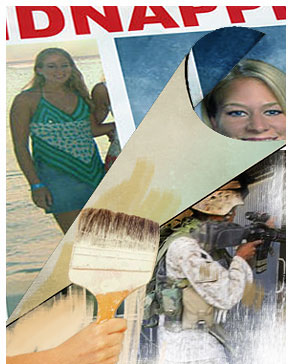
As the Iraq nightmare deepens, Fox News and its cable competitors wallow in shark attacks and Natalee Holloway. If you don't cover a war, does it exist?

  • more
    • All Share Services

War? What war?

Almost four years ago, the American right launched a great moral crusade. Sept. 11 had changed everything forever, the war party and its supporters repeated. The apostles of the New Righteousness used the smoldering ruins of the World Trade Center to anathematize anyone who failed to embrace the cause. To dissent, even to analyze, was to dishonor the dead, virtually to commit high treason. Those few who tried to stop King George’s Crusade from marching to Jerusalem (or Baghdad, in this millennium-later iteration) were swept away like the black protesters in Birmingham, Ala., in 1963, hosed off the streets not with water but with the saintly blood of the 9/11 victims. Pundits railed against an elitist “Fifth Column” and compared dissenters to Neville Chamberlain-like “appeasers.” In one of the great failures of the opposition in American history, the Democrats and the mainstream media joined the angry mob. A few mumbled some pathetic caveats as they waved their pitchforks, but their bleats were drowned out as the patriotic horde swept on to Infinite Justice.

Beyond the calls to war and vengeance, Americans were told that this was a transforming moment, an epiphany. It was a Great Awakening, not just a political but a spiritual watershed. Pious writers insisted that after 9/11, irony was dead. Analysts from across the political spectrum argued that the terror attacks, like a vast memento mori, were a manifestation of death and evil that would forever change our superficial, sensation-addled culture. The astute New York Times columnist Frank Rich criticized the media for its petty pre-9/11 obsessions with such ephemera as shark attacks and tawdry murder cases. In the dark months after the attacks, the left and right agreed that the new era should, must, be one of dignity and gravitas. For conservatives, those qualities were in the service of anger; for liberals, of analysis — but there was no disagreement about the need for transformation.

Today, the issue of how to comport ourselves in the wake of 9/11 is moot: It has been almost four years since the attacks, and most Americans — without forgetting the tragedy or disrespecting the dead — have gotten over it. But our current situation raises almost identical issues, of morality, personal conscience and the responsibility of the media.

For those opposed to the Iraq war and appalled by the moralistic blackmail practiced by the right, it has never been easy to separate legitimate mourning and reflection on the significance of 9/11 from hysteria and unreflective anger. (Indeed, one of the sadder consequences of George W. Bush’s divisive war has been the way it has scattered what could have been a shared American grief.) The “9/11 changed everything” line became a tool used by the right; it overstated the significance of what was not, historically speaking, an epochal event, and implicitly laid the groundwork for the Iraq war.

In fact, soon after the trauma of 9/11 faded it became clear that the demands for a permanent change in American manners and mores were naive at best and overbearing at worst. Moralistic pronouncements about what we should think or watch are tiresome, would result in terrible sitcoms and in any case are doomed to be defeated by what Daniel Bell called “the cultural contradictions of capitalism.” No one would really expect, or want, American culture to suddenly abandon irony, or even its obsession with shark attacks, weird real people conniving against each other on prime time and addictive murder cases. What’s the use of defeating a global enemy if as a result you can’t watch “America’s Next Top Model”?

Still, one need not be a Victorian, or Marxist, moralist to find some of those cultural contradictions pretty appalling — and getting worse all the time.

We are at war. Dozens of Americans are dying every month, and hundreds if not thousands of Iraqis, and there is no end in sight. It is a situation that calls for seriousness, analysis and reflection — in a word, for respect.

So one might expect that the mass media — and in particular, those media outlets that were the most aggressive in calling for war — would treat the war with at least a modicum of respect, and cover it seriously.

But if one expected that, one would be colossally wrong. Welcome to Fox’s America, land of dissociation, where war isn’t real but must be supported at all costs.

Fox News is rapidly becoming an essential if faintly horrific guide to the American soul, a kind of cross between an organ and a tumor. Fox is certainly not the only offender — its cable competitors CNN and MSNBC are chasing the same ratings, and are guilty of similar sins — but it’s the most egregious. Those who have watched Fox News recently must feel as if they had fallen into a bizarre time and logic warp out of Philip K. Dick, where 9/11 never happened (except when necessary to drum up support for the war on Iraq, which also doesn’t exist except when it has to be defended) and we’ve returned to those happy summer days when lurid, sexually charged murder cases and shark attacks were not just the most important stories, they were the only stories.

On Fox these days, it’s all Natalee Holloway, all the time, with breaks for “news alerts” about shark attacks. Probably the only thing that could have knocked the young woman who went missing in Aruba off the Fox air was a speech by Bush, and it did. Fox dragged itself away from Holloway long enough on Tuesday to preview the president’s prime-time speech, trotting out the usual “expert” ostriches who intoned through mouthfuls of sand that only a “steadfast message” would calm the markets and the country, as well as a long-haired right-winger in the Ted Nugent mold who informed us that the Allies had to fight Nazi terrorists after the end of World War II for 10 years. With its usual reverence, Fox also covered Bush’s speech itself, an utterly insignificant offering that seemed to have been spliced together from earlier “inspiring” Bush sound bites. Bush sought to rally support for the increasingly disastrous war by saying we had to fight the terrorists “where they are making their stand” — leaving out the inconvenient fact that they were not there before he invaded. His halftime locker-room address may have been intended to recall the steely resolve of Winston Churchill’s famous “We shall never surrender” speech, but for students of military history it may instead have summoned the words of Adolf Hitler, who proclaimed to the commander of his doomed troops in Stalingrad, “Where the soldier of Germany sets foot, there he remains.”

But Fox’s all-consuming interest is in the Holloway case, upon whose resolution the fate of the republic apparently rests. Tuesday, a short news segment opened with a live report from that epicenter of world news, Aruba, with a grim-looking reporter standing on the beach, intoning something ominous about Holloway. On Monday, its news programming was even more dominated by Holloway (a highlight was when Geraldo Rivera suggested putting military pressure on the Dutch marines to help find her body) and lovingly detailed accounts of the gory Florida shark attacks. John Gibson opened his “The Big Story” show by intoning, “This is a Fox News alert” — then proceeded to inform his viewers of the urgent news that a boy who was attacked by a shark had his leg amputated, before going on to interview a shark expert. The contrast between Fox’s resolute avoidance of showing bloody images from the war in Iraq and its nearly pornographic immersion in shark bites and unsolved murders, was glaring. Only death or bloodshed with high entertainment value gets on Fox.

In this context, it was remarkable that Fox host Neil Cavuto was able to maintain a straight face when he asked oilman T. Boone Pickens, “Does it trouble you the way the war is presented in the media?” — a question so embarrassingly Jeff Gannon-esque that even Pickens retorted, “That’s a loaded question.” There’s no problem with such “liberal media” bias at Fox: If it doesn’t like the way the war is going, it just doesn’t cover it. (Bush and Fox always sing from the same hymnal. In a not-so-subtle passage in his speech, Bush implicitly chastised news outlets for running images of bombings in Iraq, saying the insurgents carry them out “for the cameras.”)

If Fox had not been such an ardent supporter of the war, its tabloid wallowing might be merely irritating. As it is, it’s disgusting — the contrast between Fox’s earlier moralizing and its current pandering feels debased, almost depraved. Fox has not lived up to the war it demanded, and it’s hard to believe that even supporters of the war aren’t offended by this. But for today’s right wing, including those blowhards who make careers out of decrying “the death of outrage” and the loss of Victorian virtues and other sins for which liberal “relativism” and “moral cowardice” are responsible, the idea that war should be covered with dignity and seriousness is as quaint as the Geneva Conventions: What matters is propaganda, effectiveness. If you want to win a war, and it’s going badly, and its continued prosecution (or the political effectiveness of the president) depends upon the opinion of the American people, then you don’t cover it, or you whitewash it. Hence the violent anger, in some conservative quarters, at the “Nightline” programs that showed the U.S. dead in Iraq. That the ultimate act of disrespect for the dead is to ignore them apparently does not matter.

If only the war in Iraq had been the video-game cakewalk the Bush administration promised, Fox wouldn’t have had to deal with this taste problem. After all, everyone knew at the time that the most pro-war cable channel was also the one that wallowed most luxuriantly in shark attacks, tawdry murder cases and cheesy sexual titillation. There seemed no reason at the time that this should trouble anyone: After all, we were going to swagger into Iraq, kick Saddam’s evil ass, declare “Mission accomplished” and swagger back to a hero’s greeting of wonderfully pneumatic blond babes in bikinis on some cool Pacific island where the beer flows 24/7. This wasn’t going to be a war, it was going to be another hit reality show — “Survivor” without casualties, where all the dudes score with the chicks! Plus, if gravitas was needed for some reason, like if somehow a GI actually got killed or something, all the news anchors were wearing U.S. flag pins in their lapels and were pumped to get deeply emotional and patriotic at a moment’s notice.

Still, it is now slowly beginning to dawn on the American people — perhaps even on Fox, although it is not going to do anything about it — that there is a disconnect at the heart of the war party’s rhetoric about the grand mission, a deeply mixed message, and that this is doing something bad to our national character. After 9/11 Bush told Americans that they were embarked on a great struggle, the “war on terror,” and he periodically appealed to their fear and anger. But he has demanded no sacrifice — unless slapping a $1 yellow “Support Our Troops” sticker on the back of your car counts as a sacrifice. In his speech Tuesday, Bush seemed aware that the war is a phantom, disconnected from American reality: He appealed to the country to make some gesture of support to the troops on July 4. It was a pathetic, token appeal that will do little or nothing to unify the country. Perhaps it will raise some troops’ morale, but properly armored vehicles would do far more.

In the end, the larger question of how television should cover war today remains unexplored. In this era of a toothless and intimidated media, this is not surprising: It’s an explosive issue, one that places the media in direct opposition to power. Governments never want their citizens to know the truth about war. Fox News or any other media organization could argue, legitimately enough from the traditional war-coverage perspective, that U.S. casualties in Iraq are so low that covering them in detail, in the modern age of instant mass transmission, of color film and close-ups, would be both unnecessary and a manifestation of antiwar bias, since the bloody images would harm national morale. This is, of course, a debate as old as the Vietnam War: Some conservatives insisted that the American people only rejected that war when body bags began appearing on the screen, and they demanded — and demand now — that the media serve as an instrument of the government.

In fact, this attitude patronizes the American people and imposes a kind of national repression about the actual realities of war that is deeply unhealthy. That unhealthiness, a kind of spiritual rot, rises up not just from Fox’s coverage but from all war coverage that flinches, that glosses over, that pleads “taste,” that pleads “we’re a family newspaper,” that does not actually depict what happens when you go to war.

I am not a pacifist: I accept that there may be times when it is necessary to go to war. But if we do make that ultimate decision, we should do it knowing — and seeing — what war does.

We now live in an age of near-total information. In our fear and uncertainty about this unprecedented state of affairs, magnified by our underlying confusion about how to deal with war, we have embraced near-total repression. As a result, this war has been absurdly sanitized. It’s time to grow up, to make ourselves face the real boogeyman of war — not fake ones like the BTK killer, now safely behind bars and telling his gruesome tales for our horrified titillation. As Chris Hedges, one of the most unflinching chroniclers of war, has noted, modern war is “industrialized slaughter.” Or, as some GI somewhere put it, war is “about blowing motherfuckers up.” It’s about heads getting shot off, and faces torn apart, and babies cut in two, and everything else horrible that can happen to a human body when big pieces of metal hit it at incredible speed. That is what war is — no more, no less. Goya knew this; he drew it in his “Disasters of War,” and under one of his hideous etchings he wrote these simple words: “This always happens.”

This always happens: Every combat veteran knows this about war, but the politicians who make war don’t, or don’t tell. Yes, compared with World War II, or even Vietnam, not many American troops are dying in Iraq. But every GI who dies in Iraq, and every dead Iraqi civilian we don’t count, is a human being like you or me, and as worthy of memorializing as the people who died in the World Trade Center — certainly as Natalee Holloway. It’s time, long past time, for the media to get real about war. Until it does, the TV channels will just be filled with bread and circuses and lies. And the Great Awakening that was supposed to be ushered in will be revealed to be a restless sleep, haunted by shabby, mean-spirited dreams.

Continue Reading Close

Gary Kamiya is a Salon contributing writer.

Fox ad’s phony footage

Updated: Images from the controversial video suggesting 2008 were actually filmed just a few weeks ago

  • more
    • All Share Services

Fox ad's phony footage

[UPDATED BELOW]

Fox News’ new four-minute attack ad against President Obama aims to contrast the excitement candidate Obama sparked in this country four years ago with the misery of higher gas prices and unemployment President Obama has supposedly wrought on the nation today.

The ad — which the network seems to have a love/hate relationship with, as it’s been removed and replaced from its website at various points today — starts with footage meant to represent the former Obama with his message of hope and change back in 2008 and then moves into the darker times of today.

But there’s just one problem: The montage of the cheering fans from yesterday seems to include footage from just a few weeks ago. About 35 seconds into the ad, the camera follows Obama walking into a packed arena, and one woman can be seen holding a campaign sign that reads “Forward” — a slogan the campaign adopted less than a month ago.

The clip shows the inside of a stadium that highly resembles the Schottenstein Center at Ohio State, where Obama officially kicked off his general election bid on May 5. The crowd was given “Forward” signs there. Above Obama’s head in the Fox clip, scarlet banners can be seen — much like the ones that can be seen behind the crowd in photos from the May rally (scarlet is one of the school’s colors). Obama is also wearing a light blue shirt in the Fox ad that appears similar to the one he wore at the rally. Meanwhile, the arena is adorned with the wrong color for 2008: Light blue. That color was adopted by the campaign this year, while the other “hope and change” clips from the ad show the familiar navy blue signage of four years ago.

Now, Fox doesn’t claim that all the footage from the front of its ad is from 2008. But the fact that screaming Obama fans today can be passed off as screaming Obama fans from four years ago does seem to undercut the narrative that Obama’s star has fallen.

Update: Fox News’ Executive Vice President of Programming, Bill Shine, tells Yahoo News, “The package that aired on ‘Fox & Friends’ was created by an associate producer and was not authorized at the senior executive level of the network.”

Continue Reading Close

Alex Seitz-Wald is Salon's political reporter. Email him at aseitz-wald@salon.com, and follow him on Twitter @aseitzwald.

Fox News cuts Obama attack ad

Updated: The four-minute video aired on Fox and Friends before the network pulled it from its website

  • more
    • All Share Services

Fox News cuts Obama attack ad

[UPDATED BELOW]

Perhaps frustrated after years of pretending to be a “fair and balanced” news organization, Fox News threw out its usual playbook of merely skirting the line of journalistic ethics today and went all-in with a four-minute video that can only be described as a political attack ad.

The slickly-produced video, which Fox & Friends co-host Steve Doocy said had been “weeks” in the making, aired on the morning news show today after a brief introduction from the Fox crew. “Let’s talk a little bit about what the campaign slogan used to be for President Obama when he was a candidate. Remember it was ‘hope and change,’” co-host Gretchen Carlson said, “so we decided to take a look back at the president’s first term to see if it lived up to ‘hope and change.’”

What follows has all the trappings of a classic negative campaign ad: Dark and ominous orchestral music, news anchors intoning about various troubles facing the American middle class, quick cuts to stock footage of foreclosure signs, and graphics comparing gas prices and food stamp usage before and after Obama’s term. If one removed Carlson’s introduction and the Fox ticker at the bottom, even the most informed political observer would think it was produced by a Karl Rove attack group or a Mitt Romney super PAC — not a “news” organization.

Of course, Fox has long been a sort of hybrid between a real news organization and a GOP messaging shop, but the attack ad is a new level of brazenness for an already brazen outfit.

It may, in fact, even be too much for Fox executives, as the video appears to have been removed from the network’s website. It could also potentially violate parent company News Corp’s ethics standards, which prohibit the use of company resources to aid political candidates. “Always keep in mind that ‘contribution’ is defined broadly,” the ethics guide warns. It seems highly unlikely, though, that the company would worry about this, as much of what Fox has done could be considered aiding a various candidate in some sense.

A Fox spokesperson did not immediately respond to a request for comment.

Some conservatives are also concerned. “Should a news organization produce and publish attack ads like this?” Hot Air’s Ed Morrissey wondered. “We usually criticize that kind of behavior with other news organizations … That shouldn’t be the job of news-reporting organizations, even when we like the message.”

The ad comes just six months after Fox News chief Roger Ailes declared the network was undergoing a “course correction” to get away from the rank partisanship it had come to be known for. The network tried to “distanc[e] itself from the tea party cheerleading that characterized the first two years of President Barack Obama’s presidency” and “ increasingly promoted its straight-news talent,” Politico reported in February. So much for that.

Update: After displaying an error message for several hours today, suggesting it had been removed, Fox’s video of the ad is now working properly. The network may have decided to own the controversial spot, as Fox Nation, the rabidly right-wing aggregation arm of the news channel has now posted and tweeted the video, declaring it a: “MUST-SEE VIDEO.”

Update 2: The Fox Nation post has been taken down.

Update 3: Fox News’ Executive Vice President of Programming, Bill Shine, tells Yahoo News, “The package that aired on ‘Fox & Friends’ was created by an associate producer and was not authorized at the senior executive level of the network.”

Continue Reading Close

Alex Seitz-Wald is Salon's political reporter. Email him at aseitz-wald@salon.com, and follow him on Twitter @aseitzwald.

Communist accusations matter

O'Reilly says I secretly adore Karl Marx -- and provides another example of how Fox ruins the national dialogue

  • more
    • All Share Services

Communist accusations matter Bill O'Reilly (Credit: Wikipedia)
This originally appeared on Robert Reich's blog.

Bill O’Reilly, the tumescent personality of Fox News, said on his Friday show “Robert Reich is a communist who secretly adores Karl Marx.”

It’s an odd charge. If we were living in the 1950s, amid Senator Joe McCarthy’s communist witch-hunts, O’Reilly’s accusation might have some bite and cause me real injury. But these days it’s hard to find a full-throated communist anywhere in the world.

O’Reilly’s accusation isn’t even logical. How can he know if I secretly adore Karl Marx, if it’s a secret?

For the record, I’m not a communist and I don’t secretly adore Karl Marx.

Ordinarily I don’t bother repeating anything Bill O’Reilly says. But this particular whopper is significant because it represents what O’Reilly and Fox News, among others, are doing to the national dialogue.

They’re burying it in doo-doo.

O’Reilly based his claim on an interview I did last week with Jon Stewart on the Daily Show, in which I argued that because America’s big corporations were now global we could no longer rely on them to make necessary investments in human capital or to lobby for public investments in education, infrastructure, and basic R&D. So, logically, government has to step in.

Since when does an argument for public investment in education, infrastructure, and basic R&D make someone a communist or a secret adorer of Karl Marx?

But obviously, O’Reilly has no interest in arguing anything. Ad hominem attacks are always the last refuges of intellectual boors lacking any logic or argument.

This is what’s happening to all debate all over America: It’s disappearing. All we’re left with is a nasty residue.

In Washington, Democrats and Republicans no longer even talk. They just vent charges and counter-charges.

The 2012 election doesn’t seem likely to clarify any issue. At this moment the candidates and their surrogates are debating the treatment of dogs.

Across the nation, conservatives right-wingers and liberal or progressive lefties have stopped debating their respective views, or even listening to anyone they disagree with. They just find broadcasters and bloggers who confirm their views.

We’re even sorting by belief according to where we live. Today your neighbors are more likely to agree with your politics than disagree. We’ve settled into like-minded enclaves where we don’t need to think because everyone we meet confirms what we assume we already know.

It’s not that the nation is more polarized than it’s been in the past. America has been through searing conflicts, some within the living memories of most of us. The communist witch-hunts of the 1950s were followed by the civil rights movement, the Vietnam War, battles over womens’ reproductive rights and gay marriage.

What makes our current conflicts remarkable isn’t their severity but our utter lack of engagement debating them.

So many Americans are so angry and frustrated these days – vulnerable to loss of job and healthcare and home, without a shred of economic security – they’re easy prey for demagogues offering simple answers and ready scapegoats. Take, for example, Bill O’Reilly and his colleagues on Fox.

But people can only learn from others who disagree with them — or at least from witnessing debates between people who respectfully and civilly disagree. Without respect and civility, it’s not a debate – it’s just back to name-calling.

A democracy depends on public deliberation and debate. Without it, the members of a society have no means of understanding what they believe or why. The Lincoln-Douglas debates were notable not because they solved anything but because they helped Americans clarify where they agreed and disagreed on the wrenching issue of slavery.

Hence the danger today – when deliberation has stopped.

This morning I left a message on Bill O’Reilly’s office phone asking him to invite me onto his show to debate whether public investments in education and infrastructure are needed.

What are the odds he’ll invite me on?

Continue Reading Close

Robert Reich, one of the nation’s leading experts on work and the economy, is Chancellor’s Professor of Public Policy at the Goldman School of Public Policy at the University of California at Berkeley. He has served in three national administrations, most recently as secretary of labor under President Bill Clinton. Time Magazine has named him one of the ten most effective cabinet secretaries of the last century. He has written 13 books, including his latest best-seller, “Aftershock: The Next Economy and America’s Future;” “The Work of Nations,” which has been translated into 22 languages; and his newest, an e-book, “Beyond Outrage.” His syndicated columns, television appearances, and public radio commentaries reach millions of people each week. He is also a founding editor of the American Prospect magazine, and Chairman of the citizen’s group Common Cause. His widely-read blog can be found at www.robertreich.org.

Fox: “Glee” makes you trans

Bill O'Reilly thinks the show is coming for your children -- and once again misunderstands inequality VIDEO

  • more
    • All Share Services

Fox: (Credit: Wikipedia)

“Here we go again,” says the blond lady from Fox. Gretchen Carlson, I assure you I feel exactly the same way.

On Thursday’s “O’Reilly Factor,” Bill O’Reilly grappled with the terrible, terrible paradox that while “Glee” may have some merits, it also sends the message “that alternative lifestyles for children may be positive.” And then, oh no, he showed a clip of the character Unique performing a KC and the Sunshine Band song in a dress and heels. O’Reilly, who is terribly concerned that America’s youth “might go out and experiment with this stuff,” next welcomed Carlson, along with Judge Jeanine Pirro, for an old-fashioned round of pearl-clutching. “Here we go again,” said Carlson, “pandering to .3 percent of the American population that consider themselves transgender. Now I get to explain this to my 8-year-old, if I just wanted to watch a nice family show with some nice music?”

Sound familiar? Wasn’t it this time last year that a Fox affiliate was stressing out that “Glee” might turn our children gay? Wasn’t it just this week that Tennessee moved to eradicate any mention of homosexuality from the elementary school curriculum because, as Rep. Joey Hensley put it, “I have two children — in the third and fourth grade — and don’t want them to be exposed to things I don’t agree with.” It’s the old LA LA LA I DON’T WANT TO SEE YOU ploy, one that assumes whatever “these dopey kids” know about, they will “experiment” with. It’s the same kind of faulty logic that insists that abstinence-only programs will keep kids from having sex. (Spoiler: They will not.)

It’s fortunate that Pirro was on hand to gape, “Do you really think that this is the kind of thing that’s contagious?” and explain that “We all parent our kids but you can’t parent their sexuality.” Sadly, it didn’t seem to penetrate O’Reilly’s or Carlson’s brain. That “.3 percent” that Carlson so sneeringly refers to takes an overwhelmingly disproportionate amount of abuse and harassment. That’s why it’s awesome when they can see positive images of themselves on television. And as one of the teens in a powerful new clip from Illinois Safe Schools explains, “Just because you’re gay doesn’t mean you want to go sleep with every guy or turn all straight people gay.” It’s about being visible; it’s about moving from the darkness of ignorance to basic respect.

Frankly, I don’t let my own 8-year-old watch “Glee” because I think it’s too racy for her – and I question any high and mighty moralizer who thinks it’s just “a nice family show with some nice music.” But my daughter knows that there are gay and lesbian and transgender people in the world – she even knows gay and lesbian and transgender people! And yes, sometimes it’s confusing for kids to get their heads around identity and sexual orientation. But I’m here to tell Gretchen Carlson it’s a lot easier teaching a child that some boys feel they were meant to be girls than it is answering their questions about gravity or the nature of time or how big God is. To paraphrase Louis CK on the hand-wringing over what to tell The Children, it’s your kid, you figure it out.

Like Carlson, I care about what my kids watch. I don’t want my children exposed to images or ideas that would influence them to be mean or cold or desensitized to violence and its consequences. I likewise don’t want my daughters to pick up any notions from the media that they have to be skinny or sexy or downplay their intelligence to be liked.

But I don’t believe for a second that gay and trans kids are trying to ruin anybody’s Tuesday evening musical entertainment with an agenda of indoctrination. They’re not trying to entice America’s little boys to put on dresses. Good entertainment is just about understanding the human condition, about empathy for characters whose lives and experiences may be just like ours, or completely different from them. I’m about as non African-American transgender male teenager as it gets, and I can honestly say that having one on television poses exactly zero threat to my family or the identity of any member within it. “Glee’s” Unique isn’t out to change your kids or mine. Unique is just a fellow human being, with dreams and disappointments and dignity, whose boogie shoes just happen to be silver, and very, very high.

Continue Reading Close
Mary Elizabeth Williams

Mary Elizabeth Williams is a staff writer for Salon and the author of "Gimme Shelter: My Three Years Searching for the American Dream." Follow her on Twitter: @embeedub.

Fox’s misinformation effect

It's not just the programming. Conservatives are more likely to seek out outlets that affirm their views

  • more
    • All Share Services

Fox's misinformation effect Bill O'Reilly (Credit: AP/Charles Sykes)
This article originally appeared on AlterNet. It is an excerpt from Chris Mooney’s new book "The Republican Brain: The Science of Why They Deny Science and Reality."

In June of last year, Jon Stewart went on air with Fox News’ Chris Wallace and started a major media controversy over the channel’s misinforming of its viewers. “Who are the most consistently misinformed media viewers?” Stewart asked Wallace. “The most consistently misinformed? Fox, Fox viewers, consistently, every poll.”

AlterNetStewart’s statement was factually accurate, as we’ll see. The next day, however, the fact-checking site PolitiFact weighed in and rated it “false.”In claiming to check Stewart’s “facts,” PolitiFact ironically committed a serious error—and later, doubly ironically, failed to correct it. How’s that for the power of fact checking?

There probably is a small group of media consumers out there somewhere in the world who are more misinformed, overall, than Fox News viewers. But if you only consider mainstream U.S. television news outlets with major audiences (e.g., numbering in the millions), it really is true that Fox viewers are the most misled based on all the available evidence—especially in areas of political controversy. This will come as little surprise to liberals, perhaps, but the evidence for it—evidence in Stewart’s favor—is pretty overwhelming.

My goal here is to explore the underlying causes for this “Fox News effect”—explaining how this station has brought about a hurricane-like intensification of factual error, misinformation and unsupportable but ideologically charged beliefs on the conservative side of the aisle. First, though, let’s begin by surveying the evidence about how misinformed Fox viewers actually are.

Based upon my research, I have located seven separate studies that support Stewart’s claim about Fox, and none that undermine it. Six of these studies were available at the time that PolitFact took on Stewart; one of them is newer.

The studies all take a similar form: These are public opinion surveys that ask citizens about their beliefs on factual but contested issues, and also about their media habits. Inevitably, some significant percentage of citizens are found to be misinformed about the facts, and in a politicized way—but not only that. The surveys also find that those who watch Fox are more likely to be misinformed, their views of reality skewed in a right-wing direction. In some cases, the studies even show that watching more Fox makes the misinformation problem worse.

So with that, here are the studies.

Iraq War

In 2003, a survey by the Program on International Policy Attitudes (PIPA) at the University of Maryland found widespread public misperceptions about the Iraq war. For instance, many Americans believed the U.S. had evidence that Saddam Hussein’s Iraq had been collaborating in some way with al-Qaida, or was involved in the 9-11 attacks; many also believed that the much touted “weapons of mass destruction” had been found in the country after the U.S. invasion, when they hadn’t. But not everyone was equally misinformed: “The extent of Americans’ misperceptions vary significantly depending on their source of news,” PIPA reported. “Those who receive most of their news from Fox News are more likely than average to have misperceptions.” For instance, 80 percent of Fox viewers held at least one of three Iraq-related misperceptions, more than a variety of other types of news consumers, and especially NPR and PBS users. Most strikingly, Fox watchers who paid more attention to the channel were more likely to be misled.

Global Warming

At least two studies have documented that Fox News viewers are more misinformed about this subject.

In a late 2010 survey, Stanford University political scientist Jon Krosnick and visiting scholar Bo MacInnis found that “more exposure to Fox News was associated with more rejection of many mainstream scientists’ claims about global warming, with less trust in scientists, and with more belief that ameliorating global warming would hurt the U.S. economy.” Frequent Fox viewers were less likely to say the Earth’s temperature has been rising and less likely to attribute this temperature increase to human activities. In fact, there was a 25 percentage point gap between the most frequent Fox News watchers (60 percent) and those who watch no Fox News (85 percent) in whether they think global warming is “caused mostly by things people do or about equally by things people do and natural causes.”

In a much more comprehensive study released in late 2011 (too late for Stewart or for PolitiFact), American University communications scholar Lauren Feldman and her colleagues reported on their analysis of a 2008 national survey, which found that “Fox News viewing manifests a significant, negative association with global warming acceptance.” Viewers of the station were less likely to agree that “most scientists think global warming is happening” and less likely to think global warming is mostly caused by human activities, among other measures.

Health Care

In 2009, an NBC survey found “rampant misinformation” about the healthcare reform bill before Congress — derided on the right as “Obamacare.” It also found that Fox News viewers were much more likely to believe this misinformation than average members of the general public. “72 percent of self-identified Fox News viewers believe the healthcare plan will give coverage to illegal immigrants, 79 percent of them say it will lead to a government takeover, 69 percent think that it will use taxpayer dollars to pay for abortions, and 75 percent believe that it will allow the government to make decisions about when to stop providing care for the elderly,” the survey found.

By contrast, among CNN and MSNBC viewers, only 41 percent believed the illegal immigrant falsehood, 39 percent believed in the threat of a “government takeover” of healthcare (40 percentage points less), 40 percent believed the falsehood about abortion, and 30 percent believed the falsehood about “death panels” (a 45 percent difference!).

In early 2011, the Kaiser Family Foundation released another survey on public misperceptions about healthcare reform. The poll asked 10 questions about the newly passed healthcare law and compared the “high scorers”—those that answered 7 or more correct—based on their media habits. The result was that “higher shares of those who report CNN (35 percent) or MSNBC (39 percent) as their primary news source [got] 7 or more right, compared to those that report mainly watching Fox News (25 percent).”

“Ground Zero Mosque” 

In late 2010, two scholars at the Ohio State University studied public misperceptions about the so-called “Ground Zero Mosque”—and in particular, the prevalence of a series of rumors depicting those seeking to build this Islamic community center and mosque as terrorist sympathizers, anti-American, and so on. All of these rumors had, of course, been dutifully debunked by fact-checking organizations. The result? “People who use Fox News believe more of the rumors we asked about and they believe them more strongly than those who do not.”

The 2010 Election

In late 2010, the Program on International Policy Attitudes (PIPA) once again singled out Fox in a survey about misinformation during the 2010 election. Out of 11 false claims studied in the survey, PIPA found that “almost daily” Fox News viewers were “significantly more likely than those who never watched it” to believe of them, including the misperceptions that “most scientists do not agree that climate change is occurring” (they do), that “it is not clear that President Obama was born in the United States” (he was), that “most economists estimate the stimulus caused job losses” (it either saved or created several million), that “most economists have estimated the healthcare law will worsen the deficit” (they have not), and so on.

It is important to note that in this study—by far the most critiqued of the bunch—the examples of misinformation studied were all closely related to prominent issues in the 2010 midterm election, and indeed, were selected precisely because they involved issues that voters said were of greatest importance to them, like healthcare and the economy. That was the main criterion for inclusion, explains PIPA senior research scholar Clay Ramsay. “People said, here’s how I would rank that as an influence on my vote,” says Ramsay, “so everything tested is at least a 5 on a zero-to-10 scale.”

Politifact Swings and Misses

In attempting to fact-check Jon Stewart on the subject of Fox News and misinformation, PolitiFact simply appeared out of its depth. The author of the article in question, Louis Jacobson, only cited two of the studies above–“Iraq War” and “2010 Election”—though six out of seven were available at the time he was writing. And then he suggested that the “2010 Election” study should “carry less weight” due to various methodological objections.

Meanwhile, Jacobson dug up three separate studies that we can dismiss as irrelevant. That’s because these studies did not concern misinformation, but rather, how informed news viewers are about basic political facts like the following: “who the vice president is, who the president of Russia is, whether the Chief Justice is conservative, which party controls the U.S. House of Representatives and whether the U.S. has a trade deficit.”

A long list of public opinion studies have shown that too few Americans know the answers to such basic questions. That’s lamentable, but also off point at the moment. These are not politically contested issues, nor are they skewed by an active misinformation campaign. As a result, on such issues many Americans may be ill-informed but liberals and conservatives are nevertheless able to agree.

Jon Stewart was clearly talking about political misinformation. He used the word “misinformed.” And for good reason: Misinformation is by far the bigger torpedo to our national conversation, and to any hope of a functional politics. “It’s one thing to be not informed,” explains David Barker, a political scientist at the University of Pittsburgh who has studied conservative talk-radio listeners and Fox viewers. “It’s another thing to be misinformed, where you’re confident in your incorrectness. That’s the thing that’s really more problematic, democratically speaking—because if you’re confidently wrong, you’re influencing people.”

Thus PolitiFact’s approach was itself deeply uninformed, and underscores just how poorly our mainstream political discourse deals with the problem of systematic right wing misinformation.

Fox and the Republican Brain

The evidence is clear, then—the Politifact-Stewart flap notwithstanding, Fox viewers are the most misinformed. But then comes the truly interesting and important question: Why is that the case?

To answer it, we’ll first need to travel back to the 1950s, and the pioneering work of the Stanford psychologist and cult infiltrator, Leon Festinger.

In his 1957 book “A Theory of Cognitive Dissonance,” Festinger built on his famous study of a doomsday cult called the Seekers, and other research, to lay out many ramifications of his core idea about why human beings contort the evidence to fit their beliefs, rather than conforming those beliefs to the evidence. That included a prediction about how those who are highly committed to a belief or view should go about seeking information that touches on that powerful conviction.

Festinger suggested that once we’ve settled on a core belief, this ought to shape how we gather information. More specifically, we are likely to try to avoid encountering claims and information that challenge that belief, because these will create cognitive dissonance. Instead, we should go looking for information that affirms the belief. The technical (and less than ideal) term for this phenomenon is “selective exposure”: what it means is that we selectively choose to be exposed to information that is congenial to our beliefs, and to avoid “inconvenient truths” that are uncongenial to them.

If Festinger’s ideas about “selective exposure” are correct, then the problem with Fox News may not solely be that it is actively causing its viewers to be misinformed. It’s very possible that Fox could be imparting misinformation even as politically conservative viewers are also seeking the station out—highly open to it and already convinced about many falsehoods that dovetail with their beliefs. Thus, they would come into the encounter with Fox not only misinformed and predisposed to become more so, but inclined to be very confident about their incorrect beliefs and to impart them to others. In this account, political misinformation on the right would be driven by a kind of feedback loop, with both Fox and its viewers making the problem worse.

Psychologists and political scientists have extensively studied selective exposure, and within the research literature, the findings are often described as mixed. But that’s not quite right. In truth, some early studies seeking to confirm Festinger’s speculation had problems with their designs and often failed—and as a result, explains University of Alabama psychologist William Hart, the field of selective exposure research “stagnated” for several decades. But it has since undergone a dramatic revival—driven, not surprisingly, by the modern explosion of media choices and growing political polarization in the U.S. And thanks to a new wave of better-designed and more rigorous studies, the concept has become well established.

“Selective exposure is the clearest way to look at how people create their own realities, based upon their views of the world,” says Hart. “Everybody knows this happens.”

Indeed, by 2009, Hart and a team of researchers were able to perform a meta-analysis—a statistically rigorous overview of published studies on selective exposure—that pooled together 67 relevant studies, encompassing almost 8,000 individuals. As a result, he found that people overall were nearly twice as likely to consume ideologically congenial information as to consume ideologically inconvenient information—and in certain circumstances, they were even more likely than that.

When are people most likely to seek out self-affirming information? Hart found that they’re most vulnerable to selective exposure if they have defensive goals—for instance, being highly committed to a preexisting view, and especially a view that is tied to a person’s core values. Another defensive motivation identified in Hart’s study was closed-mindedness, which makes a great deal of sense. It is probably part of the definition of being closed-minded, or dogmatic, that you prefer to consume information that agrees with what you already believe.

So who’s closed-minded? Multiple studies have shown that political conservatives—e.g., Fox viewers–tend to have a higher need for closure. Indeed, this includes a group called right-wing authoritarians, who are increasingly prevalent in the Republican Party. This suggests they should also be more likely to select themselves into belief-affirming information streams, like Fox News or right-wing talk radio or the Drudge Report. Indeed, a number of research results support this idea.

In a study of selective exposure during the 2000 election, for instance, Stanford University’s Shanto Iyengar and his colleagues mailed a multimedia informational CD about the two candidates—Bush and Gore—to 600 registered voters and then tracked its use by a sample of 220 of them. As a result, they found that Bush partisans chose to consume more information about Bush than about Gore—but Democrats and liberals didn’t show the same bias toward their own candidate.

Selective exposure has also been directly tested several times in authoritarians. In one case, researchers at Stony Brook University primed more and less authoritarian subjects with thoughts of their own mortality. Afterwards, the authoritarians showed a much stronger preference than non-authoritarians for reading an article that supported their existing view on the death penalty, rather than an article presenting the opposing view or a “balanced” take on the issue. As the authors concluded: “highly authoritarian individuals, when threatened, attempt to reduce anxiety by selectively exposing themselves to attitude-validating information, which leads to ‘stronger’ opinions that are more resistant to attitude change.”

The psychologist Robert Altemeyer of the University of Manitoba has also documented an above average amount of selective exposure in right wing authoritarians. In one case, he gave students a fake self-esteem test, in which they randomly received either above average or below average scores. Then, everyone—the receivers of both low and high scores—was given the opportunity to say whether he or she would like to read a summary of why the test was valid. The result was striking: Students who scored low on authoritarianism wanted to learn about the validity of the test regardless of how they did on it. There was virtually no difference between high and low scorers. But among the authoritarian students, there was a big gap: 73 percent of those who got high self-esteem scores wanted to read about the test’s validity, while only 47 percent of those who got low self-esteem scores did.

Authoritarians, Altemeyer concludes, “maintain their beliefs against challenges by limiting their experiences, and surrounding themselves with sources of information that will tell them they are right.”

The evidence on selective exposure, as well as the clear links between closed-mindedness and authoritarianism, gives good grounds for believing that this phenomenon should be more common and more powerful on the political right. Lest we leap to the conclusion that Fox News is actively misinforming its viewers most of the time—rather than enabling them through its very existence—that’s something to bear in mind.

Disinformation Passing as “News”

None of which is to suggest that Fox isn’t also guilty of actively misinforming viewers. It certainly is.

The litany of misleading Fox segments and snippets is quite extensive—especially on global warming, where it seems that every winter snowstorm is an excuse for more doubt-mongering. No less than Fox’s Washington managing editor Bill Sammon was found to have written, in a 2009 internal staff email exposed by MediaMatters, that the network’s journalists should:

. . . refrain from asserting that the planet has warmed (or cooled) in any given period without IMMEDIATELY pointing out that such theories are based upon data that critics have called into question. It is not our place as journalists to assert such notions as facts, especially as this debate intensifies.

And global warming is hardly the only issue where Fox actively misinforms its viewers. The polling data here, from the Project on International Policy Attitudes (PIPA) are very telling.

PIPA’s study of misinformation in the 2010 election didn’t just show that Fox News viewers were more misinformed than viewers of other channels. It also showed that watching more Fox made believing in nine separate political misperceptions more likely. And that was a unique effect, unlike any observed with the other news channels that were studied. “With all of the other media outlets, the more exposed you were, the less likely you were to have misinformation,” explains PIPA’s director, political psychologist Steven Kull. “While with Fox, the more exposure you had, in most cases, the more misinformation you had. And that is really, in a way, the most powerful factor, because it strongly suggests they were actually getting the information from Fox.”

Indeed, this effect was even present in non-Republicans–another indicator that Fox is probably its cause. As Kull explains, “even if you’re a liberal Democrat, you are affected by the station.” If you watched Fox, you were more likely to believe the nine falsehoods, regardless of your political party affiliation.

In summary, then, the “science” of Fox News clearly shows that its viewers are more misinformed than the viewers of other stations, and are indeed this way for ideological reasons. But these are not necessarily the reasons that liberals may assume. Instead, the Fox “effect” probably occurs both because the station churns out falsehoods that conservatives readily accept—falsehoods that may even seem convincing to some liberals on occasion—but also because conservatives are overwhelmingly inclined to choose to watch Fox to begin with.

At the same time, it’s important to note that they’re also disinclined to watch anything else. Fox keeps constantly in their minds the idea that the rest of the media are “biased” against them, and conservatives duly respond by saying other media aren’t worth watching—it’s just a pack of lies. According to Public Policy Polling’s annual TV News Trust Poll (the 2011 run), 72 percent of conservatives say they trust Fox News, but they also say they strongly distrust NBC, ABC, CBS and CNN. Liberals and moderates, in contrast, trust all of these outlets more than they distrust them (though they distrust Fox). This, too, suggests conservative selective exposure.

And there is an even more telling study of “Fox-only” behavior among conservatives, from Stanford’s Shanto Iyengar and Kyu Hahn of Yonsei University, in Seoul, South Korea. They conducted a classic left-right selective exposure study, giving members of different ideological groups the chance to choose stories from a news stream that provided them with a headline and a news source logo—Fox, CNN, NPR, and the BBC—but nothing else. The experiment was manipulated so that the same headline and story was randomly attributed to different news sources. The result was that Democrats and liberals were definitely less inclined to choose Fox than other sources, but spread their interest across the other outlets when it came to news. But Republicans and conservatives overwhelmingly chose Fox for hard news and even for soft news, and ignored other sources. “The probability that a Republican would select a CNN or NPR report was around 10%,” wrote the authors.

In other words Fox News is both deceiver and enabler simultaneously. First, its existence creates the opportunity for conservatives to exercise their biases, by selecting into the Fox information stream, and also by imbibing Fox-style arguments and claims that can then fuel biased reasoning about politics, science, and whatever else comes up.

But at the same time, it’s also likely that conservatives, tending to be more closed-minded and more authoritarian, have a stronger emotional need for an outlet like Fox, where they can find affirmation and escape from the belief challenges constantly presented by the “liberal media.” Their psychological need for something affirmative is probably stronger than what’s encountered on the opposite side of the aisle—as is their revulsion towards allegedly liberal (but really centrist) media outlets.

And thus we find, at the root of our political dysfunction, a classic nurture-nature mélange. The penchant for selective exposure is rooted in our psychology and our brains. Closed-mindedness and authoritarianism—running stronger in some of us than in others—likely are as well.

But nevertheless, it took the emergence of a station like Fox News before these tendencies could be fully activated—polarizing America not only over politics, but over reality itself.

Continue Reading Close

Chris Mooney is the author of four books, including "The Republican War on Science" (2005). His next book, "The Republican Brain: The Science of Why They Deny Science—and Reality," is due out in April.

Page 1 of 81 in Fox News